

John Ternus Becomes Apple CEO as OpenAI Bought Tens of Thousands of Mac Minis for AI Agents
Introduction
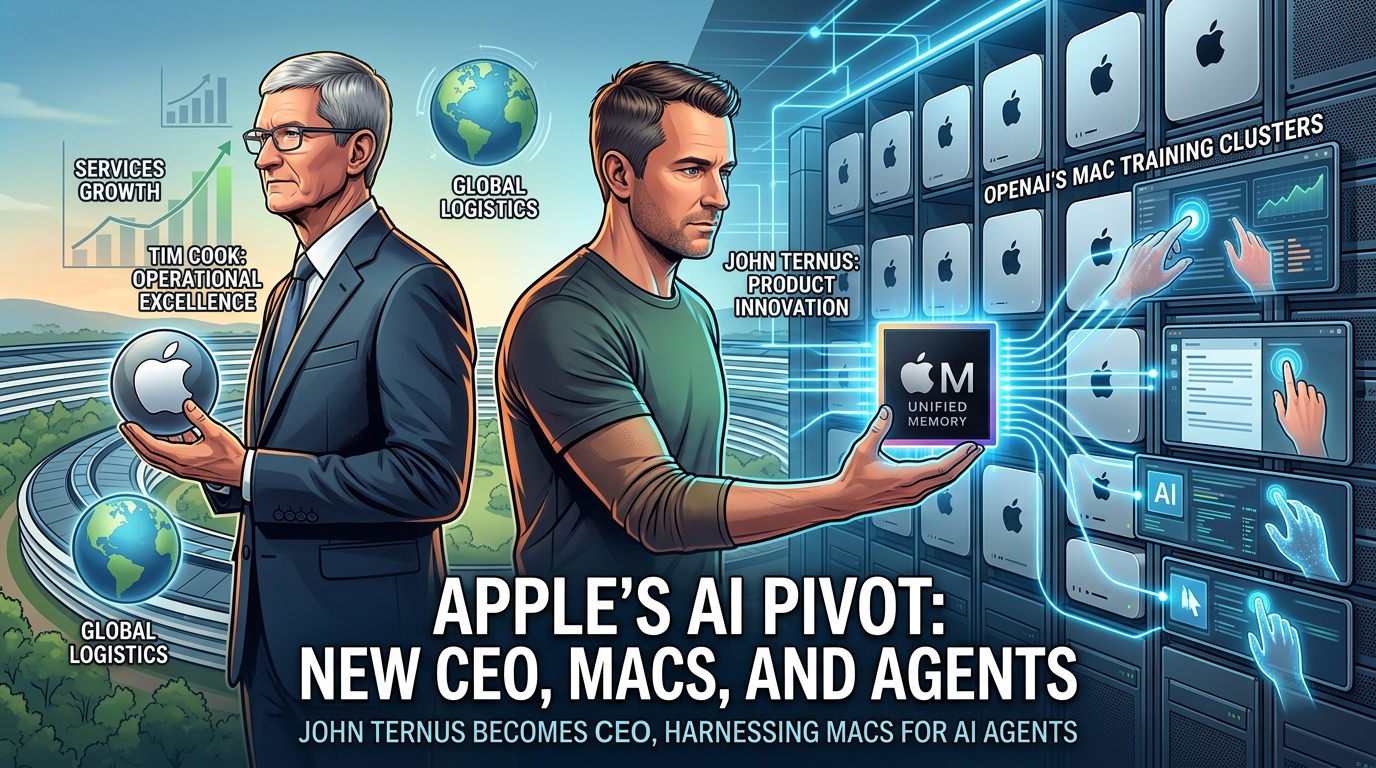
September 1, 2026 marks the end of Tim Cook's 15-year run as Apple CEO and the start of John Ternus's tenure. The leadership change arrives as OpenAI has purchased tens of thousands of screenless Mac mini and Mac Studio machines for reinforcement learning and computer-use agent training, according to reporting from The Information in late August 2026. Anthropic is renting similar Mac capacity through AWS.
Apple's unified-memory chips let labs load quantized models with tens or even hundreds of billions of parameters without constantly shuttling data between discrete GPU memory and system RAM. That demand helped Mac revenue jump nearly 29% year over year to about $10.35 billion in the fiscal third quarter ended June 27, 2026, Apple reported on July 30, 2026 — the company's fastest-growing hardware line that quarter. The story is not only a CEO handover. It is a test of whether Apple can turn silicon and new devices into an AI entry point.
Who Is John Ternus and Why Did Apple Choose a Hardware Engineer?
Apple (AAPL) chose a product engineer, not a finance operator, because the company now needs a new hardware and AI product cycle more than another decade of operational optimization. Ternus joined Apple in 2001 on the product design team, became vice president of hardware engineering in 2013, and was named senior vice president of hardware engineering in 2021. He spent 25 years inside the company and rose from Mac engineering into leadership over iPad, AirPods, iPhone, and the broader hardware organization.
Cook will remain executive chairman and will keep working with policymakers, Apple said in its April 20, 2026 announcement. That structure limits a sudden power vacuum. The board still sent a clear signal. After years of strength in supply chain, services, and margins, Apple's gap in the AI era has been product invention, not cash or users. Ternus is the first Apple CEO in about three decades to come from hardware.
His first calendar test is immediate. Apple's September product event is expected to include a new iPhone lineup, a more capable Siri AI rollout, a foldable iPhone, and a smart display that can recognize who is speaking and personalize content. Those devices were already on Ternus's hardware roadmap. Whether they ship on time and feel like a new category — not just incremental SKUs — will shape how investors judge the first months of his CEO term.
Why Did OpenAI Buy Tens of Thousands of Mac Minis and Mac Studios?
OpenAI bought the machines for reinforcement learning and computer-use agents, not for classic frontier-model pretraining on giant GPU clusters. Computer-use agents must see a screen, click, type, recover from errors, and repeat that loop thousands of times. That workload looks more like running many real computers than like training a dense transformer on matrix math alone.
According to recent reports, OpenAI acquired tens of thousands of Mac mini and Mac Studio units in recent months and wanted more. High-memory configurations had already been scarce. Apple refreshed both product lines on August 25, 2026 — earlier than its usual autumn Mac cadence — adding M6 and M5 Pro options on Mac mini and M5 Max and M5 Ultra options on Mac Studio.
Anthropic is taking a rental path. The same reporting said the lab is using Mac compute through AWS rather than buying the boxes outright. AWS has offered EC2 Mac instances for years, originally for iOS build and test. Agent training gives that fleet a second job.
The buying pattern matters because it is demand Apple did not design as an enterprise AI product line. Labs simply discovered that compact Apple desktops fit a specific training loop.
What Makes Apple Silicon Useful for Local and Agent AI?
Apple silicon's unified memory is the practical advantage. CPU, GPU, and Neural Engine share one large memory pool, so a quantized model can sit in RAM and run without the constant copy traffic common on discrete NVIDIA GPUs that split VRAM and system memory.
That architecture is why high-RAM Mac mini and Mac Studio configurations became scarce. A well-specced Mac Studio can hold very large quantized models in one box. Developers have also clustered multiple Macs over fast interconnects to serve even larger local models at lower power than a comparable GPU rack.
This does not mean Macs replace NVIDIA for pretraining the biggest foundation models. It means they are unusually good at a growing slice of the stack: local inference, agent rollouts, reinforcement learning in real UI environments, and compact clusters that sip power. NVIDIA's DGX Spark and related compact systems have a similar small-box form factor and target local AI developers, which is why NVIDIA is widely treated as Apple's main rival in that niche rather than only in the data center.
How Strong Is Mac Demand in Apple's Latest Results?
Mac is no longer a side business in Apple's hardware mix. In the quarter ended June 27, 2026, Apple reported Mac net sales of $10.352 billion, up from $8.046 billion a year earlier. That is roughly 29% growth. Cook called it Mac's best June quarter and said demand for AI and agentic tools on Mac mini and Mac Studio ran ahead of supply.
The same quarter produced record June-quarter company revenue of $109.4 billion, up 16% year over year, according to Apple's July 30, 2026 results. iPhone and Services still dwarf Mac in absolute dollars. The signal is the growth rate. A line that used to look mature is now the fastest-growing hardware category, and management has explicitly tied part of that pull to AI workloads.
Supply constraints cut both ways. They confirm real demand. They also show Apple was not fully prepared for enterprise-style AI buyers who want dense memory SKUs in volume. That is an operational issue Ternus inherits on day one.
What Products Will Decide Whether Apple Gets Back on the AI Table?
The next 12 months will be judged on devices that make AI visible, not on Mac sales to labs alone. The September event is the first public exam: a new iPhone generation, a more capable Siri AI, a foldable iPhone, and a speaker-aware smart display.
Those products matter because Apple's historical strength is a complete product, not a model card. If Siri still feels late compared with agents people already use on other platforms, the hardware story will not be enough. If the foldable and the display create a new daily surface for on-device and Private Cloud Compute features, Apple can argue it found a consumer AI entry point.
Ternus's longer pipeline is broader still. Reporting around the transition has pointed to camera-equipped AirPods, smart glasses, home security hardware, a robotic home display, and a wearable camera pendant. Not all of that ships this fall. The bet is that Apple's next growth engine is AI plus custom silicon plus new hardware surfaces — not only another few million iPhones.
Cook's era maximized operations, ecosystem lock-in, and services cash flow. The board is asking Ternus to reopen a product-innovation era. Short-term stock reaction to a CEO change should stay muted while Cook remains executive chairman. Medium-term valuation will track whether those new products work.
What Does the CEO Change Mean for Apple's Valuation Story?
The CEO change itself is not the valuation event. The AI product cycle is. Cook stays in the building. Supply chain, China policy, and government relations do not reset overnight. What can reset is the narrative that Apple missed the first AI wave and can only harvest iPhone replacement cycles.
OpenAI and Anthropic using Macs does not make Apple an AI-model company. It does make Apple a supplier of a scarce physical substrate for agent training and local inference. NVIDIA treating compact Apple boxes as a local-AI competitor is another tell. The market is no longer asking only whether Apple can ship a chatbot. It is asking whether Apple silicon plus new devices can become the default place where agents live.
Over three to five years, that combination — chips, agents, and new hardware doors into the home and pocket — is a larger swing than a single iPhone unit beat. If the products slip or feel incremental, Mac's AI tailwind will look like a side quest. If they land, Apple's operating era starts to look like a setup for another product era.
Trade the Setup on KuCoin and Enter the Prize Pool
When a market narrative is in motion, the next step is not only to decide the view, but to place it where liquidity, tools, and extra incentives line up. KuCoin’s KuLeague (Fall Season 2026) futures trading competition runs from August 31 to September 21, 2026 (UTC+8) and offers a 400,000 USDT prize pool, split across a Team Battle (100,000 USDT), a Solo PnL Contest (60,000 USDT), and a Grand Lucky Draw (240,000 USDT).
Trade $500 in a day to unlock a daily spin with a 100% prize rate. Use the same positions you would take for the story above — and compete for rewards at the same time:
Conclusion
Tim Cook's 15 years as CEO ended on September 1, 2026. John Ternus, a 25-year Apple hardware veteran, takes over with Cook as executive chairman. The handover coincides with a rare external proof point: OpenAI buying tens of thousands of Mac mini and Mac Studio systems for reinforcement learning and computer-use agents, and Anthropic renting Mac capacity on AWS.
Apple silicon's unified memory is the technical reason those boxes showed up in AI labs. Mac's latest reported quarter — about $10.35 billion in sales, up nearly 29% — is the financial reason the story stuck. NVIDIA's compact local-AI systems show the same niche is now competitive.
Ternus was chosen because Apple needs product invention in the AI era, not another operator-first chapter. The September iPhone event, new Siri AI, a foldable phone, and a speaker-aware display are the first deliverables. Longer term, the valuation question is whether AI, custom chips, and new hardware surfaces can replace the iPhone as Apple's main growth story. The Mac mini shortage is not the whole ticket. It is evidence that the ticket exists if Apple can still invent the next device people live with every day.
FAQs
Did Tim Cook leave Apple entirely on September 1, 2026?
No. He became executive chairman and continues to help with areas such as government and policy engagement while Ternus runs day-to-day operations.
Are OpenAI's Mac purchases confirmed by Apple or OpenAI?
Neither company issued a detailed official unit count. Multiple outlets on August 31, 2026 attributed the "tens of thousands" figure to The Information and people familiar with the effort.
Why not just use NVIDIA GPUs for computer-use agents?
Labs still use GPUs for large-scale pretraining. Agent rollouts that must drive a real desktop UI benefit from many complete computers with large shared memory, which is what high-spec Mac minis and Studios provide.
Disclaimer
This article is for informational purposes only and does not constitute financial, legal, or investment advice. Always conduct your own research before interacting with digital assets.