

John Ternus Becomes Apple CEO as Tim Cook Ends His 15-Year Run
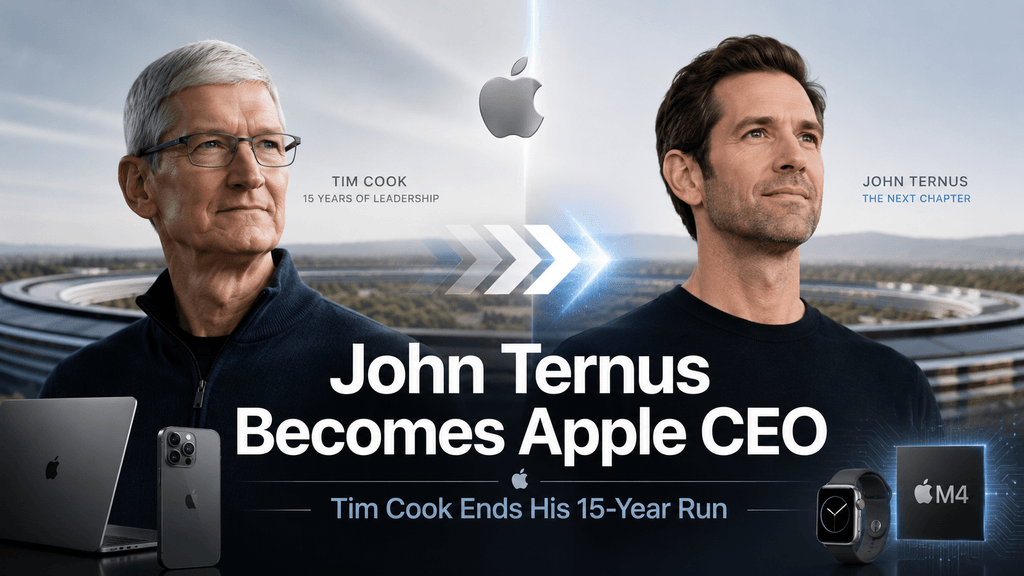
Apple has officially entered a new leadership era. On September 1, 2026, John Ternus became chief executive officer of Apple, succeeding Tim Cook after nearly 15 years at the helm of one of the world’s most valuable technology companies. The change is significant, but it is not an abrupt departure: Apple announced the succession in April after what it described as a long-term planning process, and Cook will remain closely connected to the company as executive chairman of its board.
For Apple, the transition comes at a particularly important moment. The company remains financially powerful, with record June-quarter revenue in fiscal 2026, but the technology industry is being reshaped by artificial intelligence, new computing interfaces and changing consumer expectations. Ternus therefore inherits a stronger Apple than the one Cook took over in 2011, but also a company facing a different challenge: finding its next major growth story while protecting the enormous ecosystem Cook spent 15 years building.
John Ternus Officially Takes Over as Apple CEO
John Ternus officially became Apple CEO on September 1, completing a transition announced by the company on April 20. Apple’s board unanimously approved the succession, describing it as the result of a thoughtful, long-term planning process. Tim Cook continued serving as CEO through the summer while working closely with Ternus to prepare for the handover. Ternus also joins Apple’s board of directors, while longtime chairman Arthur Levinson moves into the position of lead independent director.
The arrangement makes this more of a controlled leadership transition than a sudden management reset. Cook is stepping down as CEO, but he is not leaving Apple. As executive chairman, he will continue assisting with selected areas of the business, including engagement with policymakers around the world. That distinction is important because Apple is navigating complicated issues ranging from global regulation and trade policy to supply chains and competition across major international markets.
The September 1 transition nevertheless marks the clearest dividing line in Apple leadership since August 2011, when Cook replaced Steve Jobs as CEO. Jobs became chairman after resigning as chief executive, while Cook joined the board and took responsibility for running the company. Fifteen years later, Apple is once again using a leadership structure that allows an outgoing CEO to remain involved at board level while a new chief executive takes responsibility for day-to-day leadership.
Who Is John Ternus?
Ternus is not an outside executive being brought in to reinvent Apple. He is one of the company’s longest-serving product leaders. He joined Apple’s Product Design team in 2001, became a vice president of Hardware Engineering in 2013 and joined the executive team in 2021 as senior vice president of Hardware Engineering. Before Apple, he worked as a mechanical engineer at Virtual Research Systems and earned a bachelor’s degree in mechanical engineering from the University of Pennsylvania.
His career inside Apple has been closely tied to many of its most important hardware businesses. Ternus has overseen engineering work across iPhone, iPad, Mac, Apple Watch and AirPods, and he was a major leader in the Mac transition to Apple-designed silicon. Apple also credits his organization with advances in reliability, durability, materials engineering, repairability and lower-carbon hardware design. His teams have therefore worked on both the highly visible products consumers buy and the less visible engineering decisions that determine how those products perform over time.
That background makes Ternus very different from the stereotypical professional chief executive recruited primarily for finance, sales or corporate restructuring. His rise has been built around designing and shipping products. Cook himself described Ternus as having the mindset of an engineer and the instincts of an innovator when Apple announced the succession. The key question is whether those qualities can translate from leading hardware engineering to managing the entire company.
Why Did Apple Choose John Ternus?
The most obvious reason is continuity. Ternus has spent roughly 25 years inside Apple, giving him unusually deep knowledge of the company’s product-development process, engineering culture and internal decision-making. Rather than using the CEO transition to make a dramatic break with the Cook era, Apple has selected a leader who understands how products move from early concepts through engineering, manufacturing and global launch.
His product record also matters. Apple says Ternus helped introduce new categories including iPad and AirPods and oversaw generations of iPhone, Mac and Apple Watch hardware. He also played an important role in Apple Silicon, one of the company’s most strategically important technology shifts because it gave Apple greater control over performance, power efficiency and the integration between its hardware and software.
There is also a broader strategic interpretation. Cook entered the CEO role with a reputation for operations and supply-chain management. Ternus enters with an engineering background at a time when investors are increasingly asking where Apple’s next major product platform will come from. His appointment does not prove that Apple is abandoning Cook’s operational discipline for an engineering-first strategy, but it does make product innovation one of the most important themes surrounding the new CEO. In an industry increasingly dominated by AI, custom silicon and new device categories, Apple appears to be betting that deep technical leadership will be essential to its next phase.
What Tim Cook Changed at Apple
Ternus inherits a company operating on a dramatically larger scale than the Apple Cook took over. According to Apple, its market capitalization grew from approximately $350 billion around the beginning of Cook’s CEO tenure to roughly $4 trillion by the time the company announced his transition. Annual revenue rose from $108 billion in fiscal 2011 to more than $416 billion in fiscal 2025. Apple also says its active installed base has expanded to more than 2.5 billion devices, while its Services operation has grown into a business generating more than $100 billion annually.
| Metric | Early Cook Era | Near the End of His CEO Tenure |
| Market capitalization | About $350 billion | About $4 trillion |
| Annual revenue | $108 billion in FY2011 | More than $416 billion in FY2025 |
| Active installed base | Much smaller global base | More than 2.5 billion devices |
| Services business | Emerging ecosystem | More than $100 billion annually |
Cook’s legacy also extends far beyond financial expansion. Apple introduced Apple Watch, AirPods and Apple Vision Pro during his tenure while expanding services such as Apple Pay, Apple Music, Apple TV and iCloud. The company moved the Mac to Apple-designed silicon, strengthened its wearables ecosystem and turned recurring services revenue into a major complement to hardware sales. Privacy, supply-chain execution, environmental goals and global retail expansion also became major parts of Apple’s corporate identity under Cook.
That creates both an advantage and a burden for Ternus. He does not need to rescue Apple financially. In its fiscal third quarter of 2026, the company reported $109.4 billion in revenue, up 16% year over year, while diluted earnings per share rose 29% to $2.02. iPhone, Mac and Services all set June-quarter revenue records. Ternus therefore inherits a highly profitable business with enormous reach. The harder task is convincing consumers and investors that a company already operating at this scale still has another meaningful innovation cycle ahead.
Apple’s Biggest Challenge Is Now AI
Artificial intelligence may become the defining strategic question of the Ternus era. The industry surrounding Apple has changed quickly as generative AI has moved into search, productivity software, operating systems, consumer applications and increasingly the devices people use every day. Apple has continued developing its own AI capabilities and introduced an all-new Siri AI at WWDC26, but competitive pressure remains intense as companies including Google, OpenAI, Meta and other technology leaders race to define how users interact with intelligent software.
Apple’s challenge is different from simply building the largest language model. Its traditional competitive strength comes from combining hardware, software, custom chips and services inside a tightly controlled ecosystem. Under Ternus, the more important question may be whether AI can make the iPhone, Mac, Apple Watch, AirPods and future devices fundamentally more useful rather than simply adding another chatbot interface. If Apple succeeds, its installed base could become a powerful distribution platform for AI. If it moves too slowly, however, the interface through which consumers access digital services could increasingly be shaped by competitors.
Ternus’ engineering background makes this especially interesting. Apple may have an opportunity to compete through the physical expression of AI rather than only through software models. Personal devices equipped with custom chips, cameras, microphones, sensors and deep operating-system integration could make AI more contextual and useful. That leads to perhaps the most important long-term question facing the new CEO: can Ternus help Apple identify an AI-era opportunity large enough to become the company’s next iPhone-sized growth engine?
Could Apple Become More Hardware-Focused Under Ternus?
Ternus’ promotion naturally raises expectations that hardware innovation will remain central to Apple’s strategy. His career has been built around engineering products rather than running advertising platforms, cloud infrastructure or standalone software businesses. Apple specifically highlighted his work in reliability, durability, advanced materials and product engineering when announcing him as Cook’s successor.
That does not necessarily mean Apple will suddenly release an entirely new category of device. Hardware development takes years, and many projects that emerge during the first part of Ternus’ CEO tenure will have originated while Cook was still chief executive. But investors are likely to pay close attention to whether Apple expands into new device formats and whether technologies such as AI, Apple Silicon, spatial computing and wearables begin converging into products that can create meaningful new demand.
The possibilities frequently discussed around Apple include foldable devices, lighter computing products, advanced wearables, spatial-computing hardware and more AI-centric personal technology. Those ideas should still be treated as possibilities rather than promises. What can be said with greater confidence is that Ternus enters the CEO role with direct experience turning engineering concepts into mass-market Apple products, making the company’s hardware roadmap an obvious place to look for signs of how his leadership may differ from Cook’s.
His First Big Test Comes Almost Immediately
Ternus will not have a long honeymoon period. Apple has scheduled its next major product event for September 9, only eight days after he takes over as CEO. Reuters reported that the event is expected to feature Apple’s next iPhone lineup and could also include the company’s first foldable iPhone, although the final product announcements remain Apple’s decision and expectations should not be treated as confirmed specifications before the event.
The timing gives investors and consumers an unusually quick opportunity to see Apple under its new chief executive. The event will offer clues not only about individual products but also about how Ternus presents the company publicly, what technologies Apple chooses to emphasize and how aggressively it positions new hardware as the beginning of another upgrade cycle. Because Ternus spent years running Hardware Engineering, expectations surrounding a major hardware event under his leadership may be particularly high.
One launch, however, will not determine whether the CEO transition succeeds. Apple’s product pipeline operates on multi-year development cycles, and the strategic consequences of a leadership change may take much longer to become visible. September 9 can provide the first public glimpse of the Ternus era, but his real record will be measured through several generations of products, AI development and the company’s ability to create new sources of growth.
What the CEO Change Means for Apple Stock
For Apple shareholders, the leadership transition is important but should not be viewed in isolation. CEO changes can influence market expectations, particularly when a new leader brings a different professional background, yet Apple’s valuation will ultimately depend on revenue growth, profitability, product demand, AI execution and the company’s ability to defend its ecosystem. The fact that Ternus was selected through a planned internal succession process also reduces some of the uncertainty that can accompany a sudden executive departure.
| What Investors Will Watch | Why It Matters |
| AI execution | Could shape Apple’s next major growth narrative |
| iPhone demand | Remains central to the Apple ecosystem |
| Services growth | Provides recurring, high-value revenue |
| New hardware categories | Could expand Apple beyond mature device markets |
| China and global supply chains | Affect both demand and production |
| Capital returns | Buybacks and cash generation support shareholder value |
Apple enters the transition from a position of financial strength. Its record $109.4 billion June-quarter revenue demonstrates that the core business remains capable of substantial growth even before Ternus has had time to influence strategy as CEO. That means the market is unlikely to judge him simply on whether Apple remains profitable. The higher bar is whether he can maintain the existing engine while giving investors credible reasons to expect another major expansion opportunity.
This is also why Apple stock should not be reduced to a simple “Ternus bullish” or “Cook departure bearish” narrative. AAPL will continue responding to iPhone demand, Services margins, AI adoption, macroeconomic conditions, regulation, supply-chain costs and capital allocation. Ternus matters because he will increasingly shape decisions affecting those variables, but the company is far too large and diversified for its long-term stock performance to depend on one executive alone.
What Happens to Tim Cook Now?
Cook’s 15-year run as CEO has ended, but his Apple career has not. As executive chairman, he remains part of the company’s leadership structure and will continue supporting selected areas of the business. Apple specifically said Cook would remain involved in engagement with policymakers around the world, an important responsibility for a company facing increasingly complicated relationships with governments, regulators and global supply chains.
That continuing role may give Ternus valuable continuity during his first phase as CEO. Cook spent decades developing expertise in operations, international manufacturing, government relations and large-scale corporate management. Those capabilities are particularly relevant as Apple navigates trade tensions, regulation, competition policy and geopolitical pressure across different markets. Keeping Cook involved allows Apple to preserve some of that institutional experience without creating ambiguity over who is running the company: Ternus is CEO, while Cook leads the board as executive chairman.
The structure also echoes an important part of Apple’s previous transition. When Steve Jobs resigned as CEO in August 2011, he became chairman while Cook took the chief executive position. The circumstances are very different today, but Apple is again choosing continuity at board level rather than treating a CEO change as a complete break with the previous era.
What John Ternus Must Prove Next
The first challenge is AI. Apple must demonstrate that its combination of hardware, software, custom silicon and services remains an advantage as artificial intelligence becomes a more important layer of personal computing. Ternus does not necessarily need Apple to win every AI benchmark. He does need the company to make AI useful enough across its ecosystem that customers continue seeing Apple devices as the center of their digital lives.
The second challenge is growth beyond mature product categories. Apple can continue improving the iPhone, Mac, Watch and AirPods, but incremental upgrades alone may not satisfy expectations placed on a company of its size. New device formats, AI-enabled experiences, spatial computing and other emerging categories will matter because they could expand what Apple sells rather than simply encourage existing customers to replace devices. At the same time, Ternus must protect the Services business and the enormous installed base that make Apple far more resilient than a traditional hardware manufacturer.
Finally, he must prove that being a successful hardware leader translates into being an effective chief executive. Running Apple means managing far more than product engineering. It requires decisions about capital allocation, regulation, talent, global supply chains, privacy, market strategy and relationships with governments around the world. Ternus does not inherit a company that needs saving. He inherits one whose greatest challenge is proving that its most innovative era is not already behind it.
Conclusion
September 1, 2026 marks the beginning of Apple’s first new CEO era in 15 years. John Ternus enters the role after roughly a quarter-century inside Apple and years leading the hardware organization responsible for many of the company’s most important products. Tim Cook, meanwhile, leaves behind an Apple that is dramatically larger, more diversified and more profitable than the company he inherited from Steve Jobs, while remaining involved as executive chairman.
That makes the transition less about repairing the past than defining the future. Ternus must protect the iPhone and Services engines, turn AI into compelling consumer experiences and determine whether Apple can create another major category capable of supporting growth at enormous scale. His engineering background makes the product side of that challenge particularly compelling, but running Apple will test much more than engineering expertise.
The Cook era was defined by extraordinary scale. The Ternus era may ultimately be judged by whether Apple can turn that scale into its next generation of innovation.
FAQs
How old is John Ternus?
Apple’s official leadership materials focus primarily on Ternus’ professional background and do not prominently list his date of birth. What is clear is that he joined Apple’s Product Design team in 2001 after studying mechanical engineering at the University of Pennsylvania and has spent roughly 25 years building his career inside the company.
Is John Ternus on Apple’s board of directors?
Yes. Apple announced that Ternus would join its board of directors effective September 1, 2026, the same date he became CEO. The board transition also moved former non-executive chairman Arthur Levinson into the role of lead independent director.
Who was Apple CEO before Tim Cook?
Steve Jobs served as Apple CEO before Tim Cook. On August 24, 2011, Jobs resigned as chief executive and became chairman of the board, while Cook, who had previously served as Apple’s chief operating officer, was named CEO.
Does John Ternus own Apple stock?
As a longtime senior executive and now CEO, Ternus has participated in Apple’s executive compensation structure, which can include equity awards. The exact amount of Apple stock or unvested equity associated with him can change over time as awards vest, shares are sold and new compensation is granted, so current ownership is best assessed through Apple’s latest SEC filings rather than treated as a fixed figure.
Who runs Apple’s hardware engineering after John Ternus becomes CEO?
Apple’s leadership structure is being adjusted as Ternus moves from Hardware Engineering to the CEO role. Reuters reported when the succession was announced that Apple chip executive Johny Srouji would become chief hardware officer, taking responsibility for areas previously overseen by Ternus. The organizational change matters because Apple must preserve continuity across some of its most important engineering teams while its former hardware chief assumes company-wide responsibilities.
How many CEOs has Apple had?
Apple has had several chief executives across its history rather than a simple Steve Jobs–Tim Cook–John Ternus sequence. Leadership changed multiple times during Apple’s earlier decades before Jobs returned to the company in the late 1990s. For modern investors, however, the most consequential recent sequence is Jobs, Cook and now Ternus, with September 1, 2026 marking the first change in the CEO position since Cook took over in 2011.
🔥 KuCoin Offers A More Stable Option in A Volatile Market
If you worry about the frequent ups and downs in the market, and pursue a more stable option to earn money passively, KuCoin is the right place to come:

Simple Earn: Deposit and withdraw tokens anytime, earning stable returns.
Kucoin Earn: Earn stable profits with professional asset management.
Hold to Earn: Earn rewards by holding assets in Funding, Trading, Margin, Futures, Mining, and Unified Accounts.
Staking: Unlock the earning potential of on-chain assets.
Advanced Investments: Advanced Investments offer a variety of structured products to help your money grow in any market.
Shark Fin: Principal Protection and Guaranteed Gains
Dual Investment: Buy low and sell high with transparent return calculations.
Snowball: High yields, with price protection.
Discount Buy: Buy crypto at discount prices.
KCS Loyalty: Level up to enjoy exclusive perks by staking ≥ 1 KCS.
KuCoin Wealth: Discover future value and begin your smart investing journey.
KCS Benefits: Hold and stake KCS to access benefits across the platform.
KCS Staking 2.0: Participate in KCS on-chain governance to earn yield.
Disclaimer: This content is for informational purposes only and does not constitute investment advice. Cryptocurrency investments carry risk. Please do your own research (DYOR).