

Japan 10-Year Bond Yield Hits 3%: Could a Yen Carry Trade Unwind Hit Bitcoin?
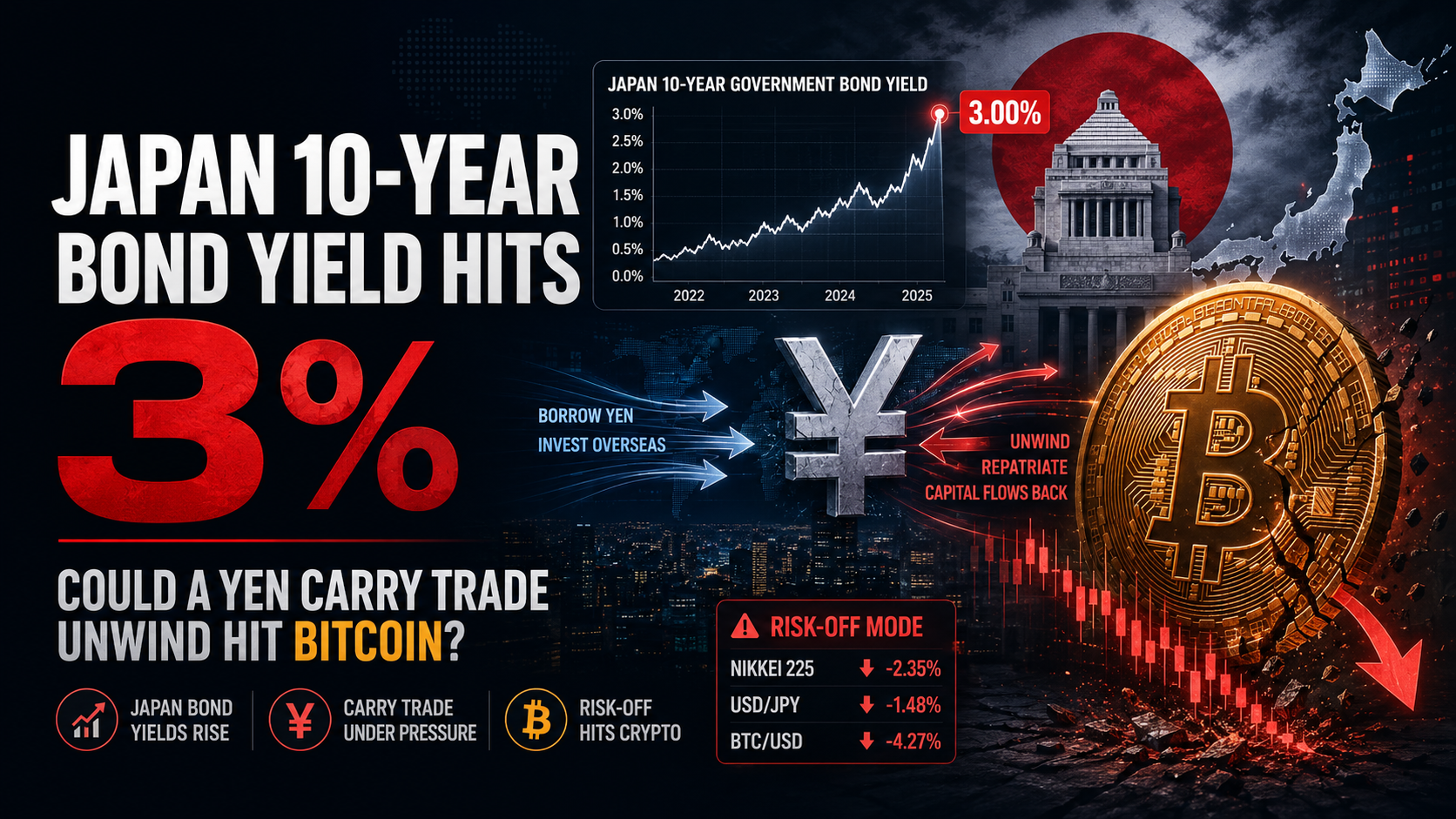
Japan’s 10-year government bond yield has reached 3% for the first time since 1996, marking a major milestone for a country that spent decades at the center of the world’s ultra-low-rate financial system. The move comes as inflation concerns, higher oil prices, fiscal uncertainty and expectations for further Bank of Japan tightening push borrowing costs higher across the Japanese yield curve. It is also part of a broader global bond selloff that has lifted sovereign yields in the United States, Europe and other major economies.
For Bitcoin investors, however, the most important number may not be 3% itself. The bigger question is whether rising Japanese interest rates eventually make one of the world’s most important funding trades less attractive. If higher yields are followed by a sharp appreciation of the yen, investors using cheap yen funding could be forced to reduce leveraged positions across global markets. That would turn a Japanese bond story into a global liquidity story — and potentially a Bitcoin story as well.
Why Did Japan’s 10-Year Yield Hit 3%?
Several forces have pushed Japanese government bond yields sharply higher. Inflation is one of the most important. Tokyo’s core consumer inflation accelerated for a third consecutive month in August, reaching 1.8% year over year, while a measure excluding fresh food and fuel reached the Bank of Japan’s 2% target. Those figures have strengthened expectations that the BOJ may need to continue normalizing monetary policy rather than treating recent inflation as temporary.
Energy prices have added another layer of pressure. Renewed Middle East hostilities have driven crude oil prices higher, raising concerns about another wave of imported inflation. Japan is particularly exposed because it relies heavily on imported energy. A weaker yen makes those imports even more expensive in local-currency terms, creating a difficult combination of rising commodity costs and currency weakness. At the same time, investors are becoming more sensitive to Japan’s fiscal outlook. Government debt exceeds 200% of GDP, and higher yields increase the cost of financing that debt. Concerns over additional fiscal spending have therefore contributed to the demand for higher compensation from long-term bond investors.
The move is not happening in isolation. Government borrowing costs have also risen sharply in the United States and Europe as investors respond to persistent inflation, high public debt, geopolitical risks and expectations that central banks may need to keep monetary policy restrictive. Japan’s 3% yield is therefore both a domestic turning point and part of a much broader repricing of global sovereign debt.
Why the 3% Level Matters
A 3% government bond yield would not look extraordinary in many economies. In Japan, however, it carries much greater significance because the country spent decades operating with exceptionally low — and at times negative — interest rates. That environment made the Japanese fixed-income assets relatively unattractive and encouraged domestic institutions as well as international traders to search for higher returns elsewhere.
The situation is now changing. When Japanese government bonds provide increasingly competitive yields, domestic investors have less incentive to take currency and duration risk by buying foreign bonds. Insurance companies, banks, pension funds and other large institutions may gradually find Japanese assets more attractive relative to overseas alternatives. Analysts responding to the latest bond selloff have specifically highlighted the possibility that rising Japanese yields could reduce demand for foreign debt and reshape international capital flows.
That is why the structural question is much bigger than whether the 10-year yield moves from 2.9% to 3.0%. The more important issue is what happens if Japanese investors no longer need to leave Japan to find meaningful yield. A sustained shift in that direction could affect U.S. Treasuries, European bonds, currencies and eventually the liquidity conditions supporting global risk assets.
Is the Bank of Japan Ready to Hike Again?
The bond market is increasingly focused on the Bank of Japan’s next move. The BOJ raised its policy rate to 1% in June, the highest level in more than three decades, and held it steady in July. Governor Kazuo Ueda said on September 2 that policymakers would use the September meeting to assess whether economic and price developments justify another increase. The BOJ’s next policy decision is scheduled for September 17–18.
Other officials have also sounded increasingly hawkish. Board member Hajime Takata has argued that the central bank should be willing to raise rates flexibly rather than follow a rigid timetable. Meanwhile, persistent inflation, a weak yen and higher energy prices are making it harder for policymakers to maintain an accommodative stance. Economists and market participants have consequently become more confident that another increase could take the policy rate toward 1.25%.
The market is therefore moving beyond a simple question of whether Japan will ever normalize monetary policy. Normalization is already underway. The more important question now is how quickly the BOJ will proceed. That matters globally because higher Japanese borrowing costs could weaken one of the financial system’s longest-running sources of cheap funding: the yen carry trade.
What Is the Yen Carry Trade?
The yen carry trade is built around a simple idea. Investors borrow money in Japanese yen at relatively low interest rates, convert those funds into another currency and invest in assets offering higher returns. If Japanese borrowing costs remain low, the higher-yielding asset performs well and the yen does not strengthen significantly, investors can profit from the difference between the two returns.
For decades, Japan provided unusually favorable conditions for this strategy. Interest rates fell toward zero in the late 1990s and remained extremely low for years. The trade became even more attractive when the Federal Reserve aggressively raised U.S. interest rates in 2022 and 2023 while the BOJ kept Japanese rates below zero. Reuters estimated in 2024 that short-term external loans by Japanese banks alone provided a possible $350 billion proxy for yen-funded trades, although the true scale was uncertain and potentially much larger once leveraged positions and broader Japanese overseas investments were considered.
The important point is that carry trades depend on more than the interest-rate gap. Exchange rates are just as important. Borrowing yen to buy dollar assets can work very well when the yen stays stable or weakens. But if Japanese funding costs rise and the yen suddenly appreciates, the same position can become much less profitable very quickly.
What Could Trigger a Yen Carry Trade Unwind?
There are two main ways the economics of the trade can deteriorate. The first is rising Japanese interest rates. As the BOJ raises policy rates and Japanese bond yields climb, borrowing in yen becomes more expensive. At the same time, if foreign yields stop rising or begin falling, the interest-rate advantage available to the carry trader narrows. A strategy that once offered a comfortable return can therefore become much less compelling.
The second risk is a sharp yen rally. Investors who borrowed yen eventually need to purchase yen again to repay their loans. If the currency appreciates substantially during the life of the trade, that repayment becomes more expensive. Highly leveraged investors may then need to close positions quickly by selling foreign assets, converting the proceeds back into yen and repaying their funding. That process can become self-reinforcing: asset sales reduce risk exposure while yen purchases push the currency higher, creating additional pressure on remaining carry positions. The 2024 market shock provided a clear example of how a stronger yen and changing BOJ expectations could contribute to broad deleveraging.
What matters today is that there is not yet clear evidence of a market-wide yen carry trade collapse. Despite Japan’s 10-year yield reaching 3%, the yen remained weak at around 160.15 per dollar on September 2. High U.S. Treasury yields and a strong dollar are still supporting a substantial U.S.-Japan yield differential. The correct interpretation is therefore that the risk of an unwind is becoming more important — not that a full unwind has already begun.
Why Could a Yen Rally Hit Bitcoin?
Bitcoin is not directly tied to Japanese government bonds, but it is highly exposed to changes in global liquidity and risk appetite. If rising Japanese rates trigger a broad reduction in yen-funded leverage, investors may need to sell liquid assets to raise cash and reduce risk. Bitcoin trades around the clock, has deep global liquidity and tends to exhibit high sensitivity to shifts in broader financial conditions, making it one of the assets that can react quickly during a deleveraging event.
The transmission would therefore look more like this:
Higher Japanese rates → less attractive yen funding → stronger yen or lower leverage → risk-asset selling → tighter global liquidity → higher Bitcoin volatility.
This is very different from saying that every rise in Japanese bond yields must cause Bitcoin to fall. The 3% yield alone is not a mechanical bearish signal. What matters is whether the move changes investor behavior across currencies and leveraged portfolios.
Recent market action illustrates the distinction. On September 2, Bitcoin traded around $77,500 while several higher-beta cryptocurrencies fell more sharply amid rising oil prices and government bond yields. The bitcoin price reflected the broader deterioration in risk sentiment as the U.S. 10-year Treasury yield briefly reached 4.81% and Japan’s 10-year yield touched the 3% level. CoinDesk characterized the pressure as a broad macro risk-off move rather than a crypto-specific event.
Why USD/JPY May Matter More Than the 3% Yield
For crypto traders trying to monitor this risk, USD/JPY may eventually prove more informative than the Japanese 10-year yield alone. Higher Japanese yields make yen-funded trades less attractive, but they do not automatically force traders to unwind positions. A rapid appreciation of the yen would provide much stronger evidence that funding conditions are changing.
The current market actually presents an unusual divergence. Japanese yields have reached levels not seen in three decades, yet the yen remains weak. On September 2, USD/JPY was still around 160.15 because U.S. yields were also rising and expectations for Federal Reserve tightening were supporting the dollar. The U.S. 10-year Treasury yield reached roughly 4.812%, preserving a large yield advantage over Japan despite the rise in JGB yields.
That means the more concerning combination for risk assets would be rising Japanese yields together with a rapidly falling USD/JPY rate. Such a move would indicate that Japanese interest-rate normalization is beginning to translate into meaningful yen strength. For traders worried about carry-trade stress, that would be a more important warning signal than 3% by itself.
Could Higher Japanese Yields Reshape Global Liquidity?
Japan has accumulated enormous overseas financial holdings partly because domestic yields were so low for so long. Japanese banks, insurers, pension funds and households had powerful incentives to search abroad for better returns. Reuters noted in its 2024 examination of the carry trade that Japanese foreign portfolio investments totaled about ¥666.9 trillion, or roughly $4.54 trillion at the time, with a significant share invested in interest-rate-sensitive debt assets.
A sustained increase in Japanese yields could gradually alter those incentives. If JGBs become more competitive, some investors may choose to allocate a larger share of future capital domestically rather than adding to holdings of U.S. or European debt. This does not mean trillions of dollars will suddenly return to Japan, but even a reduction in incremental foreign demand could matter in bond markets already dealing with large government borrowing requirements. Analysts discussing the current selloff have identified weaker Japanese demand for foreign debt as one possible channel through which higher JGB yields could push global borrowing costs higher.
For Bitcoin investors, this expands the macro framework beyond the Federal Reserve. Crypto markets often focus heavily on U.S. liquidity, U.S. interest rates and the dollar. But if Japan is transitioning away from its ultra-low-rate regime, global liquidity may increasingly depend on the interaction between the Fed, BOJ, Treasury markets and foreign-exchange markets rather than U.S. policy alone.
Is This Bearish or Bullish for Bitcoin?
In the short term, rising Japanese and global bond yields are more naturally viewed as a potential headwind for Bitcoin. Higher risk-free yields increase the opportunity cost of holding assets that do not generate conventional cash flow. They also raise borrowing costs and can reduce the amount of leverage investors are willing to use. If those higher yields are accompanied by a stronger yen and forced carry-trade unwinds, the resulting deleveraging could place additional pressure on equities, crypto and other high-beta assets.
The longer-term picture is more complicated. The current global rise in government bond yields is not being driven only by healthy economic growth. Markets are also becoming more concerned about persistent inflation, large fiscal deficits, rising debt-service costs and governments’ ability to manage increasingly large debt burdens. Japan is especially exposed because public debt exceeds 200% of GDP, but fiscal sustainability is also becoming a bigger issue in other major economies.
Those concerns can support a very different Bitcoin narrative. During immediate liquidity shocks, BTC often behaves like a risk asset. Over longer periods, some investors view Bitcoin as a scarce, non-sovereign monetary asset that exists outside traditional government debt systems. The two ideas are not mutually exclusive. Bitcoin can face short-term selling pressure from higher yields while the same fiscal and monetary uncertainty strengthens the longer-term debate over alternative stores of value.
What Should Bitcoin Traders Watch Next?
The first indicator to monitor is the Japanese 10-year yield itself. Holding above 3% would suggest that the bond market is accepting a structurally higher-rate environment, while another sharp increase could intensify pressure on the BOJ and the government. But the second indicator — USD/JPY — may be even more important. A sustained decline from around 160 would indicate yen appreciation, and a rapid move lower alongside rising JGB yields could signal that carry-trade economics are changing more aggressively.
BOJ communication is another major catalyst. The September 17–18 policy meeting will provide new information about whether the central bank is willing to raise rates again and, more importantly, how quickly it believes normalization should proceed. U.S. Treasury yields also need to be watched because the relative interest-rate gap between Japan and the United States remains central to the attractiveness of yen-funded trades.
Finally, crypto-specific leverage can show whether macro stress is beginning to translate into forced selling. Bitcoin futures open interest, funding rates, liquidations and the relative performance of higher-beta tokens can help reveal whether traders are reducing risk. The most concerning signal would not be Japanese yields rising in isolation, but a combination of higher JGB yields, rapid yen appreciation, falling global equities and accelerating crypto liquidations.
What Japan’s 3% Yield Really Means for Bitcoin
Japan’s 10-year yield reaching 3% is significant because it challenges one of the assumptions that shaped global markets for decades: that Japanese capital would remain extremely cheap and domestic yields would stay too low to compete with overseas assets. That assumption is becoming less reliable as inflation persists and the BOJ moves further away from ultra-accommodative policy.
For Bitcoin, however, the 3% threshold should not be treated as a standalone sell signal. The yen remains weak, the U.S.-Japan yield differential is still substantial, and there is no clear evidence that the global yen carry trade is undergoing a full-scale unwind. What has changed is the probability distribution. Higher Japanese rates make the funding environment less favorable than it once was, increasing the sensitivity of leveraged markets to any future yen rally.
Japan’s bond shock therefore matters less because of where the 10-year yield is today than because of what could happen next. If higher Japanese rates eventually produce a sharp appreciation of the yen and widespread deleveraging, the unwinding of one of the world’s longest-running funding trades could become a meaningful source of volatility for Bitcoin and the broader crypto market.
FAQs
What is a Japanese Government Bond (JGB)?
A Japanese Government Bond, or JGB, is debt issued by Japan’s government to finance public spending and other fiscal needs. JGBs are issued across different maturities, but the 10-year bond is widely used as a benchmark for long-term Japanese borrowing costs. Changes in its yield can affect corporate financing, mortgages, institutional investment decisions and expectations about Bank of Japan policy.
Do higher bond yields always strengthen a currency?
No. Higher domestic yields can make a currency more attractive, but exchange rates depend on relative rather than absolute conditions. A currency may remain weak if yields in another economy are rising even faster, if investors prefer another currency as a safe haven, or if trade and energy flows create selling pressure. Japan currently demonstrates this clearly: JGB yields have risen sharply, yet high U.S. yields have helped keep the dollar strong against the yen.
Why do Japanese investors hold so many overseas assets?
Decades of extremely low domestic interest rates encouraged Japanese banks, insurers, pension funds and other investors to seek better returns outside the country. Large allocations consequently accumulated in overseas government bonds, corporate debt, equities and other assets. If Japanese yields remain structurally higher, the relative attractiveness of some of those foreign investments could gradually decline.
Could Japanese investors start selling U.S. Treasuries and bring money home?
They could reduce overseas allocations or direct more new capital toward Japanese assets, but a sudden wholesale reversal is unlikely simply because the 10-year JGB yield crossed 3%. Large institutional portfolios are influenced by currency hedging costs, duration requirements, regulation, liquidity and long-term liability structures. The more realistic risk is a gradual reduction in Japanese demand for foreign bonds, which could still matter at the margin for global yields.
Is Bitcoin directly linked to Japanese bond yields?
No direct mechanical relationship exists between the Japanese 10-year yield and Bitcoin’s price. The connection runs through broader financial conditions. Japanese interest rates can influence the yen, carry trades, capital flows and global leverage. Those changes can then affect risk appetite and liquidity, which in turn influence Bitcoin. For that reason, traders should view JGB yields as part of a wider macro framework rather than as a standalone BTC trading signal.
🔥 KuCoin Offers A More Stable Option in A Volatile Market
If you worry about the frequent ups and downs in the market, and pursue a more stable option to earn money passively, KuCoin is the right place to come:

Simple Earn: Deposit and withdraw tokens anytime, earning stable returns.
Kucoin Earn: Earn stable profits with professional asset management.
Hold to Earn: Earn rewards by holding assets in Funding, Trading, Margin, Futures, Mining, and Unified Accounts.
Staking: Unlock the earning potential of on-chain assets.
Advanced Investments: Advanced Investments offer a variety of structured products to help your money grow in any market.
Shark Fin: Principal Protection and Guaranteed Gains
Dual Investment: Buy low and sell high with transparent return calculations.
Snowball: High yields, with price protection.
Discount Buy: Buy crypto at discount prices.
KCS Loyalty: Level up to enjoy exclusive perks by staking ≥ 1 KCS.
KuCoin Wealth: Discover future value and begin your smart investing journey.
KCS Benefits: Hold and stake KCS to access benefits across the platform.
KCS Staking 2.0: Participate in KCS on-chain governance to earn yield.
Disclaimer: This content is for informational purposes only and does not constitute investment advice. Cryptocurrency investments carry risk. Please do your own research (DYOR).