

Is Broadcom Stock (AVGO) a Buy in 2026? AI Growth, Valuation, Risks, and Outlook
Introduction
Can Broadcom sustain triple-digit AI growth after its stock became one of the largest AI infrastructure investments in the market? The answer is increasingly tied to its custom AI accelerators, networking business, and ability to convert AI demand into durable free cash flow.
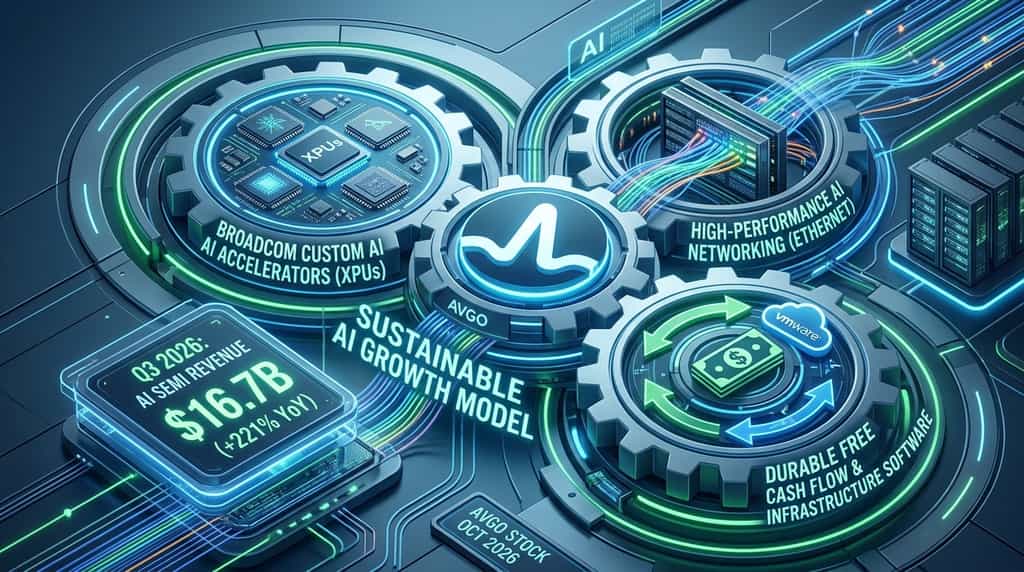
Broadcom's latest fiscal third-quarter results show that AI remains its strongest growth engine. According to Broadcom's September 2, 2026 earnings release, AI semiconductor revenue reached $16.7 billion, up 221% year over year, while total revenue increased 86% to $29.6 billion. Broadcom also expects fourth-quarter revenue of approximately $34.8 billion.
The investment case, however, is not simply about AI growth. Broadcom stock now trades at a premium valuation, making execution, customer concentration, and the sustainability of AI infrastructure spending critical factors for investors considering AVGO in 2026.
Is Broadcom Stock a Buy in 2026?
Broadcom stock remains a compelling AI infrastructure growth story, but its valuation means investors should distinguish between a strong company and an attractive entry price.
According to CompaniesMarketCap data from October 2026, Broadcom had a market capitalization of approximately $1.73 trillion and a trailing price-to-earnings ratio of about 46.3. The same data shows AVGO trading around $362.51 per share.
That valuation is substantial, but it needs to be viewed against the company's unusually rapid earnings growth. In fiscal Q3 2026, Broadcom reported GAAP diluted earnings per share of $2.68, up 215% year over year, while non-GAAP diluted EPS reached $3.32, up 96%.
The key question for AVGO investors is therefore not whether Broadcom is growing. It clearly is. The more important question is whether future earnings growth can remain strong enough to justify the premium already embedded in the stock price.
Broadcom's AI exposure provides a significant opportunity because the company does not depend exclusively on selling general-purpose GPUs. Its custom AI accelerators and Ethernet networking products are designed to support large-scale AI infrastructure deployments, creating a differentiated position within the AI semiconductor market.
For investors with a long-term horizon, that combination of AI exposure, semiconductor technology, infrastructure software, and strong cash generation can support a bullish thesis. However, investors seeking a margin of safety should pay close attention to valuation and the pace of future AI capital expenditure.
How Fast Is Broadcom's AI Business Growing?
Broadcom's AI semiconductor business is growing at an exceptional rate, making it the central driver of the company's 2026 investment thesis.
According to Broadcom's Q3 fiscal 2026 results, AI semiconductor revenue reached $16.7 billion, representing 221% year-over-year growth and 54% sequential growth. Management expects AI semiconductor revenue to rise further to $21.7 billion in fiscal Q4, which would represent 236% year-over-year growth.
The acceleration is especially important because Broadcom entered fiscal 2026 with already strong AI momentum. In Q1, Broadcom reported $8.4 billion in AI semiconductor revenue, up 106% year over year, according to its March 2026 results. By Q2, AI semiconductor revenue had increased to $10.8 billion, up 143% year over year, according to Broadcom's June 2026 earnings release.
This progression shows that Broadcom's AI business is not merely benefiting from a single quarter of unusually strong demand. AI revenue has accelerated throughout fiscal 2026.
The company's overall semiconductor solutions segment is also benefiting from this trend. Semiconductor solutions revenue reached $20.84 billion in Q3, up 127% year over year, compared with 29% growth in infrastructure software revenue.
That difference demonstrates how heavily Broadcom's current growth profile is being shaped by AI-related semiconductor demand.
What Makes Broadcom's AI Business Different From Nvidia's?
Broadcom's AI opportunity is concentrated more heavily in custom accelerators and networking infrastructure than in merchant GPUs.
Nvidia remains dominant in general-purpose AI accelerators, while Broadcom supplies customized XPU solutions and networking technologies to major AI infrastructure customers. This gives Broadcom a different role in the AI hardware ecosystem.
According to Broadcom's September 2026 filing, demand for its custom AI accelerators and AI networking solutions was unprecedented, particularly among leading frontier AI labs. Broadcom said its AI infrastructure platform is designed to support more than 20 gigawatts of compute capacity through 2028.
Broadcom also launched its AI XPV platform in June 2026 with Apollo and Blackstone. According to Broadcom, the platform launched with an initial $35 billion transaction and is designed to facilitate more than 20 gigawatts of AI compute capacity using Broadcom XPUs and networking solutions.
This model potentially expands Broadcom's addressable AI opportunity because the company can participate in infrastructure deployments without relying solely on customers funding every project from existing cash flows. The opportunity is significant, but the financing structure also introduces additional risks that investors need to monitor, particularly around customer creditworthiness and AI infrastructure economics.
What Do Broadcom's Latest Financial Results Say About Its Growth?
Broadcom's latest financial results indicate that AI demand is translating into substantial revenue, earnings, and free cash flow rather than simply creating an attractive growth narrative.
According to Broadcom's September 2026 results, fiscal Q3 revenue reached $29.6 billion, up 86% year over year. GAAP operating income rose 171% to $16.0 billion, while GAAP net income increased 216% to $13.1 billion.
Cash generation was equally important. Broadcom generated $14.2 billion in operating cash flow during Q3 and $13.7 billion in free cash flow after $0.5 billion of capital expenditures. Free cash flow represented approximately 46% of quarterly revenue. That level of cash conversion strengthens the bull case because Broadcom is not relying entirely on future revenue growth to fund its business. It is already generating significant internal cash that can support dividends, debt management, acquisitions, and shareholder returns.
The company's infrastructure software segment also remains important. Q3 infrastructure software revenue reached $8.75 billion, up 29% year over year. This segment gives Broadcom a second major earnings engine alongside semiconductors. The combination can make its financial profile more diversified than that of a pure-play AI chip company.
However, the semiconductor business currently contributes the majority of the growth. Investors should therefore avoid assuming that software revenue alone can offset a major slowdown in AI infrastructure spending.
Is Broadcom Stock Overvalued?
Broadcom stock is expensive on an absolute earnings basis, but its valuation cannot be evaluated without considering its unusually high growth and cash generation. According to CompaniesMarketCap data from October 2026, AVGO's trailing P/E ratio was approximately 46.3, while its market capitalization was about $1.73 trillion.
A trailing P/E above 40 means investors are paying a substantial premium for Broadcom's earnings. That creates a potential valuation risk if growth slows sharply.
The counterargument is that historical earnings can understate the economics of a rapidly expanding business. Broadcom's Q3 GAAP net income increased 216% year over year, while non-GAAP EPS increased 96%. In other words, the denominator in the P/E ratio is growing quickly.
This creates an important distinction between an expensive stock and an overvalued stock. A stock can trade at a high multiple and still produce attractive returns if earnings expand quickly enough. Conversely, even a strong company can deliver disappointing investment returns if investors pay too much before growth slows.
For AVGO, valuation therefore represents a risk rather than an automatic reason to avoid the stock. Investors should monitor the relationship between AI revenue growth, earnings growth, free cash flow, and the stock's valuation multiple. If earnings continue expanding rapidly while the valuation multiple remains stable or contracts moderately, future returns could still be supported by earnings growth.
What Could Drive Broadcom Stock Higher in 2027?
Continued AI accelerator demand, networking growth, software monetization, and strong free cash flow could provide the main catalysts for AVGO beyond 2026. The most direct catalyst is continued growth in custom AI accelerators. Broadcom's Q4 guidance for $21.7 billion of AI semiconductor revenue demonstrates how rapidly this business has expanded.
A second catalyst is AI networking. As AI clusters become larger, the need for high-performance networking increases because thousands or potentially millions of compute components must communicate efficiently.
A third catalyst is the integration of VMware into Broadcom's infrastructure software portfolio. Broadcom has continued developing VMware-related AI infrastructure products, including its VMware AI Factory and Private AI Cloud initiatives announced in August 2026. The software business could become particularly valuable if enterprise customers increasingly require private and hybrid infrastructure for AI workloads.
Finally, free cash flow provides financial flexibility. Broadcom generated $13.7 billion of free cash flow in Q3 alone, giving management substantial resources for shareholder returns and strategic investments.
Beyond the Headlines: What KuCoin 5.0 Means for You
Market news moves fast — but where you act on it matters just as much. This October, KuCoin launches KuCoin 5.0, transforming KuCoin into a rebuilt platform. Here's what actually changes for you:
-
One account for everything. Older platforms split your money across separate "spot," "margin," and "futures" accounts and expected you to understand why. KuCoin 5.0's unified account removes that entirely — deposit once, and everything is simply there (only available to VIPs for now).
-
Stocks, indices, and commodities. KuCoin 5.0 expands beyond crypto into global markets. When crypto chops sideways and equities rally (or the reverse), you rotate in minutes instead of opening a brokerage account and waiting days for fiat rails.
-
Real-world assets (RWA). Tokenized exposure to traditional assets like commodities, right inside your crypto account. One of the fastest-growing segments in global finance is no longer reserved for institutions — you access it from the same balance you trade with.
-
Earn while you learn. Not ready to trade? KCUSD lets your stablecoins earn daily, auto-compounding interest. The lowest-stress way to put your idle deposit to work for 4% yield.
-
An AI assistant in plain language. Ask questions, get market context, understand what you're looking at — built into the platform, no jargon required.
-
An app that doesn't overwhelm. Faster, cleaner, and consistent — intuitive from the first tap, not after a tutorial.
-
Safety you can check, not just trust. A MiCAR-licensed EU entity, Proof of Reserves you can verify yourself, and internationally certified security (SOC 2 Type II, ISO 27001:2022).
Create your account in minutes — and start on the platform built for where crypto is going, not where it's been.
Conclusion
Broadcom stock remains one of the strongest large-cap beneficiaries of the AI infrastructure expansion in 2026, but its investment case is more nuanced than simply betting on continued AI growth.
According to Broadcom's latest fiscal Q3 2026 results, AI semiconductor revenue reached $16.7 billion, up 221% year over year, while total revenue increased 86% to $29.6 billion. The company expects Q4 revenue of approximately $34.8 billion and AI semiconductor revenue of $21.7 billion. The company also generated $13.7 billion in quarterly free cash flow, demonstrating that its AI growth is translating into substantial cash generation rather than remaining purely an expectation.
However, AVGO is not a low-risk value stock. Its approximately 46.3 trailing P/E ratio as of October 2026 reflects significant investor expectations, while customer concentration leaves the company exposed to changes in AI infrastructure spending.
For investors considering Broadcom, the central question is therefore whether future AI earnings growth can justify today's valuation. Broadcom's fundamentals remain powerful, but valuation, customer concentration, and the sustainability of AI capital spending should remain central to any 2026 investment decision.
FAQs
Does Broadcom make AI chips?
Yes. Broadcom develops custom AI accelerators, often referred to as XPUs, as well as networking solutions designed for large-scale AI infrastructure. Its AI semiconductor business is a major driver of its current growth.
Does Broadcom pay a dividend?
Yes. Broadcom's quarterly common stock dividend was $0.65 per share in fiscal 2026. The company paid $3.1 billion in dividends during its fiscal Q3 period.
Is Broadcom a semiconductor company or a software company?
Broadcom is both. Its business consists of semiconductor solutions and infrastructure software. In fiscal Q3 2026, semiconductor solutions generated $20.84 billion in revenue, while infrastructure software generated $8.75 billion.
Where is Broadcom headquartered?
Broadcom is headquartered in Palo Alto, California, and operates as a global semiconductor and infrastructure software company.
What ticker symbol does Broadcom use?
Broadcom trades on Nasdaq under the ticker symbol AVGO. The company was previously associated with the Avago name before the Broadcom acquisition and subsequent corporate branding.
Disclaimer: This article is for informational purposes only and does not constitute financial, legal, or investment advice. Always conduct your own research before interacting with digital assets or investing in financial markets.