

How Is Ethereum Accelerating Its Timeline to Quantum Safety?
Introduction
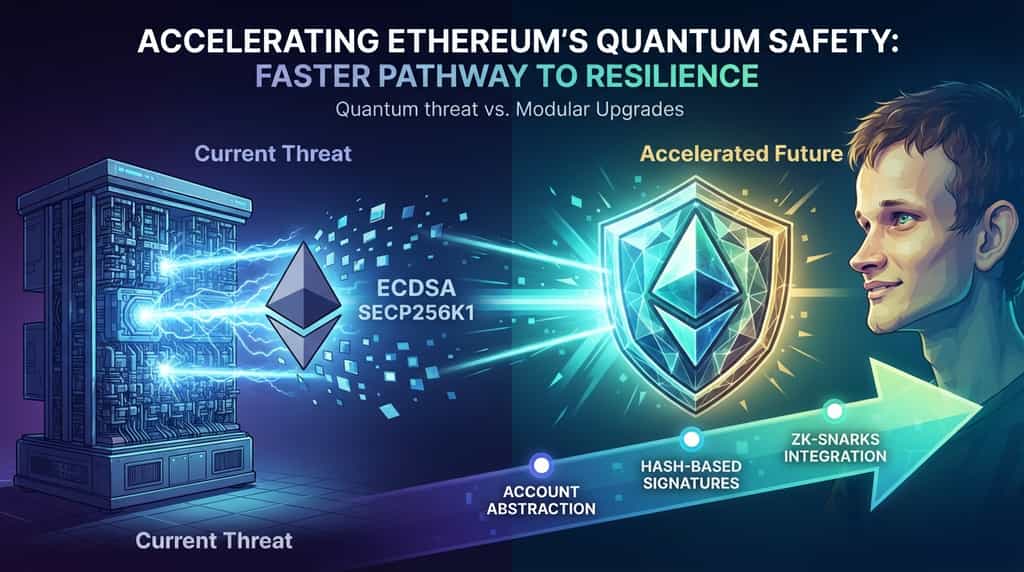
The rapid advancement of quantum computing presents a theoretical long-term threat to traditional cryptographic systems, including the public-key cryptography that secures blockchain networks. Recently, Ethereum co-founder Vitalik Buterin shifted his perspective significantly, expressing strong optimism regarding a faster, more streamlined pathway to achieving quantum resistance for the Ethereum network. This shift centers on newly proposed cryptographic and architectural adjustments that could protect user funds and smart contracts well before quantum hardware reaches a scale capable of breaking current elliptic-curve cryptography.
Key Takeaways
Vitalik Buterin has adopted an increasingly optimistic stance on accelerating Ethereum's transition to quantum-resistant cryptography, driven by recent research into more efficient cryptographic primitives and protocol upgrade paths.
-
The Core Shift: Recent cryptographic research suggests that transitioning Ethereum to quantum-safe structures may be achieved much faster and with fewer operational bottlenecks than previously estimated.
-
The Threat Model: Quantum computers pose a risk primarily through algorithms like Shor's algorithm, which can reverse cryptographic hashes and private keys derived from standard elliptic-curve signatures (such as ECDSA).
-
Proposed Solutions: The network is exploring statelessness, hash-based signatures, and advanced zero-knowledge proof aggregators that minimize the overhead of quantum-resistant cryptographic upgrades.
-
Timeline Impact: While a complete migration requires rigorous testing and hard forks, new modular implementation strategies could shield user accounts years ahead of legacy upgrade projections.
Why Is Quantum Resistance Urgent for Blockchain Networks?
Blockchains rely on asymmetric cryptography to secure user funds, validate transactions, and ensure that only the rightful owner of a private key can authorize a transfer. Standard networks like Ethereum currently use ECDSA (Elliptic Curve Digital Signature Algorithm) secp256k1 for transaction signing. While computationally secure against classical computers, these cryptographic primitives are vulnerable to quantum computers of sufficient qubit scale and error-correction capabilities running Shor's algorithm.
A sufficiently advanced quantum computer could derive a private key from a publicly exposed public key. Because blockchain addresses often reveal public keys upon outgoing transactions—or keep them exposed in historical ledger states—an unprotected network would face catastrophic ledger compromise. Consequently, core developers and researchers have prioritized finding upgrade paths that insulate the protocol before quantum hardware achieves cryptographically relevant milestones.
What Changed in Vitalik Buterin’s Perspective on Quantum Timelines?
Historically, transitioning a major smart contract platform to quantum-resistant algorithms was viewed as a multi-decade engineering hurdle. Post-quantum cryptography (PQC) alternatives—such as lattice-based or stateful hash-based signature schemes—traditionally suffer from massive signature sizes, high verification gas costs, and complex key-management requirements that could bloat the blockchain state.
Recent theoretical breakthroughs and modular protocol designs have altered this outlook. Research into succinct zero-knowledge proofs, STARK-based accumulators, and optimized hash-based signature frameworks indicates that Ethereum can absorb quantum-safe upgrades incrementally. Instead of forcing an unwieldy, network-wide cryptographic overhaul all at once, developers can deploy localized protocol components and account-abstraction layers that gradually phase out vulnerable signature schemes without crippling throughput or decentralization.
How Will Ethereum Implement Quantum-Safe Upgrades?
Upgrading a decentralized network of Ethereum's scale requires careful coordination, backwards compatibility planning, and multi-year testing phases. The transition strategy relies on several foundational pillars:
-
Account Abstraction (ERC-4337): By mainstreaming smart contract wallets, users can eventually transition their security models from native ECDSA keys to quantum-resistant signature verifiers without altering the core consensus layer immediately.
-
Hash-Based Signatures: Algorithms like SPHINCS+ or XMSS offer strong security guarantees based on hash functions rather than number-theoretic assumptions, though optimizing their signature sizes remains an active area of research.
-
Zero-Knowledge Proof Integration: ZK-rollup layers and native protocol provers can batch and verify complex cryptographic proofs off-chain, shielding the base layer from the computational overhead associated with post-quantum verification math.
The following table summarizes the primary cryptographic approaches under evaluation for post-quantum migration:
| Cryptographic Primitive | Security Basis | Key Advantages | Primary Drawbacks |
| ECDSA (Current) | Elliptic curves | Fast, compact signatures | Vulnerable to Shor’s algorithm on quantum hardware |
| Lattice-Based Crypto | Shortest Vector Problem | Good balance of speed and size | Complex mathematical assumptions, newer security track record |
| Hash-Based Signatures | Hash function security | Minimal cryptographic assumptions | Large signature sizes, strict state management requirements |
What Are the Practical Implications for Developers and Users?
For everyday participants and decentralized application (dApp) developers, the shift toward quantum safety will likely occur behind the scenes via protocol upgrades and wallet software updates. Users will not necessarily need to re-architect their funds manually on day one, as account abstraction frameworks will facilitate seamless migration paths.
However, smart contract developers must remain mindful of how long-term protocol upgrades affect gas economics, signature verification opcodes, and data availability structures. As Ethereum integrates more advanced cryptographic primitives, the tooling for zero-knowledge applications and secure key management will continue to mature, providing robust protection against future computational threats long before they materialize in the commercial market.
Conclusion
The acceleration of Ethereum's roadmap toward quantum safety marks a vital turning point in blockchain engineering. What was once perceived as a distant, intractable scaling and cryptographic barrier is now being addressed through modular protocol design, account abstraction, and efficient zero-knowledge architecture. By confronting quantum vulnerability proactively, the network aims to secure long-term resilience, ensuring that user assets and decentralized infrastructure remain protected against future technological paradigms.
FAQs
When will quantum computers pose a realistic threat to Ethereum?
Most cryptographers and quantum physicists estimate that a quantum computer capable of breaking 256-bit elliptic-curve cryptography is still years or decades away. However, because migration takes extensive time, proactive planning is already underway.
Will regular users need to take action to protect their funds?
In most proposed upgrade paths, wallet providers and account abstraction standards will handle the transition mechanics. Users will likely be prompted to update wallet settings or migrate funds to smart contract accounts equipped with quantum-resistant signature verification.
Why are post-quantum cryptographic signatures harder to process?
Post-quantum alternatives typically require significantly larger data sizes for public keys and signatures compared to traditional elliptic-curve schemes. This increases storage requirements, network bandwidth consumption, and verification gas costs on the blockchain.
Are other blockchain networks also preparing for quantum security?
Yes, multiple layer-1 protocols and research groups are actively monitoring National Institute of Standards and Technology (NIST) post-quantum cryptography standards and experimenting with modular upgrade frameworks.
Does this upgrade risk breaking existing smart contracts?
Core protocol developers design upgrades with strict backwards compatibility or phased migration schedules in mind to prevent breaking existing decentralized applications, though specific protocol-level changes always undergo rigorous testnet simulations before mainnet deployment.
Disclaimer
This general market information, possibly from third-party, commercial, or sponsored sources, is provided for reference and educational purposes only and does not constitute financial or investment advice, an offer, solicitation, or guarantee. We disclaim liability for its accuracy, completeness, reliability, and any resulting losses. Investments/trading are risky; past performance doesn’t guarantee future results. Users should research, judge prudently, and take full responsibility. For further details, please consult KuCoin’s Terms of Use and Risk Disclosure.