

Ethena Ends Monthly Investor Unlocks and Ties 95% of Net Revenue to ENA Buybacks After $7.5B USDe Milestone
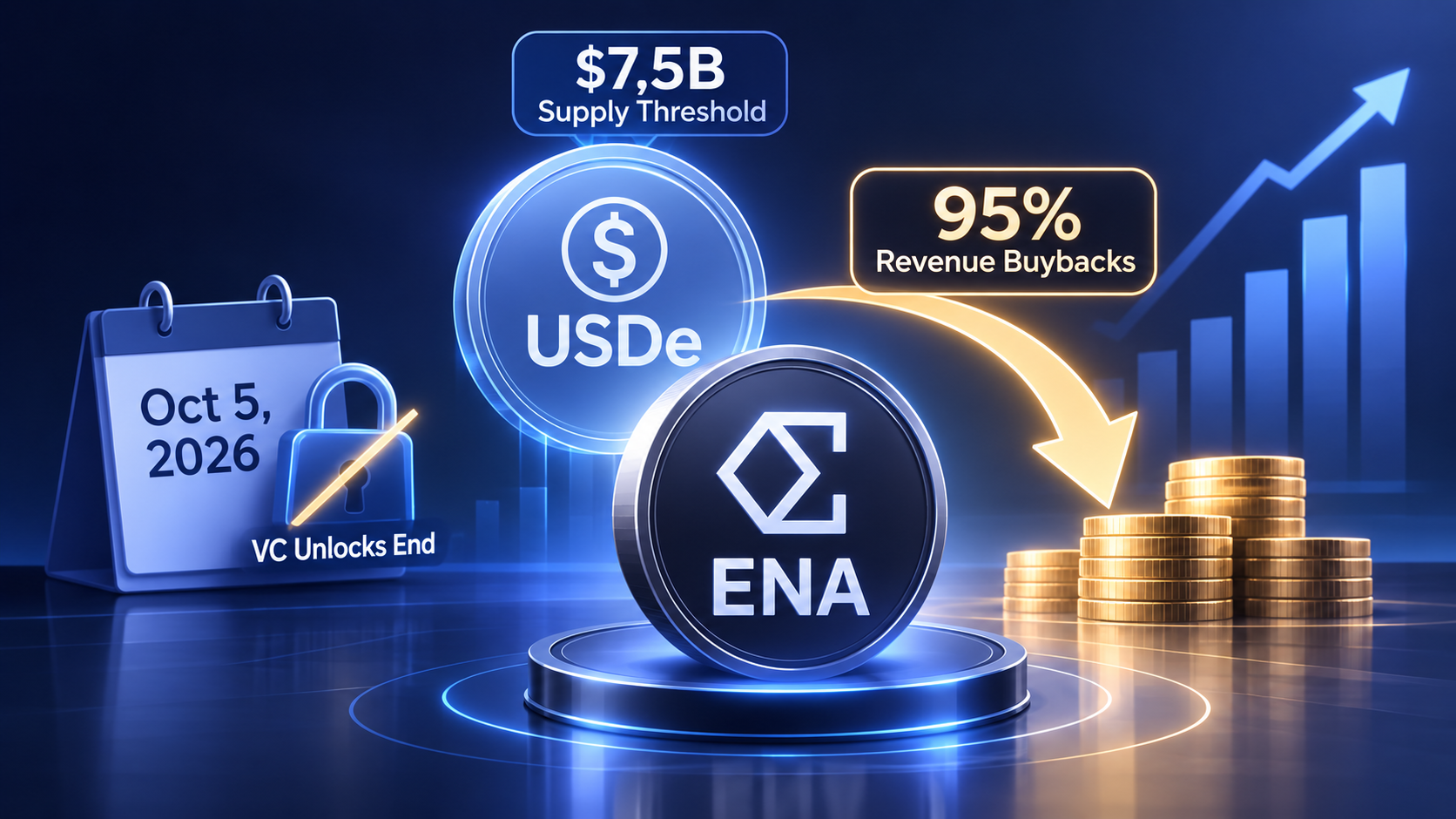
The Ethena Foundation recently submitted a landmark tokenomics overhaul that fundamentally reshapes the financial architecture of the Ethena ecosystem by ending venture capital unlock pressure and establishing direct protocol value accrual. By eliminating recurring monthly token emissions for early seed investors and tying up to 95% of net protocol revenue to programmatic secondary market ENA buybacks, Ethena aligns its governance token directly with business growth. However, the multi-million dollar revenue buyback mechanism contains a structural prerequisite: it activates only after Ethena’s synthetic dollar, USDe, reaches a circulating supply threshold of $7.5 billion.
Key Takeaways
-
Elimination of Investor Supply Overhang: Ethena is terminating recurring monthly seed investor token unlocks, consolidating remaining investor allocations into a single final release on October 5, 2026, alongside over-the-counter (OTC) seed token buyouts.
-
95% Net Revenue Buyback Engine: A proposed fee-switch framework routes 95% of net protocol earnings directly toward open-market ENA spot purchases, with the remaining 5% reserved for ecosystem development.
-
Conditional $7.5B USDe Threshold: The revenue buyback mechanism remains dormant until USDe’s circulating supply expands from current sub-$5 billion levels to $7.5 billion (a ~50% to 84% growth requirement).
-
Sustainable Value Accrual Engine: Revenue for token absorption stems from real delta-neutral staking rewards, funding rate arbitrage, and institutional clearing via Ethena [X], rather than inflationary token minting.
-
Separation of Economic Rights: Equity investors in Ethena Labs relinquish claims to protocol cash flows, ensuring operational profits directly benefit foundation reserves and ENA token holders.
What Changes Are Included in Ethena’s New Tokenomics Strategy?
Ethena’s proposed tokenomics overhaul restructures capital flows by eliminating structural token supply overhang while implementing a programmatic mechanism to turn protocol earnings into open-market spot buying pressure for ENA.
Ending Venture Capital Unlock Pressure
Venture capital unlock schedules frequently create long-term price suppression when early investors sell distributed tokens into secondary market liquidity. To solve this structural issue, the Ethena Foundation moved to terminate recurring monthly token releases for original seed investors.
Remaining original investor token allocations are set to unlock in a final, single lump-sum event on October 5, 2026, permanently removing continuous monthly emission pressure. To further neutralize market overhang, the Ethena Foundation executed over-the-counter (OTC) buyout transactions to purchase locked ENA tokens directly from major seed funds that had previously sold positions on the open market. Team allocations will continue to adhere to their original, unchanged multi-year vesting schedules.
Activating the 95% Net Revenue Buyback Program
Value accrual in decentralized finance often suffers when governance tokens lack a direct link to protocol-generated income. Ethena’s governance proposal addresses this by routing 95% of net protocol revenue toward programmatic secondary market buybacks of ENA.
According to research parameters published by Ethena Labs, net revenue generated across all core business lines—including sUSDe yields, white-label stablecoin integrations, and institutional clearing via Ethena [X]—will fund open-market ENA purchases. The remaining 5% of net revenue will be retained by the foundation to fund ongoing ecosystem development and integration grants.
Formalizing Separation of Protocol Economics
Ethena has clarified the boundary between software development equity and token-governed protocol cash flows. Under an agreement in principle, substantially all economic upside, intellectual property, and operational yield streams associated with Ethena belong exclusively to the foundation and token holders, rather than equity investors in Ethena Labs. This structural separation ensures that institutional adoption directly benefits on-chain token holders.
Why Is the $7.5 Billion USDe Milestone Critical for ENA Buybacks?
The 95% net revenue buyback mechanism operates on a conditional activation scale based on circulating supply growth rather than starting immediately upon governance approval.
| Metric / Parameter | Value / Status | Operational Impact |
| Activation Requirement | $7.5 Billion USDe Circulating Supply | Programmatic ENA buybacks remain paused until threshold is met. |
| Current USDe Supply | ~$4.07 Billion to $4.7 Billion | Requires an approximate 50% to 84% expansion in market cap. |
| Revenue Allocation Ratio | 95% Buybacks / 5% Ecosystem | Directs primary cash flows to secondary market token absorption. |
| Baseline Revenue Projection | ~$22.5 Million Annual Buyback Fund | Calculated at $7.5B supply assuming a standard 6% protocol yield. |
| Investor Unlock End Date | October 5, 2026 | Eliminates all recurring monthly VC token distributions. |
The $7.5 Billion Threshold Requirement
Programmatic ENA buybacks will not purchase a single token until USDe’s 14-day average circulating supply clears $7.5 billion. According to research published by Blockworks Advisory and OAK Research, the protocol's circulating supply sat at roughly $4.07 billion to $4.7 billion during the proposal window, leaving a growth gap of over $3 billion before the initial fee-switch tier triggers.
Setting a high activation threshold ensures the protocol maintains deep capital reserves during market contractions before distributing capital back into the governance token.
Tiered Fee-Switch Schedule and Revenue Projections
The fee-switch framework utilizes a multi-tiered scale that increases the revenue extraction rate alongside stablecoin expansion:
-
Tier 1 ($7.5 Billion USDe): Activates the base fee switch. At an estimated average protocol yield of 6%, a $7.5 billion USDe supply generates approximately $450 million in annual gross yield, directing roughly $22.5 million annually into ENA spot buybacks.
-
Higher Expansion Tiers ($10 Billion+ USDe): Step up the percentage of gross protocol margin dedicated to buybacks as USDe scales toward long-term targets of $15 billion and beyond.
By tying token absorption directly to scale, Ethena creates a reflexive flywheel: USDe supply expansion drives protocol yield, which increases programmatic open-market buying pressure on ENA.
How Does Ethena Generate Revenue to Fund Token Buybacks?
Ethena’s revenue architecture relies on delta-neutral yield strategies rather than traditional inflationary token emissions, allowing it to harvest yield from crypto derivatives and institutional lending markets.
Delta-Neutral Arbitrage and Staking Yields
USDe generates revenue through a combination of spot asset staking yields and futures funding rate arbitrage:
-
Staking Rewards: Collateral backing USDe (such as ETH) is staked on-chain to earn consensus and execution layer rewards.
-
Funding Rate Arbitrage: Ethena opens short derivatives positions equal to its long spot holdings. In bullish or sideways markets, perpetual futures funding rates pay short position holders. Ethena captures this spread, generating high real yields.
White-Label Distributions and Institutional Credit Lines
Ethena has expanded its revenue channels beyond basic crypto funding rates to insulate protocol earnings against extended bear markets:
-
Institutional Clearing via Ethena [X]: Institutional partners utilize USDe liquidity for off-exchange settlement and margin collateral, generating baseline transaction fees.
-
Over-the-Counter and Lending Integrations: Integrations across decentralized lending markets (such as Aave) and institutional credit facilities allow Ethena to earn yield on reserve assets regardless of retail trading sentiment.
What Impact Does This Tokenomics Redesign Have on ENA Market Dynamics?
Eliminating continuous venture capital token emissions while introducing a scalable demand engine alters ENA’s long-term supply and demand balance.
Removal of Structural VC Selling Overhang
Under previous tokenomics schedules, monthly investor unlocks introduced millions of ENA into circulation every 30 days. Traders frequently priced in this recurring sell pressure, creating structural resistance during market recoveries.
By consolidating remaining original investor distributions into a single final release on October 5, 2026, and executing OTC buyouts of liquid seed allocations, the foundation eliminates predictable monthly liquidations.
Establishing Real Yield Accrual for Token Holders
Governance tokens across DeFi often trade purely on market speculation when they lack dividend or buyback mechanisms. Tying 95% of net protocol revenue to secondary market spot purchases provides ENA with quantifiable cash-flow backing.
As institutional adoption of USDe grows, open-market programmatic buybacks absorb circulating ENA supply, converting stablecoin usage into sustained buying demand.
How Does Ethena Compare to Traditional and Synthetic Stablecoins?
Understanding how USDe differs from fiat-collateralized stablecoins and algorithmic assets highlights both its growth potential and structural risks.
| Feature | Fiat-Backed (e.g., USDT, USDC) | Algorithmic (e.g., historical UST) | Ethena USDe |
| Backing Mechanism | Off-chain fiat reserves & Treasuries | Uncollateralized reflexive tokens | On-chain crypto assets + Short futures |
| Primary Yield Source | Retained by issuer (TradFi yields) | Inflationary token emissions | Staking yield + Perpetual funding rates |
| DeFi Composability | High, but centralized freeze risks | High, but prone to death spirals | High, fully on-chain transparent collateral |
| Scalability Bottleneck | Banking partner approvals | Market confidence collapse | Derivatives market open interest limits |
USDe vs. Fiat-Collateralized Stablecoins
Fiat-backed stablecoins hold dollars or treasury bills in traditional bank accounts. While highly stable, issuers retain the interest earned on those reserves. Ethena, by contrast, passes underlying staking and funding yields directly to protocol participants and passes net protocol profits to ENA token holders through programmatic buybacks.
USDe vs. Uncollateralized Algorithmic Tokens
Unlike legacy uncollateralized algorithmic stablecoins that relied on mint-and-burn token mechanics, USDe is fully collateralized by spot crypto assets (ETH, BTC, SOL) combined with corresponding short futures positions. This delta-neutral setup maintains dollar parity without relying on inflationary governance token printing to support its peg.
What Are the Key Risks to Consider Before Trading ENA?
While the tokenomics overhaul strengthens value accrual, several operational and market risks remain relevant for traders.
-
Negative Perpetual Funding Rates: Ethena’s yield engine relies on positive funding rates. If crypto markets enter a prolonged bear trend where short positions must pay long positions, Ethena's protocol yield turns negative. The protocol relies on its reserve fund to absorb negative funding periods, but sustained downturns shrink protocol revenue.
-
Execution Gap to the $7.5 Billion Threshold: The headline 95% buyback mechanism provides zero spot demand until USDe supply expands by over $3 billion from current levels. If market demand for synthetic dollar yield stalls, the buyback engine will remain dormant indefinitely.
-
Lump-Sum Unlock Risk on October 5: Moving all remaining original investor unlocks to October 5, 2026, removes long-term monthly sell pressure, but it creates a localized concentration of unlocked supply on that specific date. Market volatility may spike around the distribution window depending on how seed investors manage their holdings.
Should You Trade ENA and USDe on KuCoin?
KuCoin provides a secure trading environment with deep order book liquidity for investors looking to trade ENA or integrate USDe into their crypto portfolio.
How to Buy and Trade ENA on KuCoin
-
Create and Verify Your Account: Register a free account on the official KuCoin website or mobile app, completing identity verification (KYC) to access full trading features and higher withdrawal limits.
-
Deposit Capital: Deposit crypto assets directly into your KuCoin account, or purchase USDT instantly using KuCoin’s Fast Trade service, P2P market, or third-party payment gateways.
-
Execute Trades on the Spot Market: Navigate to the KuCoin Spot Market and locate the ENA/USDT or USDE/USDT trading pair. Select a Market Order for instant execution or a Limit Order to enter positions at your target price.
-
Earn Passive Yield: Transfer your purchased assets to your KuCoin Financial Account or withdraw USDe to on-chain wallets to participate in Ethena’s staking ecosystems directly.
Conclusion
Ethena’s decision to terminate monthly venture capital unlocks and channel 95% of net protocol revenue into ENA buybacks represents a significant evolution in decentralized protocol finance. By addressing long-standing investor emission overhang and creating a direct revenue-sharing model, the foundation aligns the success of its synthetic dollar directly with token holder value.
While the programmatic buyback engine requires USDe to clear its $7.5 billion milestone before activating, the underlying framework establishes a clear fundamental target for protocol growth. As Ethena expands its institutional credit integrations and white-label distributions, traders on platforms like KuCoin can monitor USDe market cap metrics to gauge when programmatic token demand will go live.
Frequently Asked Questions (FAQs)
When do ENA token buybacks officially begin?
Programmatic ENA buybacks will begin only after USDe’s 14-day average circulating supply reaches $7.5 billion. The governance vote activates the contract framework, but actual open-market purchases remain paused until USDe supply clears this threshold.
What happens to early venture capital investor tokens on October 5, 2026?
All remaining original seed investor allocations will be fully unlocked in a single final distribution on October 5, 2026. This accelerated unlock permanently ends recurring monthly VC token releases, removing structural supply emissions going forward.
How does the Ethena Foundation calculate net revenue for buybacks?
Net revenue includes all protocol earnings generated across sUSDe yields, white-label stablecoin issuance fees, and Ethena [X] institutional clearing margins, minus operational expenses. 95% of this net total goes directly toward spot ENA purchases, while 5% funds ecosystem expansion.
Will ENA buybacks continue if USDe supply falls below $7.5 billion after triggering?
Buyback execution tiers are tied directly to active USDe supply brackets based on a 14-day moving average. If USDe supply drops back below the $7.5 billion threshold, revenue allocations pause or step down to lower bracket rates until supply recovers.
What is the difference between ENA and USDe on KuCoin?
USDe is Ethena’s synthetic dollar designed to maintain a stable $1.00 value while capturing crypto staking and funding yields. ENA is the protocol’s governance token, which grants voting rights over risk parameters and captures value through protocol revenue buybacks. Both assets are available for trading on KuCoin.