

DTCC Tokenization Service: Unlocking $30 Trillion in Real-World Assets for Institutional Markets
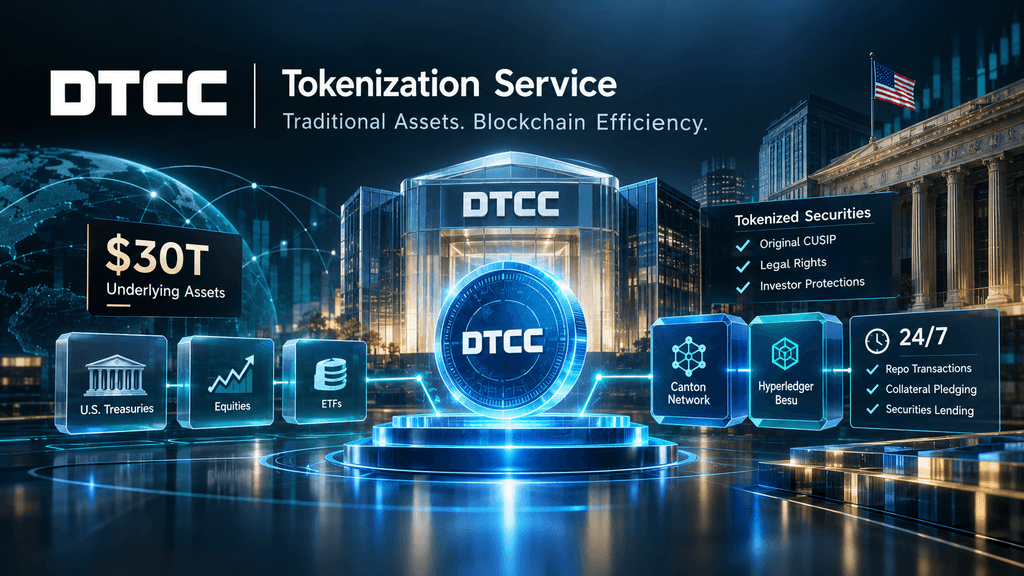
The Depository Trust & Clearing Corporation (DTCC) has officially launched its Tokenization Service (DTS), entering commercial operation to bridge traditional financial architecture with distributed ledger technology. According to announcements released in October 2026, the service initially supports 25 securities while unlocking access to approximately $30 trillion in underlying assets held within the Depository Trust Company (DTC). This milestone marks a structural shift for mainstream capital markets, bringing institutional-grade tokenization to U.S. equities, exchange-traded funds (ETFs), and government bonds.
Key Takeaways
-
Massive Asset Scope: The DTCC initiative unlocks pathways for an estimated $30 trillion in underlying assets available for tokenization, starting with an initial curated group of 25 securities.
-
Preserving Legal Integrity: Tokenized securities retain their original CUSIP numbers, legal rights, and investor protections while mapping 1:1 to assets securely held in central depository custody.
-
Institutional Network Connectivity: The service operates across enterprise-grade, permissioned blockchain networks such as the Canton Network and Hyperledger Besu.
-
24/7 Capital Efficiency: Participants can execute round-the-clock intraday repo transactions, instantaneous collateral pledging, and automated securities lending outside standard banking hours.
-
Regulatory Compliance: Built under targeted SEC no-action letter authorizations, the framework provides a risk-mitigated bridge between traditional finance (TradFi) and digital asset infrastructure.
What is the DTCC Tokenization Service and How Does It Work?
The DTCC Tokenization Service operates as a controlled, voluntary framework that mirrors traditional securities onto blockchain networks on a 1:1 basis. Based on operational updates from October 2026, the service allows eligible DTC participants to mint and burn tokenized security entitlements tied directly to assets resting safely in central depository custody.
-
Preserving Original Identifiers: Tokenized assets retain their original CUSIP numbers, legal rights, and fundamental investor protections.
-
Maintaining Central Records: The DTC continues to maintain the official books and records, eliminating reconciliation errors between separate ledgers.
-
Streamlined Conversion: Conversion orders between traditional formats and on-chain tokens execute during designated business hours with processing targets under 15 minutes.
Which Assets and Securities Are Included at Launch?
The initial rollout focuses on a highly liquid subset of 25 securities drawn from an eligible pool of roughly $30 trillion in total market value. According to regulatory parameters authorized under an SEC no-action letter, the service targets specific asset classes designed to test high-volume institutional use cases.
-
U.S. Treasury Instruments: Bills, notes, and bonds serving as prime collateral for institutional repo transactions.
-
Equities: Select blue-chip issues drawn from the Russell 1000 index.
-
Exchange-Traded Funds (ETFs): Major index-tracking funds providing deep baseline liquidity.
What Blockchain Networks Support the Tokenization Service?
Connectivity is engineered around institutional-grade, permissioned environments that satisfy rigorous compliance and security standards. Based on DTCC technical rollouts, the service supports two primary networks at launch, with additional public-private networks scheduled for future integration.
-
Canton Network: A privacy-enabled interoperable blockchain built for institutional asset management and multi-party workflows.
-
Hyperledger Besu: A private enterprise Ethereum-compatible ledger tailored for secure financial transactions.
-
Future Expansion: Additional networks, including Stellar and Circle’s Arc infrastructure, are slated for integration to broaden cross-chain availability.
How Does Tokenization Enable 24/7 Capital Efficiency?
Tokenization unlocks round-the-clock asset mobility, allowing institutional market participants to execute complex financial transactions outside normal banking hours. Live demonstrations conducted by over 40 major financial institutions showcased the practical utility of these digital rails.
-
Intraday Repo Transactions: Treasurers can execute and settle short-term repurchase agreements over weekends or late evenings, optimizing cash management.
-
Instant Collateral Pledging: High-quality liquid assets move seamlessly between counterparties to satisfy margin requirements in real time.
-
Securities Lending: Lenders and borrowers execute intraday loans with instant settlement finality, reducing counterparty credit exposure.
How to Buy/Trade Tokenized Assets on KuCoin
KuCoin provides a comprehensive gateway to trade digital assets and explore the broader tokenized economy through its advanced spot and derivatives markets. While traditional securities tethered to the DTCC service remain restricted to authorized institutional participants under SEC guidelines, retail and institutional crypto investors can leverage KuCoin's robust infrastructure to trade leading real-world asset (RWA) tokens, layer-1 utility coins, and digital commodities.
To start trading tokenized ecosystems and digital assets on KuCoin, follow these simple steps:
Register and verify your account on the official KuCoin platform using secure two-factor authentication.
Fund your account by depositing supported cryptocurrencies or fiat currencies via available payment gateways.
Navigate to the Spot or Futures trading markets, search for your preferred RWA or infrastructure token, and execute your trades securely with deep market liquidity.
Beyond the Headlines: What KuCoin 5.0 Means for You
Market news moves fast — but where you act on it matters just as much. This October, KuCoin launches KuCoin 5.0, transforming KuCoin into a rebuilt platform. Here's what actually changes for you:
-
One account for everything. Older platforms split your money across separate "spot," "margin," and "futures" accounts and expected you to understand why. KuCoin 5.0's unified account removes that entirely — deposit once, and everything is simply there (only available to VIPs for now).
-
Stocks, indices, and commodities. KuCoin 5.0 expands beyond crypto into global markets. When crypto chops sideways and equities rally (or the reverse), you rotate in minutes instead of opening a brokerage account and waiting days for fiat rails.
-
Real-world assets (RWA). Tokenized exposure to traditional assets like commodities, right inside your crypto account. One of the fastest-growing segments in global finance is no longer reserved for institutions — you access it from the same balance you trade with.
-
Earn while you learn. Not ready to trade? KCUSD lets your stablecoins earn daily, auto-compounding interest. The lowest-stress way to put your idle deposit to work for 4% yield.
-
An AI assistant in plain language. Ask questions, get market context, understand what you're looking at — built into the platform, no jargon required.
-
An app that doesn't overwhelm. Faster, cleaner, and consistent — intuitive from the first tap, not after a tutorial.
-
Safety you can check, not just trust. A MiCAR-licensed EU entity, Proof of Reserves you can verify yourself, and internationally certified security (SOC 2 Type II, ISO 27001:2022).
Create your account in minutes — and start on the platform built for where crypto is going, not where it's been.
Conclusion
The rollout of the DTCC Tokenization Service marks a definitive turning point for institutional finance, bridging the gap between legacy market structures and distributed ledger technology. By anchoring $30 trillion in underlying assets to secure blockchain rails like the Canton Network and Hyperledger Besu while preserving CUSIPs and investor protections, the initiative proves that modernization does not require abandoning regulatory rigor. As tokenized treasuries, equities, and ETFs enable 24/7 collateral mobility and real-time settlement, traditional finance and digital assets are converging into a unified, highly efficient global financial ecosystem.
FAQs
What is the primary purpose of the DTCC Tokenization Service?
The service provides a compliant pathway to issue digital token representations of traditional securities, enabling 24/7 peer-to-peer transfers, automated collateral management, and instant settlement while keeping assets anchored in the central depository.
Are tokenized securities on the DTCC platform risk-free?
No. While tokenized entitlements carry the same legal rights and investor protections as their traditional counterparts, they remain subject to general market volatility, smart contract dependencies, and institutional counterparty risks.
Can retail investors directly use the DTCC Tokenization Service?
No. The service is strictly restricted to eligible DTC participant institutions, broker-dealers, and authorized financial entities operating under regulatory oversight frameworks.
What legal framework authorizes the DTCC Tokenization Service?
The initiative operates under a three-year authorization period granted by an SEC no-action letter issued to the Depository Trust Company, permitting the tokenization of specific U.S. equities, ETFs, and Treasuries.
How do tokenized assets avoid dual-ledger reconciliation errors?
The DTC maintains official books and records on its traditional centralized infrastructure, ensuring that digital tokens minted on-chain map precisely 1:1 to assets securely held in custody without creating competing ownership claims.