

Citi Research Sees Aave’s Potential in Tokenized Capital Markets and Collateral Mobility
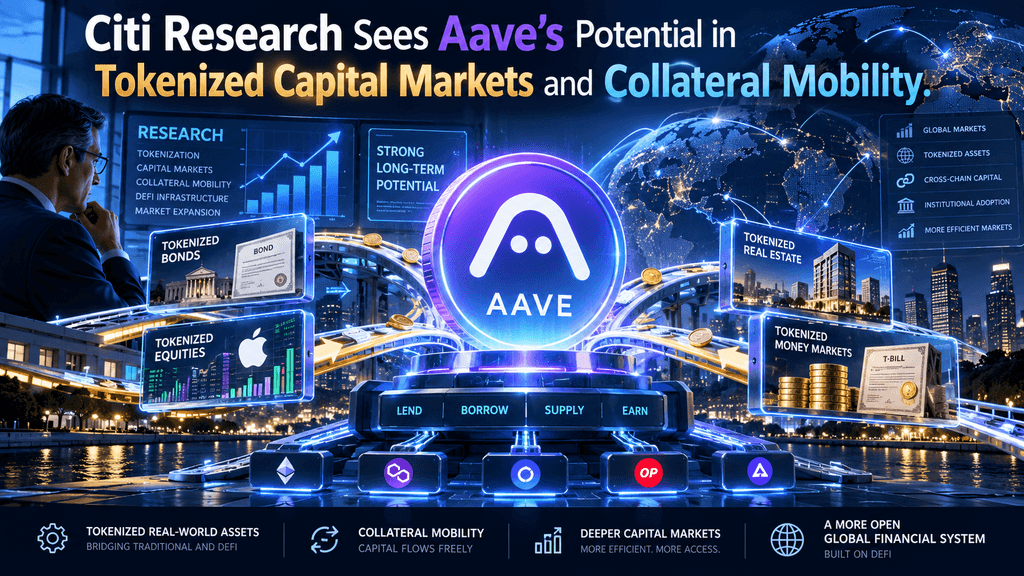
Citi Research Positions Aave as a Decentralized Collateral Mobility Ecosystem
Citi Research released a detailed 24-page note on October 19, 2026, that reframes one of decentralized finance’s largest lending protocols. Analysts Peter Christiansen and Aditi Balachandran argue that viewing Aave solely as a crypto-native money market understates its emerging role. In the report titled “US Digital Assets: Aave – Bringing Real World Finance Onchain,” they describe the protocol as a decentralized collateral mobility ecosystem. Their core claim is that as tokenization moves beyond stablecoins into money market funds, private credit, government bonds, and eventually equities, the ability to finance and repledge those assets efficiently will matter as much as the act of tokenizing them.
Citi explicitly states that collateral mobility may ultimately prove to be one of tokenization’s most important use cases. This assessment arrives while Aave already records tens of billions in cumulative borrowing and maintains a live institutional market, Horizon, designed precisely for tokenized real-world assets. The analysis examines how Aave’s architecture, risk parameters, and on-chain activity align with the scale of traditional securities finance markets that move trillions daily. The thesis is straightforward: tokenization solves the problem of moving assets on-chain; protocols such as Aave will determine how those assets are financed, pledged, and integrated into broader capital markets.
Citi Frames Aave Beyond Crypto Lending
Citi’s October 19 note deliberately steps past the familiar description of Aave as a permissionless lending pool. Analysts present it instead as infrastructure capable of performing functions that currently move tens of trillions of dollars across traditional finance. The report highlights Aave’s cumulative borrowing volume measured in the hundreds of billions across multiple networks and positions the protocol’s roadmap, V4, Horizon and the GHO stablecoin, as deliberate steps toward the intersection of collateral, liquidity, and financing. According to the note, once assets such as Treasuries, private credit instruments, and equities exist as tokens, the open question becomes how those tokens can be pledged without forced sales and how the resulting liquidity can circulate efficiently.
Citi expects this question to grow in importance as tokenization expands from stablecoins into regulated funds and bonds. The bank’s language is measured rather than promotional: it identifies a structural gap in traditional markets, idle collateral, operational cut-offs and slow mobility, and maps Aave’s existing design onto that gap. Readers of the note are directed to the practical implication that a protocol already operating at a multi-billion-dollar scale may absorb functions long handled by triparty agents, securities lenders, and collateral transformation desks. The analysis rests on observed architecture rather than projected market share.
Collateral Mobility Emerges as Tokenization’s Practical Edge
Traditional collateral systems impose measurable costs. Citi’s own broader research estimates that roughly 25 percent of collateral remains idle or unremunerated because operational frictions prevent efficient movement. Top-tier institutions can forgo hundreds of millions annually from these inefficiencies. Tokenization addresses three dimensions at once: settlement speed, the range of eligible assets, and genuine cross-border mobility. A tokenized money-market fund share can continue accruing yield while serving as collateral; programmable assets can transfer across time zones without pre-funding buffers sized for legacy cut-offs.
Citi’s earlier work on digital collateral documents institutions already testing real-time margining and the continuous mobilization of U.S. Treasuries. The October Aave note places this capability at the center of the investment case. Once assets exist as tokens, the ability to pledge them instantly and reclaim them without multi-day settlement cycles becomes a primary source of value. Aave’s design, over-collateralized borrowing against supplied assets, transparent liquidation rules, and continuous market operation, aligns directly with that requirement. The report does not claim Aave will capture the entire market; it argues that the functions Aave already performs map cleanly onto the frictions that tokenization is intended to remove.
Horizon Market Demonstrates Tokenized Fund Lending in Practice
Aave’s Horizon instance, launched for institutional and qualified participants, provides the clearest live test of the thesis. Eligible users can supply tokenized funds as collateral and borrow stablecoins or GHO without selling the underlying position. Access is deliberately restricted: only issuer-approved addresses may supply the real-world assets, and the resulting receipt tokens are non-transferable, so permissioning follows the collateral into the protocol. As of mid-October 2026, the Janus Henderson Anemoy AAA CLO Fund (JAAA) accounted for approximately $51.9 million in deposits across eleven addresses on Horizon.
Seven positions in the standard tier carried roughly $45 million of debt, predominantly in RLUSD and GHO. Midas mGLOBAL contributed an additional $30.7 million. These figures remain modest relative to Aave’s overall footprint, yet they illustrate the mechanics Citi describes: holders of regulated, yield-bearing tokens unlock liquidity while retaining exposure. Borrowers draw from permissionless stablecoin suppliers who earn interest for providing the cash leg. The market therefore separates the permissioned collateral layer from the open liquidity layer, a structure that matches institutional risk and compliance constraints more closely than fully open crypto markets.
JAAA Parameter Adjustments Highlight Risk Calibration Challenges
On October 15, 2026, risk provider LlamaRisk proposed raising JAAA’s loan-to-value limit on Horizon from 81 percent to 87 percent and the liquidation threshold from 86 percent to 89 percent, while retaining a 5 percent liquidation bonus. The recommendation rests on the fund’s redemption record: between October 2025 and early October 2026, JAAA processed 93 redemption orders totaling $717.3 million, with 91 settling on the same or next business day. LlamaRisk sized the new parameters against a three-business-day exit window. The change would reduce the buffer that triggers liquidation from roughly 5.8 percent to 2.25 percent and raise modeled maximum leverage.
The proposal also notes that JAAA’s own net-asset-value feed has been far more stable than broader senior CLO indices, with the largest three-day decline recorded at 0.08 percent in the observed period. Because the token is permissioned, liquidators and recipients of seized collateral must themselves sit on the issuer’s approved list, and recovery ultimately routes through fund redemption rather than pure on-chain sales. These operational details illustrate both the opportunity and the friction: tokenized funds can serve as collateral, yet liquidation speed and recovery pathways remain governed by traditional fund processes rather than pure blockchain finality.
GHO Debt Dynamics Reveal Looping and Pricing Pressures
Horizon’s GHO borrowing activity has supplied a practical stress test of the financing thesis. Between mid-August and mid-September 2026, GHO debt on the market rose from 23.2 million to 39.0 million, a 68 percent increase. TokenLogic, a service provider to the Aave DAO, attributed much of the growth to relative pricing: Horizon charged 3.00 percent to borrow GHO while Ethereum Core and Prime markets stood higher. The differential created an incentive to borrow GHO against collateral, sell the stablecoin for other assets, acquire more collateral, and repeat the cycle. Each loop increases recorded debt without necessarily expanding the set of end borrowers.
TokenLogic observed that the rise in Horizon debt coincided with a widening GHO discount relative to the dollar. In response, the base rate on Horizon was raised to 3.25 percent to narrow the margin available for pure arbitrage while keeping the venue competitive for genuine financing demand. The episode demonstrates that low absolute rates can attract both productive borrowing against tokenized assets and leverage-seeking strategies. Monitoring whether debt levels stabilize once relative pricing normalizes will indicate how much of the observed activity reflects lasting demand for collateral mobility versus temporary rate differentials.
Aave V4 Architecture Targets Securities Finance Functions
Aave V4 introduces a hub-and-spoke design intended to support more granular risk segmentation and specialized use cases. Liquidity is concentrated in shared hubs that issue credit and debit lines to individual spokes. Each spoke can be configured for a specific asset class, risk profile, or product type, securities lending, repo-style short-term financing, or RWA-backed borrowing, while still drawing from common liquidity. This modularity allows governance to add markets without forcing migration of existing liquidity pools. Documentation and public materials describe spokes that accept tokenized securities as collateral under conservative, asset-specific haircuts and permit owners to draw stablecoins or GHO.
A separate repo-oriented spoke can handle short-dated collateralized borrowing with continuous margining. The architecture therefore aims to replicate core functions of traditional securities finance, lending against high-quality collateral, transforming collateral, and providing short-term funding, inside a transparent, programmable environment. Whether institutions adopt these spokes at scale remains an open empirical question, yet the design choices align with the collateral-mobility functions Citi identifies as central to tokenization’s value.
Scale of Traditional Collateral Markets Sets the Addressable Opportunity
U.S. repo markets routinely clear daily exposures measured in the low trillions of dollars. Securities lending and margin collateral add further volume. Citi and other market participants have long documented that operational constraints, daylight-only settlement windows, pre-funding requirements, and limited asset eligibility leave substantial collateral idle. Tokenization is projected by Citi Institute research to expand the tokenized asset market from roughly $17 billion toward a base-case $5.5 trillion by 2030, with public-market securities and liquid collateral expected to lead.
Even modest penetration of these flows into on-chain lending markets would represent material growth relative to current DeFi lending totals. Aave’s overall supplied liquidity recently exceeded $30 billion across versions, with borrowed amounts near $12.5 billion. Horizon itself remains a small fraction of that total. The gap between traditional market size and current on-chain RWA lending activity underscores both the opportunity Citi highlights and the distance still to be covered before tokenized collateral mobility operates at institutional scale.
Permissioned Access and Non-Transferable Receipts Shape Institutional Fit
Horizon’s design deliberately limits who can supply real-world asset collateral and prevents free transfer of the resulting receipt tokens. Only addresses approved by the asset issuer may deposit the tokens; the aTokens or equivalent receipts cannot be moved freely across the broader DeFi ecosystem. This structure preserves the permissioning and investor-qualification rules attached to the underlying funds. Liquidity providers of stablecoins operate under more open conditions, creating an asymmetric market that satisfies institutional compliance requirements while still sourcing cash from a broad base of suppliers.
The approach reduces the risk that regulated assets leak into unrestricted secondary markets, yet it also constrains the speed and breadth of secondary trading that pure on-chain collateral can achieve. Citi’s framing of Aave as a collateral mobility protocol must therefore be understood within these constraints: mobility is high among approved counterparties and continuous within the protocol’s operating hours, but it remains bounded by the legal and operational wrappers of the tokenized assets themselves.
Liquidation Pathways Differ Sharply from Crypto-Native Assets
Crypto-native collateral on Aave can be liquidated through on-chain sales executed within seconds or minutes when health factors breach thresholds. Tokenized funds introduce a different recovery path. Liquidation still occurs according to protocol rules, yet the seized collateral must ultimately be redeemed through the fund’s own processes, which operate on business-day schedules and require the liquidator to be an approved party. LlamaRisk’s analysis of JAAA explicitly models a multi-day exit window and notes that suspension of redemptions would leave a narrower residual margin.
These differences affect the appropriate loan-to-value ratios, liquidation thresholds, and concentration limits that risk stewards set. High utilization of leverage near the maximum LTV, as observed in some JAAA positions, amplifies the importance of accurate calibration. The protocol can automate the initial seizure; recovery of cash value still depends on traditional fund infrastructure. This hybrid reality is central to evaluating whether Aave can scale the financing functions Citi describes without introducing new operational risks.
Stablecoin Settlement Layer Completes the Financing Circuit
Citi’s sequence begins with tokenization of assets and treats stablecoins as the settlement layer. Aave’s ability to lend against tokenized collateral is only useful if borrowers can reliably draw dollars or dollar-equivalents. Horizon already supports USDC, RLUSD, and GHO as borrowable assets. GHO’s role is particularly interesting because it is issued by the Aave ecosystem itself and can be minted against the supplied collateral under the protocol’s parameters.
The September rate adjustments and observed discount dynamics show that GHO’s peg management remains an active governance concern when large volumes are minted and sold. Broader stablecoin growth, projected by some analyses to support substantial on-chain Treasury demand, would expand the cash leg available for borrowing against tokenized funds and bonds. The interplay between expanding eligible collateral and reliable, deep stablecoin liquidity will determine how far the collateral-mobility use case can scale inside Aave’s markets.
Institutional Adoption Signals Remain Early but Directionally Consistent
Citi’s broader research on digital collateral reports that 77 percent of surveyed financial institutions expect to use some form of tokenized collateral during 2026. Live experiments already include real-time margining, continuous mobilization of Treasuries across time zones, and tokenized money-market funds used in margin processes. Aave’s Horizon market sits at the intersection of these trends: it accepts regulated tokenized funds as collateral and provides continuous borrowing facilities.
Growth in deposits of JAAA and similar products, together with proposals to raise loan-to-value limits based on demonstrated redemption performance, indicates incremental institutional engagement. At the same time, overall Horizon TVL remains modest relative to both Aave’s core markets and to the multi-trillion-dollar traditional collateral pools. The protocol’s ability to attract sustained, non-looped borrowing demand against a broader set of tokenized assets will provide the clearest empirical test of Citi’s thesis in the coming quarters.
Governance and Parameter Stewardship Become Central
Because Horizon deals with assets whose recovery paths are slower and more permissioned than pure crypto collateral, risk parameter decisions carry heightened importance. LlamaRisk’s detailed reviews of redemption histories, NAV stability, and concentration of large positions illustrate the level of ongoing analysis required. Governance must balance the desire for higher capital efficiency and higher LTVs that unlock more borrowing against the narrower buffers that result.
GHO rate adjustments show that pricing decisions also affect secondary market behavior and the stablecoin’s peg. AAVE token holders influence these parameters through the DAO but do not directly own the collateral or the interest streams generated by Horizon borrowers. The economic alignment between protocol revenue, GHO stability, and the growth of tokenized collateral lending therefore depends on continued careful stewardship. Citi’s framing assumes that such governance can keep pace with the expanding set of assets that may eventually serve as collateral.
Market Significance Reaches Beyond On-Chain Metrics
If collateral mobility develops as Citi anticipates, the practical effects will appear in capital efficiency for holders of tokenized funds and bonds, reduced need for pre-funded buffers, and the ability to maintain investment exposure while accessing liquidity. Traditional intermediaries that currently earn fees from slow collateral movement may face pressure. On-chain protocols that can demonstrate reliable liquidation, transparent risk parameters, and institutional-grade access controls stand to intermediate a larger share of financing activity.
Aave’s existing scale, multi-network presence, and specialized Horizon market give it a visible starting position. Whether that position translates into durable volume depends on continued growth in high-quality tokenized collateral, stable and deep cash markets, and risk parameters that remain credible under stress. The October 2026 research note supplies a clear analytical frame; the coming months of on-chain data will test how far that frame matches observed demand.
🔥 Beyond the Headlines: What KuCoin 5.0 Means for You
Market news moves fast — but where you act on it matters just as much. This October, KuCoin launches KuCoin 5.0, transforming KuCoin into a rebuilt platform. Here's what actually changes for you:
-
One account for everything. Older platforms split your money across separate "spot," "margin," and "futures" accounts and expected you to understand why. KuCoin 5.0's unified account removes that entirely — deposit once, and everything is simply there (only available to VIPs for now).
-
Stocks, indices, and commodities. KuCoin 5.0 expands beyond crypto into global markets. When crypto chops sideways and equities rally (or the reverse), you rotate in minutes instead of opening a brokerage account and waiting days for fiat rails.
-
Real-world assets (RWA). Tokenized exposure to traditional assets like commodities, right inside your crypto account. One of the fastest-growing segments in global finance is no longer reserved for institutions — you access it from the same balance you trade with.
-
Earn while you learn. Not ready to trade? KCUSD lets your stablecoins earn daily, auto-compounding interest. The lowest-stress way to put your idle deposit to work for 4% yield.
-
An AI assistant in plain language. Ask questions, get market context, understand what you're looking at — built into the platform, no jargon required.
-
An app that doesn't overwhelm. Faster, cleaner, and consistent — intuitive from the first tap, not after a tutorial.
-
Safety you can check, not just trust. A MiCAR-licensed EU entity, Proof of Reserves you can verify yourself, and internationally certified security (SOC 2 Type II, ISO 27001:2022).
Create your account in minutes — and start on the platform built for where crypto is going, not where it's been.
FAQs
What exactly did Citi Research conclude about Aave in its October 2026 note?
Citi Research’s 24-page analysis describes Aave as a decentralized collateral mobility ecosystem rather than a conventional crypto lending protocol. The analysts argue that as tokenization expands from stablecoins into money market funds, private credit, bonds and equities, the ability to finance and repledge those assets efficiently will become a primary use case. They point to Aave V4, Horizon and GHO as components already oriented toward that intersection of collateral, liquidity and financing. The note does not offer price targets or market-share forecasts; it maps existing protocol capabilities onto structural frictions in traditional collateral markets.
How does Aave’s Horizon market differ from its core lending markets?
Horizon is a specialized instance restricted to approved institutional and qualified participants for the supply of tokenized real-world assets. Only issuer-allowlisted addresses may deposit those assets, and the resulting receipt tokens are non-transferable. Stablecoin liquidity is supplied more openly. Borrowers can draw USDC, RLUSD, or GHO against the tokenized collateral without selling the underlying position. This asymmetric design preserves the regulatory and investor-qualification constraints attached to the funds while still sourcing cash from a broader base of suppliers.
Why are loan-to-value ratios for tokenized funds set differently from crypto assets?
Tokenized funds redeem through traditional processes that operate on business-day schedules and require approved counterparties. Liquidation on the protocol can seize the token quickly, yet converting it to cash may take one to three business days or longer if redemptions are delayed. Risk stewards therefore calibrate LTV and liquidation thresholds against observed redemption performance and modeled multi-day exit windows rather than against pure on-chain price volatility. Higher LTVs increase capital efficiency but reduce the buffer available if recovery is slower than expected.
What role does GHO play in the collateral mobility thesis?
GHO serves as a native stablecoin that can be minted against eligible collateral, including tokenized assets on Horizon. Its availability provides an additional cash leg for borrowers. However, relative pricing across Aave markets has at times encouraged looping strategies that mint GHO, sell it, and re-lever. Governance has adjusted Horizon’s GHO borrow rate to reduce pure arbitrage incentives while keeping the venue competitive. GHO’s peg stability and the economic value it returns to the DAO remain active considerations as RWA-backed minting grows.
How large is the traditional collateral market that Citi references?
U.S. repo markets alone routinely involve daily exposures in the trillions of dollars. Securities lending and margin collateral add further volume. Citi and other observers have documented that operational frictions leave a meaningful share of collateral idle or unremunerated. Even limited penetration of these flows into continuous, programmable lending markets would represent substantial absolute growth relative to current on-chain RWA lending volumes.
Disclaimer: This content is for informational purposes only and does not constitute investment advice. Cryptocurrency investments carry risk. Please do your own research (DYOR).