



CEX vs DEX: Core Differences & Trading Mechanics Explained
2026/05/20 09:42:03
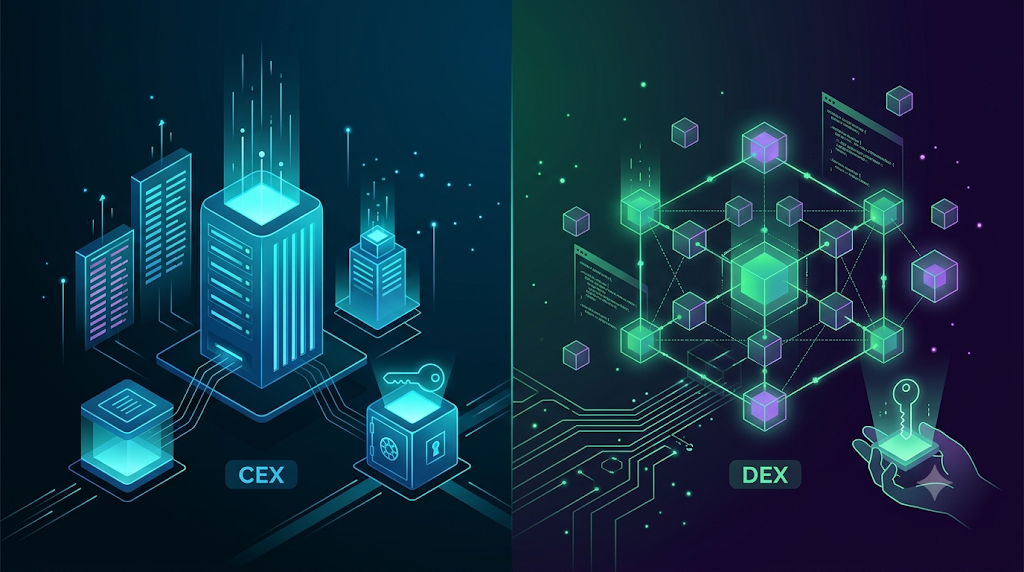
Centralized exchanges (CEX) and decentralized exchanges (DEX) are the two primary venues for trading cryptocurrencies, differing fundamentally in custody and operation. A centralized platform relies on a corporate entity holding user funds and utilizing off-chain order books. Conversely, a decentralized platform uses blockchain smart contracts and automated market makers, allowing users to trade directly from private wallets. Choosing between them depends entirely on your preference for convenience versus self-custody.
The Core Differences Between CEX and DEX Platforms
The fundamental distinction between centralized and decentralized exchanges lies entirely in asset custody and operational control. Centralized platforms require users to deposit funds into exchange-managed wallets before executing any trades. Decentralized platforms enable trustless, peer-to-peer trading directly from a user's self-custodial wallet without relinquishing asset control.
This absolute difference in custody dictates the entire user experience and risk profile. Centralized exchanges operate much like traditional equity brokerages, managing security, compliance, and backend infrastructure. Decentralized exchanges operate purely as immutable open-source code deployed on a blockchain.
Understanding these structural differences is vital for long-term risk management.
Custody and Asset Control
Centralized exchanges hold your private cryptographic keys, meaning the platform technically owns the assets and issues you an IOU on their internal database. If the exchange suffers catastrophic insolvency, your funds are completely at risk.
Decentralized exchanges completely eliminate this specific counterparty risk through direct self-custody. You connect a Web3 wallet, approve a specific blockchain transaction, and the smart contract swaps the tokens directly into your account. You retain absolute legal and physical ownership of your private keys at all times.
This self-custody model requires immense personal responsibility from the user. If you lose your wallet seed phrase while trading on a decentralized platform, no customer support team on earth can recover your lost funds.
Trading Mechanisms and Order Matching
Centralized exchanges utilize highly efficient order book matching engines to facilitate massive trading volume. These proprietary, off-chain systems record all open buy and sell limits, matching counterparties instantly. This traditional architecture allows for high-frequency algorithmic trading and execution speeds measured in mere milliseconds.
Decentralized exchanges predominantly rely on Automated Market Maker (AMM) algorithms instead of traditional order books. Users execute trades against a pre-funded liquidity pool governed by smart contracts rather than matching with a specific human counterparty.
The AMM model dictates prices dynamically based on the mathematical ratio of tokens locked in the pool. While highly innovative, this mechanism relies entirely on the underlying blockchain's block times, making it inherently slower than centralized off-chain matching engines.
Liquidity and Market Depth
Centralized exchanges command the vast majority of global crypto liquidity, heavily supported by institutional market makers. These professional trading firms provide continuous capital on both sides of the order book. This incredibly deep liquidity ensures traders can execute massive orders with minimal price impact.
Decentralized exchange liquidity relies instead on crowd-sourced capital from retail and institutional yield farmers. Anyone can deposit their personal tokens into a smart contract liquidity pool to earn trading fees. However, this liquidity frequently fractures across dozens of different, incompatible blockchain networks.
Evaluating Centralized Exchanges (CEX)
Centralized exchanges remain the primary onboarding gateway for the vast majority of cryptocurrency users globally. They offer integrated fiat currency ramps, intuitive user interfaces, and strict regulatory compliance that decentralized platforms simply cannot provide. For institutional investors and traditional retail traders, this centralized structure is absolutely mandatory.
The massive appeal of centralized platforms lies in their comprehensive service ecosystems. Beyond simple spot trading, they offer collateralized lending, margin trading, fiat off-ramps, and dedicated 24/7 customer support. This consolidation of services closely mirrors traditional banking environments.
Despite the philosophical blockchain push toward decentralization, centralized platforms processed nearly $80 trillion in trading volume throughout 2025. Their complete dominance in capital efficiency and frictionless user onboarding remains undisputed in the digital asset industry.
User Experience and Accessibility
User experience on centralized platforms is intentionally designed to mimic traditional stock brokerages flawlessly. The interfaces are highly intuitive, guiding users through account creation, fiat deposits, and initial trades seamlessly. This frictionless onboarding process is absolutely essential for driving mass retail adoption.
Decentralized platforms often present a very steep technical learning curve for new users. Interacting with a decentralized exchange requires setting up a Web3 wallet, securing a cryptographic seed phrase, and funding the wallet with native gas tokens just to pay for network fees.
Centralized exchanges abstract all of this complex blockchain architecture away from the end user. You simply log in with a standard email and password, deposit fiat currency via a credit card, and begin trading immediately.
Regulatory Compliance and Security
Centralized exchanges strictly mandate Know Your Customer (KYC) and Anti-Money Laundering (AML) identity verifications. This regulatory adherence allows them to partner securely with traditional, highly regulated banking institutions globally.
While KYC inherently removes user anonymity, it significantly reduces illicit financial activities on the platform. Institutional capital allocators strictly require this legal compliance before deploying any client funds. Centralized exchanges spend millions on dedicated legal teams to navigate complex global regulatory jurisdictions.
Security on centralized platforms relies on internal corporate protocols, offline cold storage vaults, and massive insurance funds. While localized hacks do occasionally occur, top-tier platforms heavily invest in military-grade security infrastructure to protect user deposits.
Advanced Trading Features
Advanced trading features are vastly superior and significantly more accessible on centralized exchanges. Professional traders rely heavily on complex order types like trailing stops, iceberg orders, and precise take-profit limits. Centralized matching engines process these complex conditional orders flawlessly off-chain.
High-leverage margin trading is natively integrated directly into centralized ecosystems. Users can borrow capital directly from the exchange's unified liquidity pool to amplify their market positions. This borrowing process is seamless, instantaneous, and highly capital-efficient for active day traders.
Decentralized platforms struggle immensely to replicate this advanced functionality without incurring massive blockchain network fees. While decentralized perpetuals certainly exist, centralized platforms offer a far smoother, more comprehensive suite of professional charting and rapid execution tools.
The Rise of Decentralized Exchanges (DEX)
Decentralized exchanges provide the ultimate expression of cryptocurrency's core philosophy—trustless, permissionless, and open financial infrastructure. By completely replacing corporate intermediaries with immutable code, they offer a trading environment entirely free from centralized censorship. Their market share continues to grow rapidly as users demand greater autonomy over their capital.
The complete absence of a centralized governing authority means decentralized platforms never halt trading, freeze accounts, or restrict specific geographical jurisdictions. They operate globally 24 hours a day, exactly as programmed on the underlying blockchain.
This permissionless architecture inherently allows for the immediate, unfiltered listing of new tokens. Decentralized platforms are always the first venues to trade newly launched assets, driving immense speculative retail volume.
Permissionless Trading and Anonymity
Permissionless trading mathematically guarantees that absolutely anyone with an internet connection and a compatible wallet can access the market. Decentralized exchanges explicitly do not require KYC identity verification, email registrations, or strict geographical restrictions. Users retain complete financial and personal privacy.
This total anonymity appeals heavily to traders operating in restrictive jurisdictions or those prioritizing strict data security. You trade using only a public cryptographic wallet address, keeping your real-world personal identity completely separate from your financial activities.
The permissionless nature also directly applies to Web3 project developers. Absolutely anyone can create a liquidity pool and list a new token without seeking corporate approval or paying exorbitant listing fees to a central committee.
Automated Market Makers (AMM) Explained
Automated Market Makers revolutionized decentralized trading by elegantly solving the liquidity problem without requiring order books. An AMM uses strict mathematical formulas to price assets within a specific liquidity pool. This immutable code ensures continuous pricing regardless of trade size.
When you buy a token from an AMM pool, you increase the supply of your payment token and decrease the supply of the purchased token. The algorithm automatically adjusts the price upward to mathematically reflect this new scarcity.
This automated system guarantees liquidity is always available, even for highly obscure micro-cap tokens. However, the algorithm naturally causes prices to slip dynamically based on the ratio of the trade size to the total pool size.
Smart Contract Risks and Slippage
Smart contract vulnerability represents the single most significant risk associated with utilizing decentralized exchanges. Because these platforms operate purely on open-source code, a single underlying programming flaw can be exploited by hackers. If a liquidity pool's smart contract is compromised, all deposited funds can be drained instantly.
Unlike centralized exchange hacks, there is absolutely no corporate insurance fund to reimburse victims of a smart contract exploit. The code is absolute law, and stolen funds transferred on the blockchain are virtually impossible to recover.
Slippage is another constant, daily risk on decentralized platforms. If a liquidity pool is too small, executing a large trade will significantly shift the asset's price during the transaction, resulting in a severe loss of value for the trader.
Cost Structures and Trading Fees
Centralized platforms typically utilize a highly transparent, tiered maker-taker fee model based on your 30-day trading volume. Decentralized platforms charge algorithmic swap fees permanently combined with highly variable underlying blockchain network gas costs.
High-frequency algorithmic traders heavily scrutinize these exact costs, as excessive fees can quickly erode narrow profit margins. Centralized platforms offer massive fee discounts for huge institutional volume, making them the mathematically ideal choice for heavy day trading.
Conversely, decentralized transaction fees depend entirely on the specific blockchain network's current congestion levels. While Layer-2 networks have drastically reduced on-chain costs in 2026, severe network spikes can still occasionally make small decentralized trades economically unviable.
Maker and Taker Fees on CEXs
Centralized exchanges rely entirely on a straightforward maker-taker fee schedule to heavily incentivize deep order book liquidity. Makers, who place limit orders that rest passively on the order book, provide liquidity and are directly rewarded with much lower fees. Takers, who execute market orders that immediately remove liquidity, pay a significantly higher premium.
Standard centralized trading fees generally range from a very competitive 0.1% to 0.2% per spot trade. Furthermore, holding the exchange's native utility token directly in your account often unlocks substantial additional fee reductions.
High-volume institutional traders can easily negotiate their taker fees down to near zero through dedicated VIP tiers. This highly predictable, volume-based discount structure makes centralized platforms mathematically superior for massive, high-frequency execution strategies.
Gas Fees and Network Costs on DEXs
Trading on a decentralized exchange absolutely always incurs a mandatory blockchain network fee, commonly known as gas. Because every single trade is an on-chain transaction executed by a smart contract, you must pay the network validators to physically process your swap.
During periods of extreme high market volatility, gas fees on the Ethereum mainnet can aggressively spike to hundreds of dollars per transaction. This massive cost renders small retail trades on decentralized platforms completely and totally unprofitable.
Fortunately, the massive proliferation of Layer-2 scaling solutions in 2026 has successfully mitigated this exact issue. Trading natively on these decentralized Layer-2 protocols reduces gas fees to mere cents, dramatically improving the overall user experience.
Liquidity Provider Rewards and Swap Fees
Decentralized exchanges universally charge a base swap fee, typically exactly 0.3%, which is distributed directly to the users providing liquidity to the pool. This fee mechanism financially incentivizes capital formation on the platform without ever requiring a centralized corporate market maker.
As a retail trader, this 0.3% static fee is generally slightly higher than the base tier on a premier centralized exchange. However, if you choose to act as a liquidity provider, you earn a continuous passive yield generated directly from these exact trading fees.
This distinct, decentralized economic model permanently turns regular users into highly active market makers. Participating in these decentralized liquidity pools introduces entirely new yield-generation strategies that simply do not technically exist within traditional centralized exchange architectures.
Security Architectures and Risk Profiles
The security architectures of centralized and decentralized exchanges represent fundamentally opposed philosophies regarding absolute risk management. Centralized platforms rely on opacity, massive internal corporate security teams, and heavy insurance backing to protect pooled user funds. Decentralized platforms rely entirely on absolute transparency, immutable public code, and decentralized node consensus to secure network transactions.
A centralized exchange failure typically stems from severe corporate malfeasance, poor internal controls, or highly targeted cyber attacks on hot wallets. A decentralized failure almost exclusively results from a critical mathematical flaw hidden within the smart contract code.
Traders must honestly assess their own personal risk tolerance. Do you trust a heavily regulated corporate entity to guard your assets, or do you strictly trust mathematical code and your own ability to secure your private keys?
Centralized Exchange Vulnerabilities
Centralized exchanges present a massive, highly lucrative target for sophisticated global hacking syndicates. Because these platforms pool billions of dollars in retail user funds into centralized hot and cold wallets, successfully penetrating their security yields massive financial rewards.
Furthermore, centralized platforms are inherently susceptible to internal corporate fraud and severe financial mismanagement. To aggressively mitigate these specific risks, top centralized exchanges in 2026 absolutely mandate cryptographically verifiable Proof of Reserves. This highly transparent accounting securely proves to the public that the exchange physically holds the exact assets required to completely cover all user liabilities.
Decentralized Smart Contract Exploits
Decentralized exchanges are completely and entirely immune to corporate embezzlement, but they face constant, severe threats from smart contract exploits. Hackers endlessly and meticulously scrutinize open-source DEX code searching for logical vulnerabilities, flash loan attack vectors, or complex reentrancy bugs.
If an exploit is successfully discovered, attackers can drain the entire liquidity pool in mere seconds before developers can even pause the contract.
To actively defend against this, highly reputable decentralized exchanges undergo rigorous, multi-stage security audits from premier blockchain security firms. However, an audit is never an absolute guarantee of total safety; it merely reduces the statistical probability of a catastrophic exploit.
Managing Personal Wallet Security
Trading actively on a decentralized exchange violently shifts the entire heavy burden of security directly onto the individual user. Your personal Web3 wallet is the absolute only gateway to your funds. If you accidentally approve a malicious smart contract transaction, your assets can be irreversibly drained instantly.
Highly sophisticated phishing attacks are incredibly common in the decentralized Web3 space. Users are frequently tricked into connecting their secure wallets to fake exchange websites designed to perfectly and flawlessly mimic legitimate decentralized protocols.
Utilizing hardware cold storage wallets in conjunction with decentralized exchanges is the absolute safest operational security practice available. This ensures your private cryptographic keys remain strictly offline, demanding physical, real-world confirmation for every single on-chain smart contract interaction.
Conclusion
The comparison between centralized exchanges and decentralized exchanges highlights two fundamentally different philosophies for navigating digital asset markets. Centralized platforms prioritize convenience, deep institutional liquidity, and regulatory compliance, making them the absolute best choice for fiat onboarding and high-frequency professional trading. Decentralized exchanges offer trustless, self-custodial trading environments that eliminate corporate counterparty risk. This appeals heavily to privacy-focused users and early-stage token speculators.
Market data from 2026 clearly demonstrates that both models are thriving and increasingly complementary. While centralized exchanges continue to process the vast majority of global volume, decentralized platforms have permanently secured double-digit market share. Traders no longer need to choose just one model.
By balancing the strengths of each system, modern traders can effectively navigate the evolving complexities of the cryptocurrency ecosystem.
FAQs
Do I need a Web3 wallet to use a centralized exchange?
No, centralized exchanges provide their own integrated custodial wallets for your account. You simply deposit fiat currency or transfer crypto directly into the exchange's specific deposit addresses, allowing you to trade immediately without managing a personal Web3 wallet or private keys.
Why is slippage usually worse on a decentralized exchange?
Slippage is worse on decentralized exchanges because they rely on algorithmic liquidity pools rather than deep, institutional order books. If your trade size is large relative to the total tokens locked in the pool, the mathematical formula automatically shifts the price aggressively against you during the swap.
Can a decentralized exchange freeze my trading account?
A true decentralized exchange cannot freeze your account, block your trades, or confiscate your funds. Because the platform operates purely via immutable smart contracts on the blockchain, there is no central authority with the administrative power to restrict your specific wallet address.
Are trading fees higher on a CEX or a DEX?
Trading fees are highly situational, but decentralized exchanges generally incur higher total costs due to mandatory blockchain gas network fees added on top of the base swap fee. Centralized exchanges typically offer lower, predictable base fees that can be further discounted through high trading volume tiers.
How do I convert my crypto back to fiat cash on a DEX?
You cannot directly convert cryptocurrency back to traditional fiat cash on a decentralized exchange. Because decentralized platforms do not integrate with traditional banking systems or perform KYC checks, you must transfer your crypto to a centralized exchange to sell it for fiat and withdraw to your bank.
Disclaimer:This content is for informational purposes only and does not constitute investment advice. Cryptocurrency investments carry risk. Please do your own research (DYOR).