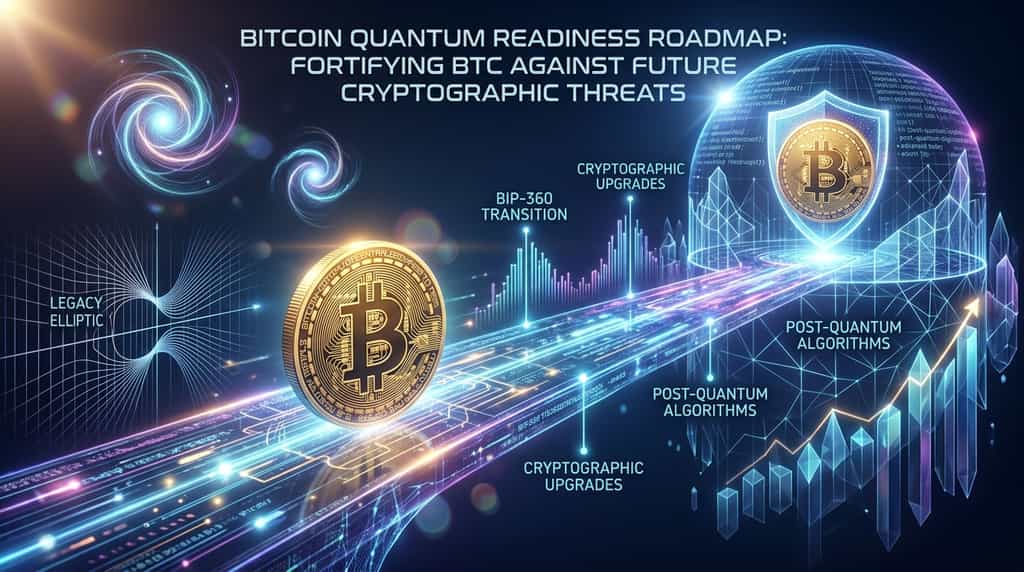
Bitcoin Quantum Computing Roadmap: Could Quantum Resistance Become the Next BTC Bullish Catalyst?
Bitcoin Quantum Computing Roadmap: Could Quantum Resistance Become the Next BTC Bullish Catalyst?
Introduction
Could Bitcoin's response to quantum computing become a catalyst for the next BTC rally? The answer depends less on an imminent quantum attack than on whether Bitcoin can demonstrate that its security model is prepared for future cryptographic threats. Quantum computers powerful enough to derive Bitcoin private keys from exposed public keys are not established as an immediate threat, but developers are already exploring ways to strengthen the network against that possibility.
In 2026, Bitcoin Improvement Proposals (BIPs) such as BIP-360and BIP-361 illustrate two different parts of the discussion: introducing quantum-resistant transaction structures and planning how users might migrate away from vulnerable signature systems. Both remain proposals, not activated Bitcoin upgrades.
A credible Bitcoin quantum computing roadmap could strengthen long-term confidence in BTC, but it would not guarantee a price rally. The market impact will depend on technical progress, community consensus, implementation costs, and whether investors view the transition as manageable or destabilizing.
Why Could Quantum Computing Threaten Bitcoin's Security?
Quantum computing could threaten Bitcoin by undermining the elliptic-curve cryptography used to authorize transactions, rather than by simply making Bitcoin mining faster. Bitcoin relies on digital signatures to prove that a spender controls the private key associated with coins. A sufficiently capable cryptographically relevant quantum computer could potentially use Shor's algorithm to derive a private key from its corresponding public key, allowing an attacker to forge a valid signature.
The distinction between public and private keys is central to understanding the risk. Bitcoin addresses do not all expose public keys in the same way. Some output types conceal the public key behind a cryptographic hash until the coins are spent, while other types expose public-key information more directly or after a transaction. Once a public key is exposed, a future quantum attacker could theoretically attempt to recover the corresponding private key. Reusing addresses or leaving funds in output types with exposed public keys can increase long-term exposure, although the practical risk depends on the output type and attack capabilities.
Quantum computing does not automatically break Bitcoin's hashing functions or make every BTC wallet instantly vulnerable. The principal concern is the potential failure of the digital-signature schemes that protect ownership. Bitcoin's proof-of-work mining also relies on hashing, which faces a different quantum-computing threat model. Grover's algorithm could theoretically provide a quadratic speedup for certain search problems, but this is not equivalent to instantly defeating Bitcoin's mining process or signature security.
The official Bitcoin BIP-360 specification describes quantum key recovery as a concern associated with cryptographically relevant quantum computers and proposes a transaction-output structure designed to reduce certain exposure risks. It does not claim that such a computer already exists or establish a date when Bitcoin will become vulnerable. That distinction matters: the current issue is long-term cryptographic preparedness, not proof that an attack is imminent.
What Is Bitcoin's Quantum Computing Roadmap in 2026?
Bitcoin's quantum-resistance roadmap is still under development, with draft proposals exploring how the network could support safer transaction types and eventually migrate users away from vulnerable cryptography. There is no single, officially adopted timeline that commits the Bitcoin network to a complete quantum-resistant upgrade. Instead, proposals must undergo technical review, community discussion, implementation, and ultimately a Bitcoin consensus process.
Two proposals help explain the current direction.
How Does BIP-360 Aim to Protect Bitcoin?
BIP-360 proposes Pay-to-Merkle-Root (P2MR), a transaction-output type designed to reduce exposure to certain quantum attacks while preserving compatibility with elements of Bitcoin's existing script system. According to the BIP-360 specification in the Bitcoin Improvement Proposals repository, P2MR uses script trees and tapscript to provide resistance to long-exposure attacks against elliptic-curve cryptography.
The proposal is a preparatory step, not a complete quantum-proof solution. Its design can reduce the risk associated with public keys remaining exposed over time, but it does not independently protect against every possible attack. In particular, a future quantum attacker might target public-key information revealed temporarily while a transaction is waiting for confirmation. Comprehensive protection against such short-exposure attacks could require post-quantum signature schemes and additional protocol changes.
BIP-360 also involves trade-offs. P2MR disables the Taproot key-path spending option in favor of script-based spending, meaning wallets and infrastructure would need to support the relevant transaction structure. Its purpose is to create an upgrade path that could accommodate future quantum-resistant signatures without requiring Bitcoin to adopt a complete new cryptographic system immediately.
What Would BIP-361 Change?
BIP-361, titled "Post Quantum Migration and Legacy Signature Sunset," explores a more extensive transition. The draft proposal discusses a staged approach that would encourage users to migrate to post-quantum transaction types and eventually restrict legacy ECDSA and Schnorr signatures.
The proposal describes a potential sequence in which sending funds to quantum-resistant outputs becomes the initial priority, followed by a later phase that tightens the rules for legacy signatures. Its draft timing is conditional on activation and should not be treated as an adopted Bitcoin upgrade schedule. The proposal also raises difficult questions about coins that remain in vulnerable outputs, including whether owners could lose access if they fail to migrate and how the network should handle funds whose owners cannot be identified.
These issues make migration more complicated than simply changing a wallet setting. Bitcoin developers, node operators, miners, exchanges, custodians, and individual holders would need to coordinate around any consensus-changing upgrade. The Bitcoin BIPs repository makes clear that publishing a proposal does not mean it has community consensus or is about to be activated.
Could Bitcoin Quantum Resistance Trigger the Next BTC Rally?
A credible quantum-resistance upgrade could support a bullish Bitcoin narrative by reducing a long-term security concern, strengthening institutional confidence, and demonstrating the network's capacity to evolve. However, a roadmap announcement alone would not establish that BTC price is undervalued or guarantee a rally. The strongest positive catalyst would be demonstrable technical progress that investors believe can be implemented without undermining Bitcoin's core properties.
Several mechanisms could support a more constructive market outlook. First, a technically credible migration plan could reduce uncertainty about Bitcoin's long-term security. Institutional investors and custodians assessing BTC over multi-year horizons may place greater value on evidence that the network can respond to emerging cryptographic risks. Second, wallet and infrastructure upgrades could create a clearer process for protecting funds, making the risk easier to evaluate and manage. Third, a successful transition could reinforce the view that Bitcoin's development process can address major challenges while maintaining decentralization and predictable monetary rules.
Yet these potential benefits should be distinguished from near-term price drivers. BTC can move because of liquidity, interest-rate expectations, institutional demand, derivatives positioning, regulatory developments, and broader risk sentiment. Quantum-resistance progress would compete with those factors rather than replace them. A technically important proposal may have little immediate market effect if investors believe the threat remains distant, while an alarming headline could cause volatility even when no practical attack capability has been demonstrated.
The rally thesis therefore rests on execution. A draft becoming more mature, an upgrade gaining broad support, and major wallet providers implementing compatible technology are more meaningful milestones than speculation about a future "quantum breakthrough." Investors should also consider the possibility that a migration debate could temporarily increase uncertainty if stakeholders disagree about timelines, implementation costs, or the treatment of funds that remain in legacy outputs.
Beyond the Headlines: What KuCoin 5.0 Means for You
Market news moves fast — but where you act on it matters just as much. This October, KuCoin launches KuCoin 5.0, transforming KuCoin into a rebuilt platform. Here's what actually changes for you:
One account for everything. Older platforms split your money across separate "spot," "margin," and "futures" accounts and expected you to understand why. KuCoin 5.0's unified accountremoves that entirely — deposit once, and everything is simply there (only available to VIPs for now).
Stocks, indices, and commodities. KuCoin 5.0 expands beyond crypto into global markets. When crypto chops sideways and equities rally (or the reverse), you rotate in minutes instead of opening a brokerage account and waiting days for fiat rails.
Real-world assets (RWA). Tokenized exposure to traditional assets like commodities, right inside your crypto account. One of the fastest-growing segments in global finance is no longer reserved for institutions — you access it from the same balance you trade with.
Earn while you learn. Not ready to trade? KCUSDlets your stablecoins earn daily, auto-compounding interest. The lowest-stress way to put your idle deposit to work for 4% yield.
An AI assistant in plain language. Ask questions, get market context, understand what you're looking at — built into the platform, no jargon required.
An app that doesn't overwhelm. Faster, cleaner, and consistent — intuitive from the first tap, not after a tutorial.
Safety you can check, not just trust. A MiCAR-licensed EU entity, Proof of Reserves you can verify yourself, and internationally certified security (SOC 2 Type II, ISO 27001:2022).
Create your account in minutes — and start on the platform built for where crypto is going, not where it's been.
Conclusion
Bitcoin's quantum computing roadmap could become a long-term bullish catalyst if developers establish a credible, secure, and broadly supported path toward quantum-resistant transactions. BIP-360 explores a transaction structure designed to reduce certain public-key exposure risks, while BIP-361 discusses a possible staged migration away from legacy signatures. Both are proposals, and neither should be confused with a fully adopted network upgrade.
The potential upside comes from reducing uncertainty about Bitcoin's future security and demonstrating that the network can adapt to evolving cryptographic threats. That progress could strengthen confidence among long-term holders, custodians, and institutions. However, a successful outcome depends on rigorous technical review, consensus, wallet and exchange support, and a practical migration process for existing BTC.
For investors, the key is to track measurable milestones rather than speculate about an exact quantum-computing deadline. The timing of a practical attack remains uncertain, and quantum resistance is only one of many factors that influence Bitcoin's valuation. Even substantial development progress cannot guarantee a BTC rally. A more defensible investment thesis considers technical readiness alongside adoption, liquidity, macroeconomic conditions, and personal risk tolerance.
FAQs
1. Will quantum computers be able to hack Bitcoin in 2026?
There is no established evidence that a quantum computer can currently derive Bitcoin private keys at the scale needed to conduct a practical network-wide attack. The risk is a future possibility that developers are researching, not a confirmed capability that makes all BTC immediately unsafe.
2. Would quantum computing allow someone to create unlimited Bitcoin?
No. A quantum attack on digital signatures would concern the ability to authorize unauthorized spending from vulnerable outputs. It would not automatically change Bitcoin's supply rules or allow an attacker to create BTC beyond the protocol's issuance schedule.
3. Could quantum-resistant cryptography make Bitcoin transactions more expensive?
It could affect transaction costs because some post-quantum signature schemes may use larger signatures or require different transaction structures. The actual impact on fees and network capacity will depend on the cryptographic approach and any changes ultimately adopted.
Disclaimer: This article is for informational purposes only and does not constitute financial, legal, or investment advice. Always conduct your own research before interacting with digital assets.