



Anthropic and OpenAI Crack Down on Private Share Trading: What It Means for Pre-IPO Investors in 2026
2026/05/13 04:06:02
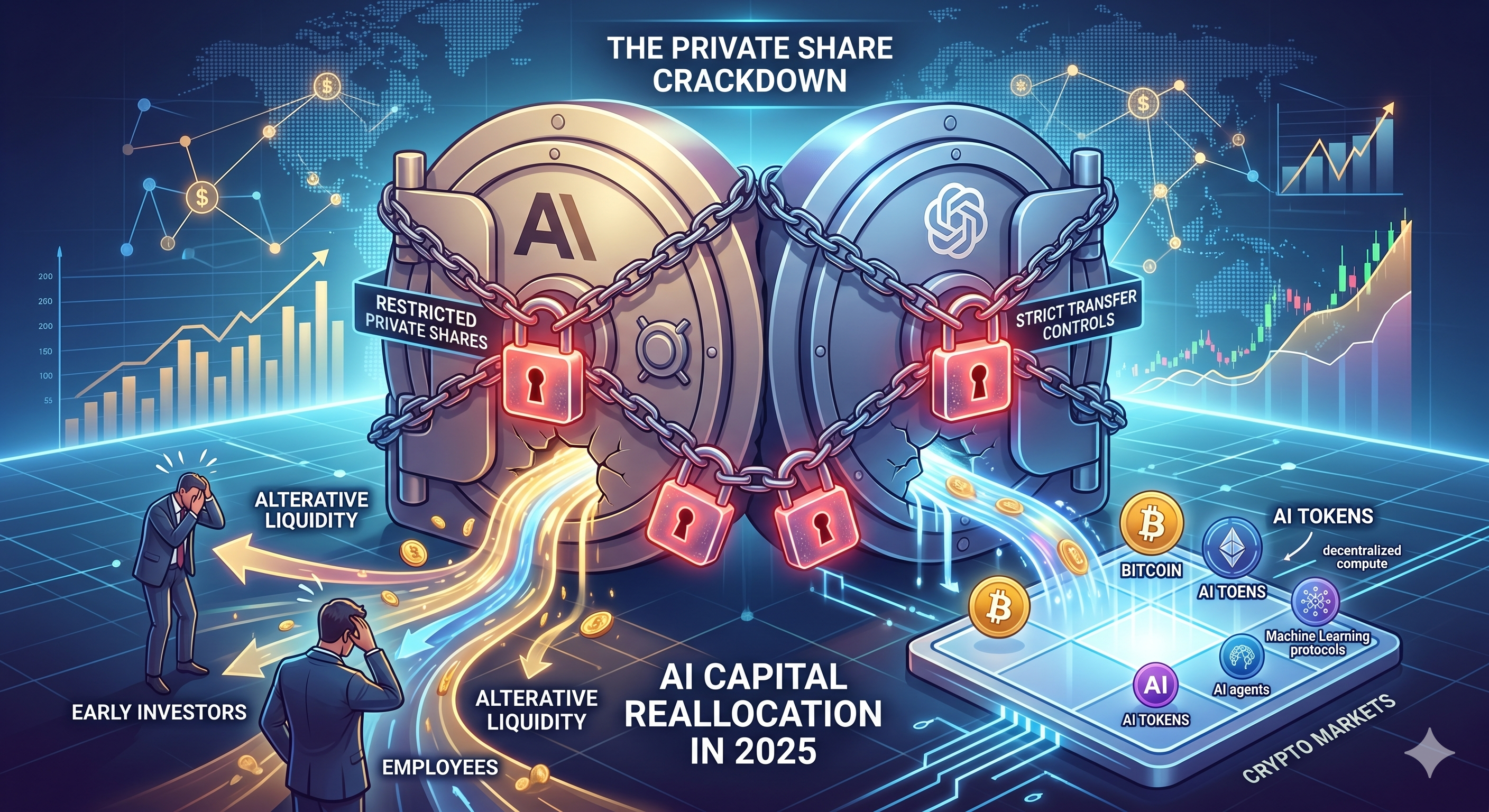
Anthropic and OpenAI have both moved aggressively in 2025 to restrict employees and early investors from selling private shares on secondary markets — a shift that could reshape how pre-IPO wealth flows into alternative assets like crypto. According to recent reports, Anthropic has implemented strict transfer restrictions on its equity, while OpenAI has restructured into a for-profit entity with tighter share controls. These crackdowns lock up billions of dollars in paper wealth, forcing investors and employees to rethink liquidity strategies.
To understand the full context, the below are recommended readings:
-
AI Security Innovations explores how Anthropic's technology is advancing beyond finance,
-
AI Coding Tools examines the competitive landscape between OpenAI and Anthropic for developers,
-
and AI IPO Crypto Impact analyzes how eventual public listings could reshape crypto market liquidity.
Both companies are restricting secondary share trading primarily to control their cap tables, protect valuations, and prevent speculative frenzies ahead of potential IPOs. This is not a routine administrative decision — it reflects a strategic pivot by two of the world's most valuable private AI companies.
Anthropic's Approach to Share Restrictions
Anthropic has implemented what insiders describe as near-total restrictions on private share transfers. According to reporting in May 2025, the company has tightened its right of first refusal (ROFR) policies, effectively giving Anthropic veto power over any secondary market transaction. Employees who wish to sell shares must first offer them back to the company at a price Anthropic determines — often below what secondary market buyers would pay.
The reasoning is straightforward. Anthropic, valued at approximately $61.5 billion following its latest funding round in early 2025 based on data from multiple venture capital trackers, wants to prevent outside speculators from accumulating significant stakes. Uncontrolled secondary trading could introduce hostile or misaligned shareholders, complicate future fundraising rounds, and create valuation discrepancies that undermine investor confidence.
OpenAI's Structural Overhaul
OpenAI has taken an even more dramatic step. The company announced its transition from a capped-profit structure to a full for-profit corporation in 2025, a move that fundamentally changes how equity is held and traded. As part of this restructuring, existing share agreements are being renegotiated, and secondary market sales have been effectively frozen during the transition period.
According to reports circulating in May 2025, OpenAI's board has also introduced extended lock-up provisions for employees, requiring them to hold shares for longer periods before any liquidity event. This is partly a response to the chaotic secondary market activity that saw OpenAI shares trading at wildly different valuations — sometimes with spreads of 20-30% between buyers and sellers on platforms like Forge Global and EquityZen.
The Broader Trend in Private Tech Markets
This crackdown is not isolated to AI companies. The trend reflects a broader shift in how late-stage private companies manage their equity. Companies like SpaceX have long maintained strict ROFR policies, and Stripe implemented similar restrictions before its eventual moves toward public markets. The difference now is scale — Anthropic and OpenAI together represent over $350 billion in combined private market valuation based on 2025 estimates, making their share restriction policies consequential for the entire secondary market ecosystem.
The secondary market for private company shares operates as an informal — and often opaque — trading ecosystem where employees, early investors, and accredited buyers negotiate transactions outside traditional stock exchanges. Understanding this market is essential to grasping why the Anthropic and OpenAI crackdowns matter.
Key Platforms and Mechanisms
Platforms like Forge Global, EquityZen, Hiive, and Nasdaq Private Market serve as intermediaries, matching sellers (typically employees or early-stage investors) with accredited buyers. These platforms handle compliance, escrow, and — critically — the company approval process. A typical transaction involves several steps:
|
Step
|
Description
|
Typical Timeline
|
|
Listing
|
Seller lists shares with price expectation
|
1-2 days
|
|
Matching
|
Platform identifies qualified buyers
|
1-4 weeks
|
|
Company Approval
|
Issuing company exercises or waives ROFR
|
2-8 weeks
|
|
Settlement
|
Legal transfer and payment processing
|
1-2 weeks
|
The company approval step is where Anthropic and OpenAI are now exerting maximum control. By aggressively exercising their ROFR rights or simply refusing to approve transfers, they can effectively shut down secondary trading of their shares.
Valuation Challenges in Private Markets
Private share prices on secondary markets often diverge significantly from official company valuations. A company might raise its latest round at a $60 billion valuation, but secondary market shares could trade at a 15-25% discount — or, in cases of extreme demand, at a premium. This price discovery problem creates arbitrage opportunities but also significant risks for buyers who may overpay for illiquid assets.
According to data from secondary market trackers in early 2025, Anthropic shares were trading at approximately 10-15% below the company's last official valuation, while OpenAI shares showed more volatile pricing due to the structural uncertainty around its for-profit conversion.
Pre-IPO investors face a significantly more challenging environment as a direct result of these restrictions. The core impact is reduced liquidity, longer holding periods, and increased uncertainty about exit timelines.
Liquidity Squeeze for Early Investors
Investors who entered Anthropic or OpenAI at earlier valuations — some at valuations as low as $1-4 billion — are sitting on enormous paper gains but now have fewer options to realize those gains. The share restrictions mean that even investors who want to take partial profits must either wait for a company-sanctioned liquidity event (such as a tender offer) or hold until an IPO.
This liquidity squeeze has cascading effects. Fund managers who allocated capital to these companies may face pressure from their own limited partners (LPs) who expected returns within a certain timeframe. Some venture funds with exposure to Anthropic or OpenAI may need to adjust their distribution timelines, which in turn affects how those LPs allocate capital elsewhere — including into crypto markets.
Impact on Employee Compensation and Wealth
For employees, the restrictions are particularly consequential. Many AI engineers and researchers at Anthropic and OpenAI accepted below-market salaries in exchange for equity that they expected to monetize through secondary sales. With that avenue now restricted, some employees are effectively locked into golden handcuffs — unable to access the wealth they have accumulated on paper.
This dynamic has already begun affecting talent retention and recruitment in the AI sector. Competing companies and crypto projects can potentially attract talent by offering more liquid compensation structures, including token-based incentives that vest and become tradeable on much shorter timelines.
Risk Reassessment for Secondary Market Buyers
Buyers who purchased Anthropic or OpenAI shares on secondary markets before the restrictions were tightened now face additional risk. Their shares may be subject to new transfer restrictions they did not anticipate, and the timeline to any liquidity event remains uncertain. This has introduced a chilling effect on the broader secondary market for AI company shares, with transaction volumes declining in Q1 2025 according to multiple market observers.
The restrictions on private AI share trading could redirect significant capital flows toward crypto markets — particularly AI-themed tokens and Bitcoin — as investors seek alternative exposure to the AI growth narrative.
The Capital Redirection Thesis
When traditional paths to AI investment become restricted, capital tends to find alternative routes. Crypto markets offer several AI-adjacent investment vehicles that do not require company approval or accredited investor status. AI-themed tokens — including those associated with decentralized compute networks, AI agent platforms, and machine learning protocols — have already seen increased interest in 2025.
Based on data from CoinGecko in early 2025, the combined market capitalization of AI-themed crypto tokens exceeded $25 billion, with notable growth in projects focused on decentralized AI infrastructure. This growth correlates with the increasing difficulty of accessing private AI company equity through traditional channels.
Bitcoin as an Alternative Store of Value
For high-net-worth individuals and fund managers who previously allocated to pre-IPO AI shares, Bitcoin represents a liquid alternative that shares some characteristics with growth-stage tech investments — namely, asymmetric upside potential and a technology-driven narrative. The key advantage Bitcoin offers over private shares is immediate liquidity. A Bitcoin position can be entered or exited in minutes, while private share transactions take weeks or months — if they are approved at all.
According to market data from May 2025, Bitcoin has been trading above $100,000, and institutional flows into Bitcoin ETFs have remained strong. Some market analysts have drawn a direct line between restricted private market liquidity and increased institutional interest in crypto as an alternative asset class.
AI Tokens vs. AI Equity — A Comparison
Investors weighing AI tokens against private AI equity face distinct trade-offs:
|
Factor
|
AI Tokens
|
Private AI Equity
|
|
Liquidity
|
High — 24/7 trading
|
Very Low — restricted transfers
|
|
Minimum Investment
|
Often under $100
|
Typically $50,000-$250,000+
|
|
Regulatory Clarity
|
Evolving
|
Established (securities law)
|
|
Upside Potential
|
High but volatile
|
High with clearer fundamentals
|
|
Company Approval Needed
|
No
|
Yes (ROFR)
|
|
Transparency
|
On-chain data available
|
Limited to company disclosures
|
This comparison highlights why some investors are shifting attention toward crypto markets as the private share landscape becomes more restrictive.
Anthropic and OpenAI's crackdown on private share trading marks a pivotal shift in how the world's most valuable AI companies manage their equity and investor relations. By restricting secondary market transactions, both companies are prioritizing cap table control and valuation stability over employee and investor liquidity — a strategy that creates significant short-term pain for shareholders but may support stronger long-term outcomes.
For pre-IPO investors, the immediate impact is clear — reduced liquidity, longer holding periods, and increased uncertainty about exit timelines. For the broader market, the restrictions are redirecting capital toward alternative investment vehicles, with crypto markets and AI-themed tokens emerging as primary beneficiaries of this capital reallocation.
The eventual IPOs of Anthropic and OpenAI could unlock tens of billions of dollars in previously illiquid wealth, with meaningful implications for crypto market liquidity. Until then, investors seeking AI exposure are increasingly turning to liquid alternatives — including Bitcoin and AI tokens available on platforms like KuCoin — that offer the flexibility and accessibility that private share markets no longer provide.
The intersection of AI and crypto continues to deepen, and the private share crackdown is accelerating this convergence in ways that will shape both industries for years to come.
Can I still buy Anthropic or OpenAI shares on secondary markets?
Technically, some platforms still list these shares, but the approval rate for transfers has dropped significantly in 2025. Both companies are aggressively exercising their right of first refusal, meaning most attempted transactions are blocked or bought back by the company at its own determined price. Prospective buyers should expect long delays and a high probability of transaction failure.
How do private share restrictions differ from public stock lock-up periods?
Private share restrictions are imposed by the company and can be changed unilaterally, while public stock lock-up periods are contractual agreements tied to an IPO with defined expiration dates. Private restrictions have no guaranteed end date — they persist until the company decides to allow transfers, conducts a tender offer, or goes public. Public lock-ups typically last 90-180 days after an IPO and then expire automatically.
Are there legal challenges to these share trading restrictions?
Some shareholders have explored legal options, but the restrictions are generally enforceable under existing securities law. Private companies have broad authority to impose transfer restrictions on their equity, and most employee stock agreements include ROFR provisions that give the company control over secondary sales. However, if restrictions are applied retroactively to shares that were previously freely transferable, legal challenges become more viable.
What are tender offers and how do they relate to these restrictions?
Tender offers are company-organized buyback events where the company offers to purchase shares from employees and investors at a set price. Both Anthropic and OpenAI have conducted tender offers in the past as a controlled alternative to secondary market trading. These events allow the company to provide selective liquidity while maintaining control over who holds its equity and at what valuation shares change hands.
Could tokenized securities solve the private share liquidity problem?
Tokenized securities — blockchain-based representations of private company equity — could theoretically provide liquidity while maintaining compliance with securities regulations. Several platforms are developing compliant tokenization frameworks, but adoption remains limited as of 2025. The main barriers are regulatory uncertainty, company willingness to adopt blockchain-based cap table management, and the need for standardized smart contract frameworks that satisfy both SEC requirements and company transfer restrictions.