

Anthropic AI Economic Scenarios: How AI Could Add Over $10 Trillion to US GDP by 2030
Introduction
Could artificial intelligence lift U.S. output by more than $10 trillion within four years? According to Anthropic’s official economic scenarios, the answer is yes in the most aggressive case: 2030 GDP reaches $44.4 trillion at 2025 price levels, 32.4% above a no-AI path. That gap is larger than $10 trillion.
Anthropic’s Economics team models the U.S. economy as millions of tasks drawn from the Department of Labor’s O*NET taxonomy. AI can leave a task unchanged, augment it, automate it, or create a new one. Three scenarios — modest, substantial, and extreme — turn those task shifts into estimates for GDP, jobs, wages, and the labor share of income.
The model is not a forecast. It is a map of what different capability and adoption paths imply. Typical survey answers from more than 10,000 Americans sit near the substantial case, not the extreme one.
What Are Anthropic’s Three AI Economic Scenarios?
Anthropic highlights three futures that differ by how capable AI becomes and how fast firms and workers adopt it.
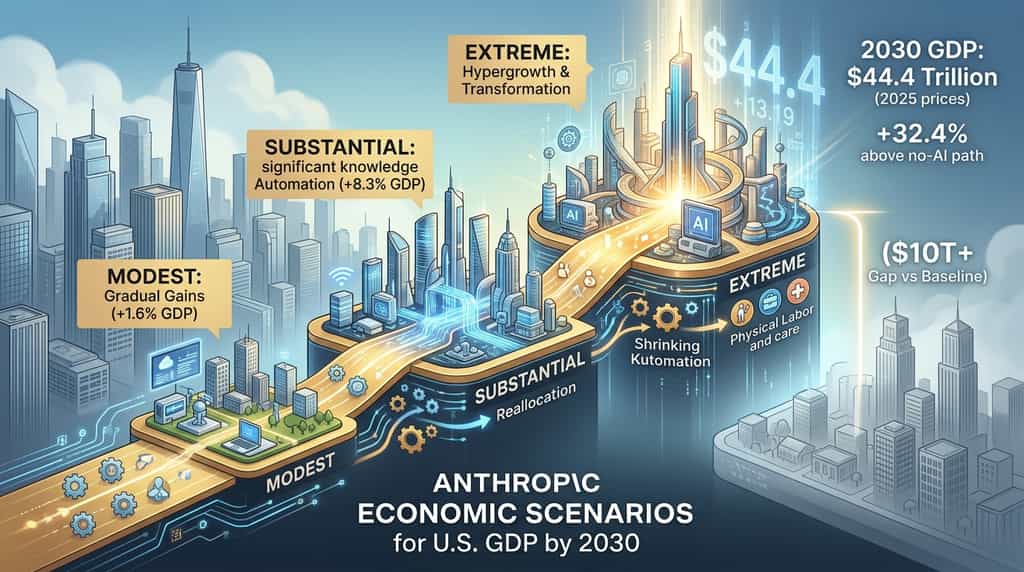
The modest scenario treats AI like the internet: real gains arrive gradually and stay inside historical norms. 2030 GDP is $34.1 trillion at 2025 prices, only 1.6% above a no-AI baseline.
The substantial scenario assumes AI can perform half of knowledge work by 2030, most of it autonomously, but adoption stays incomplete. GDP reaches $36.3 trillion, 8.3% above the no-AI path, and growth runs at about twice its normal rate.
The extreme scenario assumes AI is more productive than humans on the vast majority of knowledge-work tasks, does nearly all of them autonomously, and creates almost no new knowledge tasks for people. That path likely needs recursively self-improving systems and fast adoption. Annual GDP growth reaches about 15%, the economy doubles every 4.5 years, and 2030 GDP hits $44.4 trillion — 32.4% above the no-AI path.
Those figures come from Anthropic’s published scenario explorer and companion technical report. GDP levels are stated at 2025 price levels so comparisons isolate real activity rather than inflation.
How Does the Task-Based Model Turn AI Into GDP?
The model starts from a simple claim: the economy is made of tasks.
Every occupation is a bundle of tasks. A nurse checks patients, draws blood, charts vitals, orders supplies, and talks through diagnoses. Some of those tasks stay human-only. Some get faster with AI. Some can be fully automated. New tasks appear, such as reviewing an AI care plan.
Anthropic scales those micro changes across millions of daily task instances. Today, adding up every instance of work performed in the United States produces more than $30 trillion of value. The official size of the economy is already larger in current dollars. According to Joint Economic Committee figures based on BEA data, current-dollar U.S. GDP stood at $32.486 trillion in the second quarter of 2026. According to the U.S. Bureau of Economic Analysis, real GDP rose at a 1.5% annual rate in that quarter after 2.1% in the first quarter.
The model’s 2030 levels are not the same as today’s current-dollar GDP. They are scenario outputs at 2025 prices. The important comparison is the gap versus a no-AI path: +1.6%, +8.3%, or +32.4%.
Five inputs drive the results: what tasks AI can do, how widely people use it, how much it does without a human in the loop, how much more productive it makes remaining work, and how long displaced workers take to find new jobs.
What Happens to US GDP Growth in Each Scenario?
AI raises GDP in every scenario. The scale is the difference.
In the modest case, the 2030 economy is only 1.6% larger than it would have been without AI. Growth stays close to historical technology waves. AI touches a small share of tasks — about 4% across the economy in supporting write-ups of the same model — so macro data barely move.
In the substantial case, 2030 GDP is 8.3% higher. Growth over the year to 2030 reaches about 5.4% in the technical discussion of the model, faster than typical recent years and comparable to the late-1990s peak. Knowledge work is the engine. AI can handle half of it, but most knowledge tasks are still done without AI.
In the extreme case, 2030 GDP is 32.4% higher. Growth hits about 15.4% a year. That is the path that adds more than $10 trillion relative to a no-AI baseline at 2025 prices. The extra output comes from high autonomy, high productivity, and little creation of new knowledge tasks for humans.
Public expectations sit in the middle. Anthropic’s August survey of more than 10,000 Americans produced typical answers that imply GDP about 10% higher by 2030 and unemployment around 5%. About 10% of respondents line up with the extreme scenario.
How Would AI Change Jobs and Unemployment by 2030?
Job reallocation rises with the strength of the scenario. Unemployment stays inside historical ranges except in the extreme case.
There is always labor-market churn. Most job seekers find work in a few months in normal times. The model’s problem is occupation switching. Knowledge workers may need to move into roles less exposed to AI, such as nursing, electrical work, or construction. That switch is slow. Skills, licensing, and preferences all delay it.
In the modest scenario, cognitive employment falls only about 0.5% from mid-2026 levels. Overall unemployment is about 3.9% versus a 3.8% no-AI baseline. The labor market looks familiar.
In the substantial scenario, cognitive employment falls about 3.9% from mid-2026 levels. Economy-wide unemployment reaches about 4.6%. Knowledge-work unemployment rises while unemployment in other occupations falls.
In the extreme scenario, cognitive employment falls about 21.5% from mid-2026 levels. Unemployment rises beyond typical recession levels. Supporting descriptions of the model put knowledge-worker unemployment near 18% in that tail case. Demand shifts toward occupations AI does not automate. The number of knowledge jobs shrinks from 2026 to 2030 while other jobs expand. The bottleneck is how fast people can move.
What Happens to Wages for Knowledge Workers Versus Other Occupations?
Average wages rise in all three scenarios. The gains concentrate outside knowledge work.
Knowledge-work demand falls as AI takes more of those tasks. That puts downward pressure on knowledge wages. At the same time, higher productivity in design, permitting, logistics, and planning can raise demand for physical work. Construction, care, and other less-exposed jobs bid up pay.
In the modest scenario, wages rise slightly: about 0.4% for cognitive workers and 1.1% for other workers versus a no-AI economy.
In the substantial scenario, knowledge-worker wages are essentially flat — about 0.3% below the no-AI path. Other occupations see wages about 5.9% higher.
In the extreme scenario, knowledge-worker wages fall by more than 10% by 2030. Other workers still gain. Average wages can rise even while a large occupational group loses ground, because the mix of jobs and the size of the pie both change.
The wage story is therefore not “AI raises all pay equally.” It is “AI raises average pay while reallocating bargaining power toward work that remains hard to automate.”
What Does the Model Leave Out?
The scenarios omit several forces that will shape real outcomes.
They do not assign probabilities. They are not a prediction that 2030 GDP will be $44.4 trillion. They do not model full policy responses, business cycles, energy constraints, or catastrophic risks. They also do not center hyper-capable robots that automate most physical work. The focus is knowledge work.
Adoption speed is an assumption, not a measured law. Regulation, firm incentives, union rules, professional licensing, and public trust can slow or speed diffusion. New task creation is also an assumption. History says technologies create work as well as destroy it. The extreme case assumes almost no new knowledge tasks. That is a modeling choice, not a proven result.
Readers should treat the numbers as sensitivity analysis. Change capability, autonomy, or adjustment time, and GDP, unemployment, and the labor share all move.
Beyond the Headlines: What KuCoin 5.0 Means for You
Market news moves fast — but where you act on it matters just as much. This October, KuCoin launches KuCoin 5.0, transforming KuCoin into a rebuilt platform. Here's what actually changes for you:
-
One account for everything. Older platforms split your money across separate "spot," "margin," and "futures" accounts and expected you to understand why. KuCoin 5.0's unified account removes that entirely — deposit once, and everything is simply there.
-
Stocks, indices, and commodities. KuCoin 5.0 expands beyond crypto into global markets. When crypto chops sideways and equities rally (or the reverse), you rotate in minutes instead of opening a brokerage account and waiting days for fiat rails.
-
Real-world assets (RWA). Tokenized exposure to traditional assets like commodities, right inside your crypto account. One of the fastest-growing segments in global finance is no longer reserved for institutions — you access it from the same balance you trade with.
-
Earn while you learn. Not ready to trade? KCUSD lets your stablecoins earn daily, auto-compounding interest. The lowest-stress way to put your idle deposit to work for 4% yield.
-
An AI assistant in plain language. Ask questions, get market context, understand what you're looking at — built into the platform, no jargon required.
-
An app that doesn't overwhelm. Faster, cleaner, and consistent — intuitive from the first tap, not after a tutorial.
-
Safety you can check, not just trust. A MiCAR-licensed EU entity, Proof of Reserves you can verify yourself, and internationally certified security (SOC 2 Type II, ISO 27001:2022).
Create your account in minutes — and start on the platform built for where crypto is going, not where it's been.
Conclusion
Anthropic’s three scenarios give a clean range for AI’s U.S. growth effect by 2030. The modest path adds 1.6% to GDP and looks like the internet. The substantial path adds 8.3% and matches what a large public survey already implies. The extreme path adds 32.4%, lifts 2030 output to $44.4 trillion at 2025 prices, and is the case that puts more than $10 trillion on the table versus a no-AI baseline.
Growth is only half the story. Knowledge jobs shrink as automation rises. Other occupations absorb demand, but switching is slow, so unemployment can climb. Knowledge wages stall or fall while other wages rise. Labor’s share of income slips from about 60% toward 56% in the middle case and 45% in the tail.
The official U.S. economy is already large. According to JEC tabulations of BEA data, current-dollar GDP was $32.486 trillion in Q2 2026, with real growth of 1.5% that quarter. Anthropic’s 2030 figures are scenario outputs at 2025 prices, not a substitute for BEA releases. Use them to stress-test assumptions about capability, adoption, and who captures the gains.
FAQs
Does Anthropic say the extreme $44.4 trillion outcome is the most likely?
No. Anthropic does not attach probabilities. The typical survey respondent maps to the substantial scenario, and only about 10% of answers align with the extreme case.
Are the $34.1 trillion, $36.3 trillion, and $44.4 trillion figures current-dollar GDP?
No. Anthropic states those 2030 levels at 2025 price levels so the comparison is real activity versus a no-AI path.
Why can average wages rise if knowledge-worker pay falls?
Demand shifts toward occupations AI does not automate. Higher pay in those jobs can lift the average even when knowledge wages are flat or down.
What official source measures today’s U.S. GDP?
The U.S. Bureau of Economic Analysis publishes quarterly GDP. The second estimate for Q2 2026 showed real GDP up 1.5% at an annual rate.
Does the model include robots that replace most physical labor?
No. The published scenarios focus on knowledge-work tasks, augmentation, automation, and new task creation, not a full physical-automation economy.
Disclaimer: This article is for informational purposes only and does not constitute financial, legal, or investment advice. Always conduct your own research before interacting with digital assets.