

Why AI Infrastructure Demand Still Exceeds Supply After the Stock Market Pullback
AI Demand Surges as Semiconductor Supply Constraints Persist
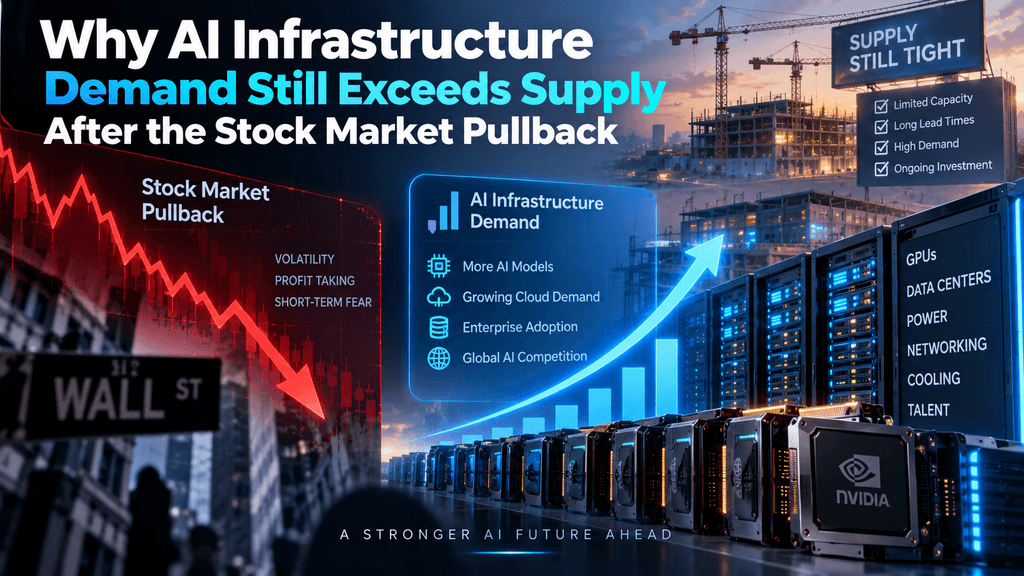
The summer of 2026 brought a sharp correction in semiconductor and AI-related equities after a multi-month advance. Profit-taking, crowded positioning, and questions about the pace of capital spending produced notable declines in chipmakers and infrastructure names. Yet the underlying physical constraints on artificial-intelligence deployment have not eased. Hyperscalers continue to guide toward record capital expenditures measured in the high hundreds of billions of dollars for the year, while high-bandwidth memory remains fully allocated, advanced packaging capacity at the leading foundry stays oversubscribed, and grid interconnection timelines stretch measured in years rather than months.
Contracted future revenue and utilization rates near full capacity indicate that demand is not theoretical. It is booked years forward. Supply, by contrast, is governed by multi-year lead times for specialized components, skilled labor, and power infrastructure. The result is a structural gap that price increases close more readily than volume expansion can. This article examines the principal layers of that imbalance with data drawn from company disclosures, independent capacity analyses, and recent market reporting. The thesis is straightforward: equity valuations can and do adjust to near-term sentiment, yet the physical mismatch between AI compute demand and the infrastructure required to deliver it remains intact and is projected to persist well beyond 2026.
Persistent Hyperscaler Capital Commitments After the Equity Correction
Major cloud providers have continued to raise or reaffirm capital-expenditure guidance even after the mid-2026 share-price declines in related stocks. Combined spending by the largest U.S. hyperscalers is tracking in the range of $695 billion to more than $750 billion for calendar 2026, with some broader estimates incorporating additional cloud and infrastructure players approaching or exceeding $800 billion. Individual company figures illustrate the scale: one leading provider has guided near $190 billion, another in the $175–185 billion range later revised higher, a third near $200 billion, and a fourth in a $130–145 billion band. These numbers represent multi-year commitments that already incorporate higher component pricing, particularly for memory. Management commentary on recent earnings calls has emphasized that demand for capacity continues to exceed available supply, with utilization rates in data center GPU fleets reported near or above 95 percent in several cases. The equity-market pullback reflected technical factors and valuation concerns rather than any material reduction in contracted cloud backlogs, which have climbed into the trillions of dollars across the group. Because a substantial portion of this spending is locked into multi-year purchase agreements and lease structures, near-term share-price volatility has limited ability to alter the physical deployment trajectory already under way.
The durability of these commitments is reinforced by the composition of spending. Roughly half of the capital is directed toward servers and accelerators, with the balance allocated to data center shells, power infrastructure, and networking. Component cost inflation itself has become a driver of higher guidance: several operators have explicitly cited elevated memory and packaging prices as reasons for upward revisions. Independent analyses of SEC filings from more than forty issuers across the AI stack show that the majority of companies describe sold-out or capacity-constrained conditions in at least one critical layer. Free-cash-flow pressures are acknowledged, yet the strategic priority remains securing scarce compute rather than optimizing near-term margins. In this environment, the stock-market correction has functioned more as a recalibration of investor expectations than as a signal that the physical build-out is decelerating. The gap between announced investment and deployable capacity therefore continues to widen in the near term, even as absolute spending reaches historic levels.
High-Bandwidth Memory Allocation Locked Through 2026 and Into 2027
High-bandwidth memory has emerged as the most acute near-term constraint across the AI accelerator supply chain. All three major suppliers have described their 2026 HBM output as effectively sold out or fully allocated under long-term contracts. One leading producer has stated that the industry faces its most severe shortage on record in 2027, with demand projected to remain ahead of supply capacity beyond 2030 despite aggressive expansion plans. HBM consumes substantially more wafer capacity per gigabyte than conventional DRAM, approximately three times as much, creating a direct trade-off that reduces output available for other memory products. Contract prices for DRAM have risen sharply in successive quarters of 2026, with some reports citing sequential increases of 50–90 percent, while spot prices for certain HBM modules have traded at multiples of long-term agreement levels. Gross margins for data-center memory segments at several suppliers have reached the mid-to-high 80 percent range, reflecting pricing power that arises precisely from the inability to expand volume rapidly.
New capacity will arrive only gradually. Front-end wafer fabs and advanced packaging facilities currently under construction or recently broken ground are not expected to reach meaningful volume production before late 2028 or 2029. One supplier has committed more than $250 billion to U.S. DRAM expansion through 2035, while another has broken ground on a multi-billion-dollar HBM packaging facility in the United States targeted for production later in the decade. Even with these investments, industry executives and independent analyses converge on the view that incremental supply will lag demand growth through the remainder of the decade. The allocation process itself favors the largest hyperscalers and accelerator designers that secured multi-year agreements earliest, leaving secondary buyers and newer entrants with limited or no access on the spot market. This concentration of scarce memory reinforces the overall supply-demand imbalance and keeps utilization of existing AI systems elevated. Price, rather than volume, remains the primary mechanism adjusting the market in the interim.
Advanced Packaging Capacity at the Leading Foundry Fully Booked
Chip-on-wafer-on-substrate packaging, the critical final assembly step that integrates logic dies with high-bandwidth memory stacks, remains sold out at the dominant foundry. Lead times of 52 to 78 weeks have been widely reported for 2026 capacity, and company statements describe the process as extremely tight through the end of the year, with visibility extending into 2027. Total CoWoS demand is estimated near one million wafers for 2026, roughly triple the level recorded two years earlier. The largest accelerator designer holds an estimated 60 percent of available allocation, with the top three customers collectively accounting for more than 85 percent. Monthly capacity is expanding from roughly 75,000–80,000 wafers toward targets of 120,000–140,000 by year-end, yet the gap between supply and demand is projected only to narrow from around 20 percent earlier in the year to approximately 10 percent.
Because advanced packaging is concentrated at a single supplier and is required for virtually every high-performance AI accelerator, the bottleneck is structural rather than temporary. Expansion requires specialized equipment, clean-room space, and process qualification that cannot be accelerated beyond certain physical and engineering limits. Alternative packaging approaches and panel-level techniques are under development and may relieve pressure later in the decade, but they are not yet available at scale for current-generation products. The result is that even when logic wafers are fabricated, final system delivery can be delayed by the packaging queue. Hyperscalers that locked capacity earliest retain preferential access, while others face extended waits or higher secondary-market prices. This dynamic contributes directly to the observation that announced data-center capacity frequently exceeds the volume of fully assembled, billable AI systems that can actually be deployed in the same period.
Power Availability and Grid Interconnection Timelines as Multi-Year Constraints
Electricity supply has shifted from a secondary concern to a primary gating factor for new AI capacity in many regions. Median timelines from grid-connection request to operational status stretch to approximately five years in major U.S. markets, with some saturated corridors requiring even longer. Only a fraction of the capacity announced for 2026 delivery is currently under construction with secured power access. Analyses of interconnection queues show that requested large-load capacity far exceeds realistic near-term demand forecasts, yet the actual headroom on existing grids remains limited after accounting for planned retirements of older generation assets. Transformers and related electrical equipment face lead times measured in years, with prices substantially higher than pre-2020 levels.
Hyperscalers have responded by pursuing on-site generation, long-term power-purchase agreements, and conversions of existing high-power industrial sites. These workarounds can accelerate individual projects, yet they do not resolve the system-wide shortfall projected by independent power-sector models. U.S. data-center power demand is forecast to grow at roughly 27 percent annually through 2030 in base-case scenarios, reaching levels that would require tens of gigawatts of new capacity beyond currently committed generation and transmission. In several regions, the greater near-term risk is under-building rather than over-building of power infrastructure. Because power must be secured before equipment can be energized and revenue-generating workloads can run, the electricity constraint effectively lengthens the entire deployment cycle and keeps existing facilities at high utilization. The stock-market correction has not altered the fundamental physics or permitting realities that govern this layer of the stack.
Data-Center Construction and Commissioning Lags Behind Announced Capacity
Announced data-center capacity has grown rapidly, yet the volume of power-secured, equipment-procured, commissioned, and billable AI-ready megawatts remains substantially smaller. Independent tracking shows that only a limited portion of projects scheduled for 2026 completion currently has a disclosed and viable power-access strategy. Vacancy rates in major markets have fallen to historically low levels near 2 percent in some reports, while global demand projections under accelerated AI-adoption scenarios point to deficits measured in hundreds of gigawatts by 2030 relative to currently planned supply. Construction timelines are further extended by shortages of skilled trades, electricians, welders, and pipefitters, and by rising community opposition in several jurisdictions that once welcomed large facilities.
The distinction between announced and deployable capacity is critical for understanding the supply shortfall. A project may secure land and enter an interconnection queue years before it can host revenue-generating AI workloads. Slippage, resizing, and delayed equipment delivery are common. Operators that locked power and long-lead components earliest retain a measurable advantage, while later entrants face higher costs and longer waits. This concentration of near-term supply reinforces pricing power for existing capacity providers and keeps utilization elevated across the installed base. Equity-market volatility has had little effect on the multi-year construction schedules already under way, leaving the physical gap between demand signals and usable infrastructure largely unchanged.
Semiconductor Foundry Utilization and Advanced-Node Constraints
Leading-edge logic capacity at the primary foundry for AI accelerators operates near or above planned utilization. Three-nanometer processes are described as fully committed for 2026, with demand earlier characterized as running approximately three times available supply. Advanced-node wafer starts are heavily skewed toward AI-related products, crowding out other applications and reinforcing allocation priorities for the largest customers. Tool-purchase forecasts by the foundry itself have nearly doubled relative to earlier internal projections, reflecting the accelerated pace of capacity expansion required simply to keep the gap from widening further. Construction of multiple new fabs is proceeding simultaneously, yet skilled labor and equipment lead times limit the speed of incremental output.
The concentration of advanced manufacturing creates a single point of leverage across the entire AI hardware ecosystem. Even when design and architecture advances reduce the silicon required per unit of performance, the absolute volume of wafers demanded continues to rise with model scale and inference growth. Packaging and memory constraints compound the foundry limitation, so that relief in one layer does not automatically translate into higher system throughput. Long-term purchase commitments from major customers provide the foundry with visibility to expand, yet the physical ramp remains measured in years. The mid-2026 equity correction did not coincide with any reduction in these forward wafer bookings, underscoring that the supply constraint is independent of short-term share-price movements.
Pricing Power Across Constrained Layers of the Supply Chain
Where volume cannot expand quickly, price has become the primary clearing mechanism. Memory contract prices have posted successive double-digit sequential increases through 2026. Data-center lease renewals at major landlords have been reported at double-digit percentage premiums. GPU-hour rental rates on the secondary market have risen from late-2025 lows even as on-demand capacity remains scarce. Gross margins for suppliers of constrained components have expanded correspondingly, in some cases reaching levels rarely seen in prior semiconductor cycles. These price signals confirm that demand remains robust relative to available supply rather than softening in response to higher costs.
The same dynamic appears in power and construction markets. Transformer and switchgear prices have risen substantially, while the cost per megawatt of AI-ready data center capacity has increased with component inflation and scarcity of skilled labor. Hyperscalers have absorbed these higher input costs within their elevated capital budgets, treating them as the price of securing scarce resources ahead of competitors. For investors, the persistence of pricing power across multiple layers of the stack provides evidence that the demand-supply imbalance is not a temporary phenomenon that equity valuations alone can resolve. Instead, higher prices ration existing capacity while new supply is brought online over multi-year horizons.
Inference Workload Growth Adding to Sustained Compute Pressure
Training of frontier models continues to require large clusters, yet inference workloads are projected to account for a rising share of total AI-related power demand, potentially exceeding 40 percent by 2030 and growing at a compound annual rate near 35 percent in some forecasts. Token consumption reported by enterprise users is already measured in the billions per month for a substantial share of organizations, with expectations of further doubling or more over the next two years as agentic and multimodal applications scale. Because inference demand is more continuous and geographically distributed than training spikes, it places sustained pressure on both centralized and edge infrastructure.
This shift does not reduce the absolute requirement for accelerators, memory, and power; it changes the utilization profile and the geographic distribution of demand. Latency-sensitive applications favor capacity closer to end users, expanding the set of locations that must secure power and connectivity. The net effect is an increase in the total addressable requirement for AI-ready infrastructure even as individual model efficiencies improve. Hyperscalers and specialized cloud providers therefore continue to expand footprints rather than simply optimize existing clusters. The equity-market correction has not altered the underlying growth trajectory of inference traffic visible in token-consumption surveys and backlog figures.
Geographic Concentration and Site-Selection Constraints
Suitable sites that combine available power, fiber connectivity, land, and community acceptance are becoming scarcer in the corridors that already host the bulk of U.S. and European capacity. Sentiment analyses indicate that public attitudes toward large data centers have turned more negative in several previously supportive jurisdictions. This opposition lengthens permitting timelines and raises the risk of project delays or cancellations. Operators are therefore exploring secondary markets, on-site generation, and international locations with more favorable power profiles, yet these alternatives introduce their own infrastructure and latency trade-offs.
The concentration of existing capacity creates network effects that reinforce demand in already constrained regions. Moving workloads is not frictionless when data gravity, regulatory requirements, and low-latency needs are considered. As a result, the most sought-after markets continue to experience the tightest supply conditions even as national or global capacity numbers appear more balanced on paper. The stock-market pullback has had no measurable effect on the local zoning, interconnection, and community-engagement processes that govern site availability.
Labor and Specialized Equipment Shortages Extending Timelines
Beyond silicon and power, shortages of skilled construction trades and long-lead electrical equipment continue to stretch project schedules. Transformer lead times exceeding 100 weeks have been widely reported, with certain generator step-up units facing even longer queues. Prices for these components have risen 70–150 percent relative to earlier in the decade. Simultaneously, the pool of qualified electricians, welders, and pipefitters required for large-scale data center construction remains limited relative to the volume of simultaneous projects under way.
These constraints interact with the silicon and power bottlenecks. A completed building shell without transformers or without the labor to install them cannot host accelerators. Equipment manufacturers themselves face upstream material and capacity limits, so rapid expansion of output is not feasible. The cumulative effect is that the time from capital commitment to revenue-generating capacity is measured in multiple years for many new sites. Equity valuations may fluctuate with quarterly sentiment, yet the physical and human-capital constraints that determine actual deployment rates evolve on a slower cycle.
Utilization Rates and Contracted Revenue Signaling Enduring Demand
GPU utilization rates reported by several large operators remain near or above 95 percent, while contracted future revenue across the AI compute ecosystem sits in the trillions of dollars against current annual spending. Cloud backlogs have expanded in parallel with capital budgets. These metrics indicate that the demand side of the equation is not softening in response to higher prices or equity-market volatility. Instead, customers continue to secure capacity years in advance because the alternative is delayed model development or inference deployment.
High utilization also means that incremental demand must be met primarily by new capacity rather than by efficiency gains within the existing base. While software and architectural improvements continue, they have not yet produced a material reduction in the absolute requirement for accelerators, memory, and power. The combination of elevated utilization and large contracted backlogs therefore sustains pressure on every constrained layer of the supply chain. The mid-2026 share-price correction occurred against this backdrop of full utilization and expanding commitments, reinforcing the conclusion that market sentiment and physical reality have diverged.
Second-Order Effects on Pricing and Competitive Positioning
The persistent gap confers durable advantages on those participants that secured early access to constrained resources. Accelerator designers with preferential packaging and memory allocations, hyperscalers with locked power and long-term component contracts, and landlords with existing high-power facilities all benefit from the scarcity. Newer entrants and smaller buyers face higher costs and longer waits, potentially concentrating market share among the best-positioned incumbents. Price increases across the stack further reinforce this dynamic by raising the capital required to compete.
At the same time, the constraints create incentives for innovation in alternative architectures, more efficient models, and distributed inference. These responses may eventually ease pressure, yet they operate on multi-year research and deployment cycles. In the interim, the imbalance continues to shape competitive outcomes and capital-allocation decisions across the industry. Equity-market fluctuations can alter the cost of capital and investor attention, but they do not immediately change the physical scarcity that determines near-term market structure.
🔥 Beyond the Headlines: What KuCoin 5.0 Means for You
Market news moves fast — but where you act on it matters just as much. This October, KuCoin launches KuCoin 5.0, transforming KuCoin into a rebuilt platform. Here's what actually changes for you:
-
One account for everything. Older platforms split your money across separate "spot," "margin," and "futures" accounts and expected you to understand why. KuCoin 5.0's unified account removes that entirely — deposit once, and everything is simply there.
-
Stocks, indices, and commodities. KuCoin 5.0 expands beyond crypto into global markets. When crypto chops sideways and equities rally (or the reverse), you rotate in minutes instead of opening a brokerage account and waiting days for fiat rails.
-
Real-world assets (RWA). Tokenized exposure to traditional assets like commodities, right inside your crypto account. One of the fastest-growing segments in global finance is no longer reserved for institutions — you access it from the same balance you trade with.
-
Earn while you learn. Not ready to trade? KCUSD lets your stablecoins earn daily, auto-compounding interest. The lowest-stress way to put your idle deposit to work for 4% yield.
-
An AI assistant in plain language. Ask questions, get market context, understand what you're looking at — built into the platform, no jargon required.
-
An app that doesn't overwhelm. Faster, cleaner, and consistent — intuitive from the first tap, not after a tutorial.
-
Safety you can check, not just trust. A MiCAR-licensed EU entity, Proof of Reserves you can verify yourself, and internationally certified security (SOC 2 Type II, ISO 27001:2022).
Create your account in minutes — and start on the platform built for where crypto is going, not where it's been.
Outlook for Gradual Capacity Relief Beyond 2027
Meaningful relief is expected only as new memory fabs, packaging lines, and power infrastructure reach volume production later in the decade. Even then, demand growth from expanding inference workloads and continued model scaling is projected to absorb a substantial share of the incremental supply. Independent forecasts generally show the tightest conditions persisting through 2027, with gradual narrowing thereafter provided that current expansion plans are executed on schedule. Geopolitical, permitting, and labor risks remain capable of extending the timeline further.
Investors and operators therefore confront a multi-year period in which demand continues to exceed readily available supply. The mid-2026 equity correction served as a reminder that valuations can adjust quickly, yet the underlying infrastructure constraints evolve far more slowly. Monitoring actual commissioning rates, memory and packaging allocation statements, and power-interconnection progress will provide clearer signals of when the gap begins to close than share-price movements alone.
FAQs
What specific factors caused the mid-2026 pullback in AI-related stocks?
The decline was driven primarily by profit-taking after a strong multi-month advance, crowded positioning in momentum names, and renewed scrutiny of the sustainability of elevated capital expenditures. Earnings reports from infrastructure suppliers continued to show robust demand and capacity constraints, indicating that the move reflected technical and sentiment factors rather than a deterioration in the physical supply-demand balance.
How long are current lead times for high-bandwidth memory and advanced packaging?
HBM output for 2026 is described as fully allocated by the major suppliers, with meaningful new capacity not expected before 2028–2029. CoWoS packaging lead times at the dominant foundry stand at 52–78 weeks, with capacity sold out through 2026 and visibility into 2027.
Are hyperscalers reducing their capital-expenditure plans after the stock correction?
Guidance for 2026 has continued to be reaffirmed or raised, with combined spending by the largest providers tracking in the $695–800 billion range depending on the set of companies included. Higher component costs have themselves contributed to upward revisions rather than prompting cutbacks.
Which layer of the AI infrastructure stack is currently the most constrained?
High-bandwidth memory is widely cited as the binding near-term constraint, followed closely by advanced packaging and power interconnection. Different operators may experience the tightest bottleneck in different layers depending on their existing contracts and geographic footprint.
Will new data center announcements close the capacity gap in 2026–2027?
Announced capacity substantially exceeds the volume of power-secured, fully commissioned, and billable AI-ready megawatts expected in the same period. Construction, equipment, and interconnection timelines mean that many announced projects will contribute to supply only in later years.
How are rising component prices affecting the overall economics of AI infrastructure?
Higher memory, packaging, and electrical equipment costs are being absorbed within elevated capital budgets. Suppliers of constrained components are realizing expanded margins, while operators treat the higher input costs as the price of securing scarce resources ahead of competitors.
Disclaimer: This content is for informational purposes only and does not constitute investment advice. Stock investments carry risk. Please do your own research (DYOR).