

2026 US Midterm Elections: Why AI, Inflation, and Fed Policy May Matter More for Markets
Energy Costs and Fed Policy Emerge as Key Market Drivers Ahead of Midterms
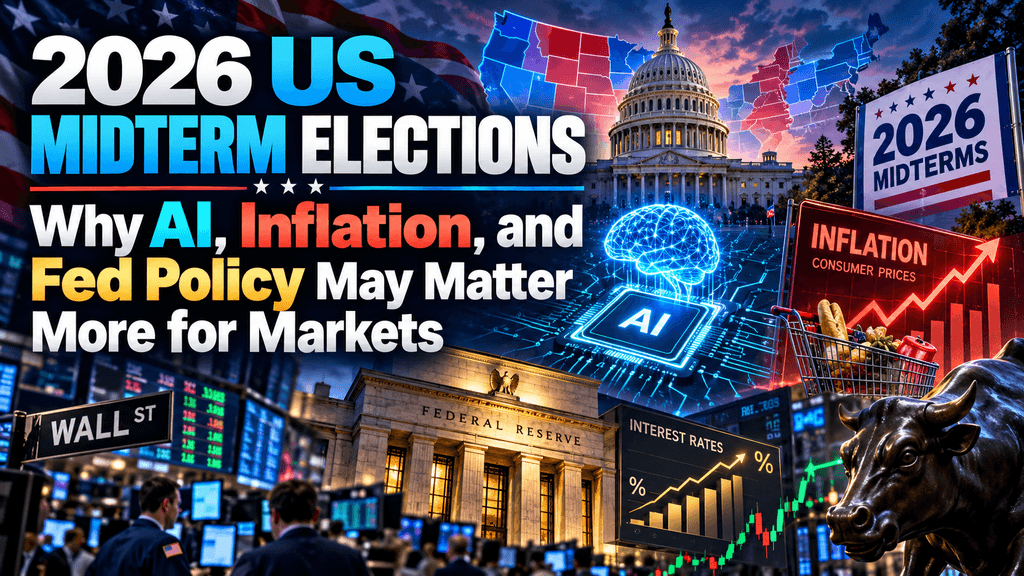
As November 3, 2026, approaches, investors are tracking congressional control with intense focus. Prediction markets currently assign roughly 90% odds to Democrats taking the House and around 60-64% to them securing the Senate, raising the prospect of divided government or a Democratic sweep. Yet the market implications extend well beyond which party holds the gavels. Persistent inflation driven by energy prices, a growing political and physical bottleneck around artificial intelligence infrastructure, and the Federal Reserve’s response to sticky price pressures are emerging as the more decisive variables for equities, bonds, and sector leadership. Recent data show the Consumer Price Index rising 3.7% year-over-year in September, the highest in recent months, while Morgan Stanley estimates U.S. data center developers face a net power shortfall of roughly 32 GW, about 34% of projected needs, through 2028 even after accounting for onsite generation.
These structural forces interact with fiscal realities, including federal debt above $40 trillion, and create conditions in which policy continuity or friction may matter less than the practical constraints on growth and capital allocation. The 2026 midterms will influence the tone of oversight and the pace of certain regulatory debates, but AI infrastructure limits, inflation dynamics centered on energy and services, and the Federal Reserve’s evolving rate path are likely to exert greater influence on market direction and sector performance in the months ahead than shifts in congressional majorities alone.
How Prediction Markets Price a Likely Democratic House and Contested Senate
Prediction platforms such as Polymarket and Kalshi currently show Democrats with approximately 90% probability of controlling the House and 61-64% odds of taking the Senate, reflecting elevated energy costs, presidential approval ratings near 37%, and historical patterns in which the president’s party loses House seats in most midterm cycles. Traders have concentrated volume on key Senate contests in Texas, Maine, Ohio, and Iowa, where margins could determine control. This pricing implies a high chance of divided government or a full Democratic sweep, both of which historically have been associated with reduced prospects for major new legislation. Average S&P 500 returns in the year following midterms have been positive across nearly every cycle since 1950, often strongest under split control. Market participants appear to be discounting the risk of sweeping policy reversals while remaining attentive to the signal that voter dissatisfaction with affordability could translate into heavier oversight of technology and finance sectors.
The concentration of betting activity on margins rather than pure winners further suggests investors are refining expectations around the degree of friction rather than outright policy reversal. The practical implication for portfolios is that any immediate post-election volatility is more likely to stem from shifts in sentiment around fiscal supply and regulatory tone than from abrupt changes in tax or spending law. Historical data indicate the index has delivered positive 12-month returns after every midterm since the modern era began, with average gains near 15%. Divided government has often correlated with relatively constructive equity environments because it limits the scope for large fiscal expansions that could pressure long-term yields. Investors monitoring these markets are therefore focusing less on binary party outcomes and more on how the resulting balance of power interacts with existing economic constraints.
Energy Prices and the Affordability Channel Driving Voter Sentiment
Gasoline and diesel prices have surged amid ongoing Middle East tensions, contributing more than half of the September CPI monthly increase and pushing the year-over-year headline rate to 3.7%. National average gas prices have risen substantially year-over-year, while diesel costs have climbed even more sharply, directly affecting transportation, agriculture, and household budgets. Polls and analyst notes consistently identify the cost of living as the dominant voter concern, eclipsing other issues for a large share of the electorate. Higher energy costs feed into broader inflation expectations and have already influenced mortgage rates, which recently approached multi-year highs near 7.4%.
This affordability pressure has tightened the link between commodity markets and political outcomes, raising the probability that sustained high prices could amplify any anti-incumbent sentiment. For markets, the energy-affordability channel creates a feedback loop. Elevated oil prices support certain energy equities and producers while simultaneously raising bond yields through higher inflation expectations and weighing on consumer discretionary spending. Analysts have noted that further upward moves in energy could reinforce Democratic odds in close races, potentially shifting the expected policy mix toward greater scrutiny of corporate pricing power and energy infrastructure. The net effect is that energy markets themselves have become an early indicator of midterm risk premium, independent of formal polling.
September CPI at 3.7% and Broadening Price Pressures
The September Consumer Price Index rose 0.6% month-over-month and 3.7% year-over-year, exceeding consensus expectations, with core CPI (excluding food and energy) advancing 0.3% and 2.6% annually. Gasoline alone accounted for more than half the monthly gain, yet software prices jumped 28% year-over-year and shelter costs accelerated, signaling that inflation is not confined to energy. The Federal Reserve’s preferred PCE measure is expected to reflect similar firmness. Markets responded by lifting the probability of an October rate hike toward 50% in some measures, reversing earlier expectations of a prolonged pause.
This data complicates the Fed’s path and elevates the importance of monetary policy relative to congressional composition. Sticky services inflation and AI-related demand for certain goods reduce the likelihood of rapid disinflation even if energy prices moderate. Bond yields, already elevated with the 10-year near or above 5% in recent sessions, remain sensitive to any signal that the central bank will need to keep policy restrictive for longer. Equity valuations, particularly in rate-sensitive sectors, face ongoing pressure until clearer progress on core inflation emerges.
Federal Reserve Rate Path and the October FOMC Meeting
After raising the federal funds target to 3.75%-4.00% in September, the first increase in three years, the Federal Open Market Committee faces a tighter decision at its late-October meeting. Hotter-than-expected CPI has restored meaningful odds of another 25-basis-point move, though many economists still expect the Committee to hold and reassess in December. Officials have emphasized that financial conditions remain accommodative and that further tightening may be required if inflation fails to move decisively toward the 2% target. Two-year yields have reacted sharply to the data, reflecting front-end pricing of a higher path.
The midterms occur against this backdrop of potential near-term policy action. Historical patterns show that bond markets respond more strongly to Fed decisions than to shifts in congressional control. A sustained higher-for-longer stance would keep pressure on equity multiples and favor quality balance sheets, while any pause or dovish surprise could support risk assets regardless of the election outcome. Investors are therefore treating the Fed’s reaction function as a more immediate market driver than the precise distribution of seats in Congress.
AI Data-Center Power Shortfalls Estimated Near 32 GW Through 2028
Morgan Stanley Research projects that U.S. data center developers face a net power shortfall of approximately 32 GW, roughly 34% of the required supply, through 2028 even after incorporating behind-the-meter generation, fuel cells, and other accelerated solutions. Gross demand is estimated far higher, with interconnection and transmission timelines of four to seven years colliding with the 18-to-36-month construction cycles of hyperscale facilities. Rack power densities continue to rise with next-generation architectures, intensifying the constraint.
This physical bottleneck introduces a non-political limit on the AI investment cycle that no election outcome can fully remove. Leading chip designers with visibility into deployment locations and geographic flexibility appear relatively insulated in near-term forecasts, while memory, optical, and secondary component suppliers face greater order volatility if projects slip. The shortfall elevates the importance of utilities, independent power producers, and on-site generation technologies as structural beneficiaries, independent of federal legislative outcomes.
State and Local Pushback on Data Centers as the Emerging Constraint
Public concern regarding electricity prices, water usage, and land allocation has transformed the siting of data centers into a highly localized political issue across multiple states. In response to these concerns, several municipalities and state legislatures are actively engaging in discussions or even implementing various limits on the establishment of new facilities. According to Morgan Stanley, the next phase of development is characterized as a “conditional buildout,” wherein state and local governments assume the role of primary stewards of AI infrastructure policy. It is anticipated that federal legislation will progress at a slow pace, and the likelihood of a national pause on such developments is considered quite unlikely, especially given the strategic priority placed on maintaining leadership in technology.
This trend toward decentralization implies that the outcomes of elections in specific states and localities may hold greater significance for the speed and scale of AI capital expenditures than the overall national balance of power within Congress. Projects that are already in progress or those that have secured reliable power sources are generally in a better position, while new greenfield developments are likely to encounter longer permitting processes and face heightened political risks. As a result, investors are increasingly adjusting their exposure toward companies that possess diversified geographic footprints and have established relationships with utility providers, recognizing the importance of these factors in navigating the evolving landscape of AI infrastructure development.
Fiscal Deficits Above 6% of GDP and Debt Past $40 Trillion
Federal debt surpassed the significant threshold of $40 trillion in August, with the deficit hovering around 6% of GDP following recent tax measures and elevated levels of government spending. Any additional proposals aimed at providing direct payments to citizens or further tax relief initiatives would likely exacerbate supply pressure on the Treasury market, creating additional challenges for financial stability. Even in a scenario of divided government, where different political parties control different branches, substantial fiscal consolidation seems improbable in the near term, as the political landscape remains contentious. Longer-term yields in the bond market have already begun to reflect these growing concerns, with the 10-year Treasury trading at levels that are near multi-year highs, indicating investor apprehension about future fiscal policies.
Any outcome from the upcoming midterm elections that either preserves or expands the government's capacity for deficit-financed stimulus measures would likely maintain upward pressure on term premiums, which are the additional yields investors demand for holding longer-term bonds. Conversely, a political configuration that increases the likelihood of future tax increases or promotes spending restraint could potentially ease that pressure somewhat. Historically, markets have treated fiscal sustainability as a secondary yet persistent driver of bond yields, often overshadowing short-term political noise and fluctuations once the results of the elections are made known to the public.
Historical S&P 500 Performance After Midterms Points to Positive Bias
Since 1950, the S&P 500 index has consistently delivered positive returns in the 12 months following every midterm election, with average gains typically hovering around 15-16%. When examining longer time frames, particularly those extending 15 months from October of the midterm election year, even stronger average advances have been observed. This historical pattern has remarkably held true through various significant events, including wars, economic recessions, and spikes in inflation. Notably, returns have tended to be strongest during periods of divided government, where control of Congress is split between parties. Pre-election periods are often characterized by increased volatility, as uncertainty tends to rise when polls become tighter.
This historical consistency provides a solid baseline expectation that markets will ultimately refocus on fundamental economic indicators once the composition of Congress becomes clear. However, it is important to note that the current cycle’s elevated starting valuation, combined with the presence of concentration risk related to artificial intelligence, introduces certain caveats that investors should consider. Nevertheless, the long-run historical record suggests that political resolution itself has often acted as a net positive catalyst for market performance more frequently than not.
Sector Implications Under Different Congressional Configurations
Under a Democratic House or a complete sweep of both chambers, analysts predict a significant increase in scrutiny directed towards financial institutions. This heightened oversight may lead to potential pressure on industrial sectors that are closely linked to traditional energy sources. Conversely, there may be possible support for consumer staples and certain alternative energy companies, which could benefit from a more favorable regulatory environment. AI infrastructure companies are currently facing challenges related to reputational risks and regulatory scrutiny; However, they are expected to experience limited near-term fundamental risks due to presidential veto power, which can act as a safeguard against abrupt policy changes.
On the other hand, if Republicans manage to retain control of both chambers, it is likely that we will see a continuation of deregulation efforts and expedited permitting processes for energy projects and data center developments. This scenario could also increase the likelihood of further fiscal expansion, which may exert downward pressure on bond markets. In all potential scenarios, independent regulatory agencies will maintain substantial authority over banking and market regulations, which serves to limit the scope for any abrupt shifts in policy direction. The more enduring differentiation in market dynamics is anticipated in areas where state-level decisions and physical constraints play a dominant role, particularly in sectors such as power generation and data center real estate, where local regulations and geographical factors significantly influence operational capabilities and investment opportunities.
Bond Market Sensitivity to Fiscal Supply and Inflation Expectations
Treasury yields have experienced a notable increase, driven by a combination of several factors, including stronger economic growth, elevated oil prices, and heightened competition for capital stemming from hyperscalers that are actively issuing debt to finance the development of AI infrastructure. This particular configuration, which raises the likelihood of larger fiscal deficits, would likely extend the existing pressure on yields. In contrast, periods of gridlock in government have historically been associated with more stable fiscal trajectories, creating relatively constructive conditions for longer-duration assets once the initial volatility subsides and settles down.
As a result, investors are strategically positioning themselves for continued term-premium risk, while simultaneously acknowledging that the policies set forth by the Federal Reserve remain the dominant influence in the near term on the front end of the yield curve. The intricate interaction between fiscal expectations driven by upcoming elections and the central bank’s responsive actions to inflation data will ultimately determine whether yields stabilize at current levels or continue to trend higher as we move into the year 2027.
Technology Leadership Versus Domestic Political Friction
AI continues to be recognized as a bipartisan strategic priority, even in the face of growing local opposition to the establishment of data centers. In the near future, it is unlikely that federal pre-emption of state regulations will occur, which results in a complex and varied landscape of conditions across different jurisdictions. Major technology firms that possess global deployment capabilities and robust balance sheets are significantly better positioned to navigate this challenging environment compared to pure-play developers who are heavily reliant on specific U.S. jurisdictions for their operations.
The market has started to distinguish between companies that are primarily exposed to risks associated with power supply and permitting processes and those whose growth directions are more closely tied to their model capabilities and the demand for their services on a global scale. This differentiation in the market is anticipated to endure, irrespective of the outcomes of the midterm elections. Investment capital will persist in flowing toward the highest-return applications within the AI sector. However, it is important to note that the costs associated with domestic infrastructure development, as well as the timelines for such projects, will play a crucial role in shaping the geographic distribution of that investment spending, as well as influencing the relative performance of equities that are related to this sector.
Practical Portfolio Considerations Ahead of November 3
Investors are strongly encouraged to place a significant emphasis on the importance of maintaining quality balance sheets, ensuring diversified exposure to power markets, and being acutely aware of the Federal Reserve’s monetary policy trajectory, rather than making binary bets based solely on election outcomes. The historical trend of strength observed in the markets following midterm elections provides a constructive and optimistic backdrop for the medium term. However, it is essential to recognize that elevated valuations, coupled with constraints in power supply, introduce unique and idiosyncratic risks within the technology sector that cannot be overlooked.
In this context, actively monitoring real-time energy prices, the various components of the Consumer Price Index (CPI), and the communications from the Federal Reserve will likely prove to be far more actionable and relevant than merely tracking the daily fluctuations in prediction-market odds, which can often be misleading. Positioning strategies that take into account the persistence of sticky inflation, the likelihood of higher interest rates being maintained for an extended period, and a conditional approach to the development of artificial intelligence, rather than an unconstrained and unregulated buildout, align more closely with the prevailing market drivers. This approach is likely to be more effective than attempts to forecast the precise composition of congressional majorities, which can be highly uncertain and volatile.
How the Interaction of These Forces Could Evolve Into 2027
Once the election results are officially announced and made public, it is anticipated that market focus will swiftly shift back to critical factors such as corporate earnings reports, the Federal Reserve’s upcoming meeting in December, and the ongoing developments regarding the power shortfall that has been affecting various sectors. Furthermore, any legislative proposals that may emerge concerning the oversight of artificial intelligence are expected to have a more significant impact on shaping the policy environment for the years 2028-2029, rather than influencing immediate market pricing in the short term.
The interplay of fiscal inertia, limitations in physical infrastructure, and the prevailing monetary policy will continue to define the landscape of opportunities available for risk assets, persisting long after the headlines from the midterm elections have faded into the background. This ongoing dynamic will play a crucial role in determining the investment climate and the performance of various asset classes in the future.
🔥 Beyond the Headlines: What KuCoin 5.0 Means for You
Market news moves fast — but where you act on it matters just as much. This October, KuCoin launches KuCoin 5.0, transforming KuCoin into a rebuilt platform. Here's what actually changes for you:
-
One account for everything. Older platforms split your money across separate "spot," "margin," and "futures" accounts and expected you to understand why. KuCoin 5.0's unified account removes that entirely — deposit once, and everything is simply there (only available to VIPs for now).
-
Stocks, indices, and commodities. KuCoin 5.0 expands beyond crypto into global markets. When crypto chops sideways and equities rally (or the reverse), you rotate in minutes instead of opening a brokerage account and waiting days for fiat rails.
-
Real-world assets (RWA). Tokenized exposure to traditional assets like commodities, right inside your crypto account. One of the fastest-growing segments in global finance is no longer reserved for institutions — you access it from the same balance you trade with.
-
Earn while you learn. Not ready to trade? KCUSD lets your stablecoins earn daily, auto-compounding interest. The lowest-stress way to put your idle deposit to work for 4% yield.
-
An AI assistant in plain language. Ask questions, get market context, understand what you're looking at — built into the platform, no jargon required.
-
An app that doesn't overwhelm. Faster, cleaner, and consistent — intuitive from the first tap, not after a tutorial.
-
Safety you can check, not just trust. A MiCAR-licensed EU entity, Proof of Reserves you can verify yourself, and internationally certified security (SOC 2 Type II, ISO 27001:2022).
Create your account in minutes — and start on the platform built for where crypto is going, not where it's been.
FAQs
What is the current probability that Democrats will control both chambers after the 2026 midterms?
Prediction markets currently assign roughly 60-63% odds to a full Democratic sweep, with House control near 90% and Senate control in the low-to-mid 60% range. These probabilities have risen in recent weeks alongside higher energy prices and softer presidential approval ratings, but the Senate remains the more uncertain contest given the specific map of competitive seats.
How significant is the projected AI data center power shortfall?
Morgan Stanley estimates a net shortfall of about 32 GW, or 34% of projected needs, through 2028 after accounting for onsite generation and other solutions. The gap is expected to widen annually if interconnection timelines remain long, creating a structural constraint on the pace of domestic AI capacity expansion.
Will the midterms change Federal Reserve policy?
The Fed’s dual mandate focuses on inflation and employment; congressional composition has limited direct influence on rate decisions. Recent hotter CPI data have already raised the odds of further tightening independent of the election, and officials have signaled that policy will remain data-dependent.
How have stocks historically performed after midterm elections?
The S&P 500 has delivered positive 12-month returns after every midterm since 1950, with average gains near 15%. Longer windows have often produced even stronger results, though past performance does not guarantee future outcomes and current valuations differ from earlier cycles.
Which sectors face the greatest near-term election-related risk?
AI infrastructure and defense names are frequently cited as more exposed to shifts in oversight tone, while consumer staples and certain alternative energy names could benefit under heavier Democratic influence. Physical power constraints, however, may prove more durable than political ones for many technology-related equities.
Disclaimer: This content is for informational purposes only and does not constitute investment advice. Investments carry risk. Please do your own research (DYOR).