

10-Year Treasury Yield Rises to 5.3% as Hot Inflation Revives Fed Rate Hike Fears
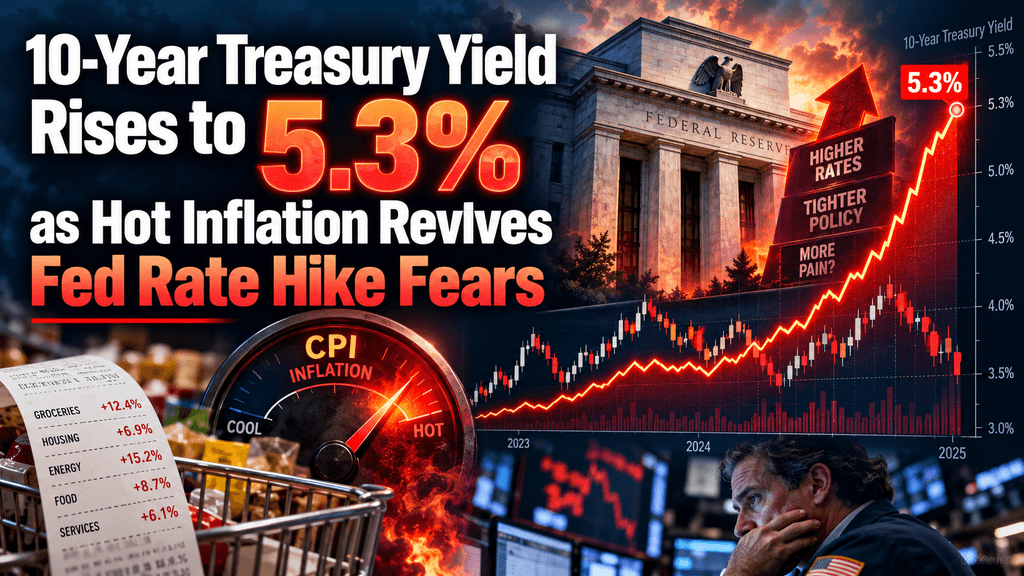
U.S. 10-Year Treasury Yield Climbs to 5.3% as Inflation Fuels Rate Hike Bets
The U.S. bond market delivered a clear message on October 14, 2026. Following the release of hotter-than-expected September consumer price data, the benchmark 10-year Treasury yield jumped as high as 5.33 percent before settling near 5.3 percent in early trading, according to market data reported across major financial platforms. The move extended a multi-month climb that has taken the yield to levels not sustained since the early 2000s. Energy prices, particularly gasoline, drove the bulk of the inflation acceleration, while broader price pressures in services and shelter also registered increases. Traders immediately repriced the probability of additional Federal Reserve action, with odds of a rate increase at the late-October meeting rising sharply from the low twenties to near 40 percent or higher in the hours after the report.
The pattern underscores how persistent inflation, elevated energy costs linked to geopolitical tensions, substantial federal borrowing, and strong capital demand from artificial-intelligence infrastructure are combining to keep long-term borrowing costs elevated. Markets had already pushed yields higher through September and early October on expectations that policy rates would remain restrictive for longer. The latest inflation print reinforced those concerns and prompted a swift reaction across equities, the dollar, and credit markets. The latest rise in the 10-year Treasury yield to the 5.3 percent area reflects a market assessment that inflation remains too high relative to the Federal Reserve’s 2 percent target, requiring a more restrictive policy stance for longer, with direct implications for borrowing costs, asset valuations, and economic activity across the United States.
September CPI Acceleration Centers on Energy While Core Measures Also Firm
September consumer prices rose 0.6 percent month over month and 3.7 percent from a year earlier, exceeding the consensus forecast of 3.6 percent for the annual rate, according to the Bureau of Labor Statistics release. Gasoline prices increased 9.1 percent over the month and accounted for more than half of the overall monthly gain in the all-items index. The broader energy category climbed 5.2 percent, contributing to a 20.4 percent rise over the past twelve months. Fuel oil posted an even larger monthly advance. These figures arrived against a backdrop of elevated crude prices, with Brent crude hovering near 105 dollars per barrel and West Texas Intermediate is near 95 dollars. The energy-driven component of the report was widely anticipated in direction if not fully in magnitude, yet the confirmation still moved markets because it kept headline inflation well above the Federal Reserve’s longer-run goal.
Core inflation, which excludes food and energy, rose 0.3 percent on the month and 2.6 percent year over year, both readings above the 0.2 percent and 2.5 percent expectations. Shelter costs increased 0.4 percent, interrupting a prior moderating trend, while used vehicles and apparel also contributed. The combination of sticky core measures and a sharp energy spike produced a report that left little room for complacency among policymakers or investors. Markets interpreted the data as evidence that the disinflation process has stalled, at least temporarily, and that further policy adjustment may be required to restore confidence that inflation is moving sustainably toward 2 percent. The immediate yield reaction reflected that assessment.
Market Pricing of October and December Fed Meetings Shifts Sharply After the Data
Before the September CPI release, CME FedWatch tool data showed roughly a 22 percent probability of a quarter-point rate increase at the October 27-28 Federal Open Market Committee meeting. Within hours of the report, that probability climbed into the high thirties to low fifties before later moderating somewhat as yields partially retraced. Pricing for a move by year-end also firmed, with markets assigning elevated odds to at least one additional hike. The Federal Reserve had already raised its target range for the federal funds rate by 25 basis points in mid-September to 3.75–4.00 percent, the first increase in three years under Chair Kevin Warsh. Officials had signaled that further tightening remained possible if inflation stayed elevated.
The quick shift in market expectations illustrates how sensitive rate pricing remains to incoming inflation data. Short-term yields, particularly the two-year note, also rose sharply, reflecting the direct link between near-term policy prospects and front-end Treasury rates. Analysts at several major institutions revised their near-term forecasts, with some now assigning higher probabilities to a December move even if the October meeting produces no change. The data effectively narrowed the window for the Fed to remain on hold without risking a further backup in long-term yields.
Energy Shock from Geopolitical Tensions Continues to Shape the Inflation Path
Gasoline’s 9.1 percent monthly surge and the broader energy index advance of 5.2 percent trace directly to elevated oil prices sustained by ongoing tensions involving Iran and broader Middle East supply risks. Year-over-year gasoline prices stood 34.2 percent higher, while fuel oil rose more than 70 percent. These increases feed into transportation, heating, and production costs, creating secondary effects that can appear in core measures with a lag. Diesel prices have also reached elevated levels, raising concerns about eventual pass-through into goods prices.
Federal Reserve officials have repeatedly cited the energy shock as a key reason policy may need to remain restrictive. Chair Warsh has described the geopolitical developments as factors that altered the committee’s assessment of how quickly price pressures would ease. Markets have internalized this view, treating higher oil prices not as a purely transitory disturbance but as a force capable of keeping inflation above target for an extended period. The persistence of these pressures has limited the room for yields to decline even when other economic data have been mixed.
Rising Term Premium Adds a Structural Layer to Higher Long-Term Yields
Beyond inflation and near-term policy expectations, the term premium, the extra compensation investors demand for holding longer-maturity bonds, has increased. One measure tracked by the Federal Reserve reached its highest level in more than a decade in early October, contributing meaningfully to the rise in the 10-year yield. Higher term premiums often reflect concerns about fiscal sustainability, greater uncertainty around the future path of rates, or reduced demand for Treasuries as a safe-haven asset.
Several market participants have noted that the safety premium traditionally associated with U.S. government debt appears to have diminished. This development, combined with large ongoing deficits, has required higher yields to clear the market for new supply. The result is a higher floor under long-term rates even if short-term policy rates stabilize. Investors monitoring the term premium closely see it as an independent driver that can keep the 10-year yield elevated regardless of modest shifts in inflation or growth forecasts.
Federal Borrowing Needs and Near-$2 Trillion Deficits Sustain Supply Pressure
Fiscal year 2026 is on track for a deficit near or above $2 trillion, equivalent to roughly 6 percent of GDP. Net interest costs have already exceeded $1 trillion in the first eleven months of the fiscal year, reflecting the higher average coupon rates on outstanding debt. As lower-yielding securities mature, the Treasury must refinance at current market rates, locking in higher interest expense. This dynamic creates a feedback loop in which higher yields increase the deficit, which in turn requires additional issuance.
The Congressional Budget Office and private analysts have highlighted that sustained yields above baseline assumptions would add trillions to cumulative deficits over the next decade. Auction demand has remained orderly, yet the sheer volume of issuance has contributed to higher yields. Market participants increasingly treat fiscal supply as a structural factor rather than a temporary influence, supporting the view that long-term rates will remain higher than the averages of the 2010s.
Artificial Intelligence Capital Spending Competes for Limited Savings
Large-scale investment in data centers, power infrastructure, and related AI projects has added to overall demand for capital. Estimates place corporate debt issuance tied to these projects in the hundreds of billions of dollars, competing directly with Treasury supply for investor funds. The resulting pressure on real rates helps explain part of the rise in nominal yields. Federal Reserve officials have acknowledged that AI-related spending is supporting demand and could continue for several more years before productivity gains fully materialize.
This competition for capital raises the neutral rate of interest, the level at which policy is neither stimulative nor restrictive. If the neutral rate has increased, then a given federal funds rate exerts less restraint on the economy, requiring higher policy rates or higher long-term yields to achieve the same inflation outcome. Markets have incorporated this reasoning into pricing, treating AI investment as a medium-term support for higher real yields.
Equity Markets and Growth-Sensitive Sectors Absorb the Higher Discount Rate
Higher Treasury yields raise the discount rate applied to future corporate cash flows, particularly for longer-duration growth stocks. Technology shares, which had already faced pressure from elevated valuations, experienced additional selling after the inflation data. Broader equity indices also moved lower as investors reassessed the implications of tighter financial conditions. Financials faced mixed pressure as higher rates support net interest margins for some banks while raising funding costs and credit concerns for others.
The 10-year yield serves as a benchmark for many corporate and consumer borrowing rates. As it has climbed, mortgage rates have moved toward levels that constrain housing activity, while auto and business loan rates have also risen. These channels transmit higher bond yields into slower spending and investment with a lag. Market participants continue to monitor whether the cumulative effect of higher yields will eventually slow growth enough to ease inflation pressures without requiring further aggressive policy action.
Mortgage and Consumer Borrowing Costs Rise in Tandem with the Benchmark Yield
Thirty-year fixed mortgage rates track the 10-year Treasury yield closely, and the recent climb has pushed those rates toward 7.5 percent in some market quotes. Higher housing finance costs reduce affordability, slow transaction volumes, and exert downward pressure on home prices over time. Consumer credit rates for vehicles and revolving debt have similarly adjusted higher, increasing the monthly burden on households.
These developments arrive as household balance sheets still reflect the residual effects of earlier inflation. The combination of elevated living costs and higher financing rates can weigh on discretionary spending. Policymakers watch these channels carefully because they form part of the transmission mechanism through which monetary policy influences demand. Sustained yields near current levels would keep financial conditions restrictive even if the federal funds rate remains unchanged in the near term.
Dollar Strength and Global Yield Spillovers Reflect the U.S. Rate Outlook
The U.S. dollar index rose to its highest level of the year following the inflation data as higher yields attracted capital inflows. Stronger dollar conditions tighten financial conditions for emerging-market borrowers and can influence commodity prices denominated in dollars. European and other developed-market bond yields also moved higher in sympathy, illustrating the global reach of U.S. rate developments.
Central banks abroad face their own inflation challenges, yet the backup in U.S. yields raises the relative attractiveness of dollar assets. This dynamic can force other central banks to respond if currency depreciation threatens their inflation targets. The result is a more synchronized global tightening impulse than would occur from domestic factors alone.
Past Context Places Current Yields Near Multi-Decade Highs
The 10-year yield has not sustained levels above 5 percent for an extended period since the early 2000s. Intraday peaks in early October reached 5.33–5.36 percent, marking the highest readings in roughly twenty-four years. The 30-year yield has similarly approached levels last seen two decades earlier. These milestones occur against a backdrop of far higher federal debt relative to GDP than prevailed in prior high-yield episodes.
Investors with shorter market memories may view 5 percent as extreme, yet historical averages over longer periods have often been higher. The current environment differs because debt levels, the structure of the investor base, and the role of the dollar as a reserve currency have all evolved. The combination of high debt and elevated yields creates a more challenging fiscal arithmetic than existed when debt ratios were lower.
Policy Communication Under Chair Warsh Emphasizes Data Dependence and Inflation Credibility
Chair Kevin Warsh has stressed that inflation has remained above target for an extended period and that the committee must remain confident underlying trends are moving toward 2 percent. Officials have described the September rate increase as the removal of a dose of accommodation rather than a decisive shift into restrictive territory. Several speakers have indicated that consecutive meetings need not produce rate changes, leaving open the possibility of a pause in October followed by further action later.
This communication style places greater weight on incoming data and less on explicit forward guidance. Markets have responded by reacting more sharply to each inflation print. The approach aims to restore credibility to the inflation mandate while preserving flexibility. Whether it succeeds in anchoring longer-term expectations will depend on the path of prices and growth in the months ahead.
Financial Conditions and the Outlook for Capital Markets
Higher Treasury yields tighten overall financial conditions by raising the cost of equity and debt capital simultaneously. Credit spreads have remained relatively contained, indicating that investors still view corporate balance sheets as sound, yet the absolute level of rates has increased the hurdle rate for new investment projects. Private equity, real estate, and infrastructure financing face higher costs that could slow deal activity.
For portfolio construction, the higher yield environment restores a meaningful income component to fixed-income allocations after years of low rates. At the same time, price volatility has increased as the market digests successive inflation and policy signals. Investors continue to weigh the income benefit against the risk of further yield increases if inflation proves more persistent than currently priced.
🔥 Beyond the Headlines: What KuCoin 5.0 Means for You
Market news moves fast — but where you act on it matters just as much. This October, KuCoin launches KuCoin 5.0, transforming KuCoin into a rebuilt platform. Here's what actually changes for you:
-
One account for everything. Older platforms split your money across separate "spot," "margin," and "futures" accounts and expected you to understand why. KuCoin 5.0's unified account removes that entirely — deposit once, and everything is simply there (only available to VIPs for now).
-
Stocks, indices, and commodities. KuCoin 5.0 expands beyond crypto into global markets. When crypto chops sideways and equities rally (or the reverse), you rotate in minutes instead of opening a brokerage account and waiting days for fiat rails.
-
Real-world assets (RWA). Tokenized exposure to traditional assets like commodities, right inside your crypto account. One of the fastest-growing segments in global finance is no longer reserved for institutions — you access it from the same balance you trade with.
-
Earn while you learn. Not ready to trade? KCUSD lets your stablecoins earn daily, auto-compounding interest. The lowest-stress way to put your idle deposit to work for 4% yield.
-
An AI assistant in plain language. Ask questions, get market context, understand what you're looking at — built into the platform, no jargon required.
-
An app that doesn't overwhelm. Faster, cleaner, and consistent — intuitive from the first tap, not after a tutorial.
-
Safety you can check, not just trust. A MiCAR-licensed EU entity, Proof of Reserves you can verify yourself, and internationally certified security (SOC 2 Type II, ISO 27001:2022).
Create your account in minutes — and start on the platform built for where crypto is going, not where it's been.
FAQs
How did the September 2026 CPI report specifically affect Treasury yields on the day of release?
The report showed a 3.7 percent year-over-year rise and a 0.6 percent monthly increase, both warmer than expected in the core components. Gasoline’s large contribution drove the headline higher while core inflation also firmed. Markets responded by selling Treasuries, pushing the 10-year yield up roughly nine basis points to the 5.3 percent area in initial trading. Probability of a near-term Fed hike rose materially before partially retracing as the session progressed.
What role has the energy price surge played in the recent yield climb?
Gasoline rose 9.1 percent in September and accounted for more than half the monthly CPI increase. Broader energy prices climbed 5.2 percent, reflecting elevated oil prices linked to ongoing geopolitical tensions. These cost pressures feed into transportation and production expenses and have kept headline inflation elevated, supporting higher rate expectations and therefore higher bond yields.
Why has the term premium become more important in explaining higher long-term rates?
The term premium represents the extra yield investors require for interest-rate and inflation uncertainty over longer horizons. Recent estimates show it reaching multi-year highs, reflecting concerns about fiscal deficits, reduced safe-haven demand, and greater policy uncertainty. This component has contributed independently to the rise in the 10-year yield beyond pure policy-rate expectations.
How large is the current federal deficit, and how does it influence yields?
Fiscal year 2026 is tracking a deficit near two trillion dollars, or about six percent of GDP. Large issuance volumes require higher yields to attract sufficient demand. Rising net interest costs further enlarge the deficit, creating a self-reinforcing dynamic that markets have begun to price more explicitly into longer-term rates.
In what way does artificial-intelligence investment affect Treasury yields?
Substantial capital expenditure on data centers and related infrastructure competes with government borrowing for available savings. This additional demand for capital supports higher real interest rates. Officials and analysts have cited the scale of AI-related spending as one factor elevating the neutral rate and contributing to the backup in nominal yields.
What is the current market pricing for Federal Reserve action through year-end?
After the September CPI data, odds of a hike at the late-October meeting rose into the high thirties to low fifties percent range before moderating. Markets continue to assign elevated probability to at least one additional increase by the end of 2026, consistent with the median projection from the September Summary of Economic Projections.
Disclaimer: This content is for informational purposes only and does not constitute investment advice. Investments carry risk. Please do your own research (DYOR).