

Tether's Bitcoin and Gold Reserves Raise USDT Undercollateralization Risks Amid Market Decline
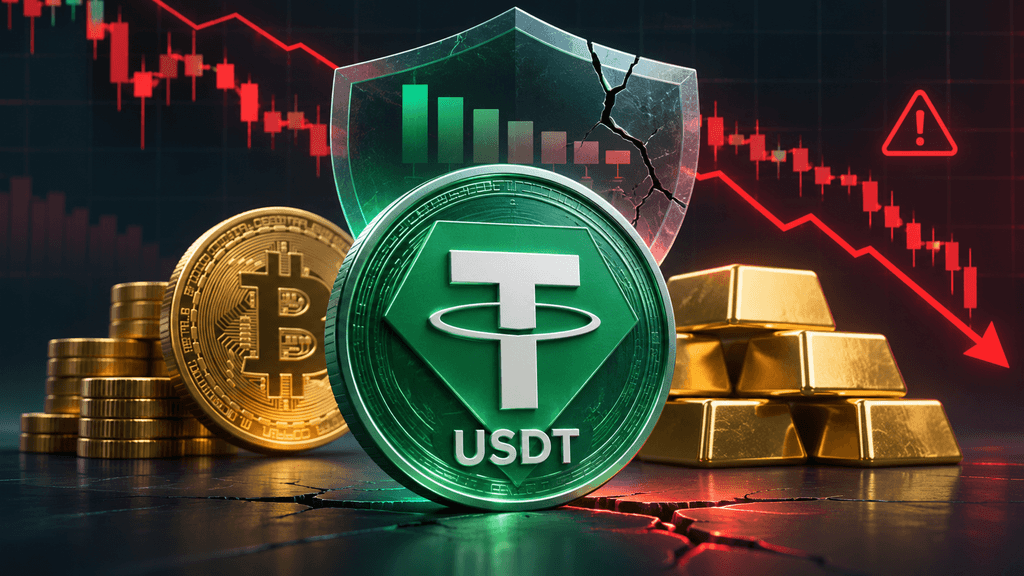
Could Tether’s Rising Exposure to Volatile Assets Weaken USDT’s Reserve Backing
Tether, the issuer of the largest dollar-pegged stablecoin by market capitalization, reported $191.45 billion in assets against $183.50 billion in liabilities as of September 30, 2026. That left an excess reserve cushion of $7.95 billion and a collateralization ratio of roughly 104.3 percent. Higher-risk holdings, including physical gold valued at $19.08 billion and Bitcoin marked at $8.37 billion, now represent a material share of the portfolio. Recent sharp declines in both assets have reduced the effective size of that cushion and prompted fresh scrutiny of whether USDT remains fully supported under stress.
The core abstract is that volatile non-cash assets several times larger than the excess buffer create the possibility that a sustained market drop could push total reserves below liabilities. S&P Global Ratings reaffirmed its lowest stability score of 5 (“weak”) for USDT on November 18, 2026, citing the rising proportion of higher-risk assets. Redemptions have continued without disruption so far, yet the narrowing margin of safety raises practical questions about liquidity, transparency, and long-term peg resilience for the more than $180 billion of USDT in circulation.
Key Takeaways
-
Tether held $191.45 billion in assets versus $183.50 billion in liabilities on September 30, 2026, creating a $7.95 billion excess cushion.
-
Gold ($19.08 billion) and Bitcoin ($8.37 billion) form a large part of the higher-risk portion of reserves.
-
S&P Global kept USDT at its weakest stability score of 5, noting higher-risk assets at 28 percent of circulating supply.
-
Bitcoin and gold price drops since the reporting date have already eroded a substantial share of the cushion.
-
Analysts estimate a further 15–20 percent decline across non-cash holdings could approach undercollateralization.
-
USDT redemptions remain orderly, with the token trading near its $1 peg.
What Does Tether’s Latest Reserve Report Show for USDT Backing
Tether’s third-quarter Financial Figures and Reserves Report, attested by BDO as of September 30, 2026, provides the most recent comprehensive snapshot of the assets supporting USDT. Total assets stood at $191.45 billion. Total liabilities reached $183.50 billion, of which the overwhelming majority related to tokens in issue. The resulting excess of $7.95 billion marked a near-doubling from the $4.11 billion reported at the end of June.
Cash-like instruments continued to dominate. U.S. Treasury bills accounted for $122.84 billion, or about 64 percent of total assets. Overnight and term reverse repurchase agreements added roughly $16.7 billion. Together, these high-quality, short-duration holdings represented the majority of the portfolio and the primary source of liquidity for redemptions. The remainder of the balance sheet contained assets whose values fluctuate with market prices or credit conditions: precious metals, Bitcoin, secured loans, public equities, and other investments.
The report valued gold using the Bloomberg closing price of $4,157.41 per ounce and Bitcoin at $83,621.23 per coin on the snapshot date. These marks contributed to the expansion of the excess cushion during the quarter, as both assets had risen from June levels. Net operating profit for the third quarter reached $1.5 billion, driven largely by income from Treasury bills and repo, bringing nine-month profit to $4.5 billion. Direct and indirect Treasury bill exposure totaled $132.4 billion according to company statements.
The attestation covers a single point in time. Activity after September 30 is not reflected in the published figures, which leaves the current real-time position dependent on subsequent price movements and any changes in holdings or liabilities.
How Much of Tether’s Reserves Are in Bitcoin and Gold
Bitcoin and physical gold together form one of the most visible and volatile components of Tether’s reserves. On September 30, the gold line stood at $19.08 billion, equivalent to roughly 10 percent of total assets and about 143 metric tons at the reported price. Bitcoin holdings were marked at $8.37 billion, corresponding to approximately 100,060 coins at the $83,621 valuation used in the report.
These two categories alone exceeded the entire excess reserve cushion. When secured loans ($14.18 billion), public equities ($4.18 billion), and other investments ($6 billion) are added, the higher-risk or non-cash portion approaches $52 billion, roughly 27–28 percent of circulating USDT and more than six times the $7.95 billion surplus. S&P Global specifically showed this concentration when it retained the “weak” stability assessment.
Company statements and on-chain estimates indicate that Tether holds additional Bitcoin outside the USDT reserve portfolio, funded from proprietary profits and excess capital. The CEO has referred to a total position near 150,000 BTC, implying tens of thousands of coins sit in a separate investment book and therefore do not appear in the attested reserves that back the stablecoin. Only the coins listed in the BDO report form part of the formal collateral calculation for USDT holders.
Gold is held as LBMA-standard physical bars. A separate Tether Gold token (XAU₮) is backed by its own allocated gold and has undergone a full KPMG audit confirming the bars, but that gold is not part of the USDT reserve pool. The dual gold exposure underscores Tether’s broader strategy of accumulating physical metal while still leaving the USDT balance sheet sensitive to daily price swings in both gold and Bitcoin.
Why Did S&P Global Keep USDT at Its Weakest Stability Score
On November 18, 2026, S&P Global Ratings reaffirmed a stability score of 5 for USDT, the lowest point on its five-point scale and the same rating assigned a year earlier. The agency’s assessment focuses on the capacity of a stablecoin to maintain its dollar peg under stress rather than functioning as a traditional credit rating.
The primary driver cited was the rising share of higher-risk assets. That category, which includes gold, Bitcoin, public equities, secured loans, corporate bonds, and certain other investments, climbed to 28 percent of circulating USDT from 24 percent the prior year. At the same time, the proportion of short-term Treasuries and Treasury-backed reverse repurchase agreements declined to approximately 72 percent from 75 percent.
S&P noted that these higher-risk holdings exceed the size of the excess reserve buffer by a wide margin. A material decline in their combined market value could therefore eliminate the surplus and leave assets short of liabilities. The agency also referenced limited public disclosure around certain counterparties, custodians, and the composition of some investment lines, as well as the fact that the first full independent audit completed in 2026 had not been released publicly at the time of the review.
Tether responded that the issue lies with S&P’s methodology rather than the quality of its reserves. The company pointed to the 104.3 percent collateralization ratio, the $7.95 billion cushion, the completed KPMG audit of its 2025 financial statements, and ongoing profitability as evidence of strength. The rating remains a point of public disagreement between the issuer and the ratings firm.
How Have Bitcoin and Gold Price Declines Affected Tether’s Excess Reserves
Between the September 30 valuation date and mid-to-late November 2026, Bitcoin declined more than 25 percent and, in some periods, exceeded 30 percent from the $83,621 mark. Gold fell roughly 15 percent from the $4,157 level used in the report. Independent analyses applying these price changes to the reported holdings, it is estimated that the combined mark-to-market loss on the two assets alone has reduced the excess cushion by approximately $5 billion.
One detailed calculation published in late November placed the residual surplus near $2.8 billion after accounting for the gold and Bitcoin moves. A brief further drop in Bitcoin toward $55,700 temporarily compressed the estimated buffer even lower. Tether’s own real-time transparency tools have at times displayed a higher residual figure, apparently reflecting Bitcoin declines while still carrying gold at the older mark or applying different internal adjustments.
Because the excess reserves function as the first line of defense against asset-price volatility, the quick shrinkage illustrates the sensitivity of the overall coverage ratio to movements in just two line items. The bulk of the portfolio remains in short-term Treasuries that do not fluctuate with crypto or precious-metal prices, yet the absolute size of the volatile sleeve means relatively modest percentage declines can consume most of the reported surplus within weeks.
What Risks Does Undercollateralization Pose for USDT Holders
Undercollateralization would mean that the market value of assets falls below the face value of outstanding USDT. In that scenario, the issuer would face a shortfall if every token holder simultaneously demanded redemption at par. Even short of a full shortfall, a thin or negative cushion can amplify confidence effects: holders may accelerate redemptions, secondary-market prices can trade at a discount, and counterparties may impose tighter limits on USDT acceptance.
The practical risk is asymmetric. High-quality liquid assets still cover the large majority of liabilities, so orderly redemptions of tens of billions of dollars remain feasible without forced sales of gold or Bitcoin. The vulnerability lies in the excess buffer itself. When higher-risk assets are multiples of that buffer, the margin for error is narrow. A simultaneous decline across gold, Bitcoin, equities, and the secured-loan book of 15–20 percent, according to several independent stress calculations, would bring total assets close to or below total liabilities on a static snapshot.
USDT continues to trade near its peg, and redemptions have proceeded normally, indicating that market participants have not treated the situation as an immediate crisis. The longer-term concern is whether repeated erosion of the cushion during market downturns gradually reduces confidence or invites greater regulatory attention to reserve composition standards.
What Role Do Secured Loans and Equities Play in Tether’s Risk Profile
Secured loans stood at $14.18 billion and public equities at $4.18 billion on the September 30 balance sheet. These categories add both yield potential and credit or market risk. The loans are described as collateralized, yet the identity of borrowers, the quality of collateral, and the terms of the facilities are not disclosed in the same granular detail as the Treasury or gold holdings. Equities introduce direct equity-market beta.
Together with gold, Bitcoin, and other investments, these lines form the higher-risk bucket that S&P and independent analysts focus on. Their combined size means that even moderate losses, whether from borrower defaults, equity-market declines, or forced liquidations, can offset gains elsewhere or further compress the excess reserves. In a broad risk-off environment, the correlations among these assets can rise, magnifying the impact on the overall surplus.
Tether has expanded these holdings over time as part of a strategy to generate returns beyond the yield available on short-term Treasuries. The trade-off is clear: higher expected income in stable markets versus greater potential drawdowns when prices fall. The Q3 report shows that price appreciation in Bitcoin and gold, rather than new purchases alone, drove much of the buffer expansion earlier in the year; the reverse dynamic is now visible.
How Has Tether Responded to Concerns About Its Reserve Cushion
Tether has consistently maintained that USDT remains fully backed and that liquidity for redemptions is the overriding priority. Company statements emphasize the size of the Treasury and repo holdings, the growth in the excess cushion during the third quarter, and the profitability of the core business. Officials have also showed the completion of a full KPMG audit of the 2025 financial statements of the USDT issuer and a separate clean audit of the Tether Gold entity.
On the specific point of S&P’s rating, Tether has argued that the methodology overweights certain asset classes and underweights the actual liquidity profile and historical performance of the stablecoin. The firm continues to publish quarterly attestations and maintains a transparency page that updates certain reserve metrics. Redemption volumes since the end of September have been substantial, approximately $8.75 billion, according to one late-November summary, yet the token has held close to par, supporting the claim that operational liquidity remains intact.
The company has not published a full real-time mark-to-market of every line item against current market prices, leaving independent analysts to apply their own estimates to the last attested figures. This gap between the quarterly snapshot and continuous market movements is the source of most of the current public discussion.
What Happens If Tether’s Non-Cash Assets Decline Further
Stress scenarios published by on-chain analysts and market commentators examine the effect of additional percentage declines across the non-cash portfolio. A further 15–20 percent drop applied to the combined gold, Bitcoin, equity, and secured-loan book would, on the September 30 base, consume the remaining estimated surplus and bring assets near or below liabilities. Because the September figures are already stale with respect to current prices, the starting point for any such calculation is lower than the published $7.95 billion.
The outcome would depend on several variables: whether Tether sells assets to rebalance, whether new capital is injected from proprietary profits, whether liabilities decline through redemptions that outpace new issuance, and whether the next attestation reflects updated marks. Historical patterns show that the buffer can expand quickly when asset prices rise and contract just as quickly when they fall. The January 2027 report covering the fourth quarter will provide the next official snapshot and will incorporate whatever price path materializes in the intervening months.
How Are USDT Redemptions Performing Amid Market Pressure
Despite the compression of the excess cushion, primary-market redemptions have continued without reported interruption. Aggregate figures indicate that roughly $8.75 billion of USDT was redeemed between the end of September and late November. Secondary-market prices have remained close to the $1 peg, with recent quotes near $0.9985. These data points suggest that demand for cash against USDT has been met from the liquid portion of the reserves and that market participants continue to treat the token as functionally interchangeable with dollars for most practical purposes.
The ability to process large redemptions without forcing sales of the more volatile holdings is the operational test of the reserve structure. So far that test has been passed. The open question is how the system would behave if redemption demand accelerated at the same time that the value of the non-cash assets continued to fall, requiring the issuer to decide whether to realize losses or allow the coverage ratio to compress further.
What Should Investors Monitor in Tether’s Upcoming Reports
The next formal attestation, expected to cover the period ending December 31, 2026, and likely published in January 2027, will be the most important near-term data point. Key items to watch include the updated values for gold and Bitcoin, any change in the size of the secured-loan book, the new excess-reserve figure, and the overall collateralization ratio. A drop in the reported surplus below previous levels, or a decline in the cash-and-Treasury share, would confirm the impact of the recent market moves.
Market participants can also track real-time indicators already available: the secondary-market price of USDT relative to the dollar, on-chain supply changes, and any official updates. Tether posts to its transparency resources. Independent stress calculations that apply current market prices to the last attested quantities remain useful until the next official numbers appear.
Continued orderly redemptions and a stable peg remain the strongest evidence that the current structure is functioning as designed for ordinary liquidity needs. The size of the volatile sleeve relative to the excess buffer is the structural feature that keeps the undercollateralization discussion alive whenever Bitcoin or gold experiences a sustained decline.
FAQs
What is the current size of Tether’s excess reserves after recent price declines?
Independent analyses that revalue the September 30 gold and Bitcoin holdings at mid-to-late November 2026 market prices estimate that the original $7.95 billion cushion has been reduced to approximately $2.8 billion and briefly lower during sharp Bitcoin drops. Tether’s own transparency tools have displayed somewhat higher residual figures at times, reflecting different marking conventions. The exact current surplus will only be known when the next attested report is published.
Why does S&P rate USDT as “weak” despite a reported surplus?
S&P’s stability score focuses on the ability to maintain the dollar peg under stress. The agency highlights that assets it classifies as higher risk now equal 28 percent of circulating USDT and are several times larger than the excess buffer. A sharp decline in those assets could therefore eliminate the surplus. Tether disputes the weighting methodology and points to its Treasury-heavy liquidity profile and historical performance.
How much Bitcoin does Tether actually hold?
The Q3 attestation lists Bitcoin valued at $8.37 billion, or roughly 100,060 coins at the September 30 price. Company executives have stated that the overall Bitcoin position is larger, near 150,000 coins, with the difference held in a proprietary investment portfolio that is not part of the USDT reserve assets.
Are USDT redemptions still functioning normally?
Yes. Aggregate redemption data show that billions of dollars of USDT have been redeemed since the end of September without reported delays or discounts at the primary level. The token continues to trade close to its $1 target in secondary markets.
Could a further drop in gold and Bitcoin leave USDT undercollateralized?
Stress calculations indicate that an additional 15–20 percent decline across the non-cash portfolio would bring total assets close to or below total liabilities on the basis of the last reported figures. Whether that outcome materializes depends on the actual price path, any rebalancing by Tether, and changes in the liability side through net redemptions.
Disclaimer: This general market information, possibly from third-party, commercial, or sponsored sources, is provided for reference and educational purposes only and does not constitute financial or investment advice, an offer, solicitation, or guarantee. We disclaim liability for its accuracy, completeness, reliability, and any resulting losses. Investments/trading are risky; past performance doesn’t guarantee future results. Users should research, judge prudently, and take full responsibility. For further details, please consult KuCoin’s Terms of Use and Risk Disclosure.