

Tesla Roadster Reveal: Why the New EV Supercar May Not Drive TSLA Stock Higher
Introduction
Tesla's next-generation Roadster is designed to showcase the company's engineering ambitions, but a dramatic reveal does not automatically translate into sustained gains for Tesla (NASDAQ: TSLA) stock. The electric supercar can generate attention, reinforce Tesla's performance-focused brand, and demonstrate new technology. However, its impact on revenue and earnings will depend on production timing, customer deliveries, manufacturing costs, and demand.
Tesla unveiled the redesigned Roadster in October 2026, positioning it as a high-performance electric vehicle with aerospace-inspired features. Yet the investment case for TSLA extends far beyond one premium car. Investors also need to evaluate vehicle deliveries, energy storage, autonomous driving, robotics, profitability, and the valuation already reflected in the share price.
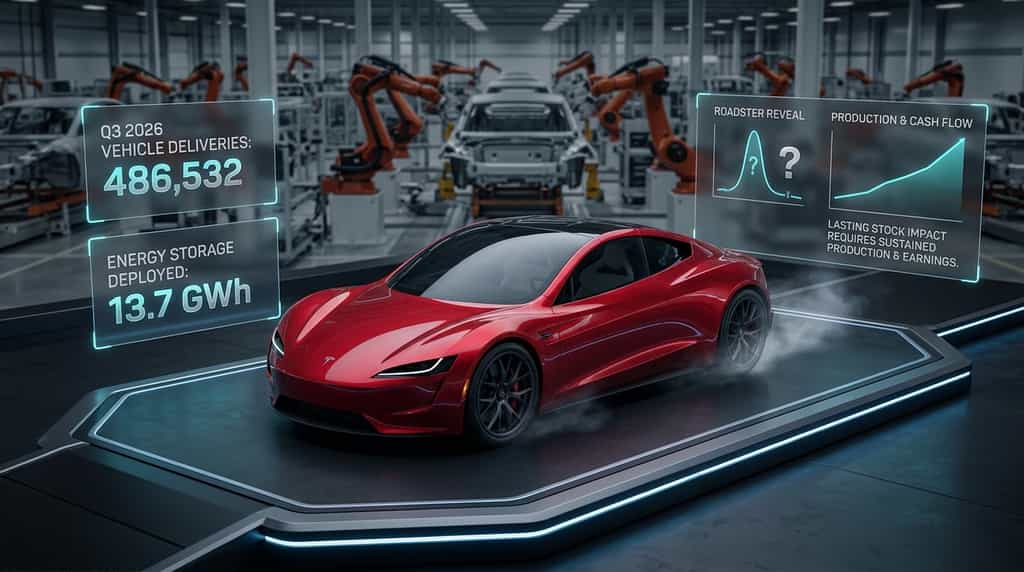
According to Tesla's official third-quarter delivery update, the company delivered 486,532 vehicles in Q3 2026 and deployed 13.7 GWh of energy storage products. These operating indicators provide broader context for assessing whether the Roadster reveal can materially change Tesla's financial outlook.
Why Is the Tesla Roadster Reveal Unlikely to Lift TSLA Stock for Long?
The Roadster reveal may support short-term investor enthusiasm, but a lasting TSLA rally requires evidence that the vehicle can contribute meaningfully to Tesla's future financial performance. A high-profile launch can strengthen brand awareness and attract attention to the company's technology. It does not, by itself, establish a new source of recurring revenue or demonstrate that earnings expectations should rise.
Tesla's Roadster has long occupied a special place in the company's product narrative. It is a premium sports car intended to demonstrate the performance potential of electric propulsion and Tesla's engineering capabilities. The latest design adds aerospace-inspired features, including cold-gas thrusters and a multi-mode suction system. These features make the vehicle a compelling showcase, but their commercial value remains a separate question.
The key distinction is between brand impact and financial impact. A launch can produce extensive online discussion, improve public awareness, and reinforce a technology-led image. For the stock to sustain a higher valuation, however, investors generally need to see a credible path from product development to production, deliveries, revenue, margins, and cash flow. Until those links become clearer, Roadster-related optimism may have a limited effect on the company's underlying earnings outlook.
There is also a timing issue. Tesla's official Roadster page promotes performance specifications and reservations, but the existence of a reservation option does not establish how many vehicles will be delivered, when volume production will begin, or how much profit each vehicle will generate. Investors should therefore distinguish announced specifications from verified production and commercial results.
How Much Revenue Could the Tesla Roadster Generate?
The Roadster's direct financial contribution is likely to depend on production volume and unit economics, not on the attention generated by its reveal. A low-volume premium sports car can strengthen a manufacturer's image, but it may have a smaller effect on total revenue than vehicles sold at scale.
Tesla's third-quarter 2026 delivery update reported 478,237 Model 3 and Model Y deliveries, compared with 8,295 deliveries across its other models. The same update reported 486,532 total vehicle deliveries. These figures show the scale difference between Tesla's mainstream vehicle lineup and its smaller product categories. The company did not report Roadster deliveries in that update.
The Roadster could still contribute value in several ways. Its premium positioning may help Tesla maintain a high-performance identity, attract customers to the brand, and showcase engineering capabilities that could inform other products. However, these indirect benefits are difficult to quantify. Investors cannot reliably translate publicity or reservation interest into future earnings without additional information about production plans, customer demand, pricing, and costs.
Why Does Production Timing Matter More Than the Reveal?
Production timing matters because a product cannot contribute material vehicle revenue until Tesla can manufacture and deliver it at commercially meaningful volumes. Delays can push revenue further into the future, increase development costs, and reduce the present value of expected cash flows.
A reservation is also not the same as a completed sale. Customers may change their plans, production specifications may evolve, and final pricing or delivery terms may differ from early expectations. Until Tesla provides clear information on production readiness and deliveries, the Roadster's financial contribution remains uncertain.
This does not mean the vehicle has no strategic value. A halo product can support brand positioning even if its direct sales are limited. The question for TSLA investors is whether that benefit is large enough to change the company's overall earnings outlook. If the Roadster remains a small part of Tesla's business, its reveal alone is unlikely to justify a major and lasting change in the stock's valuation.
What Matters More to TSLA Investors Than the Roadster?
Tesla's wider operating performance matters more to its valuation because its core vehicle business, energy operations, and longer-term technology initiatives are much larger components of the investment thesis. Investors need to evaluate whether these businesses can produce sustainable revenue growth, attractive margins, and cash generation.
The company's October 2 delivery update offers a recent snapshot. Tesla produced 464,391 vehicles and delivered 486,532 in the third quarter of 2026. It also deployed 13.7 GWh of energy storage products. Tesla cautioned in the same announcement that production and delivery numbers alone should not be treated as a reliable indicator of quarterly financial performance, which also depends on factors such as average selling prices, costs, and foreign-exchange movements.
Three areas deserve particular attention when assessing TSLA beyond the Roadster reveal.
Could Energy Storage Become a More Important Growth Driver?
Energy storage provides Tesla with a business beyond passenger vehicles. Grid-scale battery systems can serve utilities, businesses, and other customers seeking to store electricity and manage demand. The 13.7 GWh of energy storage products deployed in Q3 2026 demonstrates that this business is an active part of Tesla's operations, although deployment volume alone does not reveal segment profit or cash flow.
The investment question is whether storage growth can translate into durable earnings. Investors should monitor reported energy revenue, gross profit, deployment trends, manufacturing capacity, and demand conditions. Strong performance in this segment could support Tesla's broader financial outlook even if the Roadster contributes relatively little revenue.
How Much Value Should Investors Assign to Autonomy and Robotics?
Autonomous driving and humanoid robotics may represent substantial long-term opportunities, but their value depends on technical performance, regulatory approval, commercial adoption, and the cost of deployment. Investors should distinguish products and services that generate measurable revenue today from projects whose financial contribution remains uncertain.
Tesla's future valuation may reflect expectations for these initiatives well before they produce substantial earnings. That can create upside if commercial results exceed expectations, but it also increases the risk of disappointment if development takes longer or costs more than anticipated. Compared with the Roadster's launch event, measurable progress in autonomy, robotics, and recurring services could have a more consequential effect on long-term earnings expectations.
What Risks Could Limit the Roadster's Impact on Tesla Stock?
The main risks are production uncertainty, limited sales volume, execution costs, and a mismatch between market expectations and the vehicle's eventual financial contribution. These factors can limit the impact of a high-profile launch even when the product attracts substantial interest.
First, manufacturing a specialized sports car at scale can be more difficult than presenting a demonstration vehicle. Tesla would need to deliver the promised performance while meeting applicable safety requirements, quality standards, and customer expectations. Any delay or major specification change could weaken the initial excitement surrounding the reveal.
Second, a premium vehicle has a narrower potential customer base than a mass-market car. Even if the Roadster commands a high price, development expenses, specialized components, and limited production volume could restrict its overall contribution to profit. High selling prices do not automatically translate into high margins.
Third, investor expectations may already account for Tesla's ability to develop advanced vehicles and other technology products. If the Roadster reveal confirms what the market already anticipated, the announcement may provide little incremental information. A product launch can attract attention without materially changing the assumptions investors use to value the company.
Finally, the opportunity cost of engineering resources matters. Investors may ask whether the time, capital, and management attention allocated to a niche sports car could generate greater returns if directed toward higher-volume vehicles, energy storage, autonomy, or robotics. This is not proof that the Roadster is a poor strategic decision. It means that its value should be assessed against the returns Tesla could achieve from other priorities.
The most useful evidence will be measurable progress: a credible production schedule, confirmed customer deliveries, transparent pricing, and financial disclosures that help investors estimate the product's contribution. Until those details become clearer, the Roadster should be treated primarily as a brand and engineering milestone rather than a demonstrated earnings catalyst.
Join KuCoin's Futures Trading Competition
Looking to put your market analysis and trading skills to the test? Join the KuCoin Futures Trading Competition and explore an opportunity to compete with other traders.

Whether you are tracking AI-related stocks like Micron or following broader market trends, disciplined risk management remains essential when trading volatile assets. Before participating, review the competition rules, eligibility requirements, reward details, and trading conditions on the official event page. Futures trading involves substantial risk and may not be suitable for every trader.
Conclusion
Tesla's Roadster reveal highlights the company's engineering ambitions, but it is unlikely to be a sufficient catalyst for a sustained TSLA stock rally on its own. The vehicle could strengthen Tesla's premium brand image and demonstrate advanced electric-vehicle technology. Its direct financial impact, however, depends on production timing, delivery volume, pricing, manufacturing costs, and profitability.
Investors should place the announcement in the context of Tesla's wider business. Vehicle economics, energy storage growth, autonomous driving, and robotics are all relevant to the company's long-term valuation. Recent delivery figures provide useful operating context, but financial results are needed to assess margins and cash generation. Tesla's high valuation multiples also mean that future growth expectations matter considerably when investors assess the stock.
The key question is not whether the Roadster can attract attention, but whether it can generate measurable business value beyond the launch event. Investors should monitor official production updates, confirmed deliveries, quarterly financial results, and evidence of progress across Tesla's larger business priorities. A disciplined assessment of those factors offers a more reliable basis for evaluating TSLA than excitement surrounding a single product reveal.
FAQs
1. When will the new Tesla Roadster enter production?
Tesla's latest Roadster plans and specifications should be checked through its official Roadster page and investor announcements. A reveal or reservation option does not, by itself, confirm a firm delivery date.
2. What is the difference between Tesla's Roadster and its mass-market vehicles?
The Roadster is positioned as a premium, high-performance electric sports car, while Tesla's Model 3 and Model Y serve broader vehicle markets. Their sales volumes, production economics, and roles in Tesla's business can therefore differ substantially.
3. What should investors watch after the Roadster reveal?
Investors should monitor Tesla's official production updates, delivery figures, quarterly revenue, automotive margins, operating income, and free cash flow. These indicators help establish whether product announcements are translating into measurable financial performance.
Disclaimer: This article is for informational purposes only and does not constitute financial, legal, or investment advice. Always conduct your own research before interacting with digital assets.