

Tesla Roadster Reveal Is Unlikely to Boost TSLA Stock: Here's Why
Tesla’s Roadster Reveal Fails to Sustain TSLA Stock Gains
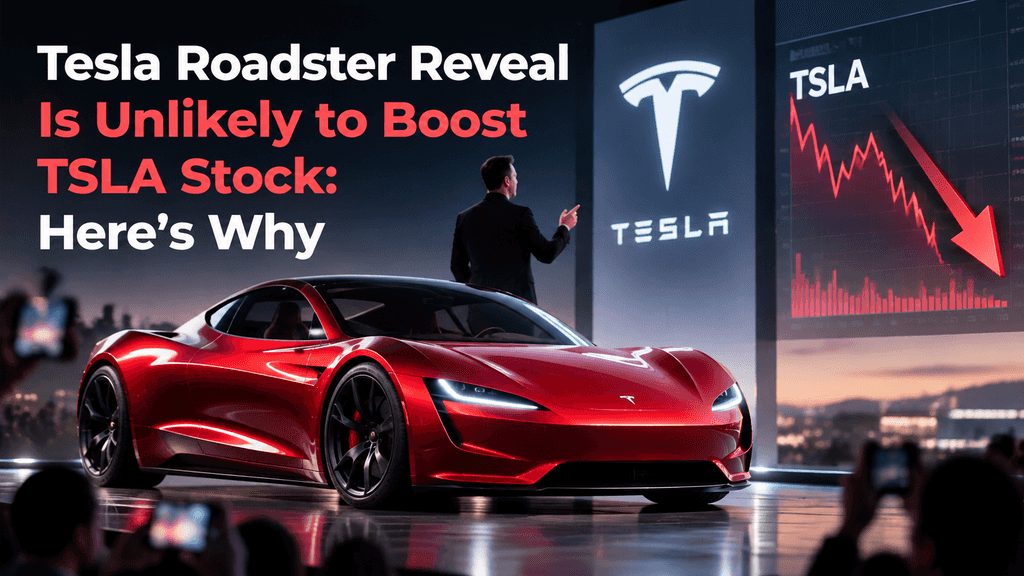
Tesla staged a dramatic reveal of its next-generation Roadster on October 15, 2026, at a SpaceX test site near McGregor, Texas. The prototype performed mid-air flips, drove inverted on a ramp using suction systems, and cleared obstacles including a Tesla Semi using cold-gas thrusters developed with SpaceX. Claims included 0-to-60 mph times near 0.8 seconds and top speeds above 230 mph across Performance, Thrust, and Rocket variants. Shares rose in premarket trading the following day, yet the gains largely reversed as regular session trading progressed, with the stock closing lower amid broader tech weakness. Production is targeted for 2028, nearly a decade after the 2017 prototype, and reservations require substantial deposits of $50,000 or $250,000 depending on trim.
Analysts have described the event as an engineering demonstration rather than a near-term earnings catalyst. Tesla’s valuation continues to rest more heavily on autonomy, robotics, and energy storage progress than on any single low-volume sports car. The Roadster reveal, while technically striking, is unlikely to deliver a sustained lift to TSLA shares because of its distant production timeline, limited expected volume, regulatory uncertainties, and the far greater weight investors place on Tesla’s core vehicle margins, free cash flow, Full Self-Driving adoption, and longer-term AI and robotaxi initiatives.
Limited Revenue Contribution Expected From Low-Volume Production
Tesla has indicated annual production volumes for the Roadster will remain modest, with some analyst estimates placing realistic sales in the low thousands of units even after 2028. At a high price point and with limited manufacturing scale, the model is projected to contribute only a few cents per share to earnings in the outer years of current forecasts. Gary Black of Future Fund noted that even optimistic assumptions of 3,000 units and $100,000 contribution per vehicle would add roughly $0.06 to 2029 earnings estimates. The company’s existing high-volume models, particularly the Model Y, continue to dominate unit sales and automotive revenue. Latest quarterly delivery figures, including 486,532 vehicles in the third quarter of 2026, already reflect the scale of the mass-market business. A halo product arriving years later cannot materially alter the near-term revenue trajectory or offset pressure from competitive pricing in the broader electric vehicle segment.
Investors tracking sequential delivery trends and automotive gross margins therefore have little reason to re-rate the stock solely based on a future sports car. Historical patterns reinforce this view. Previous Tesla product events focused on specialized vehicles have produced temporary sentiment spikes that faded once attention returned to operating metrics. The Roadster’s role as a technology showcase does not change the underlying economics of a low-volume platform that requires specialized thruster systems and faces uncertain regulatory pathways for road use. Capital and engineering resources allocated to the project must still be weighed against returns available from higher-volume platforms and autonomy software. In this context, the reveal functions more as brand reinforcement than as a meaningful addition to the financial model used by most institutional holders.
Production Timeline Extends Beyond Near-Term Valuation Horizons
Musk stated during the event that production would begin in 2028. That schedule places first customer deliveries well outside the typical 12-to-24-month windows that drive most equity valuation models. Tesla first showed a next-generation Roadster prototype in 2017 and began collecting deposits at that time. Multiple delays have followed, leaving a gap of roughly eleven years between initial announcement and planned start of production. Such extended timelines reduce the present value of any eventual cash flows and increase the risk of further slippage. Analysts covering the stock routinely emphasize nearer-term catalysts such as quarterly delivery numbers, energy storage deployments, and progress on Cybercab or Optimus production lines.
The distant timeline also means the Roadster will enter a more crowded competitive landscape for high-performance electric vehicles. By 2028, other manufacturers will have had additional years to refine their own offerings. Tesla’s own product roadmap prioritizes autonomy and robotics over expansion of its traditional vehicle lineup. Musk has previously described the Roadster as secondary to the company’s longer-term ambitions. Equity investors focused on free cash flow generation and capital expenditure discipline, therefore assign limited weight to a vehicle that remains years from volume production and still lacks a confirmed street-legal configuration for all markets.
High Valuation Already Prices in Significant Future Ambition
TSLA has traded at elevated multiples relative to traditional automakers for years, reflecting expectations for software, energy, and robotics contributions that extend beyond vehicle hardware. Recent trading levels near $370 imply substantial growth in areas such as Full Self-Driving subscriptions and robotaxi operations. A low-volume sports car, even one with novel thruster technology, does not expand the addressable market in those higher-multiple segments. Gene Munster of Deepwater Asset Management characterized the demonstration as an engineering flex with limited commercial value beyond demonstrating technical capability.
Market reactions after the reveal, initial premarket gains followed by a reversal, illustrate how quickly attention returned to broader valuation concerns and sector-wide selling pressure. Forward earnings estimates for the coming years already incorporate optimism around autonomy and energy storage. Adding a few thousand high-priced units annually does not meaningfully alter those projections. Investors monitoring the stock have repeatedly shown greater sensitivity to margin trends, capital spending intensity, and concrete milestones in robotaxi deployment than to product spectacle. The Roadster therefore sits outside the primary drivers currently embedded in the share price.
Regulatory and Legal Uncertainties Cloud Commercial Path
Musk acknowledged during the event that the thruster-equipped versions may not be legal in every jurisdiction. Cold-gas systems and aerial maneuvers raise questions about vehicle classification, safety certification, and road-use approval that traditional sports cars do not face. Florida Governor Ron DeSantis publicly stated support for making the vehicle legal in that state, yet broader federal and international frameworks remain undefined. Any production version intended for public roads will need to navigate these hurdles, potentially delaying or restricting sales in key markets.
Reservation language itself underscores the conditional nature of the project. Agreements provide approximate positioning in line rather than firm delivery commitments. Historical experience with other delayed Tesla products has left some customers cautious about timelines. These factors combine to limit the near-term commercial certainty surrounding the Roadster and reduce its ability to support a sustained re-rating of the shares.
Core Automotive Margins and Cash Flow Remain Primary Focus
Tesla reported third-quarter 2026 deliveries of 486,532 vehicles, exceeding consensus expectations, yet sequential margin trends and free cash flow generation continue to draw closer scrutiny. Automotive gross margins have faced pressure from pricing competition and product mix shifts. Capital expenditure remains elevated as the company invests in autonomy infrastructure, manufacturing capacity, and robotics. Second-quarter free cash flow turned negative after accounting for heavy investment. The October 21, 2026 earnings report is expected to provide updated visibility on these metrics.
A future low-volume sports car does not alter the immediate dynamics of the mass-market vehicle business. Investors evaluating the stock place greater emphasis on whether operating cash flow can support planned spending while margins stabilize. Progress on energy storage deployments and services revenue offers more measurable near-term contributions than a vehicle still years from production. The Roadster’s reveal does not change the hierarchy of these operational priorities.
Autonomy and Robotaxi Progress Carry Greater Weight
Tesla’s valuation narrative centers on Full Self-Driving software, robotaxi services already operating in multiple U.S. metro areas, and the Cybercab platform. Active FSD subscriptions have grown substantially, and the company continues to expand unsupervised driving capabilities. These initiatives target recurring software revenue and network effects that a one-time hardware sale of a sports car cannot match. Analysts consistently identify autonomy milestones as higher-impact catalysts for the share price than traditional vehicle launches.
The Roadster event, held at a SpaceX facility and featuring thruster technology, has fueled speculation about closer operational ties between the two companies. Yet even that narrative depends on future corporate decisions rather than on near-term Roadster economics. Progress reports on robotaxi utilization rates, Cybercab production, and Optimus development remain more relevant to the investment case than a delayed halo vehicle.
Rival EV Makers Challenge the Roadster’s Potential Brand Boost
The electric vehicle market has expanded significantly since the original Roadster concept appeared. Competitors now offer a wider range of performance-oriented models, and Chinese manufacturers in particular have scaled production of both mass-market and higher-end vehicles. Tesla’s own volume leadership rests on accessible models rather than ultra-premium sports cars. A new Roadster arriving in 2028 will compete in a more mature segment where differentiation depends less on acceleration claims alone and more on software, charging infrastructure, and brand perception already established by the broader lineup.
Market share dynamics and pricing pressure in core segments therefore exert stronger influence on near-term results than any single limited-edition product. Investors monitoring competitive intensity correctly assign limited incremental value to a low-volume addition that arrives after the competitive ecosystem has continued to evolve.
How Past Product Events Have Influenced Stock Prices
Prior Tesla product reveals have often produced short-lived trading responses followed by reversion as attention shifted back to quarterly metrics. The 2024 Cybercab event, for example, was followed by share price pressure once investors assessed the level of operational detail provided. The Roadster demonstration generated similar initial interest that proved transient once regular trading resumed and broader market conditions asserted themselves.
This pattern suggests that spectacle alone has limited lasting power when fundamental questions about margins, cash flow, and autonomy timelines remain unresolved. The brief premarket move higher on October 16, and subsequent fade illustrate the same dynamic. Institutional holders appear to treat such events as confirmatory of engineering capability rather than as independent valuation drivers. Sustained share price support continues to require measurable progress on higher-priority initiatives.
SpaceX Collaboration Signals Broader Ambitions More Than Roadster Sales
The choice of a SpaceX facility and the integration of thruster technology have intensified discussion of the potential for closer alignment between Tesla and SpaceX. Some analysts interpret the demonstration as a visible illustration of shared engineering resources and possible future corporate combination. Odds of a merger by certain future dates have moved in prediction markets following the event. That narrative may influence longer-term strategic views of Tesla, yet it remains distinct from the commercial contribution of the Roadster itself.
Any corporate combination would involve separate regulatory, valuation, and operational considerations far beyond the sale of a few thousand sports cars. The Roadster demonstration may serve as a proof point for technical collaboration, but equity investors still require concrete timelines and financial frameworks before assigning material value to such possibilities. Near-term stock performance therefore continues to hinge more on Tesla’s standalone operating results.
Energy Storage and Services Provide Clearer Near-Term Growth Paths
Tesla’s energy storage deployments and services revenue have shown stronger sequential growth rates than some vehicle metrics in recent periods. These segments generate higher margins in certain quarters and benefit from different demand drivers than passenger vehicles. Progress here offers measurable contributions to the overall financial profile without depending on a 2028 vehicle launch. Investors seeking tangible growth levers within the current business have clearer visibility into energy and services than into a still-distant sports car program.
The Roadster does not compete with or enhance these areas. Capital allocation decisions that prioritize energy manufacturing or service network expansion can produce nearer-term returns than resources devoted to a specialized vehicle platform. This hierarchy of opportunities further limits the Roadster’s ability to drive a sustained change in share price direction.
Investor Attention Remains Fixed on October Earnings and Delivery Trends
Tesla is scheduled to report third-quarter 2026 results after the close on October 21. Consensus expectations center on adjusted earnings and revenue figures that reflect the current vehicle and energy businesses. Delivery numbers already released provide one data point; margin details, cash flow statements, and commentary on autonomy and capital plans will shape the subsequent reaction.
The Roadster reveal occurred too close to this reporting date to displace focus from the operating numbers. Past experience shows that product events rarely override the information contained in a full quarterly report. Guidance on production plans, pricing trends, and investment levels carry greater weight for valuation than a demonstration of thruster technology. The sequence of events therefore places the Roadster in a supporting rather than leading role for near-term stock performance.
Engineering Credibility Does Not Automatically Translate to Earnings Growth
The demonstration successfully showcased advanced control systems, rapid acceleration, and novel propulsion integration. These capabilities reinforce Tesla’s engineering reputation and may support brand perception among enthusiasts. Yet engineering credibility alone has not historically been sufficient to expand valuation multiples when volume, margin, and cash flow trends face pressure. The distinction between impressive prototypes and scalable, profitable products remains central to how institutional investors assess the company.
Musk himself has characterized the Roadster in secondary terms relative to the company’s larger ambitions. That framing aligns with the limited commercial expectations expressed by multiple independent analysts. Credibility in one specialized domain does not substitute for progress across the higher-volume and higher-margin initiatives that currently define the investment case.
Valuation Multiples Leave Limited Room for Low-Impact Catalysts
TSLA’s elevated price-to-earnings and enterprise-value multiples already incorporate optimistic assumptions about future software and robotics contributions. Incremental news that does not expand those assumptions or accelerate their realization tends to produce only temporary trading responses. The Roadster’s distant timeline and modest projected contribution leave it outside the set of catalysts capable of supporting a durable multiple expansion.
Analysts maintaining moderate buy ratings and price targets in the low-to-mid $400 range have continued to emphasize autonomy and energy over traditional vehicle launches. In this valuation environment, the burden of proof for any new product remains high. A demonstration that generates headlines but does not alter the near-term financial model is unlikely to shift the consensus view of fair value. Share price movements after the event have been consistent with that assessment.
🔥 Beyond the Headlines: What KuCoin 5.0 Means for You
Market news moves fast — but where you act on it matters just as much. This October, KuCoin launches KuCoin 5.0, transforming KuCoin into a rebuilt platform. Here's what actually changes for you:
-
One account for everything. Older platforms split your money across separate "spot," "margin," and "futures" accounts and expected you to understand why. KuCoin 5.0's unified account removes that entirely — deposit once, and everything is simply there (only available to VIPs for now).
-
Real-world assets (RWA). Tokenized exposure to traditional assets like commodities, right inside your crypto account. One of the fastest-growing segments in global finance is no longer reserved for institutions — you access it from the same balance you trade with.
-
Earn while you learn. Not ready to trade? KCUSD lets your stablecoins earn daily, auto-compounding interest. The lowest-stress way to put your idle deposit to work for 4% yield.
-
An AI assistant in plain language. Ask questions, get market context, understand what you're looking at — built into the platform, no jargon required.
-
An app that doesn't overwhelm. Faster, cleaner, and consistent — intuitive from the first tap, not after a tutorial.
-
Safety you can check, not just trust. A MiCAR-licensed EU entity, Proof of Reserves you can verify yourself, and internationally certified security (SOC 2 Type II, ISO 27001:2022).
Create your account in minutes — and start on the platform built for where crypto is going, not where it's been.
FAQs
What specific performance claims did Tesla make for the new Roadster during the October 15 event?
When does Tesla plan to begin production of the next-generation Roadster?
Musk indicated production would start in 2028. That timeline extends more than a decade from the original 2017 prototype reveal and leaves several years of development, testing, and certification still ahead. Historical delays on other Tesla products have led some observers to treat the 2028 target as provisional until further milestones are confirmed.
How did TSLA shares react in the days following the Roadster reveal?
Shares rose several percent in premarket trading on October 16 before giving back most of the gains during regular session trading amid broader technology sector weakness. Subsequent sessions showed mixed performance influenced by overall market conditions and anticipation of the October 21 earnings report rather than sustained momentum from the product event.
Do analysts expect the Roadster to contribute meaningfully to Tesla’s earnings?
Most coverage describes the vehicle as a low-volume halo product with limited earnings impact. Estimates of a few thousand units annually and high per-unit contribution still translate to only a few cents of incremental earnings per share in the outer years of current forecasts. Greater attention remains focused on volume vehicle margins, energy storage, and autonomy software.
What role did SpaceX technology play in the demonstration?
Cold-gas thrusters developed with SpaceX enabled the mid-air flips and obstacle-clearing maneuvers shown at the McGregor site. The collaboration has renewed discussion of possible closer operational or corporate ties between the two companies, though any such combination would involve separate strategic and regulatory considerations beyond the Roadster itself.
How does the Roadster fit into Tesla’s broader product strategy?
Musk has described the vehicle as secondary to the company’s primary focus on autonomy, robotics, and energy. The Roadster is positioned as Tesla’s remaining manually driven performance car in a future dominated by robotaxi and humanoid platforms. This framing limits its weight in valuation models centered on software and network effects.
Disclaimer: This content is for informational purposes only and does not constitute investment advice. Investments carry risk. Please do your own research (DYOR).