

Tesla and SpaceX Merger Talks Accelerate: Could a $3.47 Trillion Deal Be Announced in December 2026?
Introduction
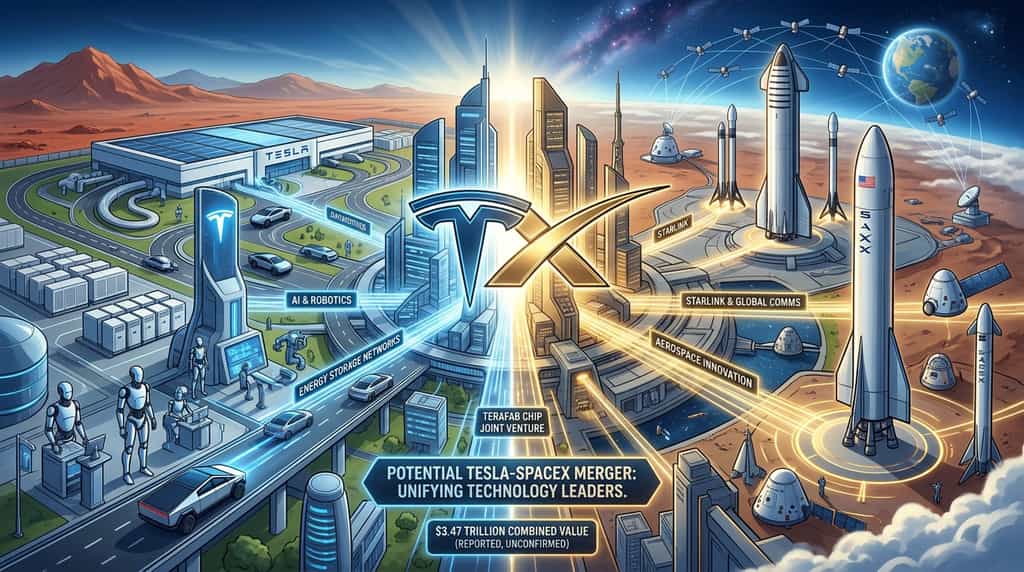
Tesla and SpaceX are reportedly making progress toward a potential merger, with an announcement possible as early as December 2026. If completed, the combination would bring electric vehicles, energy storage, aerospace, satellite communications, artificial intelligence (AI), and robotics under one corporate structure. Based on the market capitalizations cited in the reference report, the two companies have a combined value of approximately $3.47 trillion.
However, the reported figure is not a confirmed transaction valuation, and neither company has announced a definitive merger agreement. The negotiations still involve unresolved questions about transaction terms, shareholder interests, corporate governance, and regulatory review. The potential deal is therefore best understood as a major strategic possibility rather than a completed corporate transaction.
Quick Answer: What Is Happening Between Tesla and SpaceX?
Tesla and SpaceX are reportedly advancing discussions about a potential business combination, but the transaction remains unconfirmed.
-
Potential timing: An announcement could come as early as December 2026, although discussions may extend into early 2027.
-
Combined market value: The reference report places their combined market capitalization at approximately $3.47 trillion, based on separate valuations of about $1.57 trillion for Tesla and $1.90 trillion for SpaceX.
-
Strategic rationale: A combination could connect AI, robotics, electric vehicles, energy infrastructure, satellite networks, and aerospace operations.
-
Shareholder implications: The exchange ratio, transaction structure, and governance arrangements have not been disclosed.
-
Major obstacles: SpaceX's government and defense-related contracts, Tesla's international operations, shareholder approval, and regulatory scrutiny could complicate the process.
Why Are Tesla and SpaceX Considering a Merger?
The potential merger reflects an effort to bring several businesses built around AI, computing infrastructure, energy, and advanced engineering into a more closely integrated corporate structure.
Tesla and SpaceX operate in different industries, but their long-term technology requirements increasingly overlap. Tesla develops electric vehicles, energy storage systems, autonomous driving technology, and humanoid robots. SpaceX focuses on launch services, spacecraft, and Starlink satellite communications. Both businesses require substantial investment in computing, advanced chips, power systems, and engineering infrastructure.
Elon Musk has publicly expressed support for exploring a combination. During SpaceX's third-quarter earnings call in October 2026, he described a merger with Tesla as a good idea and confirmed that independent-director committees had been established to examine the possibility. The companies' discussions have therefore progressed beyond informal speculation, although this does not establish that an agreement has been reached.
Tesla's quarterly filing for the period ended September 30, 2026, provides an important qualification. It confirms that Tesla's board formed a special committee of disinterested directors to explore a deeper relationship with SpaceX, potentially including a business combination. The filing also states that there is no assurance that a transaction will be completed. Any agreed transaction would require the committee's recommendation and, where applicable, shareholder approval.
How Could a Tesla-SpaceX Merger Reshape Their AI and Technology Businesses?
The strongest strategic argument for combining the companies is the possibility of coordinating resources across several technology-intensive industries.
AI, Chips, and Computing Infrastructure
AI is a common requirement across Tesla's and SpaceX's future business plans. Tesla's autonomous driving systems and Optimus humanoid robots depend on increasingly sophisticated models, training infrastructure, and specialized processors. SpaceX's expanding satellite network and potential space-based computing initiatives also require advanced computing capabilities.
A closer corporate relationship could allow the companies to coordinate chip development, computing capacity, and infrastructure investment. This may reduce duplicated spending or improve the allocation of engineering resources. However, the actual financial benefits would depend on whether integration produces measurable improvements in costs, performance, or revenue.
One existing area of cooperation is Terafab, a chip manufacturing joint venture involving Tesla and SpaceX. Musk said during the October earnings call that the project was expected to produce its first test chips around May or June 2027, with volume production targeted for the third quarter of 2028. These are stated project targets, not completed production milestones.
Terafab illustrates why the companies may see value in deeper cooperation. Tesla needs computing capacity for autonomous driving and robotics, while SpaceX may require advanced processors for satellite networks and other infrastructure. A shared semiconductor initiative could support both businesses, although its commercial viability and production scale remain to be demonstrated.
Energy, Robotics, and Aerospace
Energy is another potential connection. Tesla's battery storage and power-management technologies could have applications across large-scale computing infrastructure, while SpaceX's launch and satellite operations require reliable power systems and advanced engineering.
Robotics also creates possible areas of cooperation. Tesla's Optimus program focuses on humanoid robots for industrial and other applications. SpaceX operates in technically demanding manufacturing and aerospace environments where automation could be relevant. A shared engineering ecosystem might support research and manufacturing efficiencies, but the practical benefits would depend on deployment costs, reliability, and operational requirements.
The potential combination would therefore connect businesses with overlapping technological needs, rather than simply placing unrelated companies under one parent organization. Still, shared technology requirements do not automatically establish that a full corporate merger would create more value than commercial partnerships or joint ventures.
Could the Announcement Be Delayed Beyond December 2026?
December is a reported possibility, not a confirmed deadline. According to reporting on November 12, 2026, the discussions have progressed, and an announcement could come as early as December. The same reports indicate that the companies have also considered a timeline extending into early 2027.
Several unresolved matters could affect the schedule:
-
Transaction valuation: The companies need to determine how each business should be valued for the purposes of a potential combination.
-
Shareholder arrangements: The exchange ratio, ownership allocation, and voting structure must be negotiated.
-
Board recommendations: The independent committees must complete their review and determine whether the proposed terms are appropriate.
-
Regulatory considerations: The companies need to assess the implications for government contracts, sensitive operations, and international business activities.
-
Final documentation: A binding agreement would require detailed legal, financial, and governance provisions.
The existence of special committees indicates that the companies are examining the possibility through formal corporate processes. It does not mean that negotiations have reached a final stage. Even if the parties agree on the broad strategic rationale, the detailed terms may take additional time to resolve.
Conclusion
The potential Tesla-SpaceX merger represents a major strategic development because it could bring electric vehicles, energy storage, aerospace, satellite communications, AI, and robotics into a single corporate structure. The approximately $3.47 trillion combined market value cited in the reference report illustrates the scale of the businesses involved, but it should not be confused with a confirmed transaction valuation.
The discussions appear to have advanced beyond informal speculation: both companies have established independent-director committees, and Musk has publicly supported exploring a combination. Nevertheless, the transaction remains subject to unresolved questions about valuation, ownership allocation, governance, shareholder approval, and regulatory review. A December announcement is possible, but early 2027 remains another reported scenario.
Ultimately, the significance of the proposal will depend less on the headline size than on the terms and execution. Whether a unified structure can generate measurable benefits beyond existing partnerships and joint ventures remains an open question. Until a definitive agreement and its conditions are disclosed, the merger should be treated as a developing corporate transaction rather than an accomplished restructuring.
FAQs
-
Are Tesla and SpaceX officially merging?
No definitive merger agreement has been announced. Both companies have established independent-director committees to explore a deeper relationship that could include a business combination.
-
When could Tesla and SpaceX announce a merger?
An announcement could come as early as December 2026, according to media reports citing people familiar with the discussions. The timeline could also extend into early 2027.
-
Why are Tesla and SpaceX considering a merger?
The companies have overlapping technology requirements in AI, chips, computing infrastructure, energy, and robotics. A combination could allow closer coordination of investment and engineering resources, although the financial benefits have not been established.
Disclaimer
This general market information, possibly from third-party, commercial, or sponsored sources, is provided for reference and educational purposes only and does not constitute financial or investment advice, an offer, solicitation, or guarantee. We disclaim liability for its accuracy, completeness, reliability, and any resulting losses. Investments/trading are risky; past performance doesn’t guarantee future results. Users should research, judge prudently, and take full responsibility. For further details, please consult KuCoin’s Terms of Use and Risk Disclosure."