

Tesla and SpaceX Merger in 2026: Valuation, Strategic Synergies, and Key Risks
Introduction
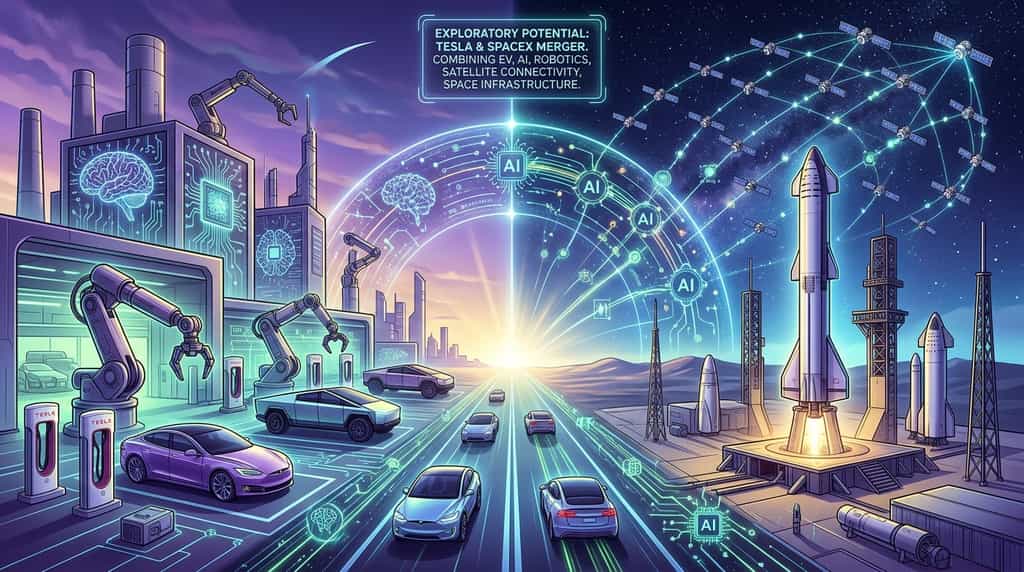
Could a merger between Tesla and SpaceX create a technology group spanning electric vehicles, satellite connectivity, artificial intelligence, robotics, and space infrastructure? As of October 22, 2026, the possibility is under formal exploration: both companies have established independent special committees to evaluate a potential combination, but no final agreement or merger terms have been announced. The outcome will depend on valuation, shareholder approval, governance, and whether the strategic benefits justify the complexity of combining two very different businesses.
The strategic case centers on shared ambitions in AI computing, chip design, robotics, manufacturing, and connectivity. Yet the companies also have distinct operating models, capital requirements, and risk profiles. Tesla generates revenue from vehicles, energy storage, and related services, while SpaceX operates launch services and Starlink and has expanded into AI infrastructure.
For investors, the central question is not simply whether a merger sounds ambitious. It is whether a transaction could create measurable long-term value for shareholders after accounting for the price paid, execution challenges, and governance risks.
What Could a Tesla-SpaceX Merger Be Worth?
The value of a combined Tesla and SpaceX would depend on the standalone value of each business, the terms of the transaction, and the additional cash flows that the combination could realistically generate. A headline valuation alone would not show whether the deal benefits Tesla shareholders, SpaceX shareholders, or both.
Investors should distinguish between three separate measures: the market value of each company before a transaction, the value implied by the merger terms, and the potential value of the combined business after synergies and integration costs. These figures can differ significantly. Even a transaction that creates a very large company can destroy value if one side pays too much or if expected benefits fail to materialize.
How Should Investors Assess Tesla's Valuation?
Tesla's valuation reflects more than its current vehicle sales. Investors also assess its energy-storage business, software, autonomous-driving ambitions, robotics development, brand, manufacturing scale, and expected future profitability. The challenge is that some of these opportunities are more mature than others, so they should not all be valued as though they already generate stable cash flow.
According to Tesla's third-quarter 2026 financial summary, the company reported revenue of $28.046 billion, broadly unchanged year over year. Gross profit reached $5.494 billion, up 9%, while GAAP net income attributable to common shareholders was $787 million, down 43%. Operating income was $718 million, and the operating margin was 2.6%.
These results illustrate why a merger analysis should examine operating performance rather than relying solely on excitement about future technology. Tesla has substantial manufacturing and software ambitions, but current profitability remains important when estimating how much financial flexibility it can contribute to a combined group.
The valuation question is whether Tesla's expected future cash flows justify the value assigned to its equity. Investors should examine vehicle margins, delivery trends, energy deployments, capital expenditure, and the pace at which software and other businesses contribute to earnings. If the merger requires Tesla shareholders to accept a low relative valuation or substantial dilution, even attractive strategic prospects might not translate into a favorable financial outcome.
How Should Investors Assess SpaceX's Valuation?
SpaceX's valuation should reflect its launch business, Starlink connectivity, AI infrastructure, future launch capacity, and the execution risks associated with large-scale engineering projects. Its mix of established services and capital-intensive growth initiatives makes it different from a conventional automaker.
According to SpaceX's third-quarter 2026 results filed with the SEC, revenue reached $14.6 billion, up 161% year over year. The company reported $2.8 billion in operating income, $4.4 billion in net income, and $8.8 billion in adjusted EBITDA. Its results cited growth in AI-related services and connectivity as major contributors.
Those figures provide a stronger foundation for valuation than speculation alone, but rapid revenue growth does not automatically establish an appropriate equity value. Investors still need to assess earnings quality, recurring versus project-based revenue, the cost of expanding computing capacity, the economics of Starlink, and future funding requirements.
A merger model should also avoid counting the same opportunity twice. If SpaceX's AI infrastructure supports Tesla's future products, the value of that collaboration should be reflected in the combined forecast without being separately added to both companies' standalone valuations as though it were two independent sources of profit.
What Strategic Benefits Could a Merger Deliver?
A merger could create value if Tesla and SpaceX share technology, infrastructure, and engineering capabilities more efficiently than they could as separate companies. The most credible areas for potential collaboration are AI computing, semiconductor design, robotics, energy systems, manufacturing, and satellite connectivity. However, each benefit would need a clear operating plan and measurable financial targets.
Could AI Infrastructure Connect the Two Businesses?
AI infrastructure is one of the clearest strategic links between the companies. Tesla develops AI systems for driving, robotics, and real-world automation, while SpaceX has expanded its computing infrastructure and AI-related services. A combined organization could coordinate hardware development, compute deployment, and software engineering across these activities.
The opportunity is not simply to combine two AI budgets. It is to improve the productivity of capital and engineering resources. Shared chip design, infrastructure procurement, model development, and computing capacity could reduce duplicated work or speed up development. The benefit would be greatest if the companies can demonstrate lower costs, shorter development cycles, or commercially useful products that would be difficult to build as efficiently on their own.
The risks are equally important. AI infrastructure requires substantial investment, and computing capacity can become expensive before it generates adequate returns. A merger could also concentrate capital allocation decisions within a larger organization, making it harder for shareholders to evaluate the performance of individual projects. Investors should look for evidence that shared infrastructure improves returns on investment rather than merely increasing spending.
Could Robotics and Manufacturing Create Operating Synergies?
Tesla's manufacturing systems, battery technology, power electronics, and robotics work could complement SpaceX's experience in advanced engineering, high-reliability hardware, and rapid prototype development. A combined group might coordinate component sourcing, production techniques, testing processes, and selected engineering resources.
For example, improvements in motors, batteries, power management, and automated production could be relevant across multiple hardware programs. Shared purchasing might also improve negotiating power with suppliers. However, aerospace and automotive production have different certification requirements, quality controls, and operating environments. Components cannot simply be transferred from one industry to the other without substantial engineering and validation.
The financial test is whether these collaborations generate incremental profit or reduce costs beyond what each company could achieve through ordinary commercial agreements. Tesla's third-quarter financial disclosure recorded purchases and sales involving SpaceX, demonstrating that some commercial links already exist. A merger would therefore need to create benefits beyond transactions that the companies can already conduct separately.
Could Starlink Strengthen Tesla's Connectivity and Software Strategy?
Starlink could potentially support connectivity-related services for vehicles, robotics, industrial equipment, or remote operations. Satellite connectivity may be particularly useful where terrestrial networks are unreliable or unavailable. A closer relationship could also simplify technical planning across connected products and infrastructure.
However, a potential use case is not the same as a commercially validated product. Tesla would need to evaluate hardware costs, power consumption, network coverage, service quality, regulatory requirements, and customer demand before deploying satellite connectivity at scale. Many everyday vehicle applications already rely on terrestrial networks, so satellite services would need to offer a meaningful advantage in specific scenarios.
Investors should also consider whether a formal merger is necessary. Commercial partnerships, supply agreements, and joint development projects can deliver some of these benefits while preserving separate corporate structures. If contracts can achieve similar outcomes at lower cost and with fewer governance complications, the case for combining the companies becomes less compelling.
What Are the Biggest Risks of a Tesla-SpaceX Merger?
The main risks are valuation disagreements, conflicts of interest, integration complexity, high capital requirements, and regulatory scrutiny. The companies operate in different industries and have different shareholder bases, so a successful transaction would require more than a compelling technology narrative.
Could the Deal Create Conflicts of Interest?
Governance is a central concern because Elon Musk leads both companies and has significant interests in each. A merger could alter the distribution of economic value and voting influence between shareholder groups. Even if the transaction has strategic merit, investors need assurance that the terms are fair to shareholders on both sides.
The use of independent special committees is relevant because directors can evaluate the proposal separately from executives whose personal interests may be affected. Investors should look for independent financial advice, transparent disclosure of valuation methods, clear procedures for handling conflicts, and appropriate shareholder voting arrangements.
The key question is whether each shareholder group receives fair consideration relative to the assets, cash flows, risks, and future opportunities it contributes. A transaction that benefits the combined organization overall can still disadvantage one group if the exchange ratio allocates too little of the future value to its shareholders.
Could Integration Costs Outweigh the Benefits?
Tesla and SpaceX have different customers, production cycles, operating requirements, and regulatory environments. Combining their management structures and financial systems could introduce additional complexity without necessarily improving day-to-day execution.
Integration could divert senior management attention from vehicle production, energy deployment, launch operations, connectivity expansion, and AI development. It could also create uncertainty for employees, suppliers, customers, and business partners. If the merger involves major changes to reporting lines or capital allocation, individual business units may find it harder to make decisions quickly.
A credible merger plan should identify specific synergies, assign accountability for delivering them, estimate implementation costs, and establish a timeline for measuring results. Broad claims about collaboration are insufficient. Investors need to know which costs will be reduced, which revenue opportunities are realistic, and how long it could take for the benefits to appear.
Join KuCoin's Futures Trading Competition
Looking to put your market analysis and trading skills to the test? Join the KuCoin Futures Trading Competition and explore an opportunity to compete with other traders.
Whether you are tracking AI-related stocks like Micron or following broader market trends, disciplined risk management remains essential when trading volatile assets. Before participating, review the competition rules, eligibility requirements, reward details, and trading conditions on the official event page. Futures trading involves substantial risk and may not be suitable for every trader.
Conclusion
A potential Tesla and SpaceX merger could unite electric vehicles, energy storage, satellite connectivity, launch services, AI computing, and robotics within one corporate group. Its strongest strategic argument is that shared infrastructure, engineering expertise, and technology development could create efficiencies that are difficult to achieve through separate operations. Recent company disclosures show that both businesses have substantial operating activities, while SpaceX's reported growth in connectivity and AI-related services adds another dimension to the strategic discussion.
However, the proposal remains exploratory as of October 22, 2026. No final terms have been announced, and the value of any transaction would depend on the relative valuations, exchange ratio, shareholder protections, regulatory requirements, and costs of integration. A larger company is not automatically a more valuable investment, particularly if projected synergies fail to materialize or one shareholder group receives unfavorable terms.
Investors should therefore prioritize official disclosures, independent valuation analysis, and measurable financial benefits over speculation. The most constructive outcome would be a transaction that strengthens both businesses while maintaining disciplined capital allocation and transparent governance. Until the companies provide definitive terms, the merger should be treated as a developing possibility, not a guaranteed catalyst for either stock.
FAQs
1. Who would own the combined Tesla and SpaceX company?
Ownership would depend on the final transaction structure and exchange ratio. Without a definitive agreement, the percentage of the combined company that each shareholder group would own cannot be established reliably.
2. Would Tesla shareholders automatically receive SpaceX shares?
Not necessarily. Shareholder consideration would depend on whether the transaction uses a share exchange, cash payment, or another structure. The final agreement would specify how existing shares are treated.
3. Would a merger change Tesla's stock ticker?
That would depend on the legal structure, listing arrangements, and decisions disclosed as part of the transaction. Investors should wait for official announcements rather than assume Tesla's ticker or listing would change.
Disclaimer: This article is for informational purposes only and does not constitute financial, legal, or investment advice. Always conduct your own research before interacting with digital assets.