

Tax Deduction for Long-Term Savings in Russia from September 1, 2026: Conditions, Limits, and Calculation of PIT Refund
Introduction
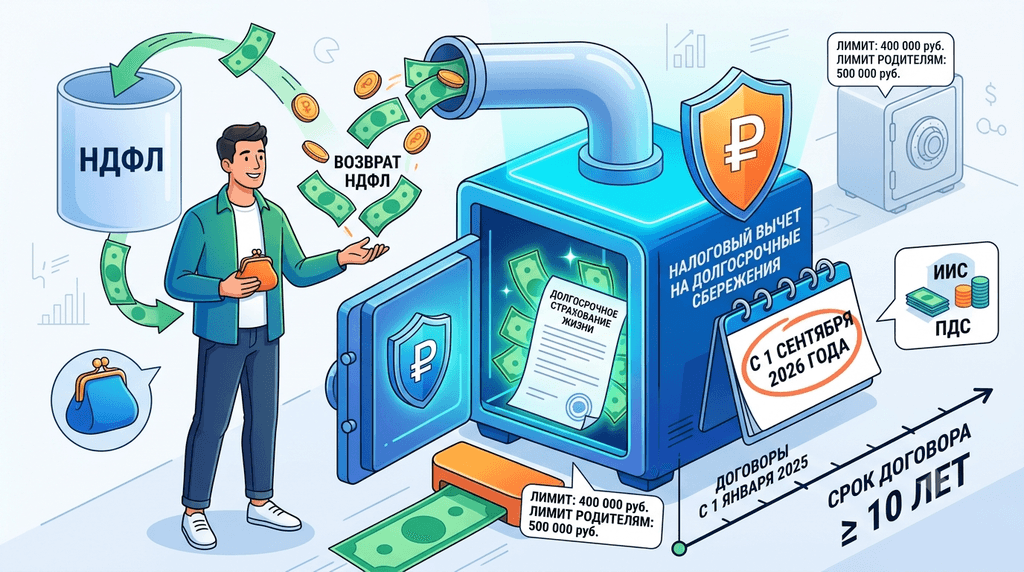
Is it possible to return part of the personal income tax (PIT) already paid if money is directed not to a regular deposit, but to long-term life insurance? From September 1, 2026, the answer became positive: insurance premiums under qualifying voluntary life insurance contracts are included in the tax deduction for long-term savings. The new rules apply to contracts concluded starting January 1, 2025, but the deduction itself is capped at a tax base of 400,000 rubles per year. For parents making contributions in favor of children, the limit can reach 500,000 rubles. This is not a payout from the state or income under the policy, but a refund of a portion of PIT based on confirmed expenses and the applicable tax rate. The main conditions are a contract term of at least 10 years until the first payout, an eligible insurance product, and the presence of taxable income.
What Has Changed in the Long-Term Savings Tax Deduction
The main change is the expansion of the list of long-term instruments: from September 1, 2026, premiums under long-term voluntary life insurance contracts were included. Previously, the deduction already applied to contributions to the long-term savings program (PDS) and to investments through an individual investment account (IIS). State Duma TV reported this on September 1, 2026, citing active provisions of the Tax Code.
The new mechanism should be understood as a unified deduction across multiple areas, rather than a separate guaranteed bonus for each policy. If a taxpayer simultaneously tops up an IIS, a long-term savings program, and an insurance contract, the expenses are accounted for within a single annual limit. Therefore, holding three products does not mean automatically tripling the maximum refund amount.
Which Contracts Are Eligible
The deduction does not apply to just any policy, but to a long-term voluntary life insurance contract that meets established conditions. The contract must be concluded starting January 1, 2025, and must provide for a period of no less than 10 years from the date of conclusion to the first payout. This requirement separates long-term savings from short-term insurance products.
The contract can be registered to the taxpayer themselves or to a close relative. At the same time, the citizen must meet the requirements for a PIT payer and confirm the actual amounts contributed. According to RIA Novosti data from September 1, 2026, the deduction is available specifically for contracts concluded from the beginning of 2025, even though the new rules came into effect later.
Why the Date of January 1, 2025 Is Important
Retrospective effect does not mean that you can claim a deduction for any old policy. It means that starting September 1, 2026, insurance contracts concluded on or after January 1, 2025, can be included in the calculation if they meet all other requirements. A contract signed before this date cannot be automatically included in the new mechanism simply because its term exceeds 10 years.
In practice, you first need to check the date of conclusion, the term until the first payout, the party to the contract, the beneficiary, and the amount of premiums paid. Only after that does it make sense to calculate the potential PIT refund.
What Limits Apply to Regular Taxpayers
For most taxpayers, the overall limit on the tax base for long-term savings is 400,000 rubles per year. This is specifically the expense amount to which the PIT rate is applied, not the size of the tax refund itself. This distinction is critical: with a base of 400,000 rubles, the refund will not be 400,000 rubles, but a fraction of that amount.
Expenses across several statutory areas can fall within this limit. For example, if a person contributed 250,000 rubles under a life insurance contract and 200,000 rubles to another long-term savings instrument, the tax base will not necessarily be 450,000 rubles. Given the overall limit of 400,000 rubles, only amounts up to that cap will be counted.
500,000 Ruble Limit for Parents
For parents, an increased cap of 500,000 rubles applies if they contribute funds in favor of their child. The child's age must be under 18. If the child is older, the increased limit is retained until they reach 24, provided they are enrolled in full-time education.
The increased limit does not waive the remaining contract requirements and does not guarantee a full refund. The parent still needs supporting documentation from the insurance organization, proof of payment, and PIT-taxable income. Additionally, it is essential to establish that the contract and payment are legitimately structured in favor of an eligible child, rather than simply paid by a parent without meeting the deduction's criteria.
| Situation | Maximum Tax Base per Year | Refund at 13% Rate | Refund at 22% Rate |
| Regular taxpayer | 400,000 rubles | up to 52,000 rubles | up to 88,000 rubles |
| Parent contributing on behalf of a child | 500,000 rubles | up to 65,000 rubles | up to 110,000 rubles |
The calculations in the table represent maximum limits. According to Moscow 24 data from September 1, 2026, the actual amount depends on the volume of insurance premiums paid and the specific taxpayer's PIT rate [3]. If an individual contributed less than the limit or paid less PIT for the relevant period, the actual refund will be lower.
How to Calculate the PIT Refund Amount
The refund amount is determined by the formula: confirmed contributions within the applicable limit multiplied by the PIT rate. Therefore, for a base of 500,000 rubles at a 13% rate, the maximum calculation looks like this: 500,000 multiplied by 13%, which equals 65,000 rubles. At a 22% rate, the calculation yields 110,000 rubles.
For example, a parent contributed 320,000 rubles during the year under a qualifying contract in favor of a child who is studying full-time and has not yet reached 24 years of age. At a 13% rate, the calculated deduction will be 41,600 rubles. If the same taxpayer contributed 600,000 rubles, only the amount within the 500,000-ruble limit will be accepted for calculation, provided the overall limit has not been reduced by other long-term instruments.
Why a 13–22% Tax Rate Does Not Equal a Guaranteed Policy Return
The PIT rate determines the size of the tax refund, not the yield of the insurance contract. It depends on the taxpayer's income structure and the applicable tax scale. Since 2025, Russia has used a progressive PIT scale, meaning different portions of income may be taxed at different rates.
The deduction should not be interpreted as a fixed 13% yield. A policy may include insurance coverage, an accumulation component, insurer fees, and payout terms. The tax benefit merely reduces the effective net cost of participation after returning a portion of previously paid PIT.
What the 30 Million Ruble Limit Means
In materials about the new benefit, a figure of 30 million rubles is sometimes mentioned. It must not be confused with the annual tax base cap of 400,000 or 500,000 rubles, and certainly not with the refund amount itself. In recent available publications, this parameter is described as a separate requirement related to the terms of the insurance contract or insurance coverage, whereas the tax calculation remains restricted to the lower annual base.
Before applying for a deduction, you must verify how the 30 million ruble parameter is specified in the legal text and in the specific insurer's contract: it may refer to the insured amount, coverage, or another product parameter. The contract must clearly state the term, first payout, insured amount, parties, and termination procedures. If a condition is unclear, it should be clarified with the insurer and a tax specialist before contributing a significant amount.
Who Can Claim the Deduction and What Documents Are Required
A taxpayer who has PIT-taxable income, has concluded a qualifying contract or makes contractually required contributions for a close relative, and can confirm payment can receive the deduction. The mere existence of a policy is insufficient: tax authorities must see the expense amounts and their compliance with eligibility rules.
Typically, required documents include the insurance contract, payment receipts, income and PIT statements, and an application or tax return depending on the chosen claim method. For a parental deduction, a child's birth certificate and proof of full-time enrollment (if the child is 18 to 24 years old) may also be required.
The specific document set depends on the filing method and tax authority requirements. Therefore, before submitting an application, check the current list in the Federal Tax Service (FTS) personal account and request a statement of paid premiums for the relevant year from the insurer.
Through the Tax Inspectorate
When filing through the FTS, the taxpayer confirms expenses for the completed tax period and indicates the deduction amount in the tax return or uses the provided electronic procedure. This option is convenient when combining data across multiple products, checking the overall limit, and claiming a refund at year-end.
A key risk is arithmetic error. If an IIS, long-term savings program, and life insurance were used simultaneously, eligible expenses must be summed up without exceeding the total limit. Data in insurer documents, bank statements, and the tax return must match.
Through an Employer
In certain cases, social deductions and those related to long-term savings can be received through an employer after confirming eligibility. In that scenario, tax withholding ceases in the corresponding amount until the confirmed limit is used up, rather than being returned as a single lump-sum payout after the year ends.
The availability of this method depends on current procedures and supporting documentation. Therefore, before contacting payroll, obtain eligibility confirmation and clarify whether the chosen expense type can be processed by the employer in the current year.
Key Restrictions to Verify Before Signing a Contract
The main restriction is the long commitment period. The contract must be valid for at least 10 years prior to the first payout, so the tax benefit should not be the sole reason for purchasing a policy. You need to evaluate the financial burden, premium indexation terms, guaranteed payout size, coverage exclusions, and fees.
Another condition involves the beneficiary. According to explanations from State Duma TV, during the contract term, a taxpayer can be the beneficiary under no more than three such contracts simultaneously. This means multiple policies must be evaluated not only by premium totals, but also by their collective legal structure.
What Happens in Case of Early Termination
Early termination can result in the loss of tax benefits. If the contract is terminated or funds are withdrawn prior to the statutory timeframe, previously claimed deductions must be returned to the budget, and penalties may accrue on the outstanding balance under applicable rules.
Repayment terms depend on the specific situation and grounds for termination. Before signing, request a surrender value calculation from the insurer and separately determine the tax consequences of early withdrawal. The tax deduction does not eliminate the liquidity risk of a long-term product.
Common Errors and Misconceptions
The first misconception is that 400,000 or 500,000 rubles can be received as cash. In reality, this is the cap on expenses accepted for calculation. The refund equals the base multiplied by the PIT rate and is limited to actual tax paid.
The second error is considering the new deduction separately from IIS and long-term savings programs. Under recent guidance, the overall limit applies to the sum of all qualifying savings types. If part of the limit is already used, only the remainder is available for insurance premiums.
The third error is assuming any life insurance contract qualifies. Short-term policies, contracts without the required timeframe before the first payout, or products with ineligible cost structures may not grant eligibility.
The fourth error is forgetting timing rules. Payments, contract dates, and the period for which the deduction is claimed must align documented evidence. Retrospective application starting September 1, 2026, covers contracts signed from January 1, 2025, but does not waive payment confirmation requirements.
How to Check a Policy Before Claiming the Deduction
First, check the execution date and ensure it is no earlier than January 1, 2025. Next, compare the time remaining until the first payout with the requirement of at least 10 years, and confirm who is designated as the policyholder, insured person, and beneficiary.
Next, request a statement from the insurer detailing premiums paid for each year. It should clearly list payment dates, purpose, contract number, and amount. If a parent is counting on the 500,000 ruble limit, separate confirmation of the child's age and full-time study status (after age 18) is required.
Finally, calculate the total volume of expenses across your IIS, long-term savings program, and life insurance. This calculation will show how much limit has been used and what amount can be claimed without risking overestimation.
KuCoin Offers A More Stable Option in A Volatile Market
If you worry about the frequent ups and downs in the market, and pursue a more stable option to earn money passively, KuCoin is the right place to come:
Simple Earn: Deposit and withdraw tokens anytime, earning stable returns.
Kucoin Earn: Earn stable profits with professional asset management.
Hold to Earn: Earn rewards by holding assets in Funding, Trading, Margin, Futures, Mining, and Unified Accounts.
Staking: Unlock the earning potential of on-chain assets.
Advanced Investments: Advanced Investments offer a variety of structured products to help your money grow in any market.
Shark Fin: Principal Protection and Guaranteed Gains
Dual Investment: Buy low and sell high with transparent return calculations.
Snowball: High yields, with price protection.
Discount Buy: Buy crypto at discount prices.
KCS Loyalty: Level up to enjoy exclusive perks by staking ≥ 1 KCS.
KuCoin Wealth: Discover future value and begin your smart investing journey.
KCS Benefits: Hold and stake KCS to access benefits across the platform.
KCS Staking 2.0: Participate in KCS on-chain governance to earn yield.

Conclusion
Starting September 1, 2026, Russia introduced an expanded tax deduction for long-term savings, incorporating premiums paid under eligible long-term voluntary life insurance contracts. The new rules apply to contracts concluded starting January 1, 2025, provided the period before the first payout is at least 10 years and other conditions are met.
For most taxpayers, the standard annual tax base cap is 400,000 rubles. Parents making contributions for children under 18 (or full-time students under 24) can qualify for a tax base cap of up to 500,000 rubles. At PIT rates ranging from 13% to 22%, this yields an estimated maximum refund of up to 65,000 or 110,000 rubles, respectively, under the maximum parental base. However, the actual amount depends on real contributions and taxes paid.
Before applying, verify your documents, remaining limits across other instruments, the 30-million-ruble contract condition, and early termination consequences. The benefit is advantageous only within a disciplined long-term strategy, not as a sole motivation to purchase an unsuitable insurance product.
Frequently Asked Questions
1. Can I get a deduction for a contract concluded in 2024?
No, the new rules apply exclusively to eligible contracts concluded starting January 1, 2025. The provisions themselves came into effect on September 1, 2026.
2. Can I claim 500,000 rubles for each child?
The increased limit applies to the parent when contributing for a child, but the final outcome depends on contract terms, verified payments, the overall cap, and actual PIT paid. An automatic multiplication of the limit by the number of children should not be assumed without evaluating the specific scenario.
3. Is a regular bank deposit eligible for this deduction?
No, a regular bank deposit does not qualify as a long-term voluntary life insurance contract and does not grant eligibility for this deduction simply based on holding terms. Bank products, PDS, IIS, and insurance contracts are distinct instruments.
4. Do I need to pay tax on the returned deduction amount?
No, a tax deduction represents a refund of previously withheld PIT rather than new investment income. The exact tax treatment depends on the specific payout type and individual taxpayer circumstances, so edge cases should be verified against active FTS guidance.
5. Can I receive a refund if I had no taxable income in a given year?
The refund is strictly limited to the amount of PIT actually calculated and paid for the relevant period. If there is no taxable income or tax paid, claiming a tax base will not yield a payout.
Disclaimer : This material is provided for informational purposes only and does not constitute financial, investment, legal, or tax advice. Transactions involving cryptocurrencies and tokenized assets carry substantial risks — including price volatility, limited liquidity, counterparty exposure, and the potential for total loss of invested capital. Readers should conduct their own research and, where appropriate, consult a qualified professional before making any financial decisions.