

Structural Liquidity Deficit of Russian Banks 2026: Causes, Consequences, and New Horizons for Investors
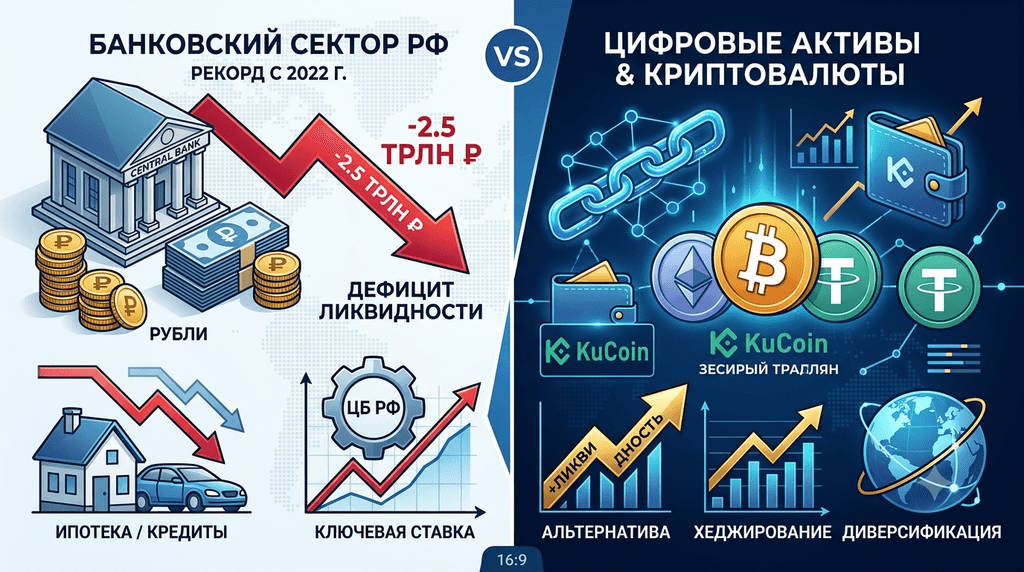
As of August 2026, the structural liquidity deficit in the Russian banking sector reached a record 2.5 trillion rubles, marking the highest level since the spring of 2022, according to official data from the Bank of Russia. The primary cause of this large-scale phenomenon was active lending to the economy and the population in previous periods, during which significant amounts of free funds were directed toward long-term investment and mortgage obligations. Under conditions of tight monetary policy, high key rates, and a changing macroeconomic environment, investors and traders are increasingly seeking alternative capital protection tools, including digital assets and cryptocurrencies on leading international platforms such as KuCoin.
Why Did the Record Liquidity Deficit of 2.5 Trillion Rubles Arise?
The structural liquidity deficit of the banking sector reflects a situation where commercial banks experience an increased need for short-term borrowing from the Bank of Russia, secured by securities and other highly liquid assets. According to analytical data from RIA Novosti for August 2026, the need for credit organizations to attract liquidity exceeded 2 trillion rubles as early as the beginning of July and settled at 2.5 trillion rubles by August 6. This irrefutably indicates that the rate of attracting funding through household deposits and corporate client funds significantly lagged behind the rate of issuing long-term loans.
Yuri Belikov, Managing Director of the Expert RA rating agency, notes that in previous years, banks actively utilized attracted liquidity in anticipation of an endless inflow of funds; however, the centralized cooling of the market through key rate hikes has fundamentally changed the balance. As a result, massive amounts of capital became immobilized in the form of long-term mortgage and corporate loans issued for extended periods. Valery Piven, head of the financial institutions ratings group at ACRA, emphasizes that despite the recorded deficit, the liquidity position of banks remains stable, and credit organizations face no fundamental problems in meeting their current obligations to clients.
The development of the liquidity situation is under the close supervision of the regulator, which assesses risks in advance and provides the necessary refinancing tools. Nevertheless, the fact that the deficit reached its peak since the spring of 2022 points to a deep structural transformation of the entire banking system. Commercial banks are forced to compete for every ruble of liquidity, leading to a revision of interest rate policies for deposits and loans and compelling market participants to seek innovative ways to manage capital. Banks are actively restructuring their business models, adapting to new economic realities where cheap resources are no longer available.
An additional factor influencing the redistribution of cash flows is the change in regulatory requirements and macroprudential limits. In conditions where the interbank market becomes more expensive, credit organizations are revising their risk management strategies. This affects the availability of credit products for the corporate sector and individuals, forcing market participants to seek alternative sources of financing and portfolio diversification.
How Did the Slowdown in Mortgage Lending in July Change the Market Landscape?
The Russian retail lending market in July 2026 demonstrated a sharp and predictable contraction, shrinking by 9% compared to June to 1.06 trillion rubles in total issuance, according to the authoritative consulting agency Frank RG . The main contribution to this decline came from the mortgage segment, which, after the unprecedented June rush, plummeted by 25.4% in monetary terms, amounting to 355.3 billion rubles . This dramatic slump was directly triggered by the exhaustion of rush demand for state-subsidized programs, particularly the Family Mortgage, the conditions of which were planned to be drastically tightened starting July 1, before the Ministry of Finance decided to postpone the adjustments to October 1 .
Against the backdrop of the sharp contraction in mortgage lending, the overall structure of the banking portfolio began to transform rapidly. As noted by leading analysts from VTB and Sberbank, the share of market-rate mortgages rose to 52% in July, as borrowers gradually adapt to base conditions without state support and seek new compromise solutions. At the same time, the cash loan segment continued its sixth consecutive month of growth (+4.8% in June in monetary terms), indicating sustained demand from the population for short-term liquidity for current urgent needs. Auto lending, conversely, decreased by 5.7%, despite the fact that the average auto loan size continued to grow for the third consecutive month, reaching 1.6 million rubles.
These large-scale changes clearly show that traditional credit channels are becoming less accessible to the general population, and bank requirements for borrowers are tightening. In conditions where mortgages and auto loans are becoming more expensive and issuance volumes are retreating to spring levels, citizens and investors are reorienting their savings toward alternative value-preservation instruments, including digital financial assets and cryptocurrency investments.
Experts note that the transformation of retail lending is systemic. The decline in issuance volumes under subsidized programs forces the construction and banking industries to revise their pricing policies, introducing new joint programs and demand-support tools. However, in the medium term, pressure on the credit market will persist, requiring participants to find new models for generating income and working with capital.
CBR Forecasts: What to Expect from the Banking Sector until the End of 2026?
In May 2026, the Bank of Russia was forced to significantly revise its official forecast for the structural liquidity deficit for the current year, increasing its target range to 2.4–3.6 trillion rubles compared to last year's expectations of 1.9–3 trillion rubles . This adjustment is related to the steady growth in demand for cash in circulation, the volume of which by the end of the year could increase by 1.5–2.1 trillion rubles . The regulator continues to maintain a tight monetary policy, forecasting an average key rate at the level of 14.5–14.6% per annum, which will continue to exert powerful pressure on the profitability of the banking business and the overall cost of borrowed funds.
|
Banking Sector Indicator
|
Value (Mid-2026)
|
Dynamics and Bank of Russia Forecast
|
|
Structural Liquidity Deficit
|
2.5 trillion rubles
|
Forecast raised to 2.4–3.6 trillion rubles for 2026
|
|
Mortgage Issuance Volume for July
|
355.3 billion rubles
|
25.4% decrease compared to June 2026
|
|
Key Rate Average Forecast
|
14.5–14.6% per annum
|
Tight monetary policy to cool inflation
|
|
Expected Cash Growth in Circulation
|
1.5–2.1 trillion rubles
|
Increased demand for cash liquidity
|
The expert financial community agrees that the current liquidity deficit does not pose systemic threats to the stability of reliable banks; however, it strictly limits the ability of credit organizations to grow high-risk portfolios. In the current reality, financial institutions are forced to optimize their balance sheets, and depositors and private investors are actively redistributing personal capital in favor of instruments that provide protection against inflation and access to global capital markets. The regulator emphasizes that all refinancing operations are carried out in full accordance with the current needs of the banking sector.
Additional aspects of the CBR's monetary policy include monitoring capital adequacy and managing interest rate risks. In conditions of high rates, banks are forced to offer competitive terms on deposits to retain their client base, which narrows their net interest margin. This creates prerequisites for seeking alternative commission income and digitizing financial services, including the active implementation of advanced technologies.
Does the Bank Liquidity Deficit Affect the Cryptocurrency Market in Russia?
Macroeconomic instability, high interest rates on classic loans, and a structural liquidity deficit in the traditional banking sector inevitably stimulate increased investor interest in alternative financial instruments, including digital assets and cryptocurrencies. When traditional credit markets slow down and requirements for borrowers and investors become extremely strict, market participants begin to actively seek independent decentralized channels to preserve, protect, and grow their capital. The development of a modern regulatory framework in the field of digital assets in Russia creates strong prerequisites for the deep integration of the blockchain industry into everyday economic processes.
The cryptocurrency market attracts private investors and institutional players with the possibility of effective capital diversification regardless of the current state of national bank liquidity. Fundamental tools such as stablecoins, spot trading of digital assets, and financial derivatives allow for successful hedging of inflation risks and cross-border settlements without the bureaucratic delays characteristic of traditional banking gateways. During periods when commercial banks are forced to direct all free resources to cover their own structural liquidity deficit, global decentralized ecosystems offer unprecedented transaction speed, transparency, and alternative liquidity.
Integrating digital assets into investment portfolios becomes a response to the structural limitations of the traditional financial system. Investors view cryptocurrencies not only as a speculative tool but also as a reliable way to hedge macroeconomic risks. The development of the regulatory field opens new opportunities for the legal use of blockchain technologies in commercial activities, which further strengthens the position of digital assets amid the bank liquidity deficit.
How to Trade and Invest on KuCoin in a Changing Financial Market?
In conditions of increasing macroeconomic turbulence, the modern private investor acutely needs a reliable, safe, and high-tech trading infrastructure capable of providing uninterrupted access to global liquid markets. The leading global cryptocurrency platform KuCoin provides professional traders and novice investors with a comprehensive range of modern tools for spot and futures trading, as well as unique opportunities for passive income through staking, farming, and crypto lending. Registering on KuCoin opens direct and secure access to efficient digital asset management with the lowest fees on the market and the highest level of protection for user funds.
To successfully start working on the platform, a new user only needs to complete a simple KYC identity verification procedure, fund their trading account with supported cryptocurrencies or available fiat gateways, and choose an optimal investment strategy. Professional technical analysis tools, advanced orders, and graphical indicators integrated into the KuCoin trading terminal allow for rapid response to any global market trends and reliably protect the investment portfolio from local fluctuations in traditional financial systems. Round-the-clock technical support, deep liquidity, and advanced security protocols make KuCoin an ideal choice for strategic investment in the digital economy of the future. The platform is constantly expanding its ecosystem of products, helping users maximize returns in any market conditions.
Using professional platforms like KuCoin allows investors to effectively overcome the limitations of local markets and diversify their investments on a global scale. The availability of a wide set of trading pairs, high order book liquidity, and modern risk management tools make the KuCoin ecosystem an indispensable assistant for every crypto market participant in 2026.
Join KuCoin 9th Anniversary Trading Campaign
KuCoin is celebrating its 9th anniversary with a special platform campaign filled with exclusive rewards, trading activities, and limited-time offers. Don’t miss the chance to participate and enjoy the benefits as the exchange marks nine years of growth and innovation. Visit the official campaign page now:

Conclusion
The situation with the record liquidity deficit in Russian banks and the large-scale cooling of the mortgage market clearly highlights the critical importance of proper capital diversification in 2026. The banking system's transition to a structural deficit of 2.5 trillion rubles and the official increase in the Central Bank's forecast to 3.6 trillion rubles reflect deep fundamental changes in the state's credit and monetary policy. While traditional financial institutions are forced to adapt to tight macroeconomic constraints and high interest rates, forward-looking investors are increasingly turning their attention to alternative asset classes. In-depth study of current financial market trends and the practical use of advanced digital economy tools allow for the reliable protection of savings and the opening of fundamentally new opportunities for financial growth in a changing economic reality.
Frequently Asked Questions (FAQs)
1. What is a structural liquidity deficit, and is it dangerous for depositors?
A structural liquidity deficit means that commercial banks need to regularly attract more short-term borrowed funds from the Central Bank against securities than they place in the regulator's deposit accounts. For ordinary depositors, this technical process poses no real danger and does not threaten the timely fulfillment of bank obligations, as credit organizations possess a sufficient margin of financial strength.
2. Why do banks continue to lend actively despite high key rates?
The inertia of high credit activity is explained by the fact that a significant portion of large-scale contracts and long-term project obligations were formed in advance, while consumer demand from the population and the corporate sector remained high. Banks were forced to fund issued long-term loans by attracting expensive liquidity, which naturally led to the formation of a structural deficit.
3. How does the bank liquidity deficit affect interest rates on deposits and loans?
Under conditions of a tight liquidity deficit and the maintenance of a high key rate, commercial banks strive to actively attract household savings by offering maximum interest rates on deposits. Simultaneously, credit organizations maintain prohibitive interest rates on retail and corporate loans, compensating for the overall cost of funding and minimizing the risks of borrower default.
4. Is there a link between bank liquidity and the cryptocurrency market in Russia?
The direct and indirect link between these segments lies in the global redistribution of investor capital. When the traditional banking sector faces liquidity constraints, strict credit limits, and high inflation, market participants begin to actively seek independent alternative tools for capital protection and growth, including digital assets and cryptocurrencies on international trading exchanges.
5. Should we expect mortgage rates to decrease by the end of 2026?
A significant decrease in market rates for mortgage loans by the end of 2026 is an unlikely scenario, as the Bank of Russia forecasts the continuation of tight monetary policy and the maintenance of a high average key rate at the level of 14.5–14.6% per annum. Further dynamics of the mortgage market will entirely depend on the parameters of state-subsidized programs and overall macroeconomic stability.
Disclaimer : This material is provided for informational purposes only and does not constitute financial, investment, legal, or tax advice. Transactions involving cryptocurrencies and tokenized assets carry substantial risks — including price volatility, limited liquidity, counterparty exposure, and the potential for total loss of invested capital. Readers should conduct their own research and, where appropriate, consult a qualified professional before making any financial decisions.