

Bitcoin Would Need to Fall 83% for STRC to Reach 1x BTC Coverage: What It Really Means
Strategy’s 1x BTC Threshold Highlights a Significant Downside Cushion
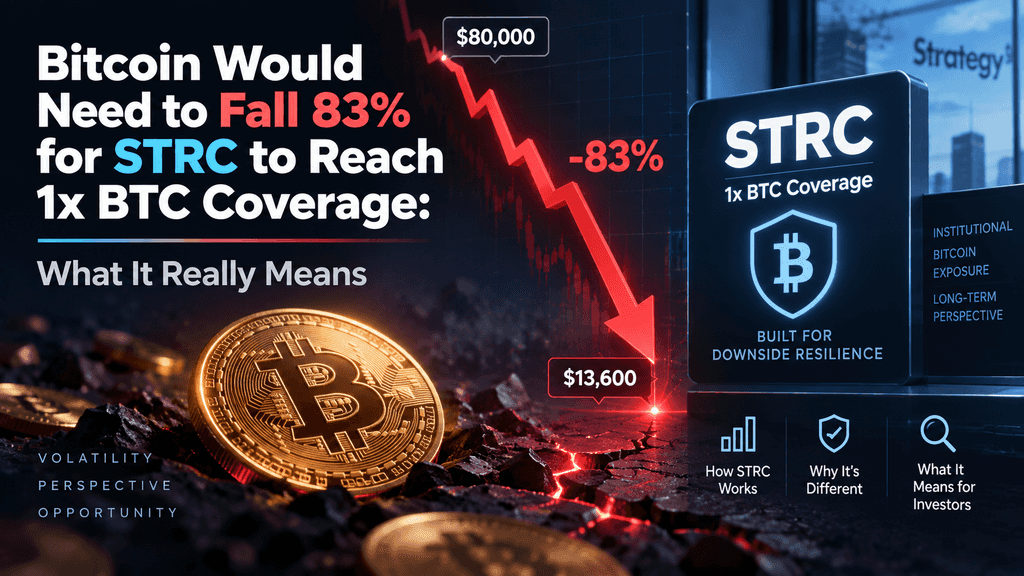
Strategy Inc. recently highlighted that Bitcoin would need to decline approximately 83 percent from then-prevailing levels before its STRC preferred stock reaches a 1x BTC Rating under the company’s internal model. The threshold sits near $13,136. This figure is not a credit rating from any external agency, nor does it signal an automatic default, dividend suspension, or specific trading price for the security. Instead, it represents the Bitcoin price at which the modeled value of Strategy’s Bitcoin reserve equals the notional claims allocated to STRC and more senior instruments in the capital stack. As of late August 2026, Strategy reported holdings of 845,050 Bitcoin alongside substantial dollar assets, underscoring the scale of the buffer the company emphasizes. The statement provides a concrete lens into how Strategy views asset coverage across its expanding suite of preferred securities and debt. It arrives after periods of volatility in both Bitcoin and the trading levels of STRC itself, which is designed to trade near its $100 stated amount while paying a variable cash dividend.
Understanding the 1x threshold requires examining the underlying calculation, the composition of claims, the role of dollar reserves, and the practical limits of what the metric does and does not measure. The analysis that follows draws on Strategy’s own disclosures, recent capital updates, and the structural features of its digital credit framework to clarify the implications for holders and observers of the company’s Bitcoin treasury strategy. The 83 percent decline required for STRC to reach 1x BTC Rating under Strategy’s model illustrates a sizable modeled asset cushion relative to allocated claims, yet the metric remains illustrative, assumption-sensitive, and distinct from cash liquidity, market pricing of the preferred shares, or legal recovery priorities in any restructuring scenario.
How Strategy Defines the 1x BTC Rating for Its Preferred Securities
Strategy’s BTC Rating is an internal, illustrative ratio that compares the value of its Bitcoin reserve to the notional amounts of debt and preferred-stock claims assigned to a given instrument and those ranking senior or equal to it under the company’s modeling conventions. A reading of 1x indicates that the Bitcoin reserve’s modeled value exactly matches those claims; readings above 1x indicate excess coverage on that basis. The company has repeatedly stated that the metric is not an external credit rating, does not incorporate potential cross-default provisions, and should not be treated as a liquidity measure or key performance indicator. It also excludes market prices of the securities themselves and focuses on notional or liquidation-preference amounts rather than trading values.
In the September 2026 presentation of the chart, Strategy mapped distinct Bitcoin price thresholds for each of its preferred series. STRC’s 1x point was shown at $13,136, corresponding to the 83 percent decline figure relative to the reference Bitcoin price used at the time. Other instruments carried different floors reflecting the different slices of the capital structure assigned to them. The model therefore produces a layered view of coverage rather than a single company-wide break-even. Because the calculation depends on the current size of the Bitcoin reserve, the outstanding notional of each security, the treatment of dollar assets, and the ordering of claims, any material change in holdings, issuance, repurchases, or cash balances can shift the thresholds even if Bitcoin’s market price remains unchanged.
The Specific Bitcoin Price Threshold Assigned to STRC
The $13,136 figure for STRC sits well below recent Bitcoin trading ranges near $79,000–$80,000. An 83 percent decline from the levels referenced in the company’s statement would place Bitcoin at that threshold. Earlier investor materials had shown illustrative floors in a similar neighborhood, sometimes rounded near $13,400 or adjusted with different cash and claim assumptions, confirming that the precise number moves with the inputs. Strategy’s own commentary stresses that reaching the 1x level does not trigger contractual consequences for STRC holders. Dividends remain subject to board declaration, and the security carries no maturity date that would force repayment.
This threshold is best understood as a snapshot of modeled asset coverage rather than a forecast or a hard floor. If Strategy continues to add Bitcoin, retire preferred shares through buybacks, or expand dollar reserves, the Bitcoin price required to reach 1x would decline further. Conversely, additional preferred issuance that increases the claim denominator, or reductions in the Bitcoin reserve, would raise the threshold. The company’s recent activity, purchasing 4,603 Bitcoin in late August at an average price near $80,318 while also repurchasing STRC and adding to cash, illustrates how both sides of the ratio can move simultaneously.
Strategy’s 1x BTC Threshold Highlights a Significant Downside Cushion
As of August 30, 2026, Strategy reported 845,050 Bitcoin on its balance sheet. The aggregate purchase price stood at approximately $63.73 billion, implying an average cost near $75,412 per coin, including fees. At contemporaneous market prices, the position carried a modest unrealized gain after earlier periods of being underwater. Alongside the Bitcoin, the company maintained a USD Reserve of $5.10 billion earmarked primarily for preferred dividends and interest, plus a separate USD Cash balance of $1.61 billion available for broader treasury purposes. Combined dollar assets therefore exceeded $6.7 billion.
These figures matter because the BTC Rating calculation can incorporate dollar assets in certain ways, effectively reducing the net claims that Bitcoin must cover. The size of the Bitcoin stack, now more than 4 percent of the eventual 21 million supply, provides the primary asset base. The dollar layers supply near-term liquidity that supports the dividend policy without immediate recourse to Bitcoin sales. Recent weekly updates show Strategy oscillating between accumulation, selective sales to fund buybacks or dividends, and equity issuance to replenish cash, reflecting active management of both sides of the balance sheet.
Layered Thresholds Across Strategy’s Preferred Capital Stack
Strategy’s chart assigned markedly different 1x Bitcoin prices to each preferred series: $1,519 for STRF, $13,136 for STRC, $14,198 for STRE, $15,857 for STRK, and $17,517 for STRD. Debt was modeled as reaching 1x at zero under the displayed assumptions. The dispersion arises because each instrument is assigned a different portion of the overall capital structure; senior or more favorably ordered claims receive lower Bitcoin-price thresholds. This produces an ordered map of modeled coverage rather than a uniform company-wide metric.
The ordering is illustrative and does not necessarily mirror strict legal priority in a bankruptcy or restructuring. Market participants must therefore distinguish between the company’s internal layering and the actual rights of holders under the governing instruments and applicable law. STRC, as the largest and most liquid of the preferred series in recent periods, occupies a middle position in the displayed thresholds, reflecting both its size and its place in the modeled stack.
Why the Metric Explicitly Avoids Predicting Default or Dividend Cuts
Strategy has been careful to separate the 1x BTC Rating from any implication of default, dividend interruption, or forced trading levels. Preferred dividends are discretionary and subject to board declaration. STRC is perpetual, so there is no maturity event that would require principal repayment. Even if the modeled ratio reached 1x, the company could continue to service dividends from dollar reserves, operating cash flow, equity issuance, or selective Bitcoin monetization under its authorized frameworks. The metric therefore functions as a coverage illustration rather than a covenant or trigger.
This distinction is important for investors who might otherwise interpret a large percentage decline as an imminent risk event. Historical periods of Bitcoin weakness have tested STRC’s trading levels and the company’s cash coverage, prompting rate adjustments, buybacks, and reserve builds. The 1x threshold sits far below those earlier stress points, reinforcing the company’s narrative of substantial modeled over-collateralization while leaving open the practical questions of liquidity management and market confidence.
The Role of the Digital Credit Capital Framework in Supporting Coverage
In June 2026, Strategy formalized its Digital Credit Capital Framework, establishing policies for a minimum USD Reserve covering at least twelve months of preferred dividends and interest, authorization for preferred and common repurchases, and a Bitcoin monetization program that permits sales under defined conditions. The framework made STRC management two-directional: issuance and Bitcoin purchases when the preferred trades near or above par, and potential retirement of claims at a discount when it trades below. Subsequent updates show the company building the reserve, executing buybacks, and selectively using equity proceeds to strengthen liquidity.
These tools give Strategy flexibility to defend the preferred structure without relying solely on Bitcoin price appreciation. By maintaining multi-year cash coverage in recent disclosures and actively managing the preferred float, the company seeks to keep STRC’s effective yield and trading range attractive to income-oriented capital. The BTC Rating sits alongside these operational levers as one more communication device rather than the sole determinant of policy.
How Dollar Reserves Interact With the Bitcoin Coverage Calculation
Dollar assets reduce the net claims that the Bitcoin reserve must cover in Strategy’s modeling. Applying the USD Reserve against senior debt or portions of preferred notional lowers the denominator and therefore lowers the Bitcoin price required to reach 1x. Depleting those cash balances without a corresponding reduction in claims would raise the threshold. Recent filings show the company deliberately increasing both the restricted USD Reserve and the more flexible USD Cash account, often funded by common-stock ATM proceeds.
This interaction means the 1x price is not solely a function of Bitcoin holdings and preferred notional. Active cash management can expand or contract the modeled cushion. Investors tracking the metric must therefore monitor both the Bitcoin stack and the evolution of dollar liquidity, as well as the company’s stated policy minimums for reserve coverage.
Recent Capital Actions That Have Moved the Coverage Inputs
In the week ending August 30, 2026, Strategy purchased 4,603 Bitcoin for roughly $369.7 million, repurchased approximately $152 million of STRC, and added $30 million to USD Cash, bringing that balance to $1.61 billion. Earlier weeks featured larger equity raises, selective Bitcoin sales to fund buybacks and dividends, and continued reserve accumulation. These actions simultaneously increased the Bitcoin numerator, reduced preferred claims through retirement, and bolstered the cash buffer.
Such activity demonstrates that the coverage ratios are not static. Management can and does adjust the inputs through ordinary capital-markets operations. The net effect of the late-August transactions was to reinforce both the Bitcoin base and the liquidity supporting the preferred structure, consistent with the company’s stated objective of keeping STRC near its $100 stated amount over time.
Market Pricing of STRC Versus Modeled Asset Coverage
STRC has traded at varying discounts and premiums to its $100 par value since launch, with periods of significant weakness coinciding with broader Bitcoin drawdowns and concerns about cash coverage. Effective yields have therefore fluctuated with the market price even when the stated dividend rate remained constant or was adjusted upward. The BTC Rating, by contrast, focuses on notional claims and Bitcoin value rather than secondary-market pricing.
A high modeled coverage ratio does not automatically translate into a tight trading range around par if investors demand higher compensation for perceived liquidity or Bitcoin-correlation risk. The divergence between modeled coverage and market pricing highlights the limits of the internal metric. Holders and prospective investors must weigh both the company’s asset-coverage narrative and the security’s observed secondary-market behavior, dividend policy flexibility, and correlation with Bitcoin.
Effects for Income-Oriented Holders of Bitcoin-Linked Preferreds
For investors seeking elevated cash yields with indirect exposure to Strategy’s Bitcoin treasury, the 83 percent buffer provides a quantitative illustration of the modeled downside tolerance before the internal coverage ratio reaches parity. It does not eliminate market risk, dividend discretion, or the possibility that prolonged Bitcoin weakness could pressure trading levels, force higher dividend rates, or prompt further capital-structure adjustments. The existence of multi-year cash coverage in recent disclosures and the company’s willingness to repurchase shares below par add practical support beyond the pure Bitcoin-coverage number.
The structure remains a hybrid: it offers equity-like perpetual capital to the issuer and bond-like income characteristics to the holder, all backstopped by a large but volatile digital-asset reserve. The 1x threshold quantifies one dimension of that backstop while leaving other dimensions, liquidity, market confidence, and operational flexibility, visible only through ongoing disclosures and management actions.
How the Threshold Could Shift With Future Activity
Any material change in Bitcoin holdings, preferred notional outstanding, debt levels, or dollar assets will recalibrate the 1x price. Continued net accumulation of Bitcoin or retirement of preferred shares would push the threshold lower; aggressive new issuance or depletion of cash without claim reduction would push it higher. Strategy’s own materials note that the displayed figures are snapshots. Observers should therefore treat the 83 percent figure as a current illustration rather than a permanent feature of the capital structure.
Regular weekly 8-K updates and periodic investor materials provide the raw data needed to recompute approximate coverage as conditions evolve. The company’s transparency on these inputs allows market participants to maintain their own models rather than relying solely on the published chart.
🔥 Beyond the Headlines: What KuCoin 5.0 Means for You
Market news moves fast — but where you act on it matters just as much. This October, KuCoin launches KuCoin 5.0, transforming KuCoin into a rebuilt platform. Here's what actually changes for you:
-
One account for everything. Older platforms split your money across separate "spot," "margin," and "futures" accounts and expected you to understand why. KuCoin 5.0's unified account removes that entirely — deposit once, and everything is simply there.
-
Stocks, indices, and commodities. KuCoin 5.0 expands beyond crypto into global markets. When crypto chops sideways and equities rally (or the reverse), you rotate in minutes instead of opening a brokerage account and waiting days for fiat rails.
-
Real-world assets (RWA). Tokenized exposure to traditional assets like commodities, right inside your crypto account. One of the fastest-growing segments in global finance is no longer reserved for institutions — you access it from the same balance you trade with.
-
Earn while you learn. Not ready to trade? KCUSD lets your stablecoins earn daily, auto-compounding interest. The lowest-stress way to put your idle deposit to work for 4% yield.
-
An app that doesn't overwhelm. Faster, cleaner, and consistent — intuitive from the first tap, not after a tutorial.
-
Safety you can check, not just trust. A MiCAR-licensed EU entity, Proof of Reserves you can verify yourself, and internationally certified security (SOC 2 Type II, ISO 27001:2022).
Create your account in minutes — and start on the platform built for where crypto is going, not where it's been.
What the 83 Percent Figure Ultimately Communicates About Risk
At its core, the statement quantifies the depth of Bitcoin price decline that Strategy’s internal model would require before STRC’s allocated claims equal the modeled reserve value. The large percentage reflects both the absolute size of the Bitcoin holdings and the way claims are layered in the calculation. It supports the company’s narrative of substantial over-collateralization on a modeled basis while remaining silent on cash-flow timing, secondary-market liquidity, legal recovery priorities, and the behavioral responses of investors during stress.
Readers should integrate the figure with the full set of disclosures, Bitcoin holdings and cost basis, dollar reserve levels and policy minimums, preferred notional and repurchase activity, dividend rate history, and observed trading ranges, rather than treating it as a standalone safety margin. The metric is one useful data point within a larger, actively managed capital structure that continues to evolve with market conditions and management decisions.
FAQs
What does a 1x BTC Rating actually mean for STRC holders?
Under Strategy’s internal model, a 1x BTC Rating means the value of the Bitcoin reserve equals the notional debt and preferred claims allocated to that instrument and those ranking ahead of or equal to it. It is an illustrative coverage ratio, not an external credit rating, covenant trigger, or prediction of default. Reaching 1x does not automatically suspend dividends or force any contractual consequence for STRC.
How was the 83 percent decline calculated?
Strategy compared the Bitcoin price required to bring the modeled reserve value into equality with the allocated claims for STRC against the then-current Bitcoin price used in its chart. The resulting percentage decline was approximately 83 percent, corresponding to a threshold near $13,136. The exact percentage moves with changes in holdings, claims, and cash.
Does reaching the threshold mean Strategy would have to sell Bitcoin?
No. The metric itself carries no forced-sale implication. Strategy maintains dollar reserves, has authorization under its framework to manage liquidity through various means, and has previously used equity issuance and selective Bitcoin sales at its discretion. Dividend payments remain subject to board declaration regardless of the BTC Rating.
How do the different thresholds for STRF, STRC, STRE, STRK, and STRD arise?
Each preferred series is assigned a different slice of the overall capital structure in the model. Instruments modeled with smaller or more senior claim sets receive lower Bitcoin-price thresholds. The dispersion produces a layered coverage map rather than a single company-wide break-even.
What role do the USD Reserve and USD Cash play in the calculation?
Dollar assets can reduce the net claims that Bitcoin must cover, thereby lowering the 1x Bitcoin price. Building cash expands the modeled cushion; depleting it without reducing claims raises the threshold. Strategy has emphasized maintaining at least twelve months of coverage under its formal framework.
Has Strategy’s Bitcoin holding size changed materially around the time of the statement?
Yes. In late August 2026, the company added 4,603 Bitcoin, bringing total holdings to 845,050. It simultaneously repurchased STRC and increased cash balances. These actions affect both the numerator and the denominator of the coverage ratios.
Is the BTC Rating the same as traditional mNAV or enterprise value metrics?
No. Traditional mNAV calculations typically compare market capitalization or enterprise value to the Bitcoin holdings net of certain liabilities. The BTC Rating is a claims-coverage construct focused on notional amounts and an ordered capital stack under Strategy’s internal conventions. The two approaches answer different questions.
Disclaimer: This content is for informational purposes only and does not constitute investment advice. Cryptocurrency investments carry risk. Please do your own research (DYOR).