

Strategy Says It Needs No Bailout: What Its $4.8B in Cash Actually Covers

Strategy's $4.8 billion in dollar assets are becoming an important part of its defence against Bitcoin market volatility. As the company expands its treasury to 851,305 BTC, Executive Chairman Michael Saylor has dismissed concerns about a potential bailout, arguing that its existing liquidity can support its financial obligations for approximately 3.4 years.
In its November 23 update, Strategy reported $3.73 billion in USD Reserve and $1.09 billion in USD Cash. The company also disclosed a $2.9 billion reduction in outstanding credit in recent months, alongside a $353 million decrease in annual dividend payments. However, the distinction between cash available for general corporate purposes and funds designated for debt interest and preferred dividends is important.
What does Strategy's $4.8 billion actually cover, and how much financial pressure could it withstand if Bitcoin prices remain under pressure?
Key Takeaways
-
Michael Saylor says Strategy does not need a bailout, citing reduced financial obligations and a 3.4-year USD coverage estimate.
-
Strategy held 851,305 BTC as of November 22, 2026, alongside $4.82 billion in combined USD Assets.
-
The USD Reserve supports debt interest and preferred dividends, while USD Cash provides flexibility for broader treasury management.
-
Strategy's 3.43-year USD Duration covers recurring interest and dividend payments, not every debt repayment or financial obligation.
-
Debt reduction, preferred stock buybacks and continued access to financing will shape the sustainability of Strategy's Bitcoin treasury.
Why Does Michael Saylor Say Strategy Does Not Need a Bailout?
Michael Saylor said Strategy does not need a bailout because the company has strengthened its ability to meet its financial obligations while maintaining its Bitcoin holdings. His November 23 statement accompanied an update on the company's debt reduction, dividend commitments and growing dollar reserves, offering insight into how Strategy plans to manage its financial position.
What Did Michael Saylor Announce About Strategy's Financial Position?
Michael Saylor said Strategy had reduced its financial obligations and strengthened its ability to meet future payments without selling its Bitcoin holdings. In a November 23 post on X, he disclosed that the company had reduced outstanding credit by $2.9 billion in recent months, cutting its annual dividend expenses by $353 million.
He also reported that Strategy's USD Duration had reached 3.4 years, indicating that its dollar assets could cover approximately 3.4 years of interest and preferred stock dividend payments at the current rate. Saylor added that the company had moved $1 billion from its USD Reserve to USD Cash, which management can use for preferred stock repurchases or additional Bitcoin purchases.
How Much Bitcoin Does Strategy Hold in November 2026?
Strategy held 851,305 BTC as of November 22, 2026, making it one of the largest corporate holders of Bitcoin. According to its November 23 SEC filing, the company had spent approximately $64.23 billion acquiring its Bitcoin holdings, at an average purchase price of $75,446 per BTC.
The latest purchase added 457 BTC to its treasury between November 16 and 22, costing approximately $29.6 million at an average price of $64,898 per Bitcoin. Strategy funded the acquisition using proceeds from sales of its MSTR common stock, continuing to rely on equity financing to expand its Bitcoin holdings.
What Does Strategy's $4.8 Billion in USD Assets Actually Cover?
Strategy's $4.8 billion in USD Assets is divided into two pools with different purposes. One is set aside to support interest and preferred stock dividend payments, while the other gives management more flexibility to fund its Bitcoin treasury and manage the company's capital.
How Much Does Strategy Hold in Its USD Reserve and USD Cash?
As of November 22, Strategy held approximately $4.82 billion in combined USD Assets, comprising $3.73 billion in USD Reserve and $1.09 billion in USD Cash. Although both are held in US dollars, the company assigns them different roles in its financial strategy.
|
Liquidity component
|
Amount
|
Primary purpose
|
|
USD Reserve
|
$3.73 billion
|
Preferred dividends and debt interest
|
|
USD Cash
|
$1.09 billion
|
Broader Bitcoin treasury and capital management
|
|
Combined USD Assets
|
$4.82 billion
|
|
Strategy describes its USD Reserve as funds intended to support dividend payments on its preferred stock and interest on outstanding debt. USD Cash, however, is maintained for broader purposes, including acquiring Bitcoin, increasing the reserve and other capital management activities.
This distinction is important because the entire $4.82 billion is not simply an unrestricted pool of money available for any purpose. Strategy maintains a separate reserve for recurring financial obligations while retaining additional dollar liquidity for other treasury decisions.
Why Did Strategy Authorize a $1 Billion Transfer From Its USD Reserve?
On November 23, Strategy announced that its board had authorized management to reallocate up to $1 billion from USD Reserve to USD Cash. Following the reallocation, the company reported balances of $3.73 billion and $1.09 billion, respectively, as of November 22.
The decision gives management greater flexibility to deploy part of its dollar holdings beyond the reserve's designated purpose. For example, USD Cash can support additional Bitcoin purchases, preferred stock repurchases and other capital management activities. Strategy had already used $64.8 million from this account to repurchase STRC preferred stock during November 16–22.
The important distinction is that Strategy did not create an additional $1 billion in liquidity. The authorization allows it to change how existing dollar assets are allocated, while the combined USD Assets remain approximately $4.82 billion.
How Can Strategy's $4.8 Billion Cover 3.4 Years of Debt and Dividends?
Strategy estimates that its $4.8 billion in USD Assets can cover approximately 3.43 years of its current interest and preferred stock dividend payments. The estimate is based on how much money the company holds compared with its annual payment obligations. However, it does not mean Strategy has enough cash to repay all its outstanding debt or cover every future financial commitment.
How Does Strategy Calculate Its 3.4-Year Cash Coverage?
According to Strategy's November 22 investor briefing, the company held $4.818 billion in USD Assets against approximately $1.41 billion in annual interest and preferred dividend obligations. Dividing the available dollar assets by these yearly payments gives Strategy a reported USD Duration of approximately 3.43 years.
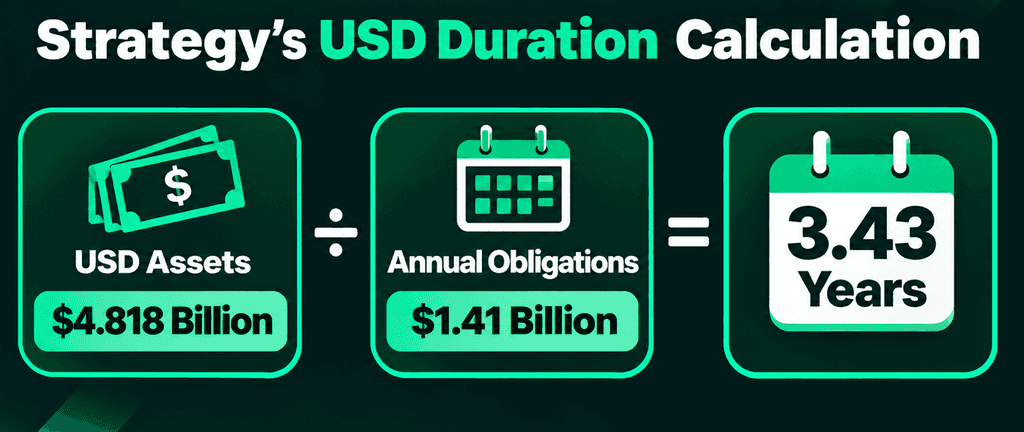
In simple terms, if Strategy continues making interest and dividend payments at the current rate, its existing USD Assets could fund those payments for approximately three years and five months without additional funding. This provides investors with an indication of how long the company's current dollar reserves could support these recurring obligations.
The calculation is particularly relevant because Strategy uses both debt and preferred stock financing to support its Bitcoin treasury. These financing arrangements create payment obligations that continue regardless of short-term movements in Bitcoin's market price.
Does Strategy's 3.4-Year Cash Coverage Include All Its Debt?
No. Strategy's USD Duration measures how long its dollar assets could cover interest and preferred stock dividend payments. However, the calculation assumes that the USD Reserve will not be needed for other financial obligations during this period, including convertible debt maturities and put rights. It therefore does not guarantee that Strategy can meet all its financial obligations for 3.43 years.
This distinction matters because Strategy could face additional cash requirements if debt becomes due or investors exercise contractual rights to require repayment before the estimated coverage period ends. Its 3.43-year figure therefore represents an estimate based on current payment obligations, not a guarantee that the company can meet every financial commitment for that period.
For investors, the figure offers a useful measure of Strategy's ability to fund recurring payments, but its overall financial position also depends on how it manages debt repayments, future financing and other corporate expenses.
How Is Strategy Reducing Its Debt and Preferred Stock Obligations?
Strategy is taking steps to reduce its outstanding financial obligations while creating more flexibility to manage future payments. Its latest update highlights two measures: reducing outstanding credit and buying back preferred stock, which carries dividend payments for the company.
Why Did Strategy Increase Its Preferred Stock Buyback Program to $4 Billion?
On November 23, Strategy announced that its board had increased the authorization for its digital credit securities repurchase program from $3 billion to $4 billion. The increase gives the company more room to buy back its preferred shares and reduce the amount of outstanding securities on which it pays dividends.
The company had already repurchased 2,183,747 STRC preferred shares for approximately $211.8 million between November 16 and 22. Of this amount, $147 million came from proceeds generated by MSTR common stock sales, while the remaining $64.8 million came from USD Cash.
Following the increase in authorization, Strategy had approximately $1.12 billion remaining for preferred stock repurchases under the program as of November 22. This means the $4 billion represents the total authorized repurchase amount, not an additional $4 billion that Strategy has already spent or committed to spend.
How Can Debt Reduction and Preferred Stock Buybacks Lower Strategy's Financial Obligations?
Repurchasing preferred stock reduces the number of outstanding shares on which Strategy may owe future dividends. Similarly, reducing outstanding credit can lower the company's future financing costs, depending on the debt and credit arrangements involved.
Saylor said Strategy had reduced its outstanding credit by $2.9 billion in recent months, resulting in a reported $353 million reduction in annual dividend payments. These figures reflect management's reported progress, although the November 23 SEC filing does not provide a breakdown of how the reductions were achieved.
Together, these measures are intended to reduce recurring payment commitments and give Strategy more room to manage its dollar reserves while maintaining its Bitcoin holdings.
Is Strategy's Bitcoin Treasury Model Sustainable Without a Bailout?
Strategy's ability to maintain its Bitcoin holdings depends on more than the amount of Bitcoin it owns or the cash it keeps in reserve. The company must continue balancing its Bitcoin purchases with debt payments, preferred stock dividends and access to new financing.
How effectively it manages these commitments will determine whether it can sustain its treasury strategy through changing market conditions.
Can Strategy Continue Buying Bitcoin While Meeting Its Financial Obligations?
Strategy can continue buying Bitcoin while meeting its financial obligations, provided it maintains sufficient liquidity and access to financing. Its November 23 filing shows how these activities work together: the company used proceeds from MSTR share sales to purchase 457 BTC for $29.6 million, while also using $147 million from share sales and $64.8 million from USD Cash to repurchase STRC preferred stock.
However, continued Bitcoin purchases are not guaranteed. Strategy must maintain enough dollar liquidity to pay interest and preferred dividends while managing its outstanding debt. Its ability to issue additional MSTR shares or preferred securities also depends on investor demand and market conditions. If financing becomes more expensive or investors become less willing to provide capital, the company could face greater pressure to balance Bitcoin accumulation against its existing obligations.
What Does Strategy's Bitcoin Treasury Mean for Institutional Adoption?
Strategy's large Bitcoin holdings demonstrate how a publicly traded company can use Bitcoin as a central part of its treasury strategy. With 851,305 BTC as of November 22, its continued accumulation keeps corporate Bitcoin ownership in focus among investors and other companies considering similar approaches.
However, Strategy's model also shows the financial commitments that can come with large-scale Bitcoin ownership. Companies considering Bitcoin as a treasury asset must account for price volatility, liquidity requirements and the cost of financing their purchases. Strategy's experience may influence how other businesses assess corporate Bitcoin adoption, but its approach is not automatically suitable for every company.
Ultimately, the sustainability of Strategy's model will depend on its ability to manage financing costs, meet financial obligations and maintain access to capital while holding Bitcoin through market fluctuations.
Conclusion
Strategy's $4.8 billion in USD Assets provides a financial buffer against its recurring debt interest and preferred stock dividend payments, with the company estimating that it can cover these obligations for approximately 3.43 years. Its efforts to reduce outstanding credit and repurchase preferred shares could further ease its payment commitments while giving management more flexibility to manage its Bitcoin treasury.
However, this cash coverage does not eliminate the risks associated with Strategy's financing model. Debt maturities, future financing conditions and Bitcoin's price volatility will continue to influence its financial position. Strategy may not need a bailout under its current outlook, but sustaining its Bitcoin strategy will depend on maintaining liquidity, managing its obligations and retaining access to capital.
FAQs
Does Strategy have enough cash to avoid a bailout?
Strategy says its $4.82 billion in USD Assets can cover approximately 3.43 years of interest and preferred stock dividend payments.
How much Bitcoin does Strategy hold in November 2026?
Strategy held 851,305 BTC as of November 22, 2026, acquired at an average purchase price of $75,446 per Bitcoin.
What is the difference between Strategy's USD Reserve and USD Cash?
USD Reserve supports debt interest and preferred dividends, while USD Cash provides flexibility for Bitcoin purchases, reserve funding and other capital management activities.
Does Strategy's $4.8 billion cash reserve cover all its debt?
No. Its USD Duration estimates coverage for interest and preferred dividends but does not account for convertible debt maturities, put rights or every financial obligation.
How is Strategy reducing its debt and dividend payments?
Strategy is reducing financial obligations through credit reduction and preferred stock buybacks, which can lower future financing costs and recurring dividend payments.
Disclaimer
This general market information, possibly from third-party, commercial, or sponsored sources, is provided for reference and educational purposes only and does not constitute financial or investment advice, an offer, solicitation, or guarantee. We disclaim liability for its accuracy, completeness, reliability, and any resulting losses. Investments/trading are risky; past performance doesn’t guarantee future results. Users should research, judge prudently, and take full responsibility. For further details, please consult KuCoin’s Terms of Use and Risk Disclosure.