

Stagflation, 5.62% Inflation, and the Central Bank's Gold Sales: What's Really Happening in Russia's Economy
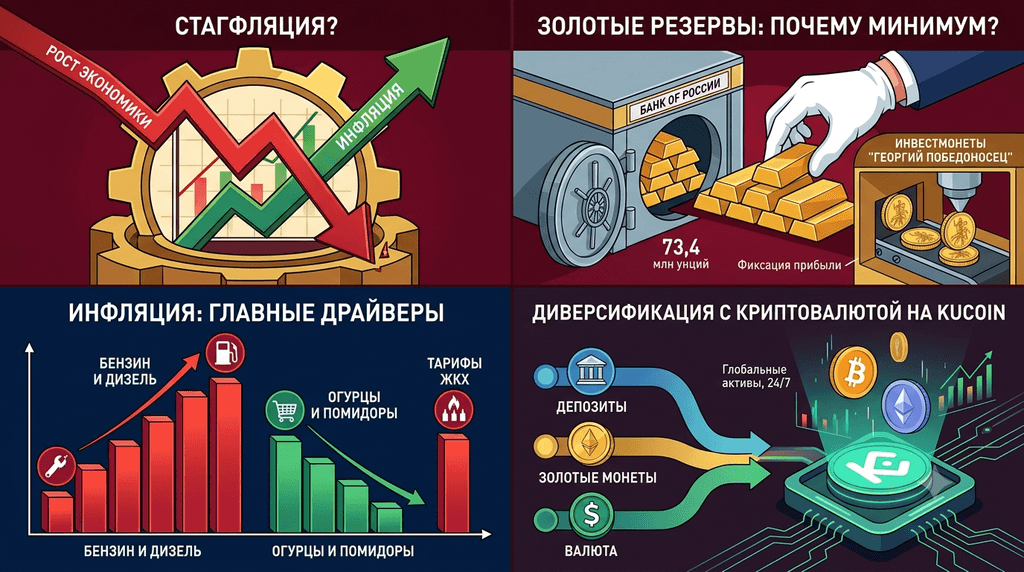
Russia's annual inflation accelerated to 5.62% as of July 13, and CMASF (the Center for Macroeconomic Analysis and Short-Term Forecasting) has already described the current state of the economy as "near-stagflationary." At the same time, the Bank of Russia's gold reserves fell to 73.4 million troy ounces — the lowest level since February 2020. At first glance, these three headlines look like a single warning sign. But is the picture really that simple?
Short answer: the price surge is driven mainly by a spike in gasoline and diesel costs, not an economy-wide overheating. The gold sales aren't a "sell-off of last reserves" — they reflect metal being redirected into investment coins and partial profit-taking near record-high prices. And while the stagflation risk is real, it remains manageable: the central bank has already begun cautiously cutting its key rate while keeping its 4% inflation target for 2027.
Below, we break down each of these three storylines in detail and show how investors typically protect their savings in this environment — including by buying cryptocurrency on KuCoin.
What Does CMASF's "Near-Stagflationary Situation" Warning Actually Mean
Stagflation is a simultaneous combination of economic stagnation and high inflation, and Russia has already moved close to this state, according to the Center for Macroeconomic Analysis and Short-Term Forecasting (CMASF). Dmitry Belousov, head of macroeconomic analysis and forecasting at CMASF, states in the report "Etude 2" that tight monetary policy is no longer effectively restraining price growth.
The root cause lies in the structure of inflation itself. Analysts point to two key factors. First, a significant share of prices doesn't depend on the central bank's key rate at all — this includes gasoline, utility tariffs, and natural-monopoly services, which rise based on government and regulatory decisions rather than demand. Second, businesses are passing their own rising costs — loan interest, leasing and rental rates — directly into final prices, simply shifting the burden onto consumers.
Compounding the situation are heavy corporate debt loads and weak competition in several sectors, which let market players maintain margins even as demand falls, instead of lowering prices. As a result, raising the key rate slows economic growth but produces little visible effect in the fight against inflation itself — a textbook sign of approaching stagflation.
It's important to note that CMASF is describing a "near-stagflationary situation," not confirmed stagflation. Officially, the Bank of Russia still considers this scenario an unlikely base case, betting instead on a gradual normalization of the fuel market and cooling demand.
Similar warnings appeared earlier in 2026 as well. Back in March, CMASF warned that the economy was "one step away" from stagflation amid a 2.1% year-on-year GDP decline in January, following 1.9% growth in December 2025 — at the time, only five of 28 major industrial sectors showed growth. The July report essentially confirms that the risk hasn't disappeared in the months since; it has simply shifted from a forecast into current reality, now with a more concrete explanation — businesses passing costs into final prices amid weak competition.
Why Annual Inflation Accelerated to 5.62%
The acceleration of inflation to 5.62% as of July 13, 2026, is driven primarily by a sharp rise in fuel prices, not by broad overheating in consumer demand. According to Rosstat data, weekly inflation from July 7–13 came in at 0.17%, down from 0.31% the week before. Since the start of the year, cumulative price growth reached 4.64%.
The biggest contributors to price growth were gasoline and diesel fuel, which rose 2.25% and 3.18% respectively over the week — an even sharper pace than the week before, when they rose 2.1% and 3.4%. Analysts identify the fuel factor as the main driver of the recent inflation spike, rather than wage growth or consumer lending.
What's Getting More Expensive — and What's Getting Cheaper
Inflation in Russia right now is uneven: some goods are rising in price at double-digit rates, while others are getting cheaper. Over the week of July 7–13, chicken meat rose 2.0%, granulated sugar rose 1.8%, and buckwheat rose 0.7%. At the same time, prices for certain Southeast Asian tourist destinations and hotel accommodations also increased.
Meanwhile, fruit and vegetable prices have been falling for a second straight week: cucumbers dropped 6.3% and tomatoes fell 3.7%. This seasonal deflation in fresh produce is partially offsetting the fuel-driven price shock, which is why weekly inflation slowed compared to previous weeks.
The Bank of Russia's official inflation forecast for 2026 remains in the range of 4.5–5.5%, with a return to the 4% target in 2027. However, the Ministry of Economic Development raised its own forecast this spring from 4.0% to 5.2%, and analysts surveyed by the central bank in July raised their 2026 inflation expectations even further — to 6.2% from a previous 5.3%. This points to growing market uncertainty about a swift return to target.
The spread between these forecasts is worth laying out in a single table — it shows just how much official agencies and independent analysts currently disagree.
| Forecast Source | 2026 Inflation Forecast | Update Date |
| Bank of Russia (official target) | 4.5–5.5% | June 19, 2026 |
| Russian Ministry of Economic Development | 5.2% (raised from 4.0%) | May 2026 |
| Bank of Russia analyst survey | 6.2% (raised from 5.3%) | July 2026 |
This spread is telling in itself: the wider the gap between the official target and market expectations, the greater the uncertainty for businesses and households trying to plan spending and savings.
Why Is the Bank of Russia Selling Gold If Reserves Are Supposed to Grow?
The decline in Russia's gold reserves isn't linked to a liquidity crisis or a forced asset sell-off — it's the result of a combination of profit-taking and redirecting metal to the domestic market. According to Bank of Russia data, as of July 1, 2026, monetary gold in international reserves stood at 73.4 million troy ounces — the lowest level since February 2020. For comparison, the figure was 73.7 million ounces on June 1 and 73.9 million on May 1.
According to the World Gold Council, global central banks collectively added 41 tonnes of gold to reserves in May 2026, while Russia, by contrast, sold 6 tonnes that month. Since the start of the year, total sales have reached 34 tonnes, bringing overall reserves down to 2,292 tonnes — Russia ranked as the leading seller of gold among global central banks in January.
The key point: the decline in the physical volume of gold has barely dented its value. Thanks to rising global gold prices, the dollar- and ruble-denominated value of reserves grew by nearly 67% over 2025, despite the drop in physical volume. In other words, the central bank is selling a relatively small share of its holdings — under 1% of the total — near record-high prices, which looks far more like planned profit-taking than a sell-off of "last reserves."
The "St. George the Victorious" Investment Coins — Where Some of the Gold Is Going
A significant portion of the gold from reserves is being redirected not to export markets, but into minting investment coins for domestic demand. In 2026, the Bank of Russia doubled the mintage of its gold and silver "St. George the Victorious" (Georgy Pobedonosets) coins — to one million units of each, up from 500,000 the year before, as public demand for protective assets increased.
This mechanism effectively works as a way to "hand out" part of the reserves to citizens in exchange for rubles, while simultaneously soaking up excess ruble liquidity in the market. Since its first issue in 2006, the price of the gold "St. George the Victorious" coin has risen more than 25-fold — from roughly 4,400 rubles to around 110,000 rubles — making it a popular instrument for conservative investors seeking inflation protection within the ruble-based system.
Can a High Key Rate Handle This Situation?
A high key rate curbs economic overheating, but it's no longer delivering a fast effect against inflation, which is why the central bank has shifted to cautiously cutting the rate rather than raising it further. At its June 19 meeting, the Bank of Russia's board cut the key rate from 14.5% to 14.25% — even though most analysts had expected a sharper 50-basis-point cut.
Bank of Russia Deputy Governor Alexei Zabotkin attributed the regulator's caution to rising fuel prices and public inflation expectations. He stressed that the central bank cannot ignore the fuel factor, but that with a well-calibrated monetary policy, it still expects to bring inflation back to the 4% target by 2027 — provided government measures succeed in normalizing the fuel market.
At the same time, the central bank kept a dovish signal for the future in its June statement, noting that upcoming rate decisions will depend on how sustainably inflation continues to slow and on inflation expectations. In other words, the regulator is balancing two risks simultaneously: preventing inflation from accelerating further, and avoiding a situation where excessively expensive credit chokes off business activity — which is precisely the attempt to stop the "near-stagflationary situation" from turning into full-blown stagflation.
How Investors Are Protecting Their Savings Amid Near-Stagflation
During periods of simultaneous price growth and economic slowdown, the classic set of protective assets tends to expand — beyond the usual deposits and gold, a growing number of retail investors in Russia are turning to cryptocurrency as a diversification tool. The logic is simple: bitcoin and other digital assets aren't directly tied to the ruble money supply, the budget deficit, or the dynamics of Russia's specific key rate.
Diversifying across several asset classes — rubles, gold, foreign currency, cryptocurrency — reduces dependence on any single macroeconomic scenario. That's why, in moments of heightened uncertainty like the current one, interest in crypto exchanges tends to rise: they provide access to assets that trade globally and aren't directly tied to local inflation or the decisions of a single central bank.
That said, it's important to distinguish short-term inflation protection from long-term investment strategy. Gold coins like the "St. George the Victorious" historically work well as a capital-preservation tool over a horizon of several years, but they have low liquidity for quick transactions and require physical storage. Cryptocurrency, by contrast, trades around the clock and allows positions to be entered and exited almost instantly, making it a convenient complement rather than a replacement for traditional protective assets.
Should You Buy Cryptocurrency on KuCoin Amid Stagflation Risks?
Buying cryptocurrency on KuCoin can be a reasonable step for those looking to diversify their portfolio beyond ruble and ruble-denominated assets, but it's worth starting with a clear understanding of volatility risk. KuCoin provides access to hundreds of trading pairs, including bitcoin, ether, and stablecoins, allowing capital to be flexibly allocated across instruments with different risk profiles.
To start trading on KuCoin, you simply need to register on the platform, complete verification, and fund your account through one of the available methods. From there, you can choose a strategy: a conservative approach focused on stablecoins and large-cap coins, or a more aggressive one that includes promising altcoins. KuCoin's built-in tools — including spot trading, staking, and futures — make it possible to tailor the instrument to a specific goal, from simple capital preservation to actively profiting from market volatility.
For those who already hold part of their savings in gold or foreign currency, the crypto market can serve as an additional third or fourth element of the portfolio rather than a replacement for an existing strategy. A small allocation to stablecoins, for example, allows capital to be held outside the ruble system without the volatility typical of bitcoin or altcoins, while a riskier portion of the portfolio can be directed toward assets with potentially higher returns. KuCoin also provides analytical tools and market data that help track price dynamics and make decisions based on current information rather than emotional reactions to macroeconomic headlines.
It's worth remembering that cryptocurrency is a high-risk asset, and any investment decision should be made with your own financial stability and investment horizon in mind — not solely in response to alarming macroeconomic news.
Conclusion
Three headlines — CMASF's warning about a near-stagflationary situation, the acceleration of annual inflation to 5.62%, and the decline of gold reserves to their lowest level since February 2020 — are related, but they don't add up to a picture of an imminent crisis. The inflation acceleration is almost entirely explained by the spike in gasoline and diesel prices, not by overheating across the whole economy. The decline in gold reserves largely reflects profit-taking at historically high gold prices and the redirection of metal into investment coins for the public, rather than a forced sell-off of the country's last assets.
The stagflation risk, however, is real: a high key rate is increasingly less effective against inflation driven by non-monetary factors like tariffs and fuel prices. The Bank of Russia is responding with cautious rate cuts while maintaining its long-term inflation target of 4% by 2027. The spread in forecasts — from an official range of 4.5–5.5% to 6.2% among independent analysts — shows that no one is fully confident in a swift return to target.
For private investors, this is a reminder not to rely on a single protective asset, but to diversify savings across different asset classes. Gold remains a well-understood tool for long-horizon capital preservation, while more liquid assets like cryptocurrency allow for a faster response to shifting market conditions. The key is to make portfolio decisions deliberately, not under the influence of alarming headlines.
Frequently Asked Questions
1. What is stagflation in simple terms?
Stagflation is a rare economic condition in which an economy simultaneously fails to grow (or contracts) while experiencing high inflation, meaning traditional tools like raising or lowering interest rates stop working as expected.
2. Is Russia selling gold because it's short on cash?
No — the volume of gold sold amounts to less than 1% of total reserves, and most of the metal is being directed toward minting investment coins for the public rather than directly covering the budget deficit.
3. Why does inflation feel higher than the official 5.62%?
Perceived inflation is often higher than the official figure because people notice price increases on frequently purchased goods — fuel, meat, sugar — more acutely, while falling prices for seasonal fruits and vegetables smooth out the overall index.
4. Will the Bank of Russia cut its key rate further in 2026?
Further cuts are possible, but the regulator has promised to act cautiously and evaluate each decision based on how sustainably inflation continues to slow, so sharp moves at upcoming meetings shouldn't be expected.
5. How does cryptocurrency differ from gold as a protective asset?
Gold has historically been considered a more stable protective asset with low volatility, while cryptocurrency offers potentially higher returns at the cost of significantly greater volatility and requires more active risk management.