

ST0x Survey: 63% Say SEC Registration Would Make Tokenized Assets Eligible
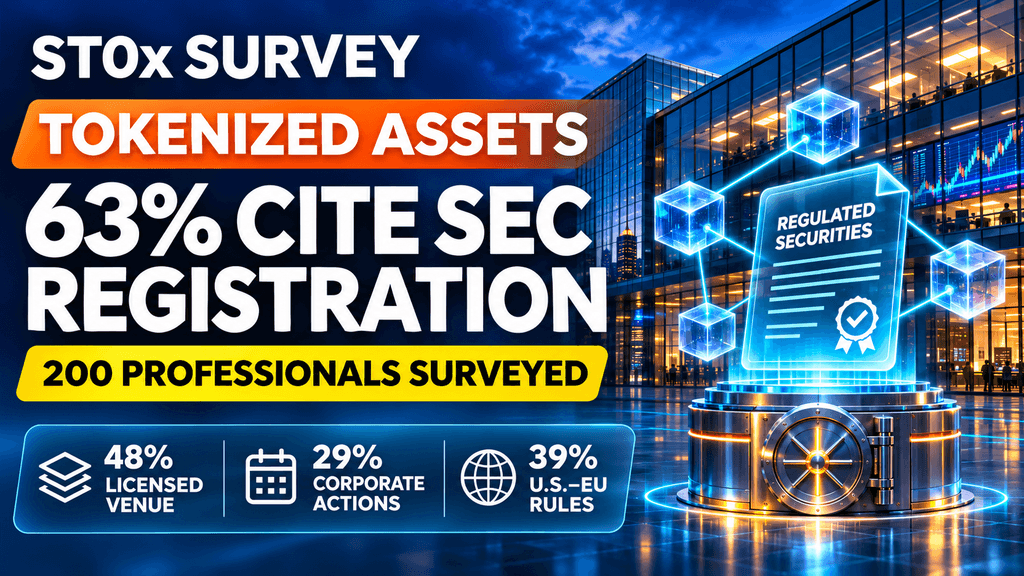
An ST0x survey of 200 institutional investors and wealth managers found that 63% believe SEC registration would make tokenized assets eligible under their investment mandates. Conducted by PureProfile in August 2026 and reported in November, the research points to regulation, legal enforceability and reliable market operations as central requirements for institutional adoption. The findings arrived after the U.S. Securities and Exchange Commission introduced a limited exemption for certain tokenized stock trading arrangements in September 2026. That regulatory change is significant, but it does not mean every tokenized security is registered, every venue is approved or institutional investment is guaranteed.
Key Takeaways
-
63% of surveyed professionals said SEC registration would make tokenized assets eligible under their investment mandates.
-
48% identified a licensed trading venue as another potential route to mandate eligibility.
-
Automated corporate actions, regulated custody and enforceable asset claims ranked ahead of lower transaction costs as trading priorities.
-
The SEC's September 17, 2026, exemption permits specific tokenized stock trading models under temporary conditions, not blanket securities registration.
-
Respondents saw near-term utility in tokenized ETFs, individual equities or both, with no single product category dominating.
-
39% identified potential U.S.–EU regulatory divergence as their leading concern for the next two years.
What the ST0x Survey Reveals About SEC Registration and Tokenized Assets
The ST0x study provides a snapshot of how professional investors assess tokenized securities when legal status and operational design are placed alongside blockchain features. ST0x Group commissioned research agency PureProfile to interview 200 professionals in August 2026, including representatives of investment managers, pension funds, insurers, family offices, banks, custodians and financial-market infrastructure firms. Participants came from North America, the United Kingdom, continental Europe, the Middle East and Asia-Pacific. The reported results describe responses to hypothetical conditions and preferences; they do not measure completed allocations or prove that the surveyed firms have approved specific products.
SEC Registration and Licensed Trading Venues Influence Institutional Eligibility
The headline finding was that 63% of respondents said registration with the U.S. Securities and Exchange Commission would make tokenized assets eligible for consideration under their mandates. Another 48% indicated that a licensed associated trading venue would support eligibility. These are distinct regulatory attributes: securities registration concerns the relevant instrument or offering, while venue licensing concerns the organization and rules governing secondary-market activity. For institutions with formal investment policies, both can affect whether a product reaches a portfolio manager for assessment.
The survey also identified regulatory assurances beyond the United States. 42% reported greater willingness to invest in an instrument covered by a European Economic Area regulator-approved prospectus, while 26% pointed to support or backing from a globally systemically important bank. An approved prospectus provides a disclosure framework; it is not a regulatory guarantee of asset quality or performance. Similarly, a bank's involvement may mean different things depending on whether it acts as custodian, service provider, distributor or contractual guarantor. Those distinctions matter when comparing tokenized securities that appear similar on a trading screen.
What the 63% Finding Means for Institutional Tokenization
Mandate eligibility is a preliminary compliance question, not an investment decision. Even if a tokenized security meets a firm's stated regulatory requirements, its investment committee may still examine counterparty exposure, liquidity, valuations, operational resilience, tax treatment and the legal terms of ownership. The survey therefore offers stronger evidence of what respondents say would reduce institutional barriers than of how much capital they are prepared to commit. The underlying questionnaire, respondent-level data and complete sampling methodology were not publicly available for independent assessment in the reviewed coverage.
The distinction is especially important because tokenization describes a method of representing rights or interests using blockchain records, not a single legal product type. A token may represent a directly issued security, an entitlement held through an intermediary or a separate claim linked to an asset's value. These structures can differ in transfer rights, insolvency treatment and regulatory obligations. As a result, institutional due diligence must establish exactly what an investor receives, who owes the obligation and how that obligation can be enforced.
Why Institutional Investors Prioritize Regulated Custody, Legal Rights, and Corporate Actions
A separate ST0x survey question asked respondents to identify the factor most likely to increase their firms' traded volume in tokenized securities over the following year. The answers centered on whether blockchain-based instruments can operate within existing institutional controls. Participants were not simply ranking the appeal of lower fees or faster transfers; they were identifying the infrastructure problems most likely to influence actual trading activity. The pattern suggests that dependable servicing and clearly defined investor protections could matter more than technological novelty alone.
Automated Corporate Actions Emerge as the Leading Trading Priority
29% selected automatic and predictable handling of corporate actions across event types as their leading potential trading driver. For tokenized equities and ETFs, this includes dividends, stock splits, mergers, tender offers and other events that can change an investor's entitlement or the instrument's reference value. A transfer recorded on a blockchain does not, by itself, guarantee that a dividend reaches the correct holder or that a reorganization is reflected accurately. Institutional operations teams need procedures for record dates, beneficial ownership, exception handling and reconciliation between digital records and traditional securities infrastructure. Inconsistent treatment could produce accounting errors or disputes even when token transfers settle correctly.
Regulated Custody and Independent Verification Support Institutional Confidence
Another 27% identified named, regulated custody of underlying assets with independent verification as the most influential improvement. Institutions need to know which legal entity holds the referenced securities, whether client assets are segregated, and how holdings are reconciled against the tokens in circulation. Public blockchain records may show how many tokens were issued or transferred, but they cannot alone establish that a broker or custodian holds the corresponding off-chain assets. Independent assurance, documented custody arrangements and reporting procedures therefore remain central. This concern is particularly relevant when tokenization introduces an issuer or intermediary between the investor and the company whose shares support the product.
Legally Enforceable Claims Determine Token Holder Rights
For 19% of participants, a legally enforceable claim on the underlying security was the leading factor that could increase trading. The phrase requires careful interpretation because not every tokenized stock confers direct shareholder status. For example, S01 Issuer GmbH's ST0x documentation describes tokens as unsecured contractual claims against S01 rather than entries on the underlying company's shareholder register; holders do not receive ordinary voting rights through those tokens. An approved EEA base prospectus discloses the product terms and risks but does not turn the claim into direct share ownership. The SEC likewise distinguishes issuer-sponsored securities, third-party custodial arrangements and synthetic products, with materially different potential rights.
Lower Transaction Fees Rank Behind Operational Reliability
Only 3% identified lower transaction costs as the factor most likely to increase their firm's tokenized securities trading, while 6% prioritized deeper secondary markets and tighter spreads. Another 17% chose approval by an EEA or equivalent regulator. These percentages relate to respondents' leading choices in one survey question; they do not mean the remaining participants consider costs or liquidity irrelevant. Fees also need to be assessed alongside custody charges, reconciliation expenses, settlement arrangements and the cost of maintaining controls across jurisdictions. An apparently inexpensive transaction can still create a substantial operational burden if reporting and asset servicing remain fragmented.
How the SEC's 2026 Tokenized Stock Exemption Works and Differs From Securities Registration
On September 17, 2026, the SEC announced an Innovation Exemption covering certain arrangements for trading tokenized National Market System stocks. The measure offers a narrowly defined regulatory route for qualifying Tokenized Securities Venues, or TSVs, and specified liquidity providers. It is relevant to the ST0x findings because it addresses a practical part of tokenized market structure, but it should not be confused with the SEC registering every stock-backed token or certifying a venue as safe. The relief is temporary, conditional and subject to operational safeguards.
How the SEC Innovation Exemption Allows Tokenized Stock Trading
The order provides a five-year conditional exemption from the Securities Exchange Act of 1934 definition of an exchange for qualifying TSVs. Certain participants supplying tokenized stock to liquidity pools also receive limited relief from the Act's dealer definition. The trading model uses permissioned participants interacting with automated market makers and liquidity pools on public, permissionless distributed ledgers. The SEC imposed limits on the number of eligible symbols and overall volume, required public and auditable smart contracts, and specified recordkeeping and transaction-transparency obligations. The design permits experimentation while preserving a framework for regulatory observation.
A TSV must also verify that eligible tokenized stocks provide the same rights and privileges as traditional shares of the equivalent class. Trading must stop when the underlying security is halted on its primary listing exchange. If an unaffiliated third party tokenizes a company's stock, the issuer must receive notice and an opportunity to object. A prospective venue must publish its own operational notice at least 30 calendar days before commencing activity. These requirements limit the exemption's reach and help distinguish the SEC's model from unrestricted trading of stock-linked tokens on open blockchain networks.
Why the SEC Exemption Is Different From Securities Registration
The exemption deals principally with specified secondary-market activity under the Exchange Act. Securities Act of 1933 registration, by contrast, concerns an offering's disclosure and registration requirements unless an applicable exemption is available. Neither concept should be treated as interchangeable with SEC approval of an investment product. The agency's January 28, 2026, staff statement also emphasized that putting securities on a blockchain does not eliminate the legal analysis required to determine what rights the token represents. A custodial entitlement and a synthetic claim tied to the same share price can have different protections and counterparty risks.
The SEC's public TSV notice page, updated November 9, 2026, listed four entities that had submitted notices of intent to operate under the exemption. The agency explicitly cautioned that inclusion does not demonstrate that a firm qualifies or has satisfied the order's conditions. For institutions, the next meaningful evidence is therefore operational: whether a venue actually meets the conditions, maintains reliable records and provides acceptable execution, custody and surveillance arrangements. The existence of regulatory relief is a confirmed development; any resulting increase in institutional activity remains an expectation rather than an established outcome.
What Tokenized ETF Preferences and U.S.–EU Regulatory Risks Mean for Institutional Adoption
Tokenized exchange-traded funds emerged as a notable potential entry point in the ST0x survey. Approximately one-third of respondents saw tokenized ETFs as offering the greatest near-term utility, compared with 28% who favored single-name tokenized equities; 39% regarded the two categories as equally useful. ETFs can provide diversified market exposure within an instrument type already familiar to professional investors, but representing an ETF on a blockchain adds questions about fund-share rights, authorized participants, underlying holdings and how the token's value tracks the listed product. Familiarity with the fund structure does not remove the need to examine the token wrapper.
How Issuer Consent and U.S.–EU Rules Could Influence Tokenized Asset Adoption
Issuer involvement was another important dividing line. Asked to choose between a product covering about 40 equities with the underlying companies' consent and a broader product covering more than 2,000 names without that consent, 49% preferred the narrower option, 27% chose breadth and 24% said the answer depended on circumstances. The result indicates that respondents may value the clarity of issuer participation even when it limits product selection. However, issuer consent does not necessarily mean the issuer guarantees the token, its liquidity or the obligations of third-party intermediaries. The precise legal structure remains decisive.
Cross-border distribution also affects institutional use. 38% said a single approved tokenized instrument distributable across EEA jurisdictions would remove a significant compliance burden, while 55% expected a moderate improvement. Firms operating in several European markets can face overlapping demands for product documentation, investor classification, reporting and local distribution arrangements. A more consistent framework could simplify those processes, although the survey did not quantify potential cost reductions. In the European Union, tokenized financial instruments generally remain subject to applicable securities rules; blockchain representation does not automatically place them within the separate MiCA regime for other crypto-assets.
Asked about the most concerning regulatory development over the next 24 months, 39% chose divergence between U.S. and EU treatment that could fragment liquidity. Reclassification after an allocation was the primary concern for 27%, while 25% selected enforcement action against a major issuer or venue and 7% cited a continued lack of clear rules. These are reported perceptions, not probabilities assigned to future events. Divergent approaches could force institutions to manage separate product eligibility, custody and trading arrangements for what appears to be similar underlying exposure, potentially reducing the benefit of a shared settlement network.
The next policy steps are still developing. On November 9, 2026, the European Commission, European Central Bank and European Securities and Markets Authority announced a call for participants in the European Tokenisation Standards Group, with applications due November 27, 2026. The Commission also scheduled a financial-market tokenization roundtable for November 26. These initiatives may help shape discussions about interoperability and market practices, but they have not yet produced a harmonized U.S.–EU rulebook. Institutional adoption will depend on what firms can legally hold and operationally support, not solely on the number of securities a blockchain system can represent.
Conclusion
The ST0x survey suggests that institutional interest in tokenized assets is increasingly tied to conventional financial safeguards: clear securities status, reliable asset servicing, accountable custody and enforceable investor rights. Its central finding indicates a potential route to mandate eligibility, but it does not establish that respondents have made allocations or that existing tokenized products meet their requirements. The SEC's September 2026 trading exemption provides a conditional framework for testing one market model, while European standard-setting discussions highlight the importance of cross-border compatibility. Whether tokenized ETFs and equities gain wider institutional use will depend on implementation, demonstrated liquidity, legal clarity and the ability of market participants to manage risks that remain unresolved.
FAQs
Can ST0x token holders redeem their tokens for actual shares?
Direct redemption is available to authorised participants who complete S01 Issuer GmbH's onboarding requirements and maintain an account with an eligible broker. Other holders generally access liquidity through trading venues, so owning a token does not automatically provide the same redemption process as holding shares in a brokerage account.
What is the difference between ST0x tStock and wtStock tokens?
A tStock represents a contractual claim against S01 linked to one underlying share. A wtStock is a wrapped version designed to account for dividends and stock splits without changing the holder's token balance; its conversion value in tStock can therefore change over time.
Are ST0x tokenized stocks available to U.S. investors?
ST0x states that its securities are offered in specified European Economic Area markets and are not available to U.S. persons. The SEC's September 2026 innovation exemption concerns certain trading arrangements and does not automatically authorize the sale of ST0x products to American investors.
Can tokenized stocks trade outside regular stock market hours?
Some tokenized products, including ST0x tokens, can trade while the exchange listing the underlying share is closed. However, prices may diverge from the last quoted share price because fresh reference-market prices are unavailable and liquidity can be thinner; permitted trading arrangements may also require coordinated trading halts.
How can investors verify whether an ST0x token is genuine?
The token's blockchain network and smart contract address should match the issuer's official token directory; a familiar ticker or name alone is insufficient. On-chain minting and burning records improve traceability, but those records do not independently establish the value of shares held by a broker or eliminate issuer credit risk.
Disclaimer: This general market information, possibly from third-party, commercial, or sponsored sources, is provided for reference and educational purposes only and does not constitute financial or investment advice, an offer, solicitation, or guarantee. We disclaim liability for its accuracy, completeness, reliability, and any resulting losses. Investments/trading are risky; past performance doesn’t guarantee future results. Users should research, judge prudently, and take full responsibility. For further details, please consult KuCoin’s Terms of Use and Risk Disclosure.