

SpaceX Q3 2026 Earnings: Revenue Jumps 161% to $14.6 Billion, Net Income Hits $4.4 Billion
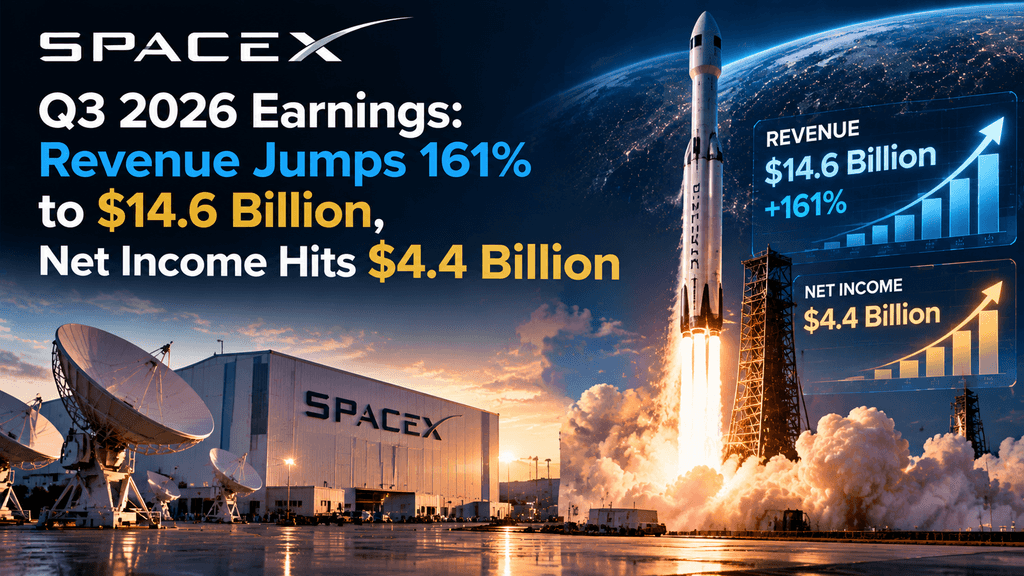
SpaceX reported a dramatic improvement in its third-quarter 2026 financial results, with revenue surging 161% year over year to $14.575 billion and net income reaching $4.4 billion, compared with a $1.1 billion loss a year earlier. The results, disclosed on October 20, highlight a major shift in the company's business model: artificial intelligence infrastructure has become its largest revenue segment, while Starlink continues to generate substantial operating profits. Adjusted EBITDA climbed 306% to $8.8 billion, reflecting the scale of the company's recent expansion.
However, the earnings report also reveals the cost of that growth. SpaceX spent $19.6 billion on capital expenditures during the quarter, with most of the investment directed toward AI computing infrastructure. The company is simultaneously expanding its satellite internet network and developing its next-generation Starship launch system. Elon Musk also confirmed that SpaceX and Tesla have established independent committees to explore a potential merger, although no transaction terms have been agreed. Together, these developments make the report significant not only for the space industry but also for investors tracking AI infrastructure, satellite connectivity, and large-scale technology investment.
Key Takeaways
-
Revenue surged 161%: SpaceX generated $14.575 billion in Q3 2026 revenue, compared with $5.576 billion in the same period last year.
-
Net income reached $4.4 billion: The company reversed its year-ago loss of $1.1 billion, while adjusted EBITDA increased 306% to $8.809 billion.
-
AI became the largest revenue segment: Super Intelligence (SI) generated $7.56 billion, accounting for approximately 52% of quarterly revenue.
-
Starlink remained the main profit generator: The Connectivity segment recorded $5.248 billion in revenue and $2.367 billion in operating income, supported by 13.6 million consumer subscribers.
-
Capital spending nearly tripled: Quarterly capital expenditures reached $19.593 billion, including $16.444 billion allocated to SI.
-
A potential Tesla merger remains uncertain: Both companies formed special committees to examine a possible transaction, but no agreement has been reached.
SpaceX Q3 2026 Earnings: Revenue and Profitability Surge
SpaceX's third-quarter results show that the company is expanding far beyond its traditional launch business. Revenue increased by approximately $9 billion from a year earlier, while the company moved from an operating loss to a substantial operating profit. According to its SEC filing, revenue reached $14.575 billion, income from operations totaled $2.791 billion, and net income was $4.4 billion. Adjusted EBITDA, a non-GAAP measure of operating performance, rose to $8.809 billion from $2.169 billion in Q3 2025.
Key Financial Results
| Financial metric | Q3 2026 | Q3 2025 | Year-over-year change |
| Revenue | $14.575B | $5.576B | 1.61 |
| Net income (loss) | $4.4B | −$1.1B | Improved by $5.5B |
| Adjusted EBITDA | $8.809B | $2.169B | 3.06 |
| Operating income (loss) | $2.791B | −$273M | Turned profitable |
| Capital expenditures | $19.593B | $6.880B | Approximately 2.85x |
Source: SpaceX's Q3 2026 SEC earnings filing. Figures are rounded where appropriate. Adjusted EBITDA is a non-GAAP measure and should not be treated as equivalent to net income.
The gap between revenue growth and adjusted EBITDA growth suggests that SpaceX is generating greater operating earnings as its business expands. Nevertheless, a single quarter cannot establish whether this improvement will persist. The company's financial performance now depends on several businesses with different cost structures, investment cycles, and growth opportunities.
Capital spending is equally important to the earnings story. SpaceX invested $19.593 billion during the quarter, exceeding its reported revenue. Capital expenditures are not equivalent to expenses recognized immediately in net income, so this comparison does not mean the company operated at a loss. Instead, it highlights the scale of investment required to build computing facilities, satellite networks, and launch infrastructure. Investors will need to assess whether these assets generate sufficient future revenue and cash flow to justify their cost.
Why Did SpaceX Revenue Jump 161%?
The primary driver was the rapid expansion of its Super Intelligence business, combined with continued growth in Starlink connectivity. SpaceX reported three main operating segments: Space, Connectivity, and Super Intelligence. SI contributed more than half of quarterly revenue, changing the company's financial profile from one centered on launches and satellite internet to one increasingly influenced by AI computing infrastructure.
| Business segment | Q3 2026 revenue | Year-over-year revenue growth | Operating income (loss) |
| Super Intelligence (SI) | $7.560B | Approximately 830% | $431M |
| Connectivity | $5.248B | 69% | $2.367B |
| Space | $1.767B | Approximately 6% | −$7M |
| Total | $14.575B | 161% | $2.791B |
Source: SpaceX's official earnings release. Growth rates are rounded.
Super Intelligence: AI Computing Becomes SpaceX's Largest Business
SI generated $7.56 billion in revenue, up from $813 million a year earlier. The company attributed the increase to cloud-services agreements, the acquisition of Cursor, and growing adoption of its AI models and software applications, including Grok Bot. Reuters reported that much of the segment's revenue came from renting data-center computing capacity to AI developers, including Anthropic, Alphabet's Google, and Reflection AI.
This growth suggests that SpaceX is developing a substantial infrastructure business alongside its existing space operations. Rather than relying exclusively on revenue from its own AI products, the company can monetize computing capacity through customer contracts. Such agreements may provide recurring revenue, particularly when customers need large amounts of processing power to train or operate AI systems.
However, rapid revenue growth does not automatically translate into equally strong profitability. SI generated approximately $431 million in operating income despite producing $7.56 billion in revenue, while its capital expenditures reached $16.444 billion. The segment is therefore expanding rapidly but remains capital-intensive. Its long-term contribution will depend on customer demand, infrastructure utilization, pricing, and the rate at which operating earnings grow relative to investment.
Connectivity: Starlink Remains a Major Profit Engine
The Connectivity segment, led by Starlink, generated $5.248 billion in quarterly revenue, up 69% year over year. Operating income reached $2.367 billion, making Connectivity the most profitable of SpaceX's three reported segments during the quarter. The company also reported 13.6 million Starlink consumer subscribers, supported by demand across consumer, enterprise, aviation, maritime, and government markets.
Starlink's importance lies in its recurring subscription revenue. Unlike individual rocket launches, broadband subscriptions can generate continuing payments from a large and geographically expanding customer base. The network can also serve customers in areas where conventional broadband infrastructure is difficult or expensive to deploy, creating opportunities in residential connectivity and specialized communications services.
Yet subscriber growth is not the only metric that matters. Reuters reported that average monthly revenue per subscriber had declined from $99 in 2023 to $69 in Q3 2026, reflecting the expansion of lower-priced plans into additional markets. This does not necessarily undermine the business model, since a larger subscriber base can offset lower average revenue per user. Nevertheless, future performance will depend on the balance between subscriber growth, pricing, network capacity, and the cost of deploying and maintaining satellites.
Space: Launch Services and Starship Remain Strategically Important
The Space segment generated $1.767 billion in revenue, up approximately 6% year over year, but recorded a $7 million operating loss. Its contribution to current profits was therefore much smaller than that of Connectivity, even though launch services and spacecraft development remain central to the company's broader strategy.
A major development during the quarter was SpaceX's first revenue-generating Starship mission, which delivered 26 Starlink V3 satellites into the company's broadband constellation. According to the earnings release, the mission added approximately ten times the downlink capacity of a typical Falcon 9 Starlink launch. If Starship becomes reliably reusable and supports frequent operations, it could substantially change the economics of deploying large satellite constellations.
However, the commercial significance of Starship depends on more than an individual successful mission. Reliability, turnaround time, launch frequency, operating costs, and customer demand must all develop sufficiently to support regular service. For now, Starship represents both a potential long-term advantage and an important source of engineering expenditure and execution risk.
Why SpaceX's $19.6 Billion Capital Spending Matters
SpaceX's capital expenditures reached $19.593 billion in Q3 2026, nearly three times the $6.880 billion reported a year earlier. The majority was directed toward SI, which accounted for approximately $16.444 billion of the quarter's investment. This allocation indicates that computing infrastructure expansion is the central focus of the current investment cycle, even as the company continues to fund Starlink deployment and rocket development.
The business logic is straightforward: SpaceX must invest in computing facilities and supporting infrastructure before it can fully monetize the capacity through cloud agreements and AI-related services. If demand remains strong and the infrastructure is efficiently utilized, these assets could support substantial future revenue. If customer demand weakens, pricing declines, or facilities remain underutilized, the same investment could weigh on returns and cash flow.
Reuters reported that SpaceX's chief financial officer expected capital expenditures to rise to between $35 billion and $40 billion in Q4 2026. That would represent a further increase in the company's investment intensity. Consequently, investors should examine capital spending alongside operating income, liquidity, financing requirements, and the pace at which new infrastructure begins generating revenue. Strong earnings are encouraging, but the sustainability of the business depends on whether investment ultimately produces attractive returns.
SpaceX and Tesla Merger Talks: What Investors Need to Know
Another major development surrounding the earnings report was Elon Musk's confirmation that SpaceX and Tesla had established special committees of independent directors to explore a potential merger. Musk described the idea favorably but cautioned that it would be premature to assume a transaction would happen. According to Reuters, the committees had not agreed on transaction terms, and shareholders would ultimately need to approve a deal.
The possibility has attracted attention because the two companies operate in businesses with potential technological overlap. SpaceX has launch systems, satellite communications, and expanding computing infrastructure, while Tesla operates in electric vehicles, energy storage, and robotics-related technologies. A combination could prompt discussions about shared investment in AI software, chip design, robotics, energy infrastructure, and communications. These potential synergies, however, remain hypotheses until a concrete transaction structure and business plan are disclosed.
A merger would also raise complicated questions about valuation, corporate governance, shareholder interests, financing, and regulatory approval. Musk's leadership roles and ownership stakes in both companies would make independent review particularly important. For news reporting, the key distinction is that formal discussions have begun, but no merger agreement has been announced. Investors should not treat speculation about a combined company as a confirmed corporate event.
How Did Markets React to SpaceX's Earnings?
The results attracted a positive initial market response. Reuters reported that SpaceX shares rose approximately 8% in extended trading after the earnings release and Musk's comments about a possible Tesla merger. The strong revenue performance, return to profitability, and rapid expansion of the AI business helped reinforce the company's growth narrative.
Nevertheless, market reactions reflect expectations as well as reported results. The quarter's performance may increase confidence in SpaceX's ability to monetize AI infrastructure, but investors must also consider the cost of expanding that business. A company can report impressive revenue growth and still face challenges if capital requirements increase faster than sustainable cash generation.
Three indicators will be particularly important in subsequent quarters: whether SI operating income improves as its infrastructure scales, whether Starlink can sustain subscriber growth without excessive pressure on average revenue per user, and whether capital expenditures begin generating sufficient incremental revenue and cash flow. The trajectory of Starship development will also matter because reliable, reusable launch operations could support both the satellite business and SpaceX's longer-term infrastructure ambitions.
What SpaceX's Results Mean for AI, Satellite Communications, and Crypto Markets
SpaceX's earnings offer a useful signal for the wider AI industry. Its growing computing-services revenue and substantial infrastructure investment show how demand for AI capacity is influencing the financial strategies of large technology companies. The opportunity is considerable, but so are the requirements for computing equipment, energy, facilities, and network capacity. Revenue growth alone cannot establish whether the returns on these investments will be attractive over the long term.
For satellite communications, Starlink's subscriber base and operating income demonstrate the commercial potential of recurring broadband services. Starship could eventually reduce the logistical constraints involved in deploying larger satellite networks, although that outcome depends on further technical and operational progress. The combination of launch capability and satellite connectivity remains a distinctive part of SpaceX's long-term strategy.
For cryptocurrency markets, the report is not a direct catalyst such as a token listing, exchange-traded fund flow, or blockchain protocol upgrade. Its relevance is indirect, through AI computing demand, data-center investment, energy requirements, and broader technology-sector risk appetite. Crypto investors may monitor these developments as part of the macroeconomic backdrop, but the earnings report alone does not establish a bullish or bearish outlook for Bitcoin or other digital assets.
What to Watch Next
The next phase of SpaceX's story will depend on whether its rapid revenue expansion can translate into durable profitability and stronger cash generation. Investors should watch SI's operating margins, the utilization of its computing infrastructure, Starlink subscriber growth, and the relationship between capital expenditures and incremental revenue. The company's ability to scale Starship operations reliably will also influence its long-term plans for satellite deployment and space infrastructure.
The potential Tesla merger is another development to follow, but meaningful conclusions will require formal disclosures covering transaction terms, valuation, governance, and shareholder approval. Until then, the most reliable assessment comes from the company's operating results rather than speculation about future corporate structures.
Conclusion
SpaceX's Q3 2026 earnings mark a significant shift in the company's financial profile. Revenue rose 161% to $14.575 billion, net income reached $4.4 billion, and AI computing infrastructure became the largest revenue segment. Starlink continued to deliver substantial operating profits, while the Space segment maintained its strategic role in launch services and satellite deployment.
The results also reveal the scale of the challenge ahead. Capital expenditures reached $19.593 billion, with management expecting an even larger investment bill in the following quarter. SpaceX must demonstrate that its expanding AI infrastructure can deliver sustainable returns while maintaining Starlink's growth and advancing Starship development. Meanwhile, discussions about a potential Tesla merger remain preliminary. The central question for future earnings reports is whether SpaceX can convert its rapid expansion into durable profitability and cash flow across its increasingly diverse businesses.
🔥 Beyond the Headlines: What KuCoin 5.0 Means for You
Market news moves fast — but where you act on it matters just as much. This October, KuCoin launches KuCoin 5.0, transforming KuCoin into a rebuilt platform. Here's what actually changes for you:
-
One account for everything. Older platforms split your money across separate "spot," "margin," and "futures" accounts and expected you to understand why. KuCoin 5.0's unified account removes that entirely — deposit once, and everything is simply there (only available to VIPs for now).
-
Real-world assets (RWA). Tokenized exposure to traditional assets like commodities, right inside your crypto account. One of the fastest-growing segments in global finance is no longer reserved for institutions — you access it from the same balance you trade with.
-
Earn while you learn. Not ready to trade? KCUSD lets your stablecoins earn daily, auto-compounding interest. The lowest-stress way to put your idle deposit to work for 4% yield.
-
An AI assistant in plain language. Ask questions, get market context, understand what you're looking at — built into the platform, no jargon required.
-
An app that doesn't overwhelm. Faster, cleaner, and consistent — intuitive from the first tap, not after a tutorial.
-
Safety you can check, not just trust. A MiCAR-licensed EU entity, Proof of Reserves you can verify yourself, and internationally certified security (SOC 2 Type II, ISO 27001:2022).
Create your account in minutes — and start on the platform built for where crypto is going, not where it's been.
FAQs
Is SpaceX's AI Business More Profitable Than Starlink?
Not yet, based on the reported Q3 2026 segment results. SI generated $7.56 billion in revenue and approximately $431 million in operating income, while Connectivity generated $5.248 billion in revenue and $2.367 billion in operating income. Although SI is growing much faster, its substantial infrastructure investment means that its current operating profitability remains below that of the Connectivity segment.
Why Did SpaceX Spend More on Capital Expenditures Than It Earned in Revenue?
SpaceX reported $19.593 billion in capital expenditures during Q3 2026, exceeding its $14.575 billion in quarterly revenue. Much of this spending supported AI computing infrastructure, with additional investment required for satellite networks and launch systems. Capital expenditures are not the same as expenses recognized immediately in net income, but the high level of spending highlights the importance of future infrastructure utilization, operating returns, and cash flow.
How Many Starlink Subscribers Does SpaceX Have?
SpaceX reported 13.6 million Starlink consumer subscribers in Q3 2026. Its Connectivity segment generated $5.248 billion in revenue and $2.367 billion in operating income during the quarter. Subscriber growth supports recurring revenue, although average revenue per user, network costs, and the investment required to expand satellite capacity remain important factors in the business's long-term profitability.
Disclaimer: This article is for informational purposes only and does not constitute investment advice. Financial results and company projections do not guarantee future performance.