

SpaceX Gets FCC Approval for 1 Million Orbital Data Center Satellites to Power AI Computing in November 2026
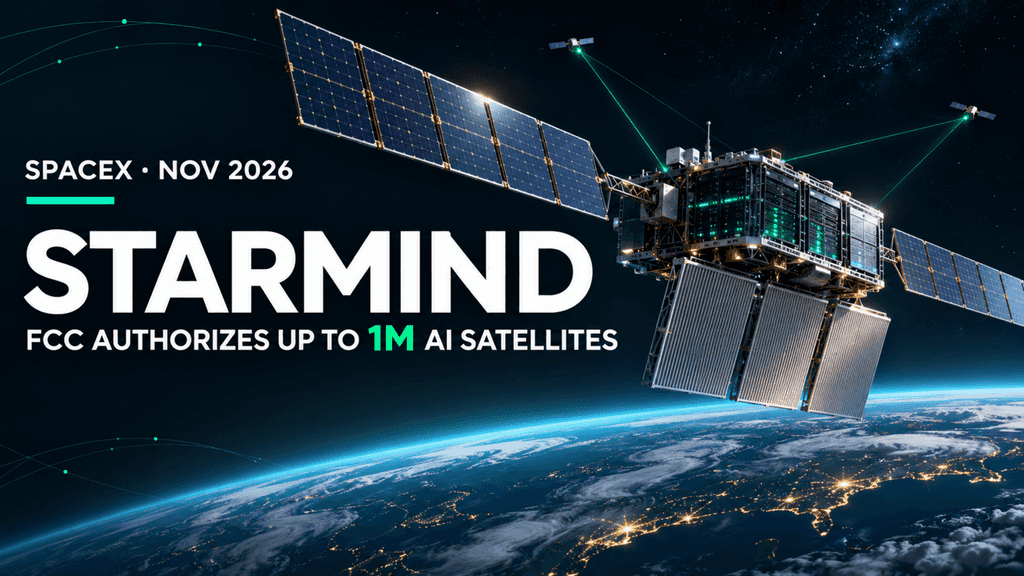
On November 25, 2026, the Federal Communications Commission (FCC) granted SpaceX conditional authorization for its proposed Starmind constellation of up to 1 million orbital AI data center satellites. The project aims to use solar-powered spacecraft to process artificial intelligence workloads in low Earth orbit and transmit results through SpaceX’s Starlink network. The decision gives SpaceX a regulatory foundation for developing computing infrastructure beyond Earth, where reliable electricity supply is becoming a major concern for AI companies. Parts of the application require additional regulatory review, while SpaceX is targeting initial deployments in 2027.
Key Takeaways
-
FCC approval: On November 25, 2026, the FCC conditionally authorized SpaceX’s proposed Starmind orbital AI data center system, covering up to 1 million satellites while deferring parts of the application.
-
Approved orbital range: The FCC authorized deployment between 500 and 1,002 kilometers above Earth, narrowing SpaceX’s original proposal, which included orbital altitudes reaching 2,000 kilometers.
-
AI computing capacity: SpaceX’s AI1 satellite design specifies an average computing-payload power demand of 175 kilowatts, with a peak of 250 kilowatts, supported by solar energy.
-
Starlink integration: Starmind is designed to process AI workloads aboard satellites and transmit results through high-bandwidth laser connections using SpaceX’s existing Starlink communications infrastructure.
-
Launch and deployment timeline: SpaceX has targeted initial Starmind launches for 2027. FCC milestones extend through November 2040, making satellite manufacturing and launch capacity central to the deployment schedule.
-
Environmental and operational challenges: Large-scale deployment will require reliable spacecraft operations and collision management. The American Astronomical Society has also raised concerns about radio interference and infrared emissions affecting astronomical observations.
What Did the FCC Approve for SpaceX’s 1 Million Starmind Satellites?
The FCC’s November 25 decision authorized SpaceX to proceed with its proposed orbital AI data center constellation under specific operating conditions. The approval covers a network of up to one million satellites, with particular emphasis on backup communications, spacecraft control and orbital safety requirements.
What Did the FCC Actually Authorize on November 25, 2026?
The FCC’s Space Bureau issued Memorandum Opinion and Order DA 26-1273, granting part of SpaceX’s application while postponing decisions on certain operating arrangements. SpaceX submitted its proposal in January 2026, and the agency accepted it for public review in February. The decision represents the first U.S. authorization for a satellite constellation specifically designed to operate as orbital data centers.
Starmind would perform AI calculations aboard spacecraft instead of sending every computing task to terrestrial facilities. SpaceX plans to use technology developed for its satellite manufacturing, launch and communications operations. The project builds on the company’s broader orbital AI data center plans, which depend on connecting specialized computing satellites through Starlink and deploying them with Starship.
The FCC grant primarily addresses backup and emergency telemetry, tracking and command communications, commonly called TT&C. These systems allow operators to monitor spacecraft health, send instructions and maintain control if primary communications are interrupted. The one million-satellite figure represents the maximum authorized constellation size, while individual launch operations remain subject to separate Federal Aviation Administration requirements.
Which Orbital Altitudes and Communication Frequencies Did the FCC Approve?
The authorized constellation covers orbital altitudes from approximately 500 to 1,002 kilometers, using six orbital shells with different inclinations. SpaceX’s original proposal considered altitudes reaching 2,000 kilometers, but the final authorization specifies a narrower range. The configuration includes both moderately inclined orbits and sun-synchronous trajectories.
Orbital placement affects several aspects of satellite operation. Lower altitudes can reduce communication distance and help spacecraft leave orbit more quickly after their missions end. Sun-synchronous trajectories can provide favorable solar exposure, an advantage for satellites carrying power-intensive AI processors. Higher altitudes, meanwhile, introduce different long-term debris and disposal considerations.
For backup communications, the FCC authorized 18.8–19.3 GHz for space-to-Earth transmissions and 28.6–29.1 GHz for Earth-to-space transmissions. These Ka-band frequencies support emergency control and telemetry rather than Starmind’s main computing traffic. SpaceX intends to rely on optical links for routine high-capacity communication between satellites.
The radio authorization operates on an unprotected, non-interference basis. SpaceX must coordinate relevant operations with other satellite providers and federal agencies and prevent harmful interference with protected services. These requirements allow Starmind to share spectrum with communications systems already operating under FCC rules.
What Conditions Did the FCC Attach to SpaceX’s Starmind Authorization?
The FCC accepted SpaceX’s orbital debris mitigation plan for satellites operating below 600 kilometers. Before deploying Starmind spacecraft above that altitude, SpaceX must submit an application modifying its authorization and provide a final debris mitigation plan. The requirement addresses collision management and spacecraft disposal in orbital regions where inactive satellites can remain for longer periods.
The agency also deferred SpaceX’s request to use alternative disposal methods for certain satellites. Under existing requirements, spacecraft ending their missions below 2,000 kilometers are generally expected to leave orbit through atmospheric reentry. SpaceX proposed additional options for some higher-altitude satellites, which require further regulatory review.
Other authorization conditions include:
-
Operational reporting: SpaceX must submit reports twice yearly, by January 1 and July 1, covering conjunction events, collision-related maneuvers and other orbital safety information.
-
International coordination: Starmind must operate consistently with its International Telecommunication Union filings, with updated filings submitted when required by changes to the constellation.
-
License certification: SpaceX must certify its first satellite’s successful operation within five business days. The authorization carries a 15-year term beginning with the first operational certification.
-
Interference protection: SpaceX must coordinate relevant communications activities and respect the rights of other licensed satellite operators.
The application faced opposition from Amazon’s satellite business, Viasat and the American Astronomical Society. Their objections addressed spectrum coordination, orbital congestion and potential effects on astronomical research. The FCC denied the petitions while retaining conditions governing the constellation’s operations and safety obligations.
How Will SpaceX’s Orbital AI Data Center Satellites Work?
Starmind is designed to place high-performance AI computing equipment aboard satellites capable of generating their own electricity and communicating through optical links. Each spacecraft would combine processors, solar arrays, thermal-management equipment and networking hardware into an orbital computing platform.
What AI Computing Hardware Will SpaceX Use in Starmind Satellites?
SpaceX’s first-generation Starmind spacecraft, known as AI1, is designed around advanced NVIDIA computing technology. The company has outlined an architecture using an optimized NVL72 system and Vera CPUs, supported by specialized electrical and cooling equipment. The processors would perform calculations directly aboard the satellite before returning the results to Earth.
One intended application is AI inference, the process of using a trained model to respond to requests or analyze information. Inference differs from model training, which requires repeatedly adjusting model parameters across large datasets. Training large AI systems often depends on frequent communication between processors, making communication performance especially relevant when computing hardware is distributed across multiple satellites.
SpaceX has published the following specifications for AI1:
-
Deployed height: Approximately 30 meters.
-
Solar-array wingspan: Approximately 75 meters.
-
Average computing-payload power: 175 kilowatts.
-
Peak computing-payload power: Up to 250 kilowatts.
-
Target vehicle efficiency: Approximately 75 kilowatts of computing capacity per metric ton of spacecraft mass.
These figures describe SpaceX’s proposed hardware configuration. The power ratings refer to electrical capacity assigned to the computing payload, not the number of AI operations performed each second.
SpaceX has also designed the system around modular computing equipment. Its architecture is intended to accommodate processors from different suppliers, giving future satellite generations more flexibility as AI hardware develops. This matters because physical processor replacements are considerably harder in orbit than inside conventional data centers.
How Will Solar Power and Cooling Support SpaceX’s Orbital AI Data Centers?
Starmind satellites are designed to generate electricity through large solar arrays while operating in sun-synchronous orbits. Such trajectories can provide near-continuous sunlight, reducing the amount of time spacecraft must depend on stored electrical energy. Solar panels in orbit also operate without clouds or the atmospheric losses that affect electricity generation on Earth.
The search for reliable electricity is one reason companies are exploring space-based AI data centers. Large terrestrial computing facilities need dependable power supplies, suitable land and extensive supporting infrastructure. SpaceX’s proposed approach would generate electricity close to the processors, reducing reliance on ground-based electrical grids.
Cooling presents a separate engineering problem. AI processors convert much of their electrical input into heat, which must be removed to maintain safe operating temperatures. Conventional data centers use combinations of liquid cooling, fans, chillers and other equipment to move heat away from servers.
In space, the lack of surrounding air prevents heat from escaping through convection. Starmind would need to transfer heat from its processors into radiator surfaces, which release thermal energy through infrared radiation. SpaceX has described thermal-management approaches involving radiators, vapor chambers and active cooling loops.
The company argues that orbital computing could reduce some of the cooling-related electricity demand associated with terrestrial data centers. However, higher computing power also requires sufficient radiator capacity, adding size and mass to each spacecraft. Engineers must balance solar generation, processing demand and heat removal to maintain reliable operation.
How Will Starmind Satellites Transmit AI Computing Results to Earth?
Starmind is intended to use high-bandwidth laser communications to transmit information between spacecraft and return completed AI calculations to Earth. SpaceX plans to connect the computing satellites with its existing Starlink network, allowing orbital processing equipment to use established satellite relay infrastructure.
A computing request would reach the orbital system, where a Starmind satellite could process the assigned task using its onboard hardware. The resulting information would then travel through optical links toward Starlink satellites and suitable ground connections. This arrangement separates the work of performing calculations from transporting information to users.
SpaceX already operates an extensive optical communications network. According to its 2026 securities filings, the Starlink constellation incorporated more than 23,000 inter-satellite lasers as of March 31, 2026. These connections form a network that can route data between spacecraft without requiring every transmission to pass immediately through a ground station.
Starmind would build on that experience while introducing new requirements. Connectivity satellites primarily carry communications equipment, whereas AI computing satellites need larger electrical systems, powerful processors and extensive thermal hardware. SpaceX’s established laser networking technology provides a foundation for transferring data between the two types of spacecraft. Actual performance will depend on the entire communications path. Network routing, available bandwidth, ground connections and computing demand all influence how quickly a request can be processed and returned. For workloads that require frequent exchanges of information, communication delays can matter as much as processor speed.
When Could SpaceX Launch Starmind Satellites, and What Challenges Could Delay Deployment?
SpaceX’s proposed deployment schedule begins with initial computing spacecraft before moving toward larger production volumes. The company’s targets depend on successful testing, high-volume manufacturing and the ability to transport substantial computing equipment into orbit.
When Does SpaceX Plan to Launch Its First Starmind Satellites?
SpaceX leadership has identified 2027 as the target for initial Starmind launches. During the November 6, 2026, Baron Investment Conference, Elon Musk discussed the possibility of launching the first computing spacecraft in the third quarter of 2027. His comments formed part of the company’s wider 2027 Starmind launch preparations.
That target is earlier than the schedule presented in SpaceX’s June 2026 securities prospectus, which discussed deploying orbital AI computing satellites as early as 2028. The updated timing suggests SpaceX wants to begin testing dedicated computing hardware sooner. Initial demonstrations and large-scale commercial operations would still involve different levels of technical and operational readiness.
The first missions would allow engineers to evaluate how powerful AI processors perform under actual orbital conditions. Tests would include electrical generation, processor stability, thermal management and laser communications. Sustained operation would also reveal how reliably the spacecraft handles radiation exposure and temperature variations.
Early flight results could influence later satellite designs. For example, unexpected thermal behavior might require changes to radiator equipment, while communication problems could lead engineers to revise networking hardware or operating procedures. Testing these systems together is essential before increasing production.
What Is SpaceX’s FCC Deployment Timeline Through 2040?
The FCC established deployment milestones that SpaceX must meet to retain its authorization. The deadlines extend well beyond the company’s initial launch plans, creating a regulatory schedule for expanding the constellation.
Under the November 25, 2026, decision, SpaceX must achieve the following:
-
November 25, 2033: Deploy and operate at least one authorized Starmind satellite.
-
November 25, 2035: Deploy and operate 10% of the authorized constellation, equivalent to 100,000 satellites.
-
November 25, 2038: Reach 50% deployment, equivalent to 500,000 satellites.
-
November 25, 2040: Complete deployment of the remaining satellites needed to reach the authorized constellation size.
These deadlines are regulatory obligations, while the company's 2027 target reflects its intended development schedule. Missing the required milestones can cause the relevant authorization to become void.
The later deadlines illustrate the scale of manufacturing required for a full deployment. Increasing the constellation from 500,000 satellites in November 2038 to one million by November 2040 would require another 500,000 operational satellites in two years. That represents a simple average of approximately 250,000 additional satellites annually during the final period, not a published SpaceX production target.
Meeting such a schedule would require sustained manufacturing, launch and operational capacity. Spacecraft failures and replacement requirements could add to production demand because maintaining the number of working satellites is different from simply counting launches.
What Could Delay SpaceX’s Starmind Satellite Deployment?
Launching large quantities of computing hardware is one of Starmind’s biggest challenges. Each satellite requires processors, solar arrays, radiators, electrical equipment, propulsion systems and communication hardware. The cost of transporting that equipment into orbit will influence how quickly SpaceX can expand the constellation.
SpaceX expects its reusable Starship rocket to support large-scale deployment. Its securities filings identify greater payload capacity, frequent launches and reliable vehicle reusability as important requirements for future satellite operations. Delays in Starship development or slower launch turnaround would affect the amount of computing equipment SpaceX can deliver into orbit.
Manufacturing is another major requirement. SpaceX is developing its Gigasat facility in Bastrop, Texas, to support high-volume satellite production. On November 10, 2026, German equipment manufacturer SINGULUS TECHNOLOGIES announced a solar-cell production agreement with SpaceX worth more than $67.3 million (€60 million), based on the exchange rate on the announcement date. The first production line is scheduled for delivery in the first half of 2027.
The agreement supports SpaceX’s effort to expand solar-array manufacturing, but complete AI satellites require a much wider supply chain. Production must coordinate advanced processors, electrical systems, structural components, thermal equipment and spacecraft testing. Even with sufficient launch capacity, delays in one critical component could slow assembly.
Hardware reliability also matters because orbiting processors operate in conditions very different from those inside terrestrial data centers. Radiation can affect sensitive electronics, while repeated temperature changes place additional demands on spacecraft materials and cooling equipment. Hardware failures are expensive to address because routine physical repairs are difficult in orbit.
Large-scale deployment would also increase operational demands. SpaceX must track potential close approaches, maintain reliable maneuvering systems and remove satellites safely at the end of their operating lives. These activities become more complex as the number of spacecraft sharing orbital regions increases. Astronomers have raised additional concerns about the effects of large satellite constellations on scientific observations. Radio transmissions can interfere with sensitive instruments, while heat emitted by onboard computing equipment can affect infrared measurements. The American Astronomical Society has warned that a constellation of Starmind’s proposed scale could create substantial challenges for observational astronomy.
Conclusion
The FCC’s November 25 decision gives SpaceX a regulatory foundation for its Starmind orbital AI computing project. The bigger challenge is turning that authorization into a working network. Solar-powered spacecraft and connections to Starlink offer a different approach to building AI infrastructure, but practical success will depend on processing performance, cooling efficiency and operating costs. Those factors will determine whether orbital data centers can become a useful alternative to conventional facilities.
SpaceX’s targeted 2027 initial launches will provide an early opportunity to evaluate progress. Readers should watch for successful deployment missions, demonstrated AI processing in orbit, reliable data transmission and manufacturing advances. The company must also meet FCC deployment requirements extending into the 2030s. The clearest measure of Starmind’s progress will be the computing capacity SpaceX successfully operates in space, rather than the maximum number of satellites it is authorized to deploy.
FAQs
Does FCC approval allow SpaceX to launch all 1 million Starmind satellites immediately?
No. The FCC authorization governs the satellite system, while the Federal Aviation Administration separately oversees commercial launches and reentries. SpaceX must also satisfy deployment milestones and applicable operating conditions before expanding the constellation.
Can existing Starlink customers use Starmind AI computing services?
An existing Starlink internet subscription does not automatically provide access to Starmind computing resources. The proposed orbital computing service is separate from Starlink’s broadband offering, even though SpaceX plans to connect the two systems through its satellite communications network.
Will Starmind process personal or business data in space?
If Starmind handles AI requests originating on Earth, the information needed for those tasks would have to reach its orbital processors. Businesses considering such services would need to assess encryption, access controls, data residency requirements and how information moves between satellites and ground networks.
Can SpaceX upgrade Starmind satellites after they reach orbit?
Software can generally be updated remotely, allowing operators to improve performance or correct certain problems. Physical upgrades are more difficult because processors, memory and power equipment are installed inside spacecraft. Launching newer satellites may be more practical than replacing components on existing ones.
Disclaimer: This general market information may come from third-party, commercial, or sponsored sources and is provided for informational and educational purposes only. It does not constitute financial or investment advice, an offer, a solicitation, or a guarantee. We assume no responsibility for the accuracy, completeness, or reliability of this information or for any losses arising from its use.
Investing and trading involve risks. Past performance does not guarantee future results. Users should conduct their own research, exercise sound judgment, and take full responsibility for their decisions. For more information, please refer to KuCoin's Terms of Use and Risk Disclosure.