

Solana Validators Push Back Against New Rules: Is Network Decentralization at Risk?
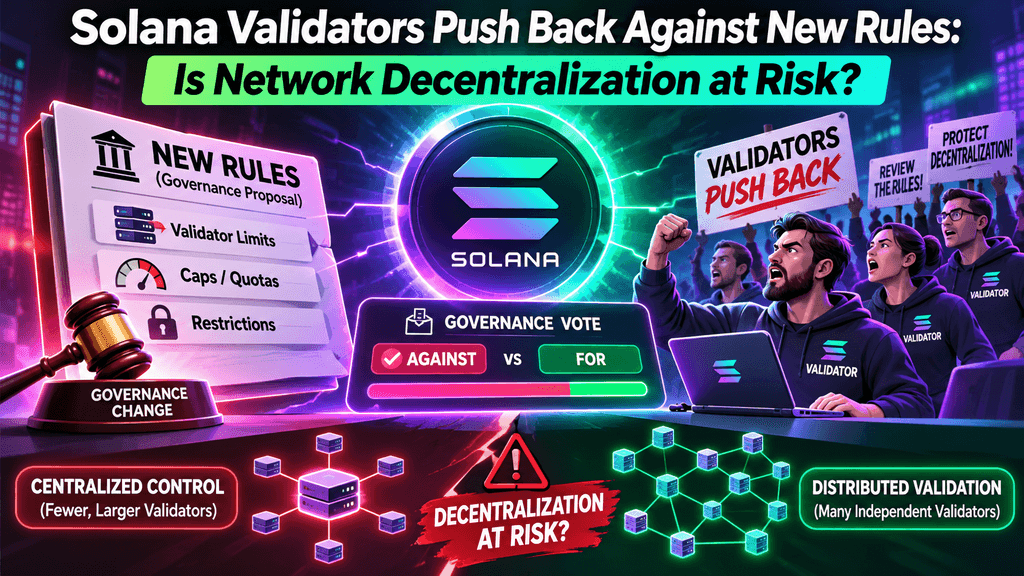
Solana is facing renewed scrutiny over its decentralization after the Solana Foundation introduced stricter rules for its validator delegation program in November 2026. The changes limit participation to 12 months, introduce a 300,000 SOL external-stake threshold for retirement, and set a maximum of 100 participating validators at a time. Independent validators have challenged the changes, arguing that withdrawing Foundation support could make it harder for smaller operators to remain economically viable and weaken the network's infrastructure diversity.
The controversy intensified on November 9, when the independent validator collective Layer33 called on the Foundation to pause planned retirements and reconsider its policy. The Foundation defended the changes, saying its original support program had largely achieved its purpose and that future delegations should prioritize contributors who improve network health. The dispute raises an important question: Can Solana make validator support more sustainable without increasing stake concentration or weakening the independent infrastructure that supports its decentralization?
Key Takeaways:
-
Stricter participation requirements: The Solana Foundation Delegation Program (SFDP) now has a 12-month membership period and a 300,000 SOL external-stake retirement threshold.
-
Community opposition: Layer33 argues that the changes could force experienced independent validators to operate without sufficient economic support.
-
Foundation's response: The Foundation plans to prioritize new validators and network contributors through more selective delegation rather than maintain broad, long-term subsidies.
-
Decentralization concerns: Smaller operators could leave the network, potentially increasing stake and infrastructure concentration, although this outcome has not yet been established.
-
Key development: The impact will depend on validator renewal decisions, external staking demand, and whether the Foundation's discretionary delegation model can support independent operators.
What Changed in Solana's New Validator Rules?
The Solana Foundation Delegation Program was established to help independent validators enter the network by providing Foundation-owned SOL as delegated stake. This support allows operators to build a track record, attract external delegations, and maintain their infrastructure while developing a sustainable business model. On November 6, 2026, the Foundation introduced stricter participation and retirement conditions, changing how long validators can receive support and when they are expected to graduate from the program.
The updated FAQ establishes a 12-month membership period, measured from the first epoch in which a validator becomes eligible for Foundation delegation on mainnet. It also states that members retire when their stake from sources outside SFDP exceeds 300,000 SOL. In addition, the Foundation's public communications describe a maximum of 100 participating validators at a time and require members to operate their own validator nodes rather than rely on white-label or managed validator services. These changes are intended to make Foundation support more selective and encourage operators to develop independent sources of stake.
| Policy area | Updated requirement | Intended effect |
| Membership duration | 12 months | Encourage validators to become independently sustainable |
| External stake | Retirement above 300,000 SOL | Graduate validators with substantial outside support |
| Program capacity | Maximum 100 participants at a time | Focus delegation resources on a more selective group |
| Operating model | Direct validator operation | Ensure operators control their own nodes and infrastructure |
An important distinction is that leaving SFDP does not mean being removed from Solana. Validators can continue operating on the permissionless network, attract SOL from independent delegators, and apply for renewal. The changes therefore affect access to Foundation funding rather than the basic right to participate in Solana consensus. However, the economic consequences could still be significant for operators that rely heavily on Foundation delegation.
Why Are Solana Validators Opposing the New Rules?
The main opposition comes from Layer33, a collective of independent Solana validators that published an open letter on November 9. The group asked the Foundation to pause planned weekly retirements, consult existing participants, and reconsider the 12-month membership limit and 300,000 SOL threshold. Layer33 argues that the policy could disadvantage experienced independent operators that have contributed to network upgrades, infrastructure testing, and ecosystem development but have not yet built sufficient external staking support.
The Economic Challenge for Independent Operators
Running a Solana validator requires ongoing spending on servers, bandwidth, software maintenance, monitoring, security, and voting-related expenses. While large operators can distribute these costs across substantial staking bases and professional infrastructure teams, smaller independent validators often operate with tighter margins. Foundation delegation helps compensate for this disadvantage by providing a source of stake and associated rewards while operators build relationships with external delegators.
When that support is withdrawn, smaller validators must attract additional outside stake or reduce their operating costs to remain sustainable. This transition may be manageable for established operators with strong reputations, but it could be difficult for teams that have invested in network participation without developing a large independent staking base. The concern is not simply that validators will receive fewer rewards; it is that some technically capable operators may no longer have sufficient economic incentives to maintain their infrastructure.
Why Layer33 Wants a Contributor-Based Model
Layer33 argues that validator eligibility should reflect more than external stake and membership duration. In its open letter, the group requested a temporary pause in retirements, additional support for validators involved in the Alpenglow community test cluster, greater transparency around the 100-validator cap, and a formal consultation process. It also proposed a contributor-based model that would recognize measurable contributions to network health.
The suggested contribution criteria include maintaining reliable uptime during upgrades, supporting different validator clients, improving geographic and infrastructure diversity, and participating in governance testing. This proposal reflects a broader disagreement over what makes a validator valuable. While the Foundation emphasizes the transition toward independent economic sustainability, Layer33 believes long-term technical contributions should also determine access to delegation support.
How Did the Solana Foundation Respond to the Backlash?
Solana Foundation engineering vice president Jacob Creech defended the changes on November 10, arguing that SFDP had largely completed its original objectives. According to Creech, the program was established to help new validators enter the network, maintain a healthy testnet, and encourage operators to test protocol upgrades at an early stage. He believes the Foundation can now achieve more by directing its delegation resources toward operators that make significant contributions to network health. The changes are therefore intended to move beyond broad onboarding support toward a more flexible and selective allocation model.
Creech also acknowledged that some existing participants would lose Foundation delegations, while emphasizing that smaller validators remain important to Solana. Existing operators can submit information about their ecosystem contributions for consideration for continued support. He reported that more than 100 validators had already submitted applications or contribution information by November 10. The Foundation also intends to use discretionary staking to reward validators involved in network improvements, including client testing and other technical work.
Why the Foundation Believes the Model Needs to Change
The Foundation's reasoning is based on the distinction between helping new validators enter the ecosystem and continuously subsidizing established operators. If validators remain dependent on Foundation delegations indefinitely, the same pool of SOL may have less capacity to support new entrants and emerging infrastructure contributors. A time-limited program could encourage operators to attract external stake and establish more independent business models, while discretionary delegation could provide targeted support to validators making valuable contributions.
However, the success of this approach will depend on the transparency of its selection criteria. If operators cannot understand how technical contributions are evaluated or why certain validators receive additional support, discretionary delegation could create uncertainty. The Foundation will need to demonstrate that its new model rewards measurable network improvements while maintaining opportunities for independent operators of different sizes.
Could the New Rules Threaten Solana's Decentralization?
The central concern is whether the withdrawal of Foundation support could accelerate the exit of smaller independent validators and increase the concentration of stake among larger operators. Solana's decentralization depends on more than the total number of validator nodes. It also depends on how voting power is distributed, whether different validators are controlled by independent entities, and whether the network relies excessively on a small number of infrastructure providers. Layer33 argues that reducing the economic viability of independent operators could weaken these dimensions even if the network continues processing transactions normally.
Validator Concentration and the Nakamoto Coefficient
One important measurement is the Nakamoto Coefficient, which estimates the minimum number of entities required to control a critical share of a blockchain network. According to Solana Compass data for epoch 1082 on November 9, 2026, Solana had 698 validators, a Nakamoto Coefficient of 18, and approximately 24.56% of active stake held by its ten largest validators. These figures provide a reference point for evaluating future changes in validator participation and staking distribution.
However, Layer33 disputes whether validator-level calculations fully reflect actual network decentralization. Multiple validator nodes may be controlled by the same company, meaning that counting each node as an independent entity could overstate the diversity of network ownership. Layer33 therefore cited a lower coefficient of 8 when grouping validators by operator, as well as a figure of 3 under a different 20% safety threshold. These figures are not directly comparable with Solana Compass's coefficient of 18 because they use different ownership assumptions and control thresholds. The disagreement illustrates why both validator count and operator-level concentration matter when assessing decentralization.
Infrastructure Diversity and Network Resilience
Infrastructure concentration is another important concern. Validators may operate independently while still relying on the same cloud provider, data center, or network service provider. If a shared infrastructure provider experiences an outage, multiple validators could be affected simultaneously, potentially reducing the network's ability to maintain consensus.
Layer33 referenced the August 12, 2026, Teraswitch routing outage as an example of this risk. The group argued that infrastructure diversity among independent operators helped limit the impact of the disruption. Solana Foundation's own delegation criteria also recognize the importance of infrastructure distribution, including requirements related to data center and autonomous system number concentration. The Foundation's published criteria set limits of 15% for data center concentration and 25% for ASN or company concentration.
This creates a potential tension in the new policy. Removing support from smaller validators may improve the efficiency of Foundation capital allocation, but it could also reduce the number of independent infrastructure operators if those validators cannot attract external stake. The actual impact will depend on whether other operators replace their capacity and whether the remaining validator set maintains geographic, ownership, and hosting diversity. A decline in validator numbers alone would not prove that Solana has become more centralized, but a sustained increase in common ownership or infrastructure concentration would be more significant.
Why Does the Alpenglow Upgrade Matter to the Dispute?
The timing of the controversy is particularly important because Solana activated its Alpenglow consensus upgrade on mainnet on October 21, 2026. Developed by Anza, Alpenglow replaces the previous TowerBFT consensus protocol and targets transaction finality of approximately 150 milliseconds, compared with around 12.8 seconds under the previous system. The upgrade represents a major technical change to how Solana validators agree on and finalize blocks, making validator participation and infrastructure reliability especially relevant.
Layer33 says independent validators contributed to the Alpenglow community test cluster by providing additional infrastructure, participating in repeated network restarts, and absorbing higher operating and voting costs during testing. The group argues that withdrawing Foundation support shortly after these contributions could discourage operators from investing in future protocol upgrades. Its proposed six-month extension for community-cluster participants is intended to recognize the additional costs associated with this work. However, these claims represent Layer33's position and do not establish that every affected validator participated in the same way or incurred equivalent expenses.
The broader issue is whether Solana's delegation policy adequately recognizes technical contributions that are not reflected in a validator's external stake balance. Testing new consensus mechanisms, supporting alternative clients, identifying software problems, and maintaining geographically distributed infrastructure can all benefit the network. A contributor-based delegation framework could provide incentives for these activities, but it would require clear evaluation standards and consistent implementation to avoid creating another source of uncertainty.
What Could the Changes Mean for SOL and Solana's Future?
The immediate impact of the SFDP changes is primarily economic and structural rather than a direct modification of SOL's tokenomics or Solana's consensus rules. Nevertheless, the policy could influence how validators operate, how stake is distributed, and how investors assess the network's long-term resilience. If independent operators successfully transition toward external delegation, the changes may encourage a more sustainable validator economy. If many smaller operators exit because they cannot cover operating costs, the network could become more dependent on a narrower group of large providers.
Three areas deserve particular attention:
-
Validator participation: Whether smaller operators can maintain their nodes after Foundation delegations are withdrawn.
-
Stake distribution: Whether the largest validators or commonly controlled operator groups gain a greater share of voting power.
-
Infrastructure diversity: Whether hosting, geographic, and client diversity remain stable as the Foundation reallocates its stake.
For SOL, the main consideration is whether the new delegation model improves the long-term sustainability of the network without weakening the infrastructure diversity that supports its security. There is currently insufficient evidence to conclude that the policy has caused a measurable decline in decentralization or directly affected SOL's market performance. Its consequences should instead be evaluated through changes in active validator numbers, stake concentration, and operator-level ownership over subsequent epochs.
Conclusion
Solana's validator controversy reflects a broader challenge facing mature proof-of-stake networks: how to balance economic sustainability with decentralization. The Foundation believes that time-limited support and selective delegation can encourage validators to become independent while directing resources toward meaningful ecosystem contributions. Layer33, however, argues that removing support from experienced smaller operators could weaken infrastructure diversity and discourage participation in future network upgrades.
Neither outcome is inevitable. The effectiveness of the new policy will depend on whether independent validators can attract external stake, whether discretionary delegation operates transparently, and whether Solana maintains a diverse distribution of voting power and infrastructure providers. Ultimately, the most important measure of success will not be whether the Foundation supports fewer validators, but whether Solana can preserve a resilient and genuinely independent validator ecosystem as its network continues to evolve.
FAQs
Can Anyone Run a Validator on Solana Without Foundation Support?
Yes. Solana is a permissionless blockchain, so operators can run validators without joining the Solana Foundation Delegation Program. They must still meet the network's technical and operational requirements to participate in consensus, but receiving Foundation delegation is not a condition for operating a validator.
What Happens to SOL Delegated by the Foundation When a Validator Retires?
The validator stops receiving Foundation delegation under SFDP. The stake is subject to the Foundation's redelegation and program management arrangements, while the validator can continue attracting stake from other sources. Retirement from SFDP does not automatically remove external delegations.
Why Does Validator Ownership Matter More Than Validator Count Alone?
A single company may control multiple validator nodes. Although each node contributes to the validator count, common ownership means their decisions and operational risks may not be fully independent. Measuring operator-level stake concentration can therefore provide additional insight into the network's actual decentralization.
How Does Solana's Alpenglow Upgrade Change Validator Responsibilities?
Alpenglow changes how validators exchange votes and reach consensus, targeting substantially faster transaction finality. Validators must run compatible software and meet the new protocol's operational requirements. The upgrade makes reliable validator infrastructure and broad participation important to maintaining network performance and resilience.
Does Solana's SFDP Policy Change Affect Its Proof-of-Stake Mechanism?
No. The new rules govern eligibility for Foundation delegation, not the underlying proof-of-stake mechanism. Validators continue participating in consensus according to their stake and protocol requirements. The potential impact is indirect, through changes in validator economics, participation, and stake distribution.
Disclaimer: This general market information, possibly from third-party, commercial, or sponsored sources, is provided for reference and educational purposes only and does not constitute financial or investment advice, an offer, solicitation, or guarantee. We disclaim liability for its accuracy, completeness, reliability, and any resulting losses. Investments/trading are risky; past performance doesn’t guarantee future results. Users should research, judge prudently, and take full responsibility. For further details, please consult KuCoin’s Terms of Use and Risk Disclosure.