

SK Hynix Q2 Earnings: Will They Serve as a Lifeline for the Memory Chip Market?
Introduction
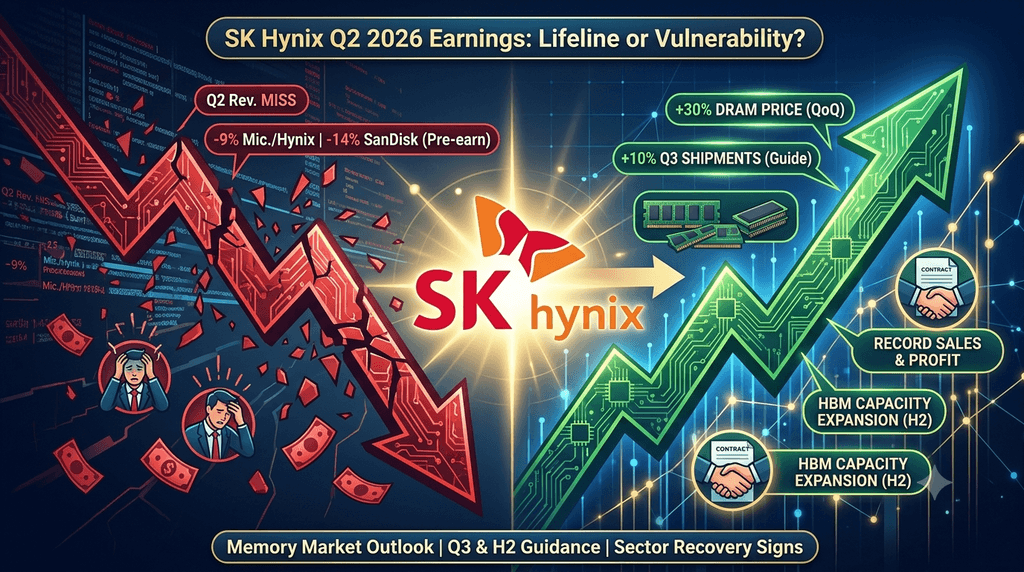
Did SK Hynix’s latest results just confirm the memory chip sector’s vulnerability — or reveal the first signs of recovery? On July 29, 2026, SK Hynix reported second-quarter revenue of 79.32 trillion Korean won, missing analyst expectations of around 84 trillion won. This seems to consolidate the nearly 9% in SK Hynix and Micron shares, plus a 14% drop in SanDisk, turning semiconductor sell-offs into an almost daily occurrence on U.S. markets.
Yet the stock and related names showed a surprising rebound after the release. While revenue fell short, the report highlighted DRAM prices rising 30% quarter-over-quarter and positive signals on future shipments and HBM capacity. These details suggest the results may ease near-term pressure on the storage chip industry even if they fall short of a full rescue.
What Did SK Hynix Report in Its Q2 2026 Earnings?
SK Hynix delivered record quarterly results but missed consensus estimates, according to the company’s official release and market reports dated July 29, 2026. Revenue reached 79.3187 trillion won, up 257% year-over-year and 51% from the prior quarter. Operating profit hit 60.5426 trillion won with a 76% margin, rising 557% year-over-year and 61% quarter-over-quarter. Net profit surged to 93.9226 trillion won.
The figures marked the highest quarterly sales and profits in company history and pushed first-half revenue above 100 trillion won for the first time. Growth stemmed from strong AI demand that lifted prices across DRAM and NAND while expanding sales of high-value products such as HBM and AI server DRAM. Cash holdings rose to 88 trillion won, and net cash stood at 69.4 trillion won.
The revenue shortfall against the roughly 84 trillion won consensus gave immediate justification for the previous day’s market declines. Still, the absolute scale of the numbers and the accompanying commentary shifted sentiment enough to support a rebound in chip shares later the same session.
How Much Did DRAM Prices Rise and What Does It Mean for Memory Chips?
DRAM average selling prices increased approximately 30% quarter-over-quarter in Q2, based on details shared in the earnings materials and contemporaneous market summaries. NAND ASPs rose in the mid-50% range. These gains, combined with a richer product mix, drove the sharp expansion in operating margins to 76%.
The price strength reflects ongoing tightness between AI-driven demand and limited supply. Management indicated that conventional DRAM and specialized memory both benefited. For the broader memory chip market, sustained elevated pricing supports higher industry revenues even when volume growth remains constrained. Analysts tracking the sector note that such sequential increases help offset earlier concerns about peaking valuations and provide a buffer against short-term demand fluctuations in smartphones and PCs.
The 30% DRAM price lift stands as one of the clearest positive signals in the report. It demonstrates that the supercycle conditions identified earlier in 2026 have not yet reversed, giving manufacturers breathing room while capacity expansions continue.
Will Q3 Shipments and HBM Capacity Expansion Ease Supply Shortages?
SK Hynix guided that third-quarter DRAM shipments could rise another 10%, according to comments referenced in post-earnings coverage. The company also stated that HBM production capacity will increase in the second half of 2026. Mass production shipments of HBM4 began in the second quarter, with further ramp-up planned. Long-term supply agreements have been finalized with about ten key customers.
These steps should gradually improve availability for mobile and PC segments that have faced shortages. Higher conventional DRAM output and expanded HBM supply reduce the crowding-out effect that has kept general-purpose memory tight. For the overall storage chip industry, the combination of rising Q3 volumes and H2 capacity adds offers a concrete path toward more balanced supply later in the year.
The guidance does not eliminate scarcity overnight. Wafer constraints and the multi-year lead time for new fabs mean tightness will persist into 2027. Nevertheless, the directional improvement in both volume and specialized capacity represents tangible progress that supports a more constructive medium-term outlook for memory chips.
Why Did Chip Stocks Rebound After the Miss?
The market treated the revenue shortfall as a classic “bad news out” event. After the previous day’s nearly 9% declines in SK Hynix and Micron and the 14% drop in SanDisk, investors appeared to view the known miss as largely priced in. Positive details on pricing, shipments, and HBM capacity then provided the catalyst for a rebound in the semiconductor group.
In addition, the steep prior decline in SK Hynix shares triggered short-sale restrictions in the U.S. market. Such limits can temporarily reduce downward pressure and allow short-covering flows to support prices. The combination of exhausted selling pressure, constructive guidance, and restricted short activity created the conditions for the observed recovery.
Macro uncertainty remains high. Factors including geopolitical tensions, fluctuating oil prices, and profit-taking after earlier gains continue to weigh on risk appetite. The rebound therefore reflects relief rather than a decisive turn in sentiment.
Are There Alternative Investment Opportunities Outside Memory Chips?
Established technology leaders such as Apple and Alphabet have shown relative resilience during the recent semiconductor sell-off. Their diversified revenue bases and lower direct exposure to memory pricing cycles have limited the impact of the chip-sector declines. These names offer a potential rotation destination for investors seeking reduced volatility while remaining within the broader technology universe.
In the crypto-adjacent space, Circle (CRCL) has declined to the area around 60–64 dollars amid crypto market fluctuations. At these levels the shares trade closer to perceived fundamental value than during earlier peaks. Recent corporate developments at Circle suggest possible catalysts that could improve the risk-reward profile for investors comfortable with the sector’s inherent volatility.
Selective opportunities in stocks that have already corrected below reasonable fundamental anchors may therefore provide better near-term risk-adjusted prospects than an immediate return to high-beta memory names.
How to Trade Related Assets and Crypto Opportunities on KuCoin?
KuCoin provides access to a wide range of crypto assets and related products that allow investors to express views on technology cycles, stablecoin demand, and broader market sentiment without direct equity exposure. Users can trade pairs linked to digital assets that often move with risk appetite in the semiconductor and AI themes. After completing account verification and funding, traders can use spot, futures, or structured products to position for volatility in the technology sector or to capture relative value between traditional tech and crypto markets. Always review risk disclosures and position sizes carefully before executing any trade.
Join KuCoin 9th Anniversary Trading Campaign
KuCoin is celebrating its 9th anniversary with a special platform campaign filled with exclusive rewards, trading activities, and limited-time offers. Don’t miss the chance to participate and enjoy the benefits as the exchange marks nine years of growth and innovation. Visit the official campaign page now:

Conclusion
SK Hynix’s Q2 2026 results delivered record absolute numbers yet missed revenue expectations, initially reinforcing the recent pressure on memory chip stocks. The 30% sequential rise in DRAM prices, the outlook for a further 10% shipment increase in Q3, and planned HBM capacity growth in the second half supplied the positive elements that allowed a post-release rebound. Short-sale restrictions added a technical support layer.
These factors improve the near-term supply picture for mobile and PC customers and confirm that pricing power remains intact. They do not, however, fully offset macro uncertainties that continue to restrain the broader semiconductor complex. The report functions more as a stabilizing influence than a decisive lifeline capable of reversing sector sentiment on its own.
Investors evaluating memory chips should weigh the constructive company-specific signals against external risks and consider diversification into more resilient large-cap technology names or selected crypto-related equities that have already corrected. Continuous monitoring of subsequent guidance and macro developments will determine whether the current relief evolves into a more sustained recovery for the storage chip market.
FAQs
What was SK Hynix’s exact Q2 2026 revenue and operating profit?
Revenue was 79.3187 trillion won and operating profit was 60.5426 trillion won, according to the company’s July 29, 2026 release.
Will higher HBM capacity in the second half fully resolve shortages?
No. It will ease constraints for certain segments but overall industry supply remains tight into 2027 because of longer lead times for new wafer capacity.
Why did chip stocks rebound after a revenue miss?
The miss was largely anticipated after the prior day’s declines, positive guidance details emerged, and short-sale restrictions limited further selling pressure.