

SharpLink Reports $751.4 Million in Q3 2026 Net Income as Revenue Grows 24%
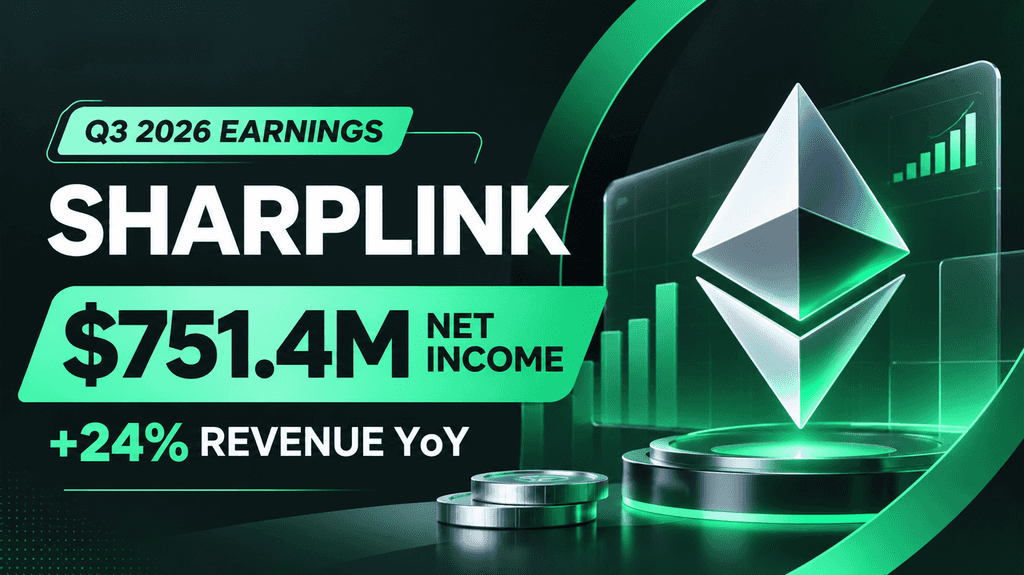
SharpLink Inc. reported $751.4 million in net income for the third quarter of 2026, while revenue increased 24% year over year to $13.5 million, according to its November 9 earnings announcement. The Ethereum-focused treasury company's results were largely driven by cryptocurrency valuation gains, alongside growth in staking operations. However, the substantial quarterly profit contrasted with a $328.4 million net loss for the first nine months of 2026. SharpLink's Q3 earnings illustrate how Ethereum price movements and treasury management can significantly influence reported profitability, making the distinction between accounting gains, recurring revenue, and cash flow particularly important.
Key Takeaways
-
SharpLink reported $751.4 million in Q3 2026 net income, while revenue increased 24% year over year to $13.5 million.
-
Ethereum staking revenue grew 27% to approximately $13.1 million, accounting for 97% of quarterly revenue.
-
Unrealized cryptocurrency gains reached $676.7 million, while realized gains contributed another $75.2 million to reported earnings.
-
SharpLink's ETH-equivalent holdings increased to approximately 895,117 as of November 2, 2026.
-
The company expanded its Ethereum treasury operations through a $200 million Lido staking allocation and the Galaxy SharpLink Onchain Yield Fund.
-
Despite quarterly profitability, SharpLink recorded a $328.4 million nine-month net loss, reflecting significant cryptocurrency valuation and impairment effects.
SharpLink Q3 2026 Earnings: Net Income Hits $751.4 Million as Revenue Grows 24%
SharpLink's third-quarter financial results showed substantial growth in reported profitability compared with the same period of 2025. According to the company's November 9, 2026 earnings release, diluted earnings per share reached $3.45, up from $0.62 a year earlier. The improvement accompanied higher Ethereum staking revenue and lower selling, general, and administrative expenses, reflecting the growing contribution of digital asset treasury operations to SharpLink's financial performance. These results also illustrate the company's increasing reliance on cryptocurrency-related activities as its primary source of financial performance.
SharpLink Revenue Growth Driven by Ethereum Staking Operations
SharpLink's quarterly revenue increased from $10.84 million in Q3 2025 to $13.46 million in Q3 2026, representing approximately 24.1% annual growth. Ethereum staking accounted for most of that increase, with revenue from staking climbing 27.1% to $13.06 million, compared with $10.27 million a year earlier. The expansion reflected the increasing contribution of the company's digital asset operations, with staking generating approximately 97% of total quarterly revenue.
Meanwhile, affiliate marketing revenue declined from approximately $570,000 to $400,000, a decrease of nearly 30% year over year. The contrasting performance illustrates how SharpLink's revenue composition has shifted toward Ethereum-based activities rather than its earlier marketing operations. The company's reliance on cryptocurrency staking rewards connects its revenue generation to committed ETH balances, validator performance, network reward conditions, and related treasury arrangements. These factors can influence future staking income independently of cryptocurrency price appreciation.
SharpLink Q3 2026 Earnings, Expenses, and Financial Performance
SharpLink's quarterly financial statements showed a significant improvement in reported profitability compared with the corresponding period in 2025. Net income increased from $104.3 million to $751.4 million, while selling, general, and administrative expenses declined. However, the results included substantial cryptocurrency-related accounting gains, meaning the reported profit should not be interpreted as equivalent to operating cash generation. This distinction is essential when evaluating earnings quality, particularly for companies holding large amounts of digital assets. The company's financial statements also showed the following changes:
-
Diluted earnings per share: Increased to $3.45 from $0.62 in Q3 2025.
-
Operating expenses: Selling, general, and administrative expenses decreased approximately 8.4% to $11.01 million from $12.02 million.
-
Revenue composition: Ethereum staking generated approximately 97% of total revenue, while affiliate marketing contributed the remaining 3%.
-
Year-over-year profitability: Reported net income increased approximately 621%, although cryptocurrency valuation changes materially influenced the comparison.
Why Ethereum Gains Drove SharpLink's $751 Million Q3 Profit
SharpLink's third-quarter profitability was largely driven by changes in the value of its Ethereum holdings rather than earnings from regular business activities. According to the company's November 2026 SEC filing, unrealized cryptocurrency gains reached $676.7 million, while realized gains contributed another $75.2 million. Together, these gains totaled approximately $751.9 million, slightly exceeding reported net income. Unrealized gains alone were equivalent to about 90% of quarterly net income, demonstrating how strongly SharpLink's financial results depend on Ethereum market valuations.
Unrealized Ethereum Gains Reach $676.7 Million as ETH Prices Recover
Ethereum's price recovery during the third quarter substantially increased the reported value of SharpLink's cryptocurrency assets. The company's SEC filing indicates that ETH traded at approximately $1,563 on June 30, 2026, compared with $2,681 on September 30, representing an increase of roughly 71.5%. Under U.S. accounting standard ASC 350-60, SharpLink measures its directly held ETH at fair value and recognizes changes in that value through its income statement. Consequently, rising Ethereum prices can generate significant accounting gains even when the company does not sell the underlying cryptocurrency.
These unrealized gains are noncash accounting adjustments, meaning they do not represent money received from asset sales or an increase in the number of ETH tokens held. Their effect on reported profitability can also reverse when market conditions deteriorate. Movements in the ETH/USDT spot trading market provide context for Ethereum's changing market valuation, although continuously updated trading prices should be distinguished from the reporting-date values used in financial statements. This distinction matters for Ethereum treasury companies because quarterly earnings can fluctuate considerably with cryptocurrency prices, independently of operating revenue or staking activity.
Realized Crypto Gains and Liquid Staking Accounting Shape SharpLink's Earnings
Beyond Ethereum's market appreciation, SharpLink recognized $75.2 million in net realized cryptocurrency gains during the quarter. Its Form 10-Q attributes much of this amount to treasury transactions involving liquid staking tokens rather than conventional cryptocurrency sales. These activities included approximately $55.6 million in gains from LsETH redemptions, $18.0 million from converting ETH into wstETH, and $1.7 million from contributing wstETH to the Galaxy SharpLink Onchain Yield Fund. Such transactions can trigger realized accounting gains when an asset is derecognized and a replacement asset is recognized, even without a corresponding cash sale.
SharpLink's accounting treatment also differs between native Ethereum and liquid staking tokens. While directly held ETH is measured at fair value, assets such as LsETH, weETH, and wstETH are generally carried at cost less impairment under ASC 350-30. This distinction creates several important financial implications:
-
Different valuation treatments: Changes in native ETH prices affect reported earnings through fair-value adjustments, while liquid staking tokens follow separate impairment accounting.
-
Impairment charges: SharpLink recognized approximately $1.04 million in cryptocurrency impairment expenses during Q3 2026.
-
No impairment reversal: Previously recorded impairment losses on these liquid staking tokens cannot be reversed merely because their market prices subsequently recover.
-
Cash versus accounting gains: Realized gains arising from token conversions or redemptions do not necessarily indicate that equivalent cash proceeds were received.
These accounting differences explain why the profitability of a company holding both native ETH and liquid staking tokens cannot be assessed through cryptocurrency price movements alone. They also make the composition of reported earnings particularly important when comparing SharpLink's financial performance across reporting periods. As a result, financial comparisons should account for both the market valuation of assets and the accounting treatment applied to different cryptocurrency holdings.
SharpLink Expands Ethereum Holdings as Nine-Month Losses Highlight Financial Risks
SharpLink continued expanding its Ethereum treasury during the third quarter of 2026, combining substantial ETH holdings with new staking and onchain yield strategies. However, its broader financial results revealed significant challenges. Despite the company's profitable third quarter, its financial statements showed a considerable loss for the first nine months of 2026, raising important questions about liquidity, treasury management, and exposure to cryptocurrency market volatility. The contrast also demonstrates the importance of examining cumulative financial results alongside individual quarterly earnings.
SharpLink's Ethereum Holdings Reach 895,117 ETH as Treasury Expands
SharpLink reported approximately 892,708 ETH in total holdings as of September 30, 2026, with cryptocurrency assets carrying a combined accounting value of approximately $2.1 billion. According to its SEC filing, the company's ETH-equivalent holdings increased to 895,117 by November 2, reflecting its ongoing treasury management activities. The total includes both directly held Ethereum and liquid staking tokens measured according to their redeemable ETH equivalents. This distinction is important because the reported figure does not represent an entirely liquid balance of native ETH available for immediate transfer.
SharpLink's November 2 treasury disclosure provided the following breakdown:
-
Native Ethereum: 603,953 ETH held directly, including assets committed to native staking.
-
Liquid Collective (LsETH): Holdings equivalent to approximately 135,868 ETH.
-
ether.fi (weETH): Holdings representing approximately 73,601 ETH.
-
Lido (wstETH): Holdings equivalent to approximately 81,695 ETH, including assets contributed to the Galaxy SharpLink Onchain Yield Fund.
The diversification across staking arrangements allows SharpLink to maintain economic exposure to Ethereum while using different infrastructure providers. However, liquid staking tokens can involve redemption delays, protocol-specific requirements, and differences between their market prices and underlying ETH redemption values. The reported total also includes wstETH contributed to the Galaxy fund that is no longer held directly in SharpLink's custody but remains part of its economic exposure. Consequently, the headline ETH-equivalent balance should not be interpreted as an amount that could necessarily be converted into cash immediately.
Lido Staking and Galaxy Digital Fund Expand Ethereum Yield Strategies
SharpLink advanced its treasury operations by completing a $200 million ETH staking allocation through Lido on September 28, 2026. The transaction provided exposure to wrapped staked ETH (wstETH), allowing the company to participate in Ethereum staking while holding tokens that can be used in certain decentralized finance arrangements. Under its agreement, SharpLink committed to holding the resulting wstETH for one year after completing the allocation, introducing a contractual condition that affects treasury flexibility. Unlike conventional native staking, Lido liquid staking involves tokenized positions representing underlying staked ETH and associated rewards.
The company also began deploying capital through the Galaxy SharpLink Onchain Yield Fund, established in August 2026 with $125 million in initial commitments, including $100 million from SharpLink and $25 million from Galaxy Digital. Its September 30 filing showed that approximately $11.2 million of SharpLink's commitment had been called and satisfied using fund-level borrowing secured by contributed wstETH collateral, leaving approximately $88.8 million in unfunded commitments. Separately, SharpLink disclosed that it had bridged approximately $205.8 million in weETH to Linea, an Ethereum Layer 2 network, under an existing ecosystem agreement. These arrangements broaden potential sources of staking rewards and protocol incentives, but they also introduce additional counterparty, smart-contract, and collateral-management considerations.
Nine-Month Net Loss and Cash Flow Raise Questions About SharpLink's Financial Outlook
SharpLink's financial performance remained uneven when assessed beyond the latest quarter. For the nine months ended September 30, 2026, the company reported a net loss of $328.4 million, compared with a loss of approximately $127,000 in the corresponding period of 2025. Its financial statements showed that cryptocurrency valuation losses and impairment charges significantly affected cumulative profitability, partly offset by revenue and realized gains. Impairment expenses on certain cryptocurrency assets totaled approximately $268.8 million over the nine-month period, illustrating how earlier market conditions continued to affect the company's reported financial position.
Liquidity provides another important measure of financial resilience. SharpLink ended September with approximately $47.9 million in cash and cash equivalents, while net cash used in operating activities reached $25.1 million during the first nine months of 2026, compared with $8.4 million a year earlier. Although the company holds substantial cryptocurrency assets that could potentially support liquidity needs, converting staked positions into cash may be subject to network withdrawal queues, contractual conditions, and market circumstances. Future financial performance will also depend on how effectively SharpLink manages several interconnected risks:
-
Treasury liquidity: Some staked ETH positions cannot be withdrawn immediately, potentially limiting access to funds during periods of market stress.
-
Financing exposure: Collateral-backed borrowing and external capital arrangements may create additional obligations or financing costs if utilized.
-
Shareholder dilution: SharpLink reported approximately 217.3 million common shares outstanding on November 3, making changes in share count relevant when evaluating ETH holdings and financial performance on a per-share basis.
-
Cryptocurrency market volatility: Changes in Ethereum valuations could materially affect future asset values, profitability, and balance-sheet strength.
For SBET shareholders, the key considerations extend beyond quarterly earnings to include cumulative financial performance, treasury liquidity, and exposure to Ethereum's market cycles. SharpLink's larger ETH treasury provides a substantial base for staking operations, but its long-term financial results remain sensitive to asset valuations, capital requirements, and the risks associated with deploying cryptocurrency across multiple protocols. Monitoring ETH exposure on a per-share basis alongside operating cash flow may provide a more complete assessment of the company's financial development.
Conclusion
SharpLink's third-quarter results demonstrate the substantial influence of Ethereum holdings on its financial performance. Although staking revenue continued expanding and the company's ETH treasury grew, most of the reported $751.4 million profit came from cryptocurrency-related gains rather than recurring operating income. The contrast between quarterly profitability and the nine-month net loss also shows why a single reporting period provides an incomplete picture of the company's underlying financial position. Evaluating the durability of its revenue therefore requires looking beyond headline profitability to the financial contribution of its treasury operations.
For SBET shareholders, future performance will depend on more than changes in Ethereum's market value. Staking revenue, operating cash flow, treasury liquidity, financing requirements, and potential share dilution remain important considerations. SharpLink's expansion into liquid staking and onchain yield arrangements may create additional revenue opportunities, but it also introduces operational and liquidity risks. Subsequent financial reports will provide a clearer indication of whether growing staking operations can support more consistent financial performance independently of cryptocurrency valuation gains.
FAQs
Does SharpLink's $751 million net income represent cash profit?
No. SharpLink's reported net income included substantial noncash cryptocurrency valuation gains. These gains increase accounting profit without necessarily generating cash receipts. Cash flow from operations, realized transaction proceeds, and unrealized asset appreciation must be evaluated separately when assessing the company's financial performance.
How does SharpLink earn income from Ethereum staking?
SharpLink earns staking rewards by committing ETH to activities that support Ethereum's proof-of-stake network. Rewards depend on factors including the amount staked, network conditions, validator performance, and service arrangements. Staking revenue differs from gains caused by changes in Ethereum's market price.
What is the difference between SharpLink's native ETH and ETH-equivalent holdings?
Native ETH refers to Ethereum held directly, including ETH committed to native staking. ETH-equivalent holdings also account for liquid staking tokens based on their underlying ETH redemption values. These tokens may carry different liquidity conditions, redemption procedures, and accounting treatments.
What should readers monitor in SharpLink's next earnings report?
The most useful indicators include staking revenue growth, changes in ETH holdings per share, operating cash flow, cryptocurrency valuation gains or losses, and financing activity. Comparing these measures across reporting periods can help distinguish recurring business performance from changes in digital asset prices.
Disclaimer
This general market information, possibly from third-party, commercial, or sponsored sources, is provided for reference and educational purposes only and does not constitute financial or investment advice, an offer, solicitation, or guarantee. We disclaim liability for its accuracy, completeness, reliability, and any resulting losses. Investments/trading are risky; past performance doesn’t guarantee future results. Users should research, judge prudently, and take full responsibility. For further details, please consult KuCoin’s Terms of Use and Risk Disclosure.