

Securitize to Integrate With Stellar, Expanding Multi-Chain RWA Infrastructure
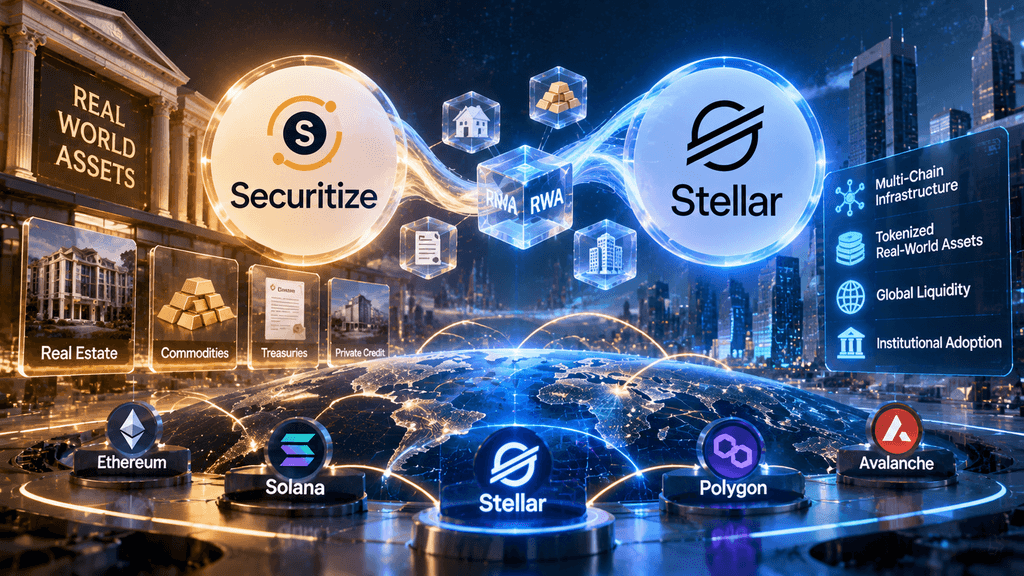
The tokenization of traditional financial assets is entering a new phase as financial institutions seek blockchain infrastructure that can support asset issuance, investor management, and digital settlement. On October 28, 2026, Securitize announced plans to integrate with the Stellar network, expanding the blockchain options available for issuing and managing tokenized financial products. The announcement, made during the Stellar Development Foundation's Meridian 2026 conference in Lisbon, highlights the growing importance of multi-chain infrastructure in the real-world asset (RWA) market. Rather than relying on a single blockchain, asset managers can increasingly evaluate networks according to their operational requirements, regulatory needs, and distribution strategies.
For Securitize, the planned integration represents another step in expanding its institutional tokenization infrastructure. For Stellar, it offers an opportunity to attract additional asset issuers and strengthen its position in blockchain-based financial services. However, the announcement does not establish that new products are already live or guarantee an immediate increase in network activity. The central questions are how the integration could work, why multi-chain infrastructure matters, and whether the partnership can translate into measurable growth for Stellar's RWA ecosystem and meaningful demand for its native token, XLM.
What Did Securitize Announce?
Securitize announced plans to integrate its tokenization infrastructure with Stellar, enabling support for the issuance and management of tokenized financial assets on the network. The development expands the range of blockchain environments available to institutions working with Securitize and creates a potential route for additional financial products to enter Stellar's ecosystem. The announcement was made during Meridian 2026, an event organized by the Stellar Development Foundation that brings together participants in the blockchain and financial services industries. The stated direction is clear: connect institutional asset tokenization with another blockchain network rather than limit product development to a single infrastructure environment.
The distinction between an announced integration and a fully operational service is important. The announcement did not establish a confirmed launch date for specific products, disclose the initial assets expected to be issued, or provide a projected total value of assets that could migrate to Stellar. It also did not demonstrate that existing Securitize products would automatically become available on the network. Those outcomes depend on subsequent implementation decisions, product documentation, and participation by asset issuers. Consequently, the immediate significance lies in the expansion of Securitize's infrastructure strategy and Stellar's opportunity to attract more institutional activity, while the commercial impact remains to be demonstrated.
How Will the Securitize–Stellar Integration Work?
From Traditional Financial Products to Tokenized Assets
Tokenization represents financial rights or interests through digital tokens recorded on a blockchain. Depending on the product, the underlying asset may be a government securities fund, a private credit instrument, or another regulated financial product. However, creating a token is only one part of the process. Issuers must also establish the legal structure of the product, maintain investor records, apply eligibility requirements, manage transfers, and define how distributions or redemptions are handled. These responsibilities make institutional tokenization more complex than simply deploying a smart contract or creating a publicly transferable digital asset.
Securitize's role is to provide infrastructure for the issuance and administration of tokenized securities and related financial products. Stellar provides a blockchain environment that supports digital asset issuance, transfers, and settlement-related activity. The planned integration could connect these capabilities so that participating issuers have another network available when structuring eligible products. The exact division of responsibilities, technical implementation, and supported product features should be confirmed through subsequent official documentation rather than assumed from the announcement alone.
What Stellar Adds to the Infrastructure
For asset managers, blockchain selection involves more than transaction speed or network fees. Institutions also consider asset management requirements, transfer restrictions, compliance controls, integration costs, and the availability of relevant financial applications. Stellar's existing experience with tokenized financial assets may make it an attractive option for issuers seeking an established network environment. If the integration progresses to production, Securitize's clients could evaluate Stellar alongside other supported networks according to the requirements of individual products.
Nevertheless, the integration should not be interpreted as evidence that every stage of the financial process will become automated. Investor verification, custody arrangements, redemption procedures, and legal ownership rights may continue to depend on separate service providers and contractual frameworks. The commercial value of the integration will ultimately depend on whether asset issuers use it to launch products, whether eligible investors can access those products, and whether the resulting activity is sustainable. Technical connectivity creates an opportunity, but actual adoption determines whether that opportunity becomes a meaningful business outcome.
Why Stellar Matters in the RWA Market
Stellar's Existing Tokenized Asset Ecosystem
Stellar is not entering the tokenized asset market for the first time through this announcement. Its ecosystem already includes financial products associated with established asset managers and financial technology providers. Franklin Templeton, for example, has used Stellar in connection with its tokenized government money market fund, while other market participants have explored blockchain-based investment products and financial instruments on the network. These examples demonstrate that Stellar has an existing institutional use case beyond cryptocurrency transfers alone.
This background matters because financial institutions often prefer infrastructure with a demonstrated operating history and an ecosystem of relevant applications. Existing products can provide useful experience in asset issuance, investor access, and the operational requirements of regulated financial instruments. However, the scale and activity of each product must be evaluated individually. Assets issued on Stellar by existing partners should not automatically be attributed to Securitize's integration, and figures reported by different data providers may use different definitions of tokenized value, circulating supply, or assets under management.
Institutional Adoption Requires More Than Blockchain Speed
Institutions evaluating tokenization infrastructure generally assess whether a network can fit into their existing financial operations. Reliability, compliance requirements, integration costs, investor distribution, and the ability to manage products over their life cycles may be just as important as transaction performance. An infrastructure provider that can connect asset issuers with appropriate blockchain environments may therefore offer value beyond simply supporting additional networks.
Securitize's planned integration could strengthen Stellar's institutional proposition by giving asset issuers another route to deploy eligible financial products. Yet the presence of an additional infrastructure partner does not guarantee new investment flows or greater liquidity. Asset managers must still determine whether a particular product makes commercial sense, whether distribution channels are available, and whether the relevant legal and operational arrangements can be maintained. Stellar's longer-term success in RWA will depend on the products and investor activity it attracts, not merely on the number of integration announcements it accumulates.
Why Multi-Chain Tokenization Matters
More Blockchain Options for Asset Managers
A multi-chain strategy allows tokenization platforms to support financial products across different blockchain environments. This can be useful because asset issuers do not all have identical requirements. One institution may prioritize compatibility with existing applications, while another may focus on transaction costs, investor access, or particular settlement capabilities. Supporting additional networks can give an infrastructure provider more flexibility when working with clients that have different technical and commercial preferences.
For Securitize, adding Stellar to its network options could expand the range of infrastructure configurations available to participating issuers. It may also help the company reach financial products or users that are better served by Stellar's existing ecosystem. The benefit, however, should be assessed in terms of actual client demand and product deployment. A network integration is strategically useful only when it addresses a real requirement or creates a viable route to additional business.
The Trade-Offs of a Multi-Chain Strategy
Supporting multiple blockchains also introduces operational complexity. Each network may have different technical standards, transaction procedures, monitoring requirements, and integration considerations. Asset issuers must ensure that records remain consistent, transfer restrictions are applied correctly, and investors understand which network supports a particular product. Where assets or representations of assets move between networks, additional controls may be necessary to prevent discrepancies and maintain the integrity of the underlying financial arrangements.
Multi-chain infrastructure should therefore be viewed as a balance between flexibility and complexity. Additional network support can widen distribution options, but it may also increase engineering, compliance, and ongoing maintenance requirements. For institutional clients, the objective is not necessarily to use as many blockchains as possible. It is to select infrastructure that meets the needs of each product while preserving reliable administration and clear legal rights. Securitize's Stellar integration will be more meaningful if it produces practical benefits for issuers than if it merely increases the number of networks listed as supported.
What Could the Integration Mean for XLM?
Potential Benefits for Stellar Network Activity
If Securitize's integration results in new financial products being issued and managed on Stellar, the network could benefit from additional tokenized assets, transfers, and institutional participation. More products may also encourage further development of applications that support asset management, payments, and related financial services. Over time, these activities could strengthen Stellar's position as infrastructure for tokenized financial markets, particularly if issuers and investors continue using the network after their initial deployments.
The relevant evidence will be measurable adoption rather than announcements alone. Investors should watch for confirmed product launches, the value of assets actually issued on Stellar, transaction activity associated with those products, and the number of participating institutions. It is also important to distinguish the total value of tokenized assets from the amount that actively trades or moves on-chain. A product can represent a substantial asset value while generating relatively little transaction activity, so headline asset figures do not necessarily reveal how much practical usage a network receives.
Why XLM Price Gains Are Not Guaranteed
XLM is Stellar's native token, but growth in the network's RWA ecosystem does not automatically translate into an equivalent increase in token demand. The relationship depends on how applications use the network, how transaction fees are paid, how frequently assets move, and whether increased activity creates meaningful demand for the network's native asset. These factors must be assessed alongside broader cryptocurrency market conditions and investor expectations.
The market may also price in anticipated developments before measurable adoption appears. A short-term movement in XLM following an announcement would not, by itself, establish that the integration caused the change. Bitcoin's direction, overall market liquidity, derivatives positioning, and other Stellar-related developments could all influence the token's performance. A more reliable assessment would compare XLM's price and trading volume before and after the announcement, examine its performance relative to BTC, and then track whether subsequent implementation milestones coincide with sustained changes in network activity. Without such evidence, claims of a guaranteed price rally would be premature.
What Risks and Challenges Could Limit Adoption?
Regulatory and product-level requirements remain central to institutional tokenization. Putting a financial product on a blockchain does not automatically change its legal status, remove investor eligibility requirements, or make it available in every jurisdiction. Depending on the product, issuers may need to maintain restrictions on transfers, verify investor eligibility, establish custody arrangements, and define redemption procedures. The rights represented by a token ultimately depend on the legal structure and documentation of the underlying asset rather than the token's existence on a particular network.
Commercial adoption presents another challenge. The integration's value will depend on whether asset managers choose to use Stellar, whether suitable products can be launched, and whether investors find those products useful. Supporting another blockchain also requires ongoing technical maintenance and coordination between infrastructure providers and issuers. If the integration takes longer than expected or attracts limited product demand, the near-term effect on Stellar's ecosystem may remain modest. These limitations do not negate the strategic rationale for the partnership; they show why product launches, actual asset issuance, and sustained activity are more meaningful indicators than the announcement alone.
What to Watch After the Announcement
The first milestone is confirmation of implementation. Investors and industry observers should look for an official launch timeline, details of the first supported products, participating asset managers, and information about investor eligibility. Product documentation will also help clarify which issuance, management, transfer, and settlement functions are supported. These details can establish whether the announced integration has moved from a strategic plan into an operational service.
The second milestone is measurable adoption. Useful indicators include tokenized asset value on Stellar, activity associated with newly launched products, participation by financial institutions, and the continued use of those products after launch. XLM price and volume can provide market context, but they should be evaluated alongside network metrics and broader crypto market conditions. The most important test is whether Securitize's expanded infrastructure creates sustained financial activity on Stellar, rather than simply adding another network to its multi-chain strategy.
Conclusion
Securitize's planned integration with Stellar represents a strategic expansion of its institutional tokenization infrastructure and another opportunity for Stellar to attract financial products and participants. The development reflects a broader shift in RWA markets toward infrastructure that can support asset issuance, administration, and distribution across multiple blockchain environments. For issuers, additional network options may improve flexibility; for Stellar, the potential benefit lies in converting that flexibility into actual products and sustained usage.
The announcement does not yet establish a confirmed launch date, initial issuance volume, or measurable increase in network activity. Its implications for XLM are therefore conditional rather than automatic. Investors should focus on implementation milestones, product launches, tokenized asset activity, and the relationship between network usage and native-token demand. Ultimately, the integration's significance will be determined by whether it helps institutions bring more financial products on-chain and gives investors practical reasons to use them.
FAQs
Does using Stellar mean investors must hold XLM directly?
Not necessarily. The requirements depend on how a specific financial product is implemented, how transactions are funded, and which services the issuer or platform provides. The integration announcement alone does not establish that every investor must purchase or hold XLM.
Will existing Securitize funds automatically become available on Stellar?
No such conclusion follows from the announcement. Existing products would need to be separately supported, issued, or made available on Stellar according to the issuer's implementation plan and applicable product requirements. Investors should look for specific product announcements rather than assume automatic migration.
Does tokenization change the legal ownership rights of an asset?
Tokenization does not automatically change the legal rights attached to an underlying asset. Those rights depend on the product's legal structure, offering documents, contractual arrangements, and applicable law. Investors should review the relevant documentation before assuming that holding a token provides a particular claim or ownership interest.
Can tokenized financial products trade around the clock?
A blockchain network may operate continuously, but that does not mean every financial product can be traded or redeemed at all times. Trading availability can depend on issuer rules, transfer restrictions, market access, counterparties, and the product's legal structure.
What would demonstrate that the integration is commercially successful?
Evidence would include confirmed product launches, actual issuance volumes, participation by asset managers, sustained investor activity, and continued use of Stellar for relevant transactions. A partnership announcement establishes strategic intent, while measurable adoption provides stronger evidence that the integration is producing commercial value.
Disclaimer: This general market information, possibly from third-party, commercial, or sponsored sources, is provided for reference and educational purposes only and does not constitute financial or investment advice, an offer, solicitation, or guarantee. We disclaim liability for its accuracy, completeness, reliability, and any resulting losses. Investments/trading are risky; past performance doesn’t guarantee future results. Users should research, judge prudently, and take full responsibility. For further details, please consult KuCoin’s Terms of Use and Risk Disclosure.