

Sber Launches International Cryptocurrency Settlements for Businesses: Terms, Fees, and Foreign Trade Rules
Introduction
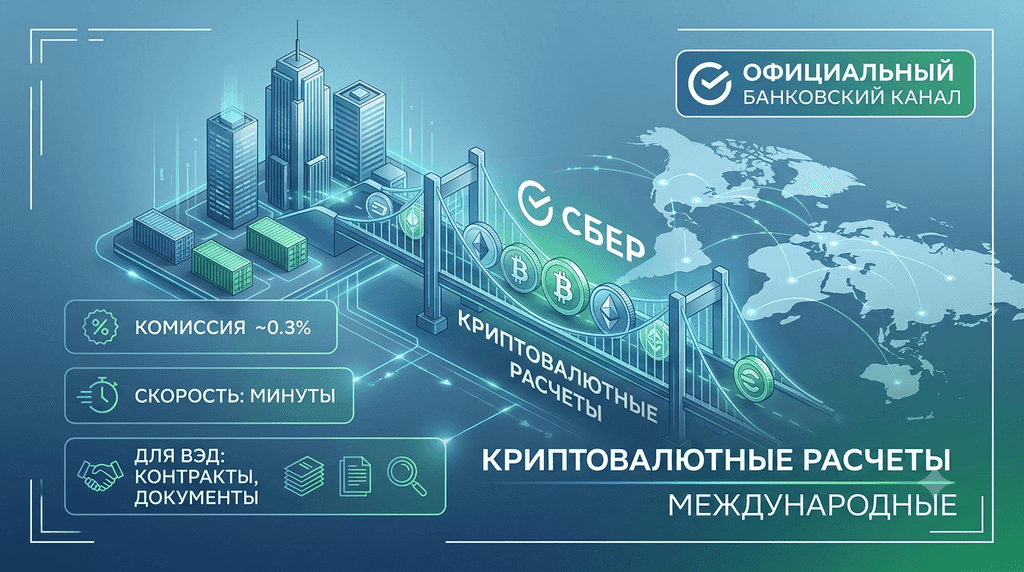
Can a company now pay a foreign trade contract in cryptocurrency through a major Russian bank—and how long does it take? Since September 1, 2026, Sber has offered corporate clients international cryptocurrency settlements: a transfer from one crypto wallet to another takes several minutes, there is no minimum transaction amount, and the average transaction cost is 0.3%. The service is not intended for private investors. It is designed for companies engaged in foreign economic activity and conducting transactions under foreign trade contracts. According to RBC on September 1 and Sber's announcements, the bank automatically generates documents for banking and foreign exchange control. This article explains how the new tool works, who can use it, and which restrictions remain in place.
What Exactly Has Sber Launched for International Cryptocurrency Settlements?
Sber has launched a corporate service for cross-border settlements under foreign economic contracts using cryptocurrency. This is not a general-purpose way to pay for any purchase with digital assets. Instead, it is banking infrastructure for export and import transactions in which the payment is connected to a contract, supporting documents, and foreign exchange control.
The bank announced the launch at the Eastern Economic Forum in Vladivostok on September 1, 2026. Sber's announcement states that the tool is intended for corporate clients engaged in foreign economic activity. According to RBC, the bank expects strong demand from Russian exporters and importers.
The key change for businesses is that the cryptocurrency transfer is integrated into a formal settlement procedure. A company does not have to find an informal channel, explain the origin of a transaction after the fact, or collect scattered confirmations for its records. The system accompanies the transaction with the documents required by the bank and foreign exchange control authorities.
At the same time, Sber does not eliminate client or foreign trade contract screening. A company must still comply with Russian law, provide the required information about its counterparty, and confirm the business purpose of the payment. Cryptocurrency becomes a method of cross-border settlement, but it does not exempt a business from standard compliance procedures.
Who Can Use the Service and Who Cannot?
The service is available to legal entities and other Sber corporate clients engaged in foreign economic activity. The primary users are exporters receiving payment from foreign buyers and importers that need to settle with an overseas supplier.
Which Companies Are the Target Audience?
The target user is a Russian company with a genuine foreign trade contract, a foreign counterparty, and a need to send a payment outside Russia. For this company, the speed and cost of the transfer matter, but so do the ability to demonstrate the transaction's economic purpose to the bank, prepare the necessary documents, and record the settlement in its accounts.
The tool may be useful for companies trading with markets where traditional banking channels are slow, expensive, or dependent on additional intermediaries. However, the decision to use cryptocurrency should be made together with an accountant, lawyer, and foreign exchange control specialist. Whether a transaction is permissible depends on the contract terms, the counterparty's jurisdiction, the selected digital asset, and applicable requirements.
Why Is the Service Not Intended for Retail Clients?
At launch, the product is not aimed at C2C scenarios or private retail investors. An ordinary user does not have a foreign trade contract for which the bank must prepare a set of documents for foreign exchange control. Therefore, owning a personal crypto wallet or being interested in international transfers does not, by itself, provide access to the service.
It is important to distinguish corporate foreign trade settlements from an individual's purchase of cryptocurrency. Sber describes the new tool specifically as a business solution, not as a universal crypto-payment service for the general public. This limitation reduces the risk of mistakenly interpreting the launch as permission to pay for any goods or services inside Russia with cryptocurrency.
How Does an International Cryptocurrency Payment Work?
The transaction follows a wallet-to-wallet model: digital assets are transferred from one crypto wallet to another, while the system records the information needed to support the foreign trade transaction. According to PortAmur on September 8, 2026, the transfer itself takes a couple of minutes.
First, the company prepares a foreign trade contract and agrees with the bank that the selected settlement method may be used. It then provides the payment details: amount, cryptocurrency, recipient wallet, counterparty information, and payment purpose. After the transaction is checked, it is sent to the digital asset network.
The bank then generates documents for banking and foreign exchange control. This step distinguishes an official banking channel from an informal transfer of cryptocurrency between parties. The company receives confirmation that can be used to record the foreign trade transaction and respond to requests from control departments.
The several-minute timeframe applies to the blockchain transfer between wallets. The full transaction may take longer because of contract review, sanctions and compliance procedures, network confirmation, and actions by the foreign partner. Businesses should therefore avoid promising customers instant crediting in every case.
How Much Does a Settlement Cost, and Is There a Minimum Amount?
The average transaction fee is 0.3%, and there is no minimum payment threshold. Sber and its press service disclosed these terms when the service was announced on September 1, 2026; RBC also reported them. The absence of a minimum amount allows the tool to be used not only for large contracts but also for smaller foreign trade payments, provided they meet the bank's requirements.
The 0.3% fee is presented as the average transaction cost and as a figure below the expense associated with traditional international settlement instruments. When comparing options, businesses should consider more than the bank's percentage. They should also account for possible network fees, conversion spreads, digital asset custody costs, and legal and accounting expenses.
|
Parameter
|
Service terms
|
|
Clients
|
Sber corporate clients engaged in foreign economic activity
|
|
Minimum amount
|
None
|
|
Average transaction cost
|
0.3%
|
|
Wallet-to-wallet speed
|
Several minutes
|
|
Documents
|
Generated automatically during the transaction
|
A low fee does not mean that every transaction will be cheaper than a bank transfer. The final benefit depends on the route, contract currency, counterparty's country, and selected cryptocurrency. Companies should compare the total payment cost rather than relying only on the published average percentage.
Which Documents Are Automatically Generated for Accounting and Control?
Automatic document generation addresses the central practical problem for businesses: officially demonstrating how cryptocurrency is connected to a foreign trade transaction. With a private or informal transfer, a company may struggle to confirm the payment, record it in its accounts, and pass checks under anti-money-laundering requirements.
During the transaction, the system creates the information package required by the bank and foreign exchange control. It links the wallet, amount, transfer time, counterparty, and foreign contract. As a result, the payment does not remain an isolated blockchain event without a clear business context.
For businesses, the risk of checks under Federal Law No. 115-FZ—the law on combating money laundering and terrorist financing—is particularly important. An official service does not guarantee automatic approval of every transaction, but it provides a transparent channel through which the bank can see the source and purpose of the payment. The company must still provide accurate information and respond to compliance inquiries.
Accordingly, document automation is not a way to bypass control. It is a way to pass through it in a more predictable format. If the contract, shipment, product price, or counterparty information raises questions, the payment may be subject to additional review or rejected.
What Does Russian Law Say About Cryptocurrency Settlements Under Foreign Trade Contracts?
Cryptocurrency settlements under foreign trade contracts have received a legal foundation within the current digital asset framework and after the testing of an experimental legal regime. Sber notes that the Bank of Russia's pilot, which began in September 2024, demonstrated demand for these transactions. After the cryptocurrency regulation law entered into force, the bank announced the move to a full corporate tool.
For Russian companies, it is essential to distinguish an international foreign trade transaction from a domestic payment. Russian law still prohibits using cryptocurrency in Russia as a means of payment for goods and services. The new service therefore cannot be interpreted as permission to pay a Russian store, contractor, or employee with bitcoin or another cryptocurrency.
The legal scenario is specific: a Russian company signs a foreign trade contract with an overseas partner and makes an international settlement permitted under the applicable rules. Inside Russia, cryptocurrency does not become ordinary money for everyday payments. The company must separately verify whether the foreign counterparty's jurisdiction permits this type of settlement.
Before the first transaction, the business should specify in the contract the currency or digital asset, the exchange-rate calculation method, the moment when the obligation is considered fulfilled, fees, refunds, and liability for network delays. These terms reduce the risk of a dispute if the asset's value changes sharply or the transaction requires additional confirmation.
What Benefits Does the Russian Exporter or Importer Receive?
The main benefit is a reduction in cross-border payment time from days to several minutes at the wallet-transfer level. This is especially important for companies that need to confirm payment to a supplier quickly, release a shipment, or support working capital.
The second benefit is access to counterparties and markets where traditional payment routes are limited. Cryptocurrency infrastructure may reduce the number of intermediaries and simplify settlement between the parties if both are prepared to work with digital assets and comply with local rules.
The third benefit is transaction formalization. Automatically generated documents help connect the blockchain transfer with the contract and accounting records. This matters more than speed alone: a business needs not merely a fast transfer, but a verifiable transaction that it can explain to a bank, auditor, and tax specialist.
Finally, the absence of a minimum amount makes the solution flexible. A company can consider cryptocurrency not only for very large contracts, but also for a test shipment or regular small payments. However, it should test the complete process—not just the technology—from the contract through accounting treatment.
Which Risks Should a Company Consider?
The key risk is cryptocurrency volatility between price agreement and actual payment execution. If the contract is denominated in fiat currency, the parties should determine in advance which exchange rate will be used and who bears the impact of a change in value.
The second risk concerns the blockchain transaction itself. An incorrect wallet address, unsupported network, or insufficient number of confirmations may cause a delay or loss of funds. Before sending a payment, the company should use internal approval for payment details and a test procedure, if the bank's terms allow it.
The third risk is compliance. Automatically generated documents do not eliminate checks of the counterparty, wallet, source of funds, or payment purpose. A transaction involving assets with an opaque history may raise additional questions even when a foreign trade contract exists.
The fourth risk is the difference between rules in the partner's country and Russia. The Russian legal framework for foreign trade settlements does not guarantee that a foreign supplier can accept a digital asset or withdraw it in its own jurisdiction. Before signing a contract, the company should therefore check local requirements, tax consequences, and banking practice.
How Should a Company Prepare for Its First Crypto Payment?
Preparation should begin with a legal review, not with the choice of a wallet. Companies should verify that the transaction is connected to a genuine foreign trade contract and that the payment method is permitted under the applicable rules in Russia and the counterparty's country.
The company should then agree with the bank on the document list, digital asset, payment route, and transaction confirmation procedure. The accountant should determine in advance how to record the cryptocurrency value, fee, and exchange-rate difference. The foreign exchange control specialist should verify what information will be required for the specific contract.
Before sending funds, the company must check the counterparty, wallet address, network, limits, and refund procedure. The contract should state when the obligation is considered fulfilled: at the moment of sending, after the first confirmation, or when the funds reach the recipient's wallet. This is particularly important for goods with strict delivery deadlines.
It is reasonable to conduct the first transaction for a limited amount even though there is no minimum threshold. This approach allows the company to test document flow, confirmation speed, and coordination between accounting and the bank without taking excessive operational risk.
Should a Business Use Sber's Cryptocurrency Settlement Service?
Companies with genuine foreign economic activity should consider the service if they value speed, official support, and access to an alternative international settlement route. The combination of transfers completed in several minutes, a fee of around 0.3%, no minimum amount, and automatic document generation makes the solution a notable tool for exporters and importers.
However, the product does not replace a financial strategy and is not suitable for domestic payments in Russia. Before connecting, a company must review the contract, counterparty, jurisdiction, tax accounting, foreign exchange control, and volatility of the selected asset. If these conditions are met, cryptocurrency settlement can become an additional channel rather than a risky replacement for the entire banking infrastructure.
Users interested in the digital asset market and crypto portfolio management can explore the tools available on KuCoin. However, KuCoin is not automatically part of Sber's service: corporate foreign trade settlements must be arranged through the bank and conducted in accordance with applicable law.
Beyond the Headlines: What KuCoin 5.0 Means for You
Market news moves fast — but where you act on it matters just as much. This October, KuCoin launches KuCoin 5.0, transforming KuCoin into a rebuilt platform. Here's what actually changes for you:
-
One account for everything. Older platforms split your money across separate "spot," "margin," and "futures" accounts and expected you to understand why. KuCoin 5.0's unified account removes that entirely — deposit once, and everything is simply there.
-
Stocks, indices, and commodities. KuCoin 5.0 expands beyond crypto into global markets. When crypto chops sideways and equities rally (or the reverse), you rotate in minutes instead of opening a brokerage account and waiting days for fiat rails.
-
Real-world assets (RWA). Tokenized exposure to traditional assets like commodities, right inside your crypto account. One of the fastest-growing segments in global finance is no longer reserved for institutions — you access it from the same balance you trade with.
-
Earn while you learn. Not ready to trade? KCUSD lets your stablecoins earn daily, auto-compounding interest. The lowest-stress way to put your idle deposit to work for 4% yield.
-
An AI assistant in plain language. Ask questions, get market context, understand what you're looking at — built into the platform, no jargon required.
-
An app that doesn't overwhelm. Faster, cleaner, and consistent — intuitive from the first tap, not after a tutorial.
-
Safety you can check, not just trust. A MiCAR-licensed EU entity, Proof of Reserves you can verify yourself, and internationally certified security (SOC 2 Type II, ISO 27001:2022).
Create your account in minutes — and start on the platform built for where crypto is going, not where it's been.
Conclusion
The launch of international cryptocurrency settlements means that Russian businesses now have a formal banking channel for paying foreign trade contracts with digital assets. Sber offers the service to corporate clients engaged in foreign economic activity, not to private retail users. A wallet-to-wallet transfer takes several minutes, there is no minimum amount, the average fee is stated at 0.3%, and documents for the bank and foreign exchange control are generated automatically during the transaction.
The product's main value lies in more than speed. A company can connect a blockchain transaction with its contract, accounting records, and compliance procedures, including checks under Federal Law No. 115-FZ. Important restrictions remain, however: cryptocurrency cannot be used to pay for goods and services inside Russia, and every international transaction must comply with the contract, the bank's requirements, and the rules of the counterparty's country.
The new tool should therefore be treated as an additional settlement method for a prepared company. Legal review, accurate accounting, wallet control, and volatility assessment remain essential conditions for safe use.
Frequently Asked Questions
1. Can an individual send cryptocurrency through Sber's new service?
No. At launch, the service is intended for corporate clients engaged in foreign economic activity. Private retail users are not the product's target audience.
2. Can cryptocurrency be used to pay for a Russian product or service?
No. The launch of foreign trade settlements does not remove the prohibition on using cryptocurrency in Russia as a means of payment for goods and services. The service applies to cross-border contracts with foreign counterparties.
3. Is there a minimum payment amount?
No stated minimum threshold applies. However, the absence of a minimum amount does not eliminate checks of the transaction, contract, counterparty, or source of funds.
4. Is the 0.3% fee fixed for every transaction?
No. The 0.3% figure is stated as the average transaction cost. Actual expenses may depend on the specific route, conversion, network fee, and transaction terms.
5. What should a company do if the crypto wallet address is incorrect?
The company should immediately stop the payment before sending it and contact the responsible bank employee. After a blockchain transaction has been confirmed, recovery usually depends on the recipient's cooperation and the network's technical capabilities. Payment details should therefore be checked before the transaction is authorized.
Disclaimer : This material is provided for informational purposes only and does not constitute financial, investment, legal, or tax advice. Transactions involving cryptocurrencies and tokenized assets carry substantial risks — including price volatility, limited liquidity, counterparty exposure, and the potential for total loss of invested capital. Readers should conduct their own research and, where appropriate, consult a qualified professional before making any financial decisions.