

Sber Forecasts Russian Crypto Market Growth: Reaching 7.5 Trillion Rubles by 2029
Introduction
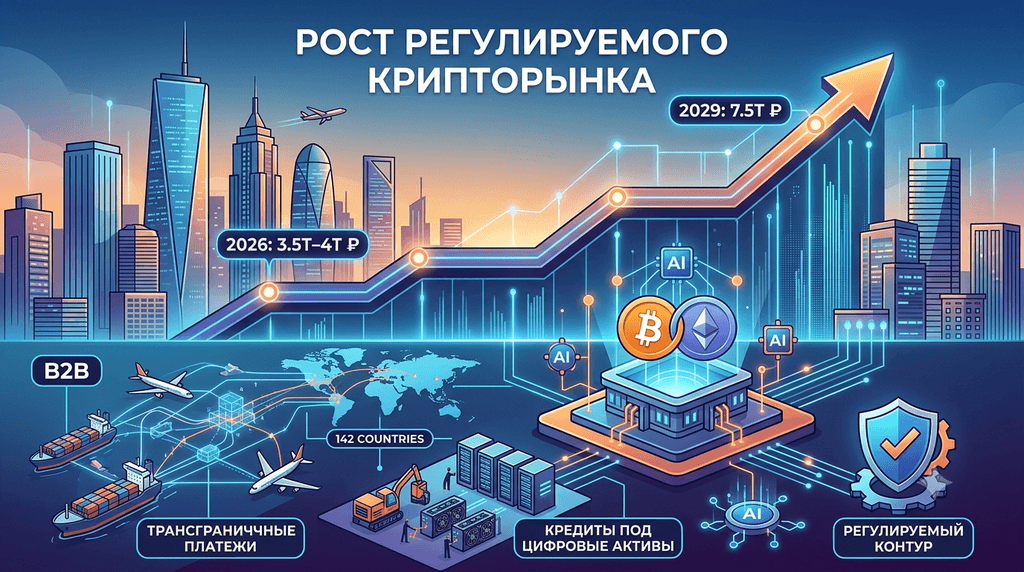
Can Russia’s regulated cryptocurrency market double in size within just a few years? According to estimates by SberCIB Investment Research analysts, exchange-based trading volume under the new regulatory regime could grow from 3.5–4 trillion rubles in its first year to 7.5 trillion rubles by 2029. Sber announced this forecast ahead of the Eastern Economic Forum in an interview published on September 1, 2026.
However, this does not mean an immediate launch of retail crypto buying within standard banking apps. Sber is focusing primarily on B2B infrastructure: cross-border settlements for companies engaged in foreign economic activity (FEA), alongside corporate loans backed by digital assets for mining operations and institutional holders. Retail access via SberApp is currently not supported, making the transition rate from grey-market crypto transactions into the regulated framework the market's central question.
What Crypto Market Volume Does Sber Forecast?
Sber projects that regulated crypto exchange trading in Russia will reach approximately 3.5–4 trillion rubles in the regime's first year, increase to 4.75–5.25 trillion rubles in 2028, and approach 7.5 trillion rubles by 2029. The baseline scenario assumes a gradual expansion rather than an overnight migration of all existing operations to licensed platforms.
| Period | Forecasted Regulated Trading Volume | What the Indicator Represents |
| First year of the regime | 3.5–4 trillion rubles | Initial share of existing turnover passing through organized venues |
| 2028 | 4.75–5.25 trillion rubles | Expansion of liquidity and business adaptation to new rules |
| 2029 | ~7.5 trillion rubles | A more mature regulated segment, though not the entirety of digital asset flows |
For context, the current average daily cryptocurrency volume in Russia is estimated at around 50 billion rubles, translating to approximately 18 trillion rubles annually. Comparing these figures is crucial: SberCIB’s forecast specifically targets the exchange-traded and regulated segment, whereas the 18 trillion ruble metric represents overall turnover, including P2P channels, unorganized OTC desks, and grey-market exchanges.
Consequently, the forecast should not be interpreted as a guarantee of 7.5 trillion rubles in net new market demand. A substantial portion of this growth represents the statistical legalization of pre-existing operations. The market will become far more transparent to regulators, banks, and institutional players, rather than expanding solely through new capital inflows.
Why Will the Regulated Market Launch with Only 20% of Total Volume?
In the first year, licensed exchanges are expected to capture only about 20% of Russia’s current cryptocurrency turnover—roughly 3.5–4 trillion rubles out of the estimated 18 trillion rubles. This conservative start stems not from a lack of market interest, but from friction between the new regulatory infrastructure and established user habits.
First, the transitional licensing window creates a delay. Full compliance and licensing adjustments run until July 1, 2027. Market participants are adapting to a multi-stage rollout of regulated intermediaries, exchanges, digital depositories, and compliant exchange services rather than a fully finished ecosystem on day one.
Second, unorganized P2P trading and OTC exchange desks exhibit strong operational inertia. Grey channels attract users due to operational flexibility, wider asset selections, and fast execution. Their inherent drawbacks—lack of institutional investor protection, counterparty risks, and regulatory ambiguity—do not always outweigh their convenience for short-term retail operations.
Third, derivatives already absorb part of the institutional demand. According to data cited alongside the forecast, annual volume for crypto futures on the Moscow Exchange stands at approximately 0.7 trillion rubles. While not a direct substitute for spot trading, it indicates that a segment of professional demand has already transitioned to exchange-traded structures.
Thus, the 20% figure represents an initial conversion wave: large corporations and professional market participants migrate early, while retail users and smaller P2P operators shift more gradually.
What Changed in Cryptocurrency Regulation starting September 1, 2026?
On September 1, 2026, Federal Law No. 282-FZ of August 4, 2026, "On Digital Currencies and Digital Rights," came into force in Russia, establishing a comprehensive framework for digital currency operations, exchange trading, intermediation, and digital custody. The Bank of Russia has aligned its operational rules for information system operators with this framework.
The new model structures the infrastructure into distinct tiers:
-
Organized Trading: Must be conducted strictly through legally recognized exchange operators.
-
Intermediaries: Licensed brokers and management companies facilitate client access.
-
Custody & Accounting: Entrusted to specialized digital depositories.
-
Exchange Services (OTC): Brought into the regulated sphere provided they meet statutory criteria.
Legalization does not convert cryptocurrency into legal tender for domestic payments within Russia. General restrictions remain on paying for goods and services with digital currencies domestically. The statutory exception applies to foreign economic activity (FEA), allowing exporters and importers to utilize cryptocurrencies for cross-border settlements under the new experimental regime.
Retail investors face structured limits as well. Under regulatory guidelines published on August 28, 2026, non-qualified investors are restricted to a select list of assets (primarily Bitcoin, Ethereum, and USDT) and subject to annual transaction caps per intermediary.
Why Is Sber Betting on B2B Rather Than Retail Trading?
Sber’s primary product priority focuses on corporate clients requiring cross-border settlements and liquidity backed by digital assets, rather than mass retail cryptocurrency purchases. Retail crypto purchasing remains unavailable within SberApp. This approach aligns with institutional banking risk models: corporate transactions carry clear economic rationales, trade documentation, and currency control compliance, whereas retail demand is heavily influenced by speculative market volatility.
Focusing on B2B minimizes initial operational risks. The bank can integrate digital assets into existing foreign trade workflows, compliance checks, and corporate lending engines. For enterprise clients, cryptocurrency functions as an operational settlement route or collateral mechanism rather than a speculative asset.
Will Businesses Be Able to Conduct FEA Payments via SberBusiness?
Yes, Sber has launched international cryptocurrency settlements for corporate clients engaged in foreign economic activity. According to reporting from September 1, 2026, transactions feature no minimum payment threshold, carry an average transaction fee of 0.3%, and execute between crypto wallets within minutes.
The core advantage extends beyond blockchain transfer speeds: standard banking documentation and currency control compliance files are generated automatically during the transaction process. Sber plans to integrate crypto payment capabilities directly into the "SberBusiness" mobile application by the end of 2026, enabling corporate users to select digital payment routes alongside traditional banking methods.
Cryptocurrency is not isolated from the broader banking stack under this model. It operates as an integrated execution route within the corporate banking portal, offering importers alternative settlement paths and enabling exporters to receive international payments when traditional correspondent banking corridors face operational friction.
How Does Lending Backed by Digital Assets Work?
Sber’s second major corporate initiative involves cryptocurrency-collateralized loans tailored for crypto mining operations and corporate digital asset holders. The product allows companies to unlock liquidity from holdings without liquidating their underlying digital positions.
This framework alters traditional credit underwriting. The evaluation model assesses not only the borrower's financial statements, but also the liquidity, verifiable ownership, and market value of the digital collateral. This structure is particularly advantageous for corporate holders during market uptrends, preserving upside exposure while funding working capital needs.
However, collateralized digital asset lending carries distinct risk factors. High price volatility requires banks to implement haircuts, margin call provisions, supplementary collateral requirements, and automated liquidation workflows. For corporate borrowers, sudden market downturns introduce margin calls or mandatory partial loan paydowns.
Which Cryptocurrencies Can Be Used as Collateral?
Bitcoin serves as the initial core collateral asset. Subject to Bank of Russia regulatory approval, Sber plans to expand eligible collateral to include Ethereum (ETH) and Tether (USDT).
Adding ETH connects the lending framework to the broader smart contract ecosystem, while USDT introduces a USD-pegged stablecoin widely utilized in international trade settlement and liquidity management.
The inclusion of USDT highlights the growing institutional utility of stablecoins for cross-border liquidity. Recognizing USDT under formal valuation, custody, and risk management frameworks reflects its functional role in commercial operations. Nonetheless, each asset class carries distinct risk parameters: BTC, ETH, and USDT will feature varied haircut rates, loan-to-value (LTV) limits, and collateral management requirements based on liquidity profiles and issuer risks.
How Does AI Connect Crypto Payments Across 142 Countries?
Sber’s international payment infrastructure utilizes an AI routing system that dynamically selects optimal execution paths across traditional correspondent accounts, partner banks, and cryptocurrency channels. The algorithm evaluates settlement parameters across 142 countries, balancing channel availability, transaction fees, processing speed, and compliance requirements.
This architecture abstracts technical complexity away from the end user. Corporate clients do not need to manually configure blockchain networks, manage intermediary risk, or generate standalone compliance documentation for each channel. The user inputs payment parameters inside the corporate portal, and the system recommends or automatically assigns the optimal routing channel.
This model aligns with Sber’s broader artificial intelligence strategy. By 2026, approximately 50% of Sber’s corporate lending transactions utilize autonomous AI processing, representing over 7 trillion rubles in issued financing. Extending AI routing to cross-border crypto settlements accelerates execution without eliminating mandatory compliance gates.
The AI router incorporates automated sanctions screening, counterparty verification, proof-of-funds checks, wallet risk scoring, and currency control verification. Corporate clients retain legal responsibility for transaction reporting, underlying commercial documentation, and regulatory compliance.
What Risks Could Slow Down Market Growth?
The primary risk facing Sber's projections is the timeline gap between statutory enactment and full infrastructure readiness. Although the law took effect on September 1, 2026, full licensing procedures, official registries, custodial standards, and inter-institutional workflows require time to mature. The Bank of Russia has granted existing information system operators until September 1, 2028, to achieve complete regulatory alignment.
A second challenge is operational competition from established grey-market P2P networks. Regulated venues must offer not only legal certainty, but also competitive transaction fees, deep liquidity, and efficient fiat on/off-ramps. High legal compliance costs or processing delays could lead users to retain transaction volume outside organized exchanges.
Volatility and collateral quality represent a third risk factor. Sharp drawdowns in BTC or ETH market prices can contract trading volumes and trigger margin calls across credit portfolios. While USDT mitigates direct price volatility relative to unpegged crypto assets, it introduces smart contract, regulatory, and issuer concentration risks.
Finally, market observers must distinguish between growth in reported regulated volume and organic retail adoption. The transition of volume from OTC desks to licensed exchanges increases statistical transparency, but does not indicate widespread adoption of cryptocurrency for domestic consumer payments, which remain legally restricted in Russia.
How to Buy or Trade Cryptocurrency via KuCoin?
Sber's regulatory rollout focuses on institutional and B2B workflows, leaving retail crypto access outside SberApp. For individual market participants evaluating digital asset trading, platforms like KuCoin offer specialized retail exchange infrastructure.
Before initiating trades on external exchanges, users should complete the following steps:
-
Jurisdiction & Eligibility: Verify service availability and regulatory requirements within your local jurisdiction.
-
Account Verification: Complete mandatory Identity Verification (KYC) procedures.
-
Risk Management: Evaluate platform security features, fee structures, and self-custody options versus exchange storage.
-
Product Selection: Distinguish between spot trading, derivatives, and passive yield products based on risk tolerance. Avoid using leverage without a clear understanding of liquidation mechanisms.
Cryptocurrencies remain high-risk, volatile financial assets. While institutional infrastructure growth enhances market transparency, it does not eliminate asset price volatility, operational risks, or evolving regulatory constraints.
KuCoin Offers A More Stable Option in A Volatile Market
If you worry about the frequent ups and downs in the market, and pursue a more stable option to earn money passively, KuCoin is the right place to come:
Simple Earn: Deposit and withdraw tokens anytime, earning stable returns.
Kucoin Earn: Earn stable profits with professional asset management.
Hold to Earn: Earn rewards by holding assets in Funding, Trading, Margin, Futures, Mining, and Unified Accounts.
Staking: Unlock the earning potential of on-chain assets.
Advanced Investments: Advanced Investments offer a variety of structured products to help your money grow in any market.
Shark Fin: Principal Protection and Guaranteed Gains
Dual Investment: Buy low and sell high with transparent return calculations.
Snowball: High yields, with price protection.
Discount Buy: Buy crypto at discount prices.
KCS Loyalty: Level up to enjoy exclusive perks by staking ≥ 1 KCS.
KuCoin Wealth: Discover future value and begin your smart investing journey.
KCS Benefits: Hold and stake KCS to access benefits across the platform.
KCS Staking 2.0: Participate in KCS on-chain governance to earn yield.
Conclusion
Sber’s projections signal that Russia’s cryptocurrency market is entering a new developmental stage led by institutional B2B infrastructure rather than retail trading. SberCIB projects regulated exchange trading volumes at 3.5–4 trillion rubles in the first year, 4.75–5.25 trillion rubles in 2028, and approximately 7.5 trillion rubles by 2029. These figures reflect a gradual migration of volume from unorganized P2P channels and OTC desks into licensed venues, rather than an immediate conversion of the entire estimated 18 trillion ruble overall market.
Sber’s operational strategy concentrates on enterprise needs: cross-border crypto settlements for foreign economic activity are active, integration into "SberBusiness" is slated by year-end 2026, and crypto-collateralized corporate lending links digital assets directly with corporate balance-sheet liquidity. Automated AI routing across 142 countries aims to streamline complex multi-channel settlements.
The trajectory of market growth will depend on licensing speeds, market liquidity, and institutional trust in the emerging regulatory framework. Sber's figures provide a benchmark for institutional infrastructure development across Russia's evolving digital asset landscape.
Frequently Asked Questions
1. Can I currently buy Bitcoin through SberApp?
No. Retail cryptocurrency purchases are not supported within SberApp. Sber’s digital asset initiatives focus exclusively on corporate banking, foreign trade settlements, and collateralized B2B lending.
2. Which cryptocurrencies does Sber plan to accept as collateral?
Bitcoin (BTC) serves as the primary initial collateral asset. Following Bank of Russia regulatory clearance, Sber plans to expand collateral options to include Ethereum (ETH) and Tether (USDT).
3. Is cryptocurrency legal tender for domestic payments in Russia?
No. The entry into force of the new law does not alter the general prohibition on using cryptocurrency for domestic goods and services payments within Russia. A specific statutory framework applies exclusively to cross-border settlements for foreign trade (FEA).
4. Why is the forecasted regulated volume lower than the total market turnover?
The overall 18 trillion ruble market estimate includes unorganized P2P transactions, non-licensed OTC desks, and informal exchange channels. Sber’s forecast isolates the specific volume expected to transition onto licensed exchanges and regulated intermediaries.
5. What does crypto settlement mean for a Russian importer?
It provides an alternative, compliant transaction channel for settling cross-border invoices with foreign counterparties. Transactions must fulfill statutory foreign trade regulations, bank compliance checks, and currency control documentation requirements.
Disclaimer : This material is provided for informational purposes only and does not constitute financial, investment, legal, or tax advice. Transactions involving cryptocurrencies and tokenized assets carry substantial risks — including price volatility, limited liquidity, counterparty exposure, and the potential for total loss of invested capital. Readers should conduct their own research and, where appropriate, consult a qualified professional before making any financial decisions.