

Samsung Q3 2026 Earnings: Profit Miss, $21B Dividend and 2027 Chip Shortage Outlook
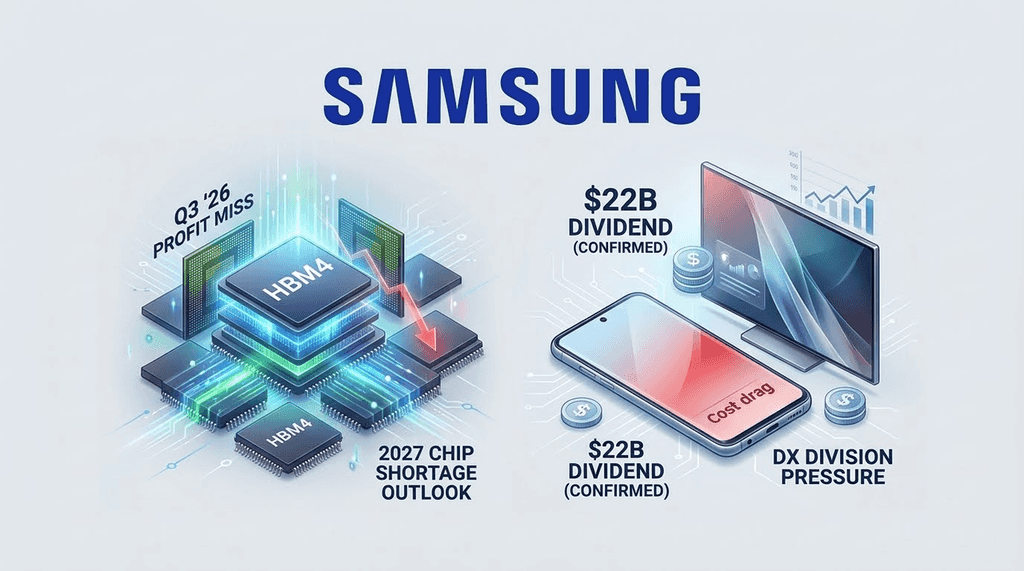
Samsung Electronics released its audited consolidated financial results for the third quarter of 2026 on October 29, revealing a historic milestone alongside a stark operational divergence across its core business units. Consolidated operating profit reached an unprecedented ₩107.44 trillion on record quarterly revenue of ₩195.25 trillion. Confirming the preliminary guidance issued on October 8, the result marks the fourth consecutive quarter of record earnings and the first time in corporate history that a South Korean enterprise generated more than ₩100 trillion in quarterly operating profit—outearning global technology peers including Microsoft, Alphabet, and Meta.
Despite the historic operating headline, equity markets reacted negatively, with Samsung shares falling more than 4% in Seoul trading and dragging the broader KOSPI index back below the 6,000 threshold. The sell-off was driven by a combination of a bottom-line net profit miss, an in-line dividend announcement that had already been priced in by the market, and growing investor scrutiny over internal business imbalances. While operating profit rose 783.11% year-over-year and 20.1% quarter-over-quarter, consolidated net profit came in at ₩75.14 trillion, falling noticeably short of the ₩87.4 trillion consensus projection compiled by financial tracker FnGuide.
Furthermore, although the board of directors approved a record single-quarter cash dividend of approximately ₩30 trillion, the payout merely matched expectations set in August while deferring decisions on the remainder of its annual shareholder return package until January 2027. Operationally, the semiconductor division generated over 99% of total corporate operating profit, whereas the consumer device division logged its second consecutive quarterly operating loss as surging memory chip prices inflated manufacturing costs for smartphones and appliances. During the earnings conference call, management also warned that customer demand for artificial intelligence memory will continue to outstrip supply throughout 2027, pointing to a multi-year structural supply deficit across the semiconductor industry.
Deconstructing the Q3 Financial Statements: Semiconductor Boom vs. Consumer Drag
Samsung’s third-quarter income statement illustrates an extraordinary concentration of earnings within upstream semiconductor fabrication, contrasted directly against severe cost inflation in downstream consumer hardware.
The Semiconductor Division (DS) Performance
The Device Solutions (DS) division, which encompasses memory, system LSI, and foundry operations, generated ₩147.1 trillion in third-quarter revenue and ₩106.5 trillion in operating profit. Accounting for 99.1% of Samsung’s consolidated operating income, the semiconductor division achieved an overall operating margin of 72.4%, with standalone memory operating margins estimated near 80%.
This earnings surge was propelled by relentless capital investment in artificial intelligence data centers. Shipments of high-value HBM4 modules and server-grade DDR5 memory expanded sharply as cloud hyperscalers ramped up next-generation GPU and CPU server deployments. Simultaneously, the expansion of enterprise and personal AI agent services accelerated demand for high-capacity, QLC-based enterprise solid-state drives (eSSDs) required for high-throughput data retrieval. Samsung also noted that its foundry business achieved sharp revenue growth during the quarter and is projected to record double-digit percentage revenue expansion in the fourth quarter. Among other subsidiaries, Samsung Display contributed ₩8.0 trillion in revenue and ₩1.1 trillion in operating profit, while Harman International recorded ₩4.3 trillion in revenue and ₩600 billion in operating profit.
The Device eXperience (DX) Deficit
On the opposite side of the ledger, the Device eXperience (DX) division, responsible for finished consumer products including Mobile eXperience (MX) smartphones, televisions, and home appliances, reported ₩52.1 trillion in revenue and an operating loss of ₩800 billion (approximately $599 million). While narrower than some market fears of a ₩1 trillion deficit, the result marked the division’s second consecutive quarterly loss, with the mobile business alone losing roughly ₩600 billion.
The irony of Samsung’s integrated corporate structure is that the very memory price boom driving near-80% margins in its semiconductor arm is directly eroding profitability in its consumer hardware business. Embedded memory chips represent a substantial portion of a smartphone’s bill of materials (BOM). As soaring memory prices drove up handset manufacturing costs, global smartphone demand softened amid cost-conscious consumer behavior, with Samsung’s third-quarter smartphone shipments slipping roughly 8% to 9% quarter-over-quarter to 58 million units. Unable to pass the full extent of component inflation onto consumers despite price increases on flagship models, Samsung has reportedly notified supply-chain partners of plans to trim fourth-quarter smartphone production targets by 20% to 30%.
Explaining the Net Profit Miss and Post-Earnings Stock Reaction
While Samsung’s ₩107.44 trillion operating profit slightly beat consensus estimates of roughly ₩105.7 trillion to ₩106 trillion, the 4% decline in its share price reflected investor focus on the ₩12.26 trillion gap between actual net profit (₩75.14 trillion) and the ₩87.4 trillion FnGuide consensus, alongside broader valuation and growth considerations.
Several non-operating and structural factors contributed to the divergence between operating earnings and net income. Across the South Korean semiconductor sector in the third quarter, surging pre-tax profits triggered substantially higher corporate income tax provisions, while end-of-quarter volatility in foreign exchange markets and valuation adjustments on investment assets weighed on non-operating balances (a pattern similarly observed in rival SK Hynix’s third-quarter report, where tax, foreign exchange, and investment valuation items reduced an ₩83.3 trillion operating profit to ₩39.8 trillion in net income).
Additionally, equity investors weighed the pace of sequential earnings momentum. Although Samsung’s 783.11% year-over-year operating profit growth is historic in absolute terms, it compares against a much lower baseline from the third quarter of 2025. On a sequential basis, operating profit growth moderated to 20.1% quarter-over-quarter from higher growth rates earlier in the year. With Samsung’s stock having already pulled back roughly 30% from its June 2026 peak prior to the October earnings cycle, institutional desks closely scrutinized whether downstream consumer losses and massive capital expenditure requirements could cap near-term free cash flow expansion.
In a separate regulatory filing on October 29, Samsung’s board approved a third-quarter cash dividend of ₩4,601 per share for both common and preferred stock, totaling approximately ₩30 trillion (including roughly ₩3.69 trillion allocated to preferred shares), scheduled for payment on November 27 to shareholders of record as of September 30.
Execution of the 2026 Shareholder Return Plan
The ₩30 trillion payout forms a central pillar of the ₩90 trillion to ₩110 trillion annual shareholder return framework that Samsung unveiled in August 2026. Including the third-quarter dividend, shareholder returns executed or confirmed by Samsung so far this year total approximately ₩35 trillion (roughly $26.2 billion).
However, market disappointment stemmed from both timing and peer comparison. Because the ₩30 trillion third-quarter dividend merely matched the figure management had already flagged in August, it offered no upside surprise for traders. Moreover, Samsung postponed concrete decisions on how to deploy the remaining ₩55 trillion to ₩75 trillion (or up to ₩80 trillion depending on the final envelope, potentially including further treasury share buybacks and cancellations) until a board meeting in January 2027. Investors also noted that while Samsung’s cumulative operating profit is roughly 40% larger than that of rival SK Hynix, its total ₩90 trillion to ₩110 trillion shareholder return package is broadly similar in size to SK Hynix’s newly announced ~₩100 trillion return plan (which features ₩30 trillion+ in dividends and over ₩60 trillion in share buybacks and cancellations).
At the same time, Samsung faces substantial capital investment demands to defend its manufacturing position. During the earnings call, management projected full-year 2026 capital expenditures (CapEx) at approximately ₩84.4 trillion, with the semiconductor DS division accounting for roughly ₩76.8 trillion—funds dedicated primarily to building new wafer fabrication facilities and expanding capacity for AI and high-performance computing.
The 2027 Memory Outlook: Deepening Chip Shortage and Wafer Displacement
For the global technology and artificial intelligence sectors, the most consequential takeaway from the third-quarter earnings cycle is the supply-demand trajectory heading into 2027 and 2028. Samsung stated during its earnings call that it expects AI memory demand to continue expanding in the fourth quarter and warned that the industry-wide memory chip shortage will deepen in 2027 as demand further outstrips available supply.
The Mechanics of HBM Wafer Displacement
The primary catalyst behind the prolonged memory shortage is the physical manufacturing trade-off between High Bandwidth Memory (HBM) and standard DRAM. HBM chips require significantly larger die sizes and complex vertical stacking processes, such as through-silicon vias (TSVs) and advanced thermal bonding, consuming roughly three times the silicon wafer capacity per gigabit compared to conventional DDR5 memory.
As Samsung, SK Hynix, and Micron shift an ever-larger share of their cleanroom wafer starts toward high-margin HBM4 modules to supply next-generation AI accelerators, they cannibalize the wafer capacity available for standard server DRAM, PC memory, and mobile LPDDR5X. Goldman Sachs analysts warned on October 29 that the global DRAM shortage could persist through 2028, projecting average HBM prices to rise significantly next year, while SK Hynix management stated this week that its DRAM and HBM output is effectively booked through 2029, with overall demand expected to outrun supply through 2030.
Multi-Year Fab Construction Lead Times
Despite committing ₩76.8 trillion in 2026 semiconductor CapEx, Samsung and its peers cannot resolve the supply deficit overnight. Constructing, equipping, and qualifying new greenfield semiconductor cleanrooms requires multiple years of civil engineering and over a year of lead time for extreme ultraviolet (EUV) lithography and advanced packaging tools. Consequently, enterprise server buyers and consumer electronics manufacturers face tight component allocations and elevated memory pricing well into the second half of the decade.
What Samsung’s AI Memory Outlook Means for AI Crypto and DePIN
While Samsung Electronics operates within traditional hardware markets, its third-quarter results carry macro signals for digital asset participants tracking artificial intelligence tokens and Decentralized Physical Infrastructure Networks (DePIN):
Validation of AI Agent Infrastructure Demand: Samsung specifically cited the expansion of personal and enterprise AI agent services as a primary driver behind surging enterprise QLC SSD and server DRAM orders. This hardware bottleneck reinforces the broader infrastructure narrative surrounding on-chain AI agent ecosystems and decentralized compute protocols.
Hardware Scarcity through 2027–2028: With HBM4 wafer displacement tightening global memory supply and pushing enterprise hardware costs higher through at least 2027, cost-sensitive AI developers face sustained cloud and hardware pricing pressure, a structural dynamic frequently monitored by decentralized GPU and storage networks.
Conclusion
Samsung Electronics’ third-quarter 2026 financial report highlights a historic divergence within the global technology hardware ecosystem. By generating ₩107.44 trillion in quarterly operating profit, with ₩106.5 trillion coming directly from semiconductors, Samsung underscored the immense pricing power and margin expansion created by the global AI infrastructure buildout. Yet that same memory supercycle has become a direct headwind for consumer hardware, pushing Samsung’s mobile and appliance division into its second straight quarterly loss. With ₩76.8 trillion in 2026 semiconductor CapEx underway and AI memory demand projected to outstrip supply through 2027, upstream silicon fabrication remains the undisputed profit engine of the AI economy.
FAQs
Why did Samsung shares fall despite record ₩107.44 trillion operating profit in Q3 2026?
Although Samsung’s Q3 2026 operating profit of ₩107.44 trillion ($80.5 billion) set an all-time South Korean corporate record, its net profit of ₩75.14 trillion missed the FnGuide market consensus of ₩87.4 trillion. In addition, its ₩30 trillion quarterly cash dividend had already been telegraphed in August, decisions on the remaining ₩55 trillion to ₩75 trillion in shareholder returns were pushed to January 2027, and its DX consumer division suffered an ₩800 billion operating loss.
How much did Samsung’s semiconductor division earn in Q3 2026?
Samsung’s Device Solutions (DS) semiconductor division generated ₩147.1 trillion in revenue and ₩106.5 trillion in operating profit during the third quarter of 2026. The chip division accounted for over 99% of Samsung’s total operating profit and achieved a 72.4% operating margin, fueled by surging HBM4, server DDR5, and enterprise SSD demand.
Why did Samsung’s smartphone and consumer electronics division lose money?
The Device eXperience (DX) division posted an ₩800 billion operating loss in Q3 2026 (including a roughly ₩600 billion loss in mobile) — its second consecutive quarterly deficit. Soaring prices for embedded memory chips sharply increased smartphone manufacturing costs at a time when quarterly phone shipments fell roughly 8% to 9% to 58 million units, prompting Samsung to cut Q4 smartphone production targets by 20% to 30%.
Will the AI memory chip shortage continue in 2027?
Yes. During its October 29 earnings call, Samsung projected that AI memory demand will continue to outpace supply throughout 2027, driven by next-generation CPU/GPU server deployments and AI agent storage needs. Because HBM manufacturing consumes roughly three times the wafer capacity of standard DRAM and new fabs take years to build, analysts and industry peers expect tight memory supply to persist into 2028 and beyond.
Disclaimer
This general market information, possibly from third-party, commercial, or sponsored sources, is provided for reference and educational purposes only and does not constitute financial or investment advice, an offer, solicitation, or guarantee. We disclaim liability for its accuracy, completeness, reliability, and any resulting losses. Investments/trading are risky; past performance doesn’t guarantee future results. Users should research, judge prudently, and take full responsibility. For further details, please consult KuCoin’s Terms of Use and Risk Disclosure.