

Tokenized Real-World Assets in 2026: Why Liquidity and Regulation Still Matter
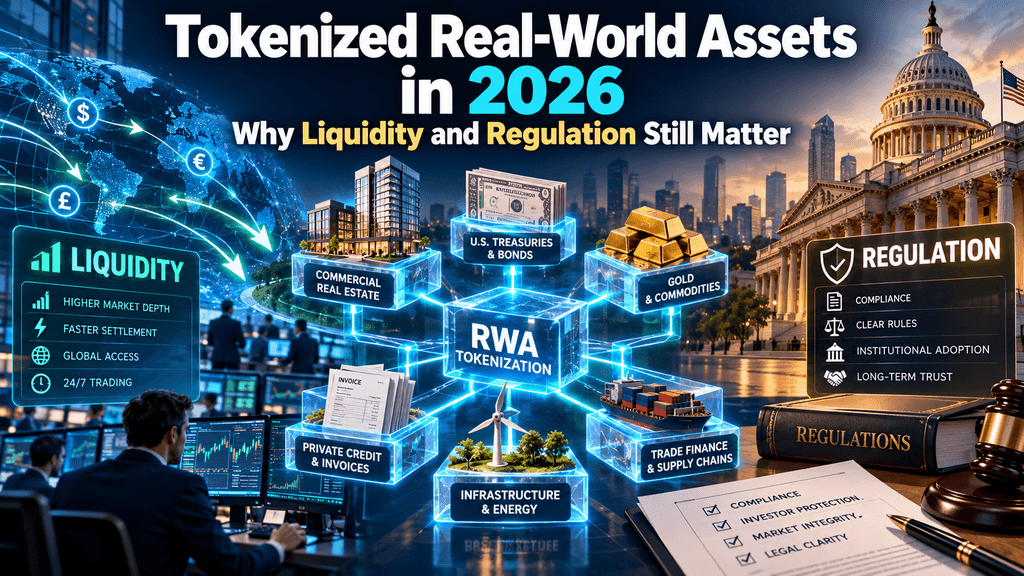
Real-world asset (RWA) tokenization is entering a new phase in 2026 as major financial institutions bring stocks, bonds, and investment funds onto blockchain networks. On October 8, Securitize launched tokenized U.S. stock trading, following the Securities and Exchange Commission's September decision to introduce a conditional regulatory exemption for certain onchain securities markets. These developments suggest that tokenization is moving beyond experimental projects toward practical financial applications.
According to RWA.xyz, distributed tokenized real-world assets reached approximately $39 billion in October 2026. Yet growing asset values do not necessarily translate into active trading markets. Many tokenized products still face limited secondary-market liquidity, restrictions on asset transfers, and uncertainty surrounding investor rights. As traditional finance increasingly explores blockchain infrastructure, two questions have become central: can tokenization create meaningful liquidity, and can regulation support broader adoption without weakening investor protection?
How Big Is the RWA Market in 2026?
Tokenized real-world assets are digital representations of traditional financial or physical assets recorded on blockchain networks. Depending on their structure, these tokens may represent ownership interests, contractual claims, investment fund shares, or exposure to underlying assets. Their potential advantages include more efficient transfers, programmable transactions, improved recordkeeping, and easier integration with digital financial infrastructure.
The market has expanded substantially. As of October 9, 2026, RWA.xyz reported approximately $39.02 billion in Distributed Asset Value, $351.97 billion in Represented Asset Value, and around 5.19 million asset-holding addresses. These figures measure different aspects of tokenization. Distributed assets generally involve tokens issued and held across blockchain wallets, while represented assets may use blockchain primarily for ownership records or asset representation. The two values should not be combined into a single market capitalization, and wallet addresses should not automatically be treated as unique investors.
Several asset categories are contributing to this expansion. Tokenized U.S. Treasuries and money market funds have attracted institutions seeking yield-bearing cash management products. Tokenized stocks are gaining attention as securities infrastructure develops, while gold-backed tokens, private credit, and real estate products offer different investment applications. However, the liquidity characteristics of these assets vary considerably.
| RWA Category | Typical Underlying Assets | Main Financial Use |
| Tokenized Treasuries | Government bonds and money market funds | Yield and cash management |
| Tokenized Stocks | Publicly traded equities | Securities trading and transfers |
| Tokenized Commodities | Gold and other physical assets | Digital commodity exposure |
| Private Credit | Loans and debt instruments | Lending and income generation |
| Tokenized Real Estate | Property-related investment interests | Fractional investment access |
The growing diversity of assets illustrates tokenization's potential, but it also raises a fundamental question: does making an asset available onchain actually make it easier to trade?
Why Is RWA Liquidity Still Limited?
Liquidity remains one of the biggest challenges facing real-world asset tokenization. Blockchain technology can make digital asset transfers faster, but market liquidity depends on whether investors can buy or sell meaningful quantities without causing substantial price changes. An asset may have a large outstanding value while generating little secondary-market activity.
Tokenization Doesn't Automatically Create Buyers
Consider a private credit fund with $100 million in tokenized assets. Investors may hold blockchain-based representations of their fund interests, but that does not guarantee an active market for those tokens. Without enough buyers, sellers, and professional market makers, investors may face wide bid-ask spreads or struggle to exit their positions.
A 2026 study published in FinTech, titled Tokenized but Illiquid? Evidence from Real-World Asset Markets, examined Ethereum-based tokenized Treasuries, gold-backed assets, and private-credit-related tokens. It found that outstanding asset value alone was not a reliable indicator of observed liquidity. Gold-backed tokens generally demonstrated broader participation and more persistent activity than many Treasury and private credit products in the study's sample.
These findings suggest that RWA market development should be evaluated through actual trading participation and turnover rather than token issuance alone.
Trading Liquidity Is Different From Redemption Liquidity
Another important distinction is the difference between selling a token to another investor and redeeming it for the value of its underlying asset. Secondary-market liquidity depends on trading activity, while redemption liquidity depends on the issuer's contractual obligations, asset availability, and settlement procedures.
For example, a tokenized money market fund may provide redemption mechanisms for eligible investors, but requests could remain subject to operating conditions or processing requirements. Private credit and real estate assets may face even greater limitations because their underlying investments cannot always be liquidated immediately.
This creates a potential mismatch between blockchain settlement speed and traditional asset liquidity. A token might be transferable around the clock, but that does not mean its underlying value can always be redeemed instantly. Consequently, 24/7 trading should not be confused with guaranteed 24/7 liquidity.
Fragmented Markets Create Additional Challenges
Liquidity can also become fragmented when similar assets are issued across different blockchain networks. If tokenized securities trade separately on Ethereum, Solana, and permissioned institutional platforms, investors may encounter disconnected pools of liquidity rather than one unified market.
The Bank for International Settlements highlighted this problem in July 2026, noting that multiple blockchain networks can fragment infrastructure, assets, and liquidity. Cross-chain bridges and multichain issuance may reduce these barriers, but they introduce additional security, governance, and operational dependencies.
For RWA markets to mature, faster transactions must be accompanied by reliable pricing, effective market making, accessible redemption mechanisms, and stronger interoperability.
How Is Regulation Changing RWA Markets?
Regulatory clarity is closely connected to liquidity because institutional investors and financial intermediaries need enforceable rules before participating in securities markets. Tokenized assets may operate on blockchains, but their underlying economic functions often remain subject to traditional financial regulations.
The SEC's 2026 Innovation Exemption
On September 17, 2026, the U.S. Securities and Exchange Commission introduced a temporary, conditional Innovation Exemption for certain tokenized National Market System stocks. The framework allows eligible Tokenized Securities Venues to conduct limited onchain trading using permissioned automated market makers and liquidity pools.
The exemption lasts five years and includes restrictions on eligible securities, market activities, and participation. Importantly, covered tokenized stocks must provide rights and privileges corresponding to the underlying traditional securities, including relevant voting and dividend rights. Issuers also have an opportunity to object to third-party tokenization arrangements.
The policy represents a significant regulatory development, but it is not a blanket authorization for unrestricted RWA trading. The SEC is allowing specific market structures to operate under defined conditions while considering longer-term regulatory requirements.
Why Legal Ownership Still Matters
In January 2026, SEC staff published a statement on tokenized securities, distinguishing securities tokenized by issuers from those created by third parties. These arrangements can involve different ownership records, custodial relationships, and investor claims.
A token backed by actual securities may give investors legally defined interests in those securities, while a synthetic token might provide only economic exposure to price movements. The distinction becomes especially important if a custodian fails, an issuer enters bankruptcy, or investors attempt to exercise shareholder rights.
Outside the United States, regulatory approaches also differ. The European Union's Markets in Crypto-Assets Regulation (MiCA) excludes crypto-assets that qualify as financial instruments from its general scope, meaning tokenized securities may remain subject to existing financial market rules. Ultimately, legal certainty helps investors understand what they own and whether their rights can be enforced.
Are Tokenized Stocks Going Mainstream?
Tokenized equities have become one of the most visible developments in the 2026 RWA market. Recent launches suggest that traditional securities trading is moving closer to blockchain infrastructure, although broad adoption and consistently deep liquidity have not yet been demonstrated.
Securitize Brings U.S. Stocks Onchain
On October 8, Securitize announced the launch of Securitize Stocks, providing eligible investors with tokenized access to major U.S. equities. The initial offering includes securities associated with Apple, Microsoft, Nvidia, Alphabet, Tesla, and other publicly traded companies.
The products initially operate on Solana through Securitize's registered broker-dealer platform. According to the company, the tokens are backed one-to-one by underlying shares and provide corresponding security entitlements and economic benefits. This approach differs from purely synthetic products that track stock prices without conveying comparable securities interests.
The development could help connect traditional equity ownership with blockchain-based transfers and settlement. Nevertheless, the launch itself does not establish that these securities already possess the trading depth of their conventional stock-market counterparts.
Can Tokenized Stocks Really Trade 24/7?
Another development came on October 5, when OKXICE, a joint venture involving OKX and Intercontinental Exchange, filed plans for a tokenized U.S. stock trading venue. The proposal aims to support round-the-clock trading, reflecting growing interest in extending securities market accessibility beyond traditional exchange hours.
Continuous trading could improve convenience and allow investors to respond more quickly to global events. However, liquidity outside regular market hours depends on active participants and reliable price discovery. When underlying stock markets are closed, lower participation could produce wider spreads or greater short-term price deviations.
The distinction is important: extending market hours creates trading opportunities, but sustainable liquidity still requires capital, market makers, and effective links with traditional securities infrastructure.
Why Are Institutions Embracing Tokenization?
Institutional interest in RWA tokenization extends beyond creating new investment products. Large financial institutions are exploring whether blockchain can improve custody, collateral management, asset transfers, and settlement processes that currently depend on multiple intermediaries.
DTCC Moves Securities Toward Blockchain
On July 15, 2026, the Depository Trust & Clearing Corporation (DTCC) announced that securities held through the Depository Trust Company had been converted into blockchain-based tokens and used in real production transactions.
The initiative demonstrated how tokenized securities could operate alongside existing market infrastructure while preserving relevant rights and protections. DTCC also outlined plans for a broader tokenization service targeted for October 2026, although the July transactions should be distinguished from the status of a subsequent full commercial rollout.
This development matters because established post-trade institutions already support major securities markets. Their participation could help tokenized assets integrate with institutional custody, settlement, and operational systems rather than remaining isolated blockchain products.
Tokenized Treasuries Offer Practical Use Cases
Tokenized Treasury products and money market funds illustrate why institutions are interested in the technology. These assets can provide familiar income-generating exposure while potentially improving how financial institutions manage balances, transfers, and eligible collateral.
Products such as BlackRock's BUIDL demonstrate how traditional asset management can be connected to blockchain-based infrastructure. The value proposition goes beyond trading tokens continuously: programmable settlement and more efficient asset movement may reduce operational friction in certain institutional workflows.
However, institutional adoption still depends on reliable custody, redemption arrangements, appropriate counterparty relationships, and regulatory compliance. Tokenization becomes commercially valuable when it improves existing financial activities without introducing disproportionate operational risk.
Can RWA Tokenization Benefit DeFi?
Real-world asset tokenization could expand the range of financial instruments available within decentralized finance. Traditional DeFi applications have historically relied heavily on cryptocurrencies and stablecoins, while tokenized securities and income-generating funds may introduce additional forms of collateral and investment exposure.
RWA Collateral and Stablecoin Settlement
Tokenized Treasuries and fund interests could become useful collateral in approved lending and financing arrangements. However, their integration depends on legal transferability, valuation methods, liquidation procedures, and investor eligibility restrictions. A permissioned security cannot necessarily circulate freely through every DeFi application.
Stablecoins may also improve transaction settlement between tokenized financial products. Circle's arrangement allowing eligible holders of BlackRock's BUIDL fund to transfer shares in exchange for USDC illustrates how tokenized funds can connect with digital-dollar liquidity. Such mechanisms may reduce settlement friction without removing the underlying product's contractual conditions.
What Does RWA Growth Mean for Ethereum and Solana?
Ethereum remains a major network for tokenized assets, while Solana has gained attention through initiatives such as Securitize Stocks. Other public and permissioned networks are also competing to provide institutional-grade financial infrastructure.
Growing RWA activity could increase demand for blockchain transactions, custody services, and smart contract execution. However, higher tokenized asset values do not automatically translate into proportional appreciation in ETH, SOL, or other native cryptocurrencies.
The actual benefit depends on transaction frequency, network fees, economic activity, and how value flows through each blockchain ecosystem. Investors should therefore distinguish adoption of blockchain infrastructure from investment demand for its associated token.
What Risks Could Slow RWA Growth?
Beyond liquidity and regulation, tokenized assets face operational risks that can affect both issuers and investors. Smart contract vulnerabilities, inaccurate asset data, custody failures, and inconsistencies between blockchain records and traditional ownership registers may disrupt otherwise legitimate financial products.
Cross-chain infrastructure introduces additional complexity. Bridges, interoperability protocols, and permissioned networks may depend on administrators or third-party services, creating potential points of failure. A technical problem could delay asset transfers even when the underlying securities remain financially sound.
The underlying assets also retain their traditional risks. Tokenizing a loan does not eliminate borrower default, just as tokenizing property does not remove valuation uncertainty or ownership disputes. Investors must evaluate the financial quality of the asset and the reliability of the tokenization arrangement separately.
What's Next for RWA Tokenization?
The next phase of RWA growth may depend less on the number of tokens issued and more on whether those tokens develop meaningful financial utility. Market participants will increasingly need to demonstrate active secondary-market trading, manageable bid-ask spreads, transparent asset valuations, reliable redemption procedures, and effective settlement arrangements.
Institutional infrastructure projects, regulated trading venues, and interoperability initiatives could help close the gap between blockchain-based representation and traditional market functionality. Yet adoption will likely vary across asset categories. Treasury products may benefit from established cash management demand, while private credit and real estate could continue facing structural liquidity constraints.
Ultimately, the strongest evidence of progress will come from how efficiently investors can use, transfer, finance, and exit tokenized positions—not simply how much asset value appears onchain.
FAQs
Can Retail Investors Buy Tokenized Real-World Assets?
Some tokenized assets are available to retail investors, while others are restricted to qualified or institutional participants. Eligibility depends on the product, jurisdiction, and trading platform.
Do RWA Tokens Always Represent Direct Ownership?
No. Depending on their structure, tokens may represent direct ownership, fund shares, contractual claims, or synthetic exposure. Investors should examine the issuer's legal documents.
How Can Investors Verify RWA Asset Backing?
Investors can review issuer disclosures, custody arrangements, reserve attestations, independent audits, and relevant legal documentation. Blockchain transparency alone does not verify offchain assets.
Are RWA Tokens the Same as Stablecoins?
No. Stablecoins generally aim to maintain a stable reference value, while RWA tokens can represent diverse assets such as stocks, bonds, commodities, and investment funds.
Can Tokenized Assets Generate Yield?
Some tokenized Treasury funds, private credit products, and other instruments may distribute income. Returns depend on underlying assets, product terms, fees, and associated risks.
🔥 Beyond the Headlines: What KuCoin 5.0 Means for You
Market news moves fast — but where you act on it matters just as much. This October, KuCoin launches KuCoin 5.0, transforming KuCoin into a rebuilt platform. Here's what actually changes for you:
-
One account for everything. Older platforms split your money across separate "spot," "margin," and "futures" accounts and expected you to understand why. KuCoin 5.0's unified account removes that entirely — deposit once, and everything is simply there (only available to VIPs for now).
-
Stocks, indices, and commodities. KuCoin 5.0 expands beyond crypto into global markets. When crypto chops sideways and equities rally (or the reverse), you rotate in minutes instead of opening a brokerage account and waiting days for fiat rails.
-
Real-world assets (RWA). Tokenized exposure to traditional assets like commodities, right inside your crypto account. One of the fastest-growing segments in global finance is no longer reserved for institutions — you access it from the same balance you trade with.
-
Earn while you learn. Not ready to trade? KCUSD lets your stablecoins earn daily, auto-compounding interest. The lowest-stress way to put your idle deposit to work for 4% yield.
-
An AI assistant in plain language. Ask questions, get market context, understand what you're looking at — built into the platform, no jargon required.
-
An app that doesn't overwhelm. Faster, cleaner, and consistent — intuitive from the first tap, not after a tutorial.
-
Safety you can check, not just trust. A MiCAR-licensed EU entity, Proof of Reserves you can verify yourself, and internationally certified security (SOC 2 Type II, ISO 27001:2022).
Create your account in minutes — and start on the platform built for where crypto is going, not where it's been.
Conclusion: Liquidity and Regulation Will Shape RWA's Future
Real-world asset tokenization has made substantial progress in 2026, supported by growing market participation, institutional infrastructure projects, and new regulatory developments. The emergence of tokenized stock trading and blockchain-based securities settlement suggests that traditional finance is taking the technology increasingly seriously.
However, token issuance alone does not create a functioning financial market. Sustainable RWA adoption requires sufficient liquidity, enforceable investor rights, dependable custody, and effective connections with existing financial infrastructure.
The future of tokenization will depend not simply on how many assets move onchain, but on whether those assets can be traded efficiently, settled securely, and held with clear legal protections.
Disclaimer: This article is for informational purposes only and does not constitute investment, legal, or financial advice. Tokenized assets may involve market, liquidity, operational, and regulatory risks. Product availability and investor eligibility vary by jurisdiction.