

Russian Stock Market in August 2026: How Record Sberbank Dividends and Ruble Devaluation Are Pushing the MOEX Index Higher
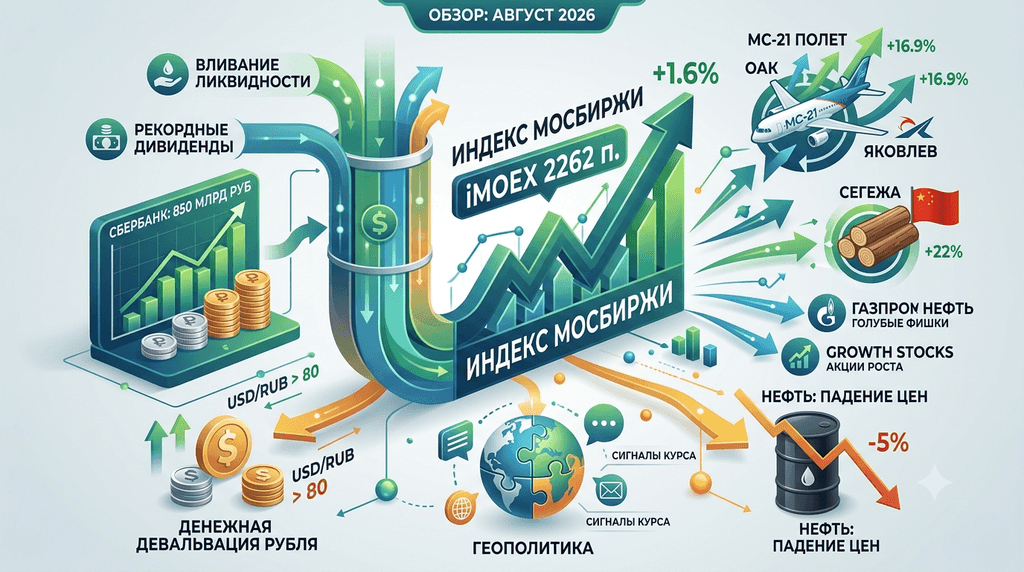
The Russian stock market at the beginning of August 2026 is demonstrating strong upward momentum, driven by a massive influx of liquidity from record dividend payments. The primary catalyst for this growth is the completion of the payment cycle by Sberbank, which distributed an unprecedented 850.2 billion rubles among its shareholders. According to Moscow Exchange data, the MOEX Index (iMOEX) has already gained over 1.6%, reaching the 2,262-point mark. Investors are actively reinvesting these funds, creating excess demand across a wide range of assets—from classic blue chips to mid-cap stocks with individual growth drivers. In this article, we analyze where these dividend flows are being directed, how long the current rally might last, and the risks posed by the persistent geopolitical background and falling oil prices.
Where is the Market Liquidity Coming From and When Will it Peak?
The main source of capital inflow into the Russian market in August 2026 is the dividends from major blue-chip companies, dominated by Sberbank's record payout of 37.64 rubles per share. Sber's total distributed profit reached 850.2 billion rubles, marking a historical high for the Russian banking system. Under current legislation and National Settlement Depository (NSD) regulations, funds typically reach brokerage and custodial accounts within 10 to 18 business days after the record date, which was July 20, 2026. This means the bulk of the liquidity began entering the market in the first week of August, establishing a powerful base for new purchases.
Based on an analysis of previous payment periods, experts from Finam and BCS expect that between 15% and 25% of the total dividend volume will be reinvested back into equities. In monetary terms, this represents approximately 130 to 210 billion rubles, comparable to a full week's trading turnover on the entire Russian stock market. In addition to Sberbank, the market is being fueled by payments from Gazprom Neft and several energy sector companies that closed their registers in mid-July. The arrival of funds is occurring in stages, which helps smooth volatility while providing consistent support to quotes even amid a negative external environment.
It is important to note that the reinvestment structure in 2026 has undergone changes. While investors previously preferred returning funds to the same companies that paid the dividends, there is now a noticeable rotation of capital toward growth stocks and companies benefiting from import substitution. Nevertheless, Sberbank remains a favorite for conservative strategies, as the bank's high yield and stable financial performance make it a defensive asset during uncertain times. The peak of fund arrivals is expected by August 15, after which the "dividend fuel" factor will gradually begin to fade.
Which Specific Stocks are Receiving Capital Inflows and Why are Some Seeing Anomalous Surges?
Market capital in early August is being distributed unevenly, focusing on companies with strong fundamental news and sectors showing success in technological sovereignty. The most impressive growth has been seen in the aviation sector: United Aircraft Corporation (UAC/OAK) soared by 16.92%, while Yakovlev jumped by 15.33%. The reason for this rally was the first flight of the fully import-substituted serial MC-21 airliner, which took place on August 3, 2026. According to official reports from Rostec, the aircraft spent 83 minutes in the air, confirming the functionality of all domestic systems, including PD-14 engines and onboard electronic equipment. This event served as a powerful catalyst for investors seeking long-term ideas in the real sector of the economy.
In parallel with aviation, the timber holding Segezha Group demonstrated anomalous dynamics, with its shares rising by more than 22% in a single trading day. This was driven by a "short squeeze" effect—the forced closing of short positions following positive news about a joint project with Chinese partners. According to published data, the company plans to build a major biochemical complex in Siberia focused on deep wood processing and exporting high-margin products to China. Given Segezha's high debt load in the past, the news of the partnership with China was perceived by the market as a signal of the company's financial recovery.
Other beneficiaries of the liquidity inflow include:
— Gazprom Neft (+6.42%): Investors value the company for its high operational efficiency and generous dividend policy, which remains intact even amid volatile oil prices.
— SFI (Holding ЭсЭфАй) (+9.21%): Growth is driven by expectations regarding the monetization of subsidiary assets and potential new payouts to shareholders.
— Blue Chips: Surgutneftegas (preferred shares) is in demand as a tool for hedging currency risks amid the weakening ruble.
At the same time, traditional oil giants like Rosneft and LUKOIL faced pressure in early August, declining by 0.4% to 0.5%. This is due to a sharp drop in global Brent and WTI oil prices by more than 4-5%. The price decline was triggered by diplomatic signals from Washington: the Donald Trump administration stated a priority for diplomatic methods in relations with Iran, which reduced the geopolitical risk premium in the Middle East. Thus, the dividend support in the oil sector was neutralized by the negative situation in commodity markets.
How Sustainable is the Current Technical Rebound of the MOEX Index?
The technical picture of the MOEX Index (iMOEX) at the beginning of August 2026 points to a local success for buyers, although the medium-term trend remains downward. The index successfully tested the psychologically important support level of 2,200 points, forming a "double bottom," which served as a signal for speculative players to enter. The current value of 2,262 points confirms the strength of the rebound, but for a full reversal, the market needs to overcome key resistance around 2,330 points, where the 50-day moving average is located.
According to technical analysis, the current movement can be classified as a "dividend rally" within a bearish cycle that began in mid-March. The downward trend line is still above current quotes, and without additional fundamental drivers (such as a de-escalation of the conflict or a sharp rise in commodity prices), the market could face a new wave of selling once the dividend liquidity is fully absorbed. Support and resistance levels for August 2026 are distributed as follows:
— Support 1 (2,200 pts): A critical level that must be held to maintain optimism.
— Support 2 (2,150 pts): The year's low; a break below this would open the path to 2,000 points.
— Resistance 1 (2,330 pts): The 50-day average zone, where profit-taking by large players is expected.
— Resistance 2 (2,400 pts): A psychological milestone and the upper boundary of the downward channel.
Investors should exercise caution: trading volume during the rebound remains moderate, indicating the dominance of private investors over institutional ones. In the absence of non-residents in the market, volatility could rise sharply with any changes in the news background. Therefore, the technical rebound is currently viewed by experts as an opportunity for portfolio rebalancing rather than the start of a new "bullish" cycle.
How are Ruble Devaluation and Geopolitical Signals Affecting Stock Quotes?
The weakening of the national currency is the second most significant factor in the growth of the Russian stock market in August 2026, creating favorable conditions for exporting companies. The official US dollar exchange rate surpassed the 80-ruble mark for the first time since April, and the yuan-to-ruble rate rose by nearly 2%, exceeding the 12-ruble level. For the Russian stock market, where oil and gas, metallurgical, and chemical companies hold a significant share, a weak ruble means an increase in ruble-denominated revenue and, consequently, potential for future dividends. This "currency hedging" mechanism through stock purchases allows investors to protect their savings from inflation.
From a geopolitical perspective, the market in early August received several moderately positive signals that supported buying sentiment. Statements by American politicians, particularly Marco Rubio, regarding the possibility of resuming negotiations between Russia and Ukraine in the coming weeks, created hope for reduced sanctions pressure in the long term. Although professional market participants treat such statements with skepticism, they served as a reason for private investors to close short positions. The psychological support from "expectations of peace" overlaps with excess liquidity, creating a synergy effect.
However, the other side of the coin must also be considered:
-
Inflationary Risks: Ruble devaluation will inevitably lead to higher inflation, which may force the Bank of Russia to maintain a high key interest rate for a longer period. This makes bonds and deposits serious competitors to stocks in terms of yield.
-
Import Costs: For companies dependent on foreign components (even from friendly countries), a weak ruble means rising operating costs. In this context, projects like the MC-21, where the localization level allows for minimizing currency risks, have an advantage.
-
Sanctions Background: Despite diplomatic rhetoric, the risks of new restrictions against the financial sector remain high, which restrains the inflow of long-term investments.
Why are Oil Prices Falling Despite General Optimism in the Russian Market?
The paradoxical situation where the MOEX Index rises amid a collapse in oil quotes is explained by the specifics of the current moment and the redistribution of risks on the global stage. In early August 2026, global WTI oil prices fell by more than 5.7%, and Brent dropped below key support levels. The main trigger was President Donald Trump's decision to abandon an escalation of the conflict with Iran in favor of a diplomatic settlement. The reduction in Middle East tensions instantly removed the "war premium" from oil prices, hitting the quotes of energy companies worldwide.
For the Russian market, this creates a certain dissonance. On one hand, the fall in oil is negative for Rosneft, LUKOIL, and Tatneft, whose shares performed worse than the market in early August. On the other hand, a drop in energy prices globally is often accompanied by a strengthening dollar and a weakening of emerging market currencies, including the ruble. As noted above, the ruble's devaluation to 80 per dollar largely compensates oil producers for the loss in the dollar price of a barrel. According to analyst calculations, at an exchange rate of 80 RUB/USD, the ruble price of oil remains comfortable for budget execution and dividend payments.
Furthermore, the Russian market is now largely isolated from global capital flows, making it less sensitive to correlations that were relevant before 2022. Internal factors—such as the reinvestment of Sberbank dividends and successes in import substitution—now play a much more important role than daily price fluctuations in London or New York. Nevertheless, if the drop in oil prices becomes prolonged and Brent consolidates below $70 per barrel, it will inevitably lead to a revision of profit forecasts for Russian exporters for the second half of 2026.
Should You Invest in Russian Assets on KuCoin?
Amid the volatility of traditional markets and currency restrictions, the KuCoin crypto exchange provides unique opportunities for users to manage capital and access global financial instruments. If you want to use your dividend profits to diversify your portfolio, KuCoin offers a wide range of solutions—from purchasing stablecoins (USDT/USDC) to protect against ruble devaluation to investing in promising blockchain projects.
— P2P Platform: A fast and secure way to exchange rubles for cryptocurrency and vice versa using popular Russian payment systems. This is an ideal tool for moving dividend profits into protective digital assets.
— KuCoin Earn: The opportunity to earn passive income on your crypto assets with yields that often exceed bank deposit rates and the dividend yields of many stocks.
— Access to Liquidity: Unlike local platforms, KuCoin provides access to the global market 24/7, which is critical during periods of high geopolitical turbulence.
— Security and Verification: The platform adheres to high standards of data and fund protection for users, while providing a user-friendly interface.
Join KuCoin 9th Anniversary Trading Campaign
KuCoin is celebrating its 9th anniversary with a special platform campaign filled with exclusive rewards, trading activities, and limited-time offers. Don’t miss the chance to participate and enjoy the benefits as the exchange marks nine years of growth and innovation. Visit the official campaign page now:

Conclusion
Summarizing the situation in the Russian market in August 2026, it can be stated that we are witnessing a classic "liquidity rally," fueled by record payments from Sberbank and other industry leaders. The arrival of over 850 billion rubles into the system has created a powerful impulse that allowed the MOEX Index to bounce off the bottom and begin its ascent toward new targets. Successes in the real sector, such as the flight of the import-substituted MC-21 and Segezha's new projects with China, add fundamental stability to the market and attract investor attention to mid-cap stocks.
However, one must not forget the risks that continue to weigh on the market. The fall in global oil prices and persistent geopolitical uncertainty require a balanced approach and thorough diversification from investors. The ruble's weakening to 80 per dollar, while supporting exporters, carries inflationary threats that could lead to tighter monetary policy. In these conditions, the most effective strategy appears to be a combination of reliable Russian dividend stocks with digital assets on global platforms like KuCoin. The current rise is a good opportunity for profit-taking in overbought papers and searching for new growth points that will form as the dividend mass is absorbed by mid-August.
Frequently Asked Questions (FAQs)
1. Exactly when will Sberbank dividends reach the accounts of private investors?
Typically, the process of transferring funds takes 10 to 18 business days after the record date (July 20, 2026). Thus, most investors will see the funds in their brokerage accounts between August 3 and August 14. The timing may vary slightly depending on the specific broker and depository.
The explosive growth of these shares is linked to the successful first flight of the fully import-substituted serial MC-21 aircraft on August 3. This event confirms the technological independence of Russian aircraft manufacturing and clears the way for mass deliveries to airlines, radically improving the financial prospects of Rostec group companies.
3. How will falling oil prices affect the future dividends of Russian companies?
The direct impact is negative, as dollar revenue decreases. However, the current ruble devaluation (rate above 80 per dollar) largely compensates for this fall. If the ruble price of oil remains above 6,000–6,500 rubles per barrel, companies will be able to maintain high payouts. The critical factor will be the duration of the low-price period for Brent.
A short squeeze is a situation where a sharp rise in price forces traders betting on a decline (short positions) to buy back shares en masse to close their losses, which accelerates the price surge even further. In Segezha's case, the trigger was news of a large-scale project with China, which refuted the market's negative expectations regarding the company's financial stability.
5. Will the reinvestment of dividends help the MOEX Index overcome 2,330 points?
The chances of this are high, as the potential reinvestment volume is estimated at 130–210 billion rubles. This liquidity is sufficient to break through resistance in the absence of new geopolitical shocks. However, to consolidate above 2,330 points, the market will need support from oil prices or further ruble weakening that increases the valuation of exporters.
Disclaimer : This material is provided for informational purposes only and does not constitute financial, investment, legal, or tax advice. Transactions involving cryptocurrencies and tokenized assets carry substantial risks — including price volatility, limited liquidity, counterparty exposure, and the potential for total loss of invested capital. Readers should conduct their own research and, where appropriate, consult a qualified professional before making any financial decisions.