

Russian Stock Market Growth Slowed: How Geopolitical Expectations, Oil, and the Central Bank Rate Affect the MOEX Index
Introduction
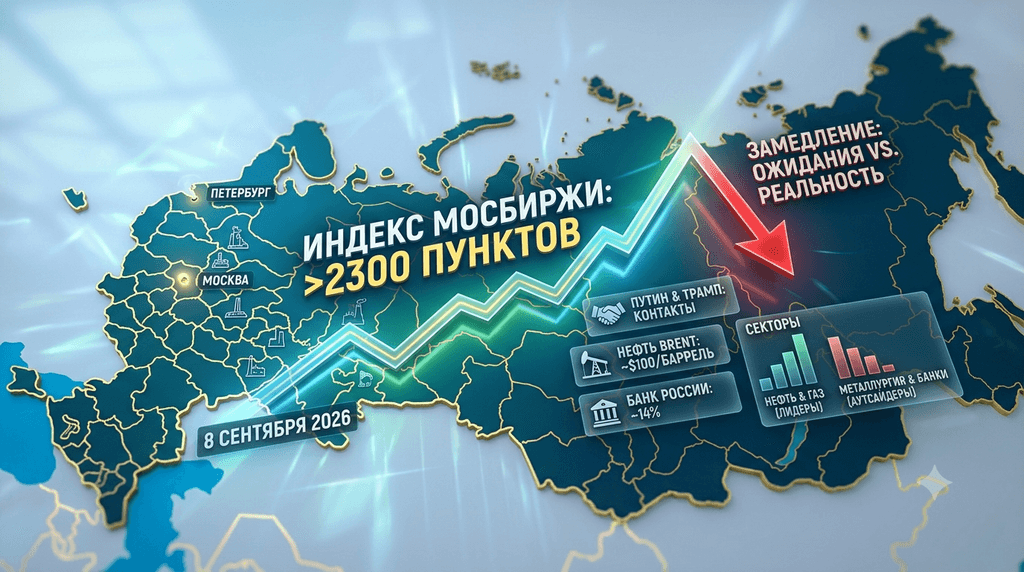
Why can the Russian market gain more than 1.5% during a trading session and then give back almost all of that advance? The MOEX Index showed exactly this pattern on September 8, 2026: it first moved above 2,300 points and then ended the main trading session near 2,267–2,274 points. According to Business Online and the RBC article published on Dzen on September 8, 2026, investors quickly reassessed their hopes for a diplomatic breakthrough after the phone call between Vladimir Putin and Donald Trump.
The main conclusion is clear: the Russian stock market slowed not because all positive factors disappeared, but because geopolitical optimism was insufficiently confirmed. High oil prices and expectations surrounding the Bank of Russia’s key rate decision continued to support prices, but traders became more cautious. As a result, the MOEX Index retained an upward bias, while the market shifted from an emotional surge to a search for concrete signals.
Why Did the MOEX Index Slow After a Strong Start?
Growth slowed because investors began taking profits after new political news failed to provide clear confirmation of an imminent settlement. According to Business Online, the MOEX Index gained more than 1.5% during the September 8 session and moved above 2,300 points for the first time since August 12, 2026. By 5:56 p.m. Moscow time, it had already fallen 0.09% to 2,267.15 points.
Finam reported a similar pattern in its September 8, 2026 publication. At the close of the main session, the MOEX Index had risen 0.37% to 2,274.08 points, while the RTS Index gained 0.04% to 828.45 points. Trading volume totaled 66.6 billion rubles. During the evening session, IMOEX2 added another 0.28%.
The difference between the intraday high and the final result shows that the market was responding not only to fundamental factors, but also to changing expectations. Before details of the presidents’ conversation were published, market participants may have priced in faster diplomatic progress. Once the information emerged, it became clear that the conversation was constructive but confidential, and that no specific timetable or parameters for the next step had been announced.
That is why the geopolitical impulse proved short-lived. For the index to rise sustainably, the market needs more than positive statements—it needs confirmed actions, such as new negotiations, agreed decisions, or changes in external economic conditions. Until such confirmation appears, traders are likely to close part of their profitable positions.
How Did the Putin–Trump Phone Call Affect Russian Stocks?
The conversation supported the market on expectations of improved relations, but it did not become an independent driver of a long-term rally. According to Finam on September 8, the presidents of Russia and the United States spoke for about an hour. Russian presidential aide Yuri Ushakov said the conversation was constructive and candid, but confidential. The two sides discussed the results of Steve Witkoff’s and Jared Kushner’s trips to Moscow and Kyiv on September 5–6 and agreed to remain in contact.
These reports initially increased demand for Russian stocks. Investors may have assumed that the restoration of political dialogue could eventually improve trading conditions, reduce some external risks, and expand opportunities for individual companies. However, the market received no numerical or calendar-based reference point that would allow it to assess the probability of this scenario.
Citing analysts, Business Online noted that a sustainable rise in the index toward 2,500 points would be possible only with real progress in the negotiations. This is an important distinction between expectation and fact. Expectations can drive short-term price movements, while confirmed progress can change assessments of companies’ future cash flows and risk premiums.
The reports also mentioned a possible resumption of trilateral negotiations and Steve Witkoff’s statement that substantial progress had been made. According to analysts, the market is responding to such signals more cautiously than it did a year earlier: traders already factor in the risk that high-profile political statements may not produce quick results.
Which Stocks Were the Leaders and Laggards?
The leaders on September 8 were mainly oil, commodity, and selected export-oriented companies, while the metals and banking segments came under pressure. According to Finam, Tatneft common shares rose 3.56%, preferred shares gained 3.09%, Surgutneftegas advanced 3.24%, ALROSA increased 1.91%, and Nornickel rose 1.33%.
According to the RBC material published on Dzen, by 6:20 p.m. Moscow time, common shares of Surgutneftegas and Tatneft were up about 3%, Tatneft preferred shares had gained 2.5%, ALROSA had risen 1.6%, and Nornickel was up 1.1%. The minor differences between the publications reflect different quotation times.
The metals sector was the weakest area. Finam recorded declines of 3.4% for MMK, 2.47% for Severstal, 2.4% for Sovcombank, 2.16% for NLMK, and 1.9% for Novatek. In the RBC publication, as of 6:20 p.m. Moscow time, MMK was down 3.06%, Sovcombank had fallen 2.55%, Novatek had declined 2.38%, and PhosAgro had dropped 2.12%.
This uneven performance shows that the market did not move as a single unit. Demand was concentrated in stocks that could benefit from commodity prices, currency movements, or company-specific factors. By contrast, shares of companies sensitive to domestic demand, the cost of money, and economic-cycle expectations performed more weakly.
Finam separately noted that PIK shares fell 0.54%. The company announced plans to leave the exchange, while the mandatory buyout was expected to take place at 551.4 rubles, according to the publication. The Moscow Exchange planned to halt trading in PIK shares from October 20, with October 15 expected to be the final trading day in the T+1 order book. This example shows that index movements do not eliminate corporate events capable of determining the price of an individual stock.
How Did Oil and the Currency Market Support Russian Prices?
Oil became the main external offset to weakening geopolitical optimism. According to Finam on September 8, Brent futures rose 0.48% to $97.47 per barrel, while WTI gained 0.85% to $92.26. Finam and the Dzen article also noted that oil prices temporarily exceeded $99 per barrel.
Commodity prices were supported by reports of attacks by Iran-backed Houthi forces on energy facilities in Saudi Arabia. Finam relayed the position of Saudi authorities, according to which the attacks affected economic facilities and several cities, while operations at some energy facilities were temporarily halted. These reports are relevant to the market, but they remain source-attributed statements and should not be treated as independent confirmation of a long-term supply deficit.
According to the same Finam publication, Goldman Sachs raised its year-end 2026 Brent forecast to $85 per barrel and its WTI forecast to $80. If supply disruptions continued, the bank allowed for prices above $120 in 2027. This is a forecast scenario rather than an already achieved level, so it should be used only as a reference point for assessing risk.
On the Moscow Exchange currency market, the yuan fell 1.05% against the ruble to 12.757 rubles. Dmitry Babin, a stock-market expert at BCS World of Investments, cited by Finam, said the currency market was forming an equilibrium: weaker geopolitical influence and the exit from foreign-currency positions were offsetting weak exports and high imports. The publication gave a short-term consolidation range of 12.7–13 rubles for CNY/RUB.
The combination of expensive oil and a stronger ruble has mixed effects. Commodities support exporters’ revenue and budget expectations, while a stronger ruble can limit the ruble value of revenue for companies that earn a significant share of their income in foreign currency. Investors should therefore assess not only Brent prices, but also CNY/RUB dynamics, export volumes, and corporate expenses.
Why Does the Bank of Russia’s Decision Remain a Key Factor?
The Bank of Russia’s key-rate decision could determine the market’s next phase more strongly than individual political statements. According to Finam, the central bank’s board meeting was scheduled for September 11, 2026, while the market expected the rate to remain at 14%. Business Online and Dzen also identified the meeting as the nearest major event for investors.
Keeping the rate unchanged would support a scenario of cautious financial easing without sending a decisive signal that inflation has been defeated. For stocks, this could be moderately positive if the decision matches expectations and does not intensify concerns about rising prices. However, high borrowing costs continue to restrict demand for debt financing, investment, and shares of companies that are especially sensitive to interest expenses.
That is why the market carefully distinguishes between the decision itself and the regulator’s commentary. An unexpected rate cut could increase demand for stocks, but it would also require investors to assess inflation risks. Keeping the rate unchanged could trigger short-term profit-taking if investors had already priced in a softer scenario. In both cases, the future path of policy matters more than the headline alone.
The external backdrop is also linked to Federal Reserve policy. According to Finam, traders estimated the probability of a U.S. rate hike in September at roughly 60% after a stronger-than-expected labor-market report. On September 8, U.S. indexes moved in different directions: the S&P 500 fell 0.4%, the Dow Jones declined 1.09%, and the Nasdaq rose 0.17%. The DXY dollar index fell 0.28% to 98.9 points. These figures come from Finam’s September 8 publication and show that the Russian market was developing against a mixed global backdrop.
What Could Support or Limit Further Growth?
Sustained further growth is possible only if several factors improve at the same time: concrete progress in negotiations, continued high oil prices, a predictable central-bank decision, and no new deterioration in external restrictions. Each factor can support the market, but none can guarantee growth on its own.
The positive scenario assumes that diplomatic contacts develop into a confirmed negotiation process. In that case, the geopolitical risk premium could decline, giving investors grounds to reassess companies sensitive to foreign trade and access to capital. Under this scenario, the forecast by Mikhail Zeltser of a potential move toward 2,500 points, cited by Business Online and Dzen, would become a more meaningful reference point.
The neutral scenario means that the current range remains in place. Geopolitical news would trigger sharp but short-lived impulses, while most trading would revolve around the key rate, the ruble, oil, and corporate reports. According to Finam, on September 9 investors were expected to monitor Sber’s eight-month results and the decision by Yandex shareholders on dividends.
The negative scenario involves renewed escalation, lower commodity prices, stronger sanctions pressure, or tougher rhetoric from central banks. In that case, even strong individual stocks would not fully offset a rise in the overall risk premium. Traders should remember that an intraday high above 2,300 points and a close near 2,270 points are not the same thing: the market has already shown how quickly sentiment can change.
Beyond the Headlines: What KuCoin 5.0 Means for You
Market news moves fast — but where you act on it matters just as much. This October, KuCoin launches KuCoin 5.0, transforming KuCoin into a rebuilt platform. Here's what actually changes for you:
-
One account for everything. Older platforms split your money across separate "spot," "margin," and "futures" accounts and expected you to understand why. KuCoin 5.0's unified account removes that entirely — deposit once, and everything is simply there.
-
Stocks, indices, and commodities. KuCoin 5.0 expands beyond crypto into global markets. When crypto chops sideways and equities rally (or the reverse), you rotate in minutes instead of opening a brokerage account and waiting days for fiat rails.
-
Real-world assets (RWA). Tokenized exposure to traditional assets like commodities, right inside your crypto account. One of the fastest-growing segments in global finance is no longer reserved for institutions — you access it from the same balance you trade with.
-
Earn while you learn. Not ready to trade? KCUSD lets your stablecoins earn daily, auto-compounding interest. The lowest-stress way to put your idle deposit to work for 4% yield.
-
An AI assistant in plain language. Ask questions, get market context, understand what you're looking at — built into the platform, no jargon required.
-
An app that doesn't overwhelm. Faster, cleaner, and consistent — intuitive from the first tap, not after a tutorial.
-
Safety you can check, not just trust. A MiCAR-licensed EU entity, Proof of Reserves you can verify yourself, and internationally certified security (SOC 2 Type II, ISO 27001:2022).
Create your account in minutes — and start on the platform built for where crypto is going, not where it's been.
Conclusion
The Russian stock market did not enter a full bear trend on September 8, 2026, but it did reveal the limits of geopolitical optimism. The MOEX Index initially rose more than 1.5% and moved above 2,300 points before falling back toward 2,267–2,274 points. According to Finam, Business Online, and the RBC material published on Dzen, the slowdown resulted from a reassessment of expectations after the phone call between Vladimir Putin and Donald Trump. The conversation was constructive, but it did not provide a concrete plan that the market could quickly price in.
Stocks continued to receive support from oil near $97–$99 per barrel, a stronger ruble, and hopes for renewed negotiations. At the same time, high interest rates, uncertainty surrounding sanctions, and uneven sector performance limited the overall advance. Tatneft, Surgutneftegas, ALROSA, and Nornickel were among the leaders, while MMK, Severstal, Sovcombank, and other stocks declined.
The market’s next direction will depend on three verifiable signals: the Bank of Russia’s decision on September 11, oil-price behavior, and real progress in foreign-policy dialogue. For now, the market remains highly sensitive to news and requires discipline rather than an unconditional bet on a rapid rally.
Frequently Asked Questions
1. Can the MOEX Index rise above 2,300 points again?
Yes, it can, if confirmed progress is made in the negotiations, the rate decision is favorable, and oil continues to provide support. An intraday move above 2,300 points alone does not guarantee that the index will hold that level.
2. What Does a Decline After Positive News Mean?
It means that the market may have priced in the news in advance, while the published details failed to provide a new strong impulse. In this situation, participants often take profits, especially after a rapid intraday rise.
3. Why Is the Yuan Exchange Rate Important for Russian Stocks?
The yuan exchange rate affects the ruble value of export revenue, import costs, and the overall assessment of currency risk. However, its impact differs by company, so CNY/RUB should not be used as the only signal for buying stocks.
4. How Does the Geopolitical Risk Premium Affect Company Valuations?
The greater the uncertainty, the higher the return investors demand for holding an asset. This reduces their willingness to pay a high price for shares. If risk declines, valuations may rise, but only if expectations are confirmed by real changes.
5. What Data Should Investors Track After the Bank of Russia Meeting?
Investors should monitor not only the key-rate decision, but also comments on inflation, demand, lending, and the future policy path. The ruble, oil prices, trading volumes, and the performance of the most liquid stocks are also important.
Disclaimer : This material is provided for informational purposes only and does not constitute financial, investment, legal, or tax advice. Transactions involving cryptocurrencies and tokenized assets carry substantial risks — including price volatility, limited liquidity, counterparty exposure, and the potential for total loss of invested capital. Readers should conduct their own research and, where appropriate, consult a qualified professional before making any financial decisions.