

Russian Banking Sector Profit Rose to RUB 443 Billion in July 2026: The Role of Provisions, Lending, and Deposits
2026/08/26 12:06:00
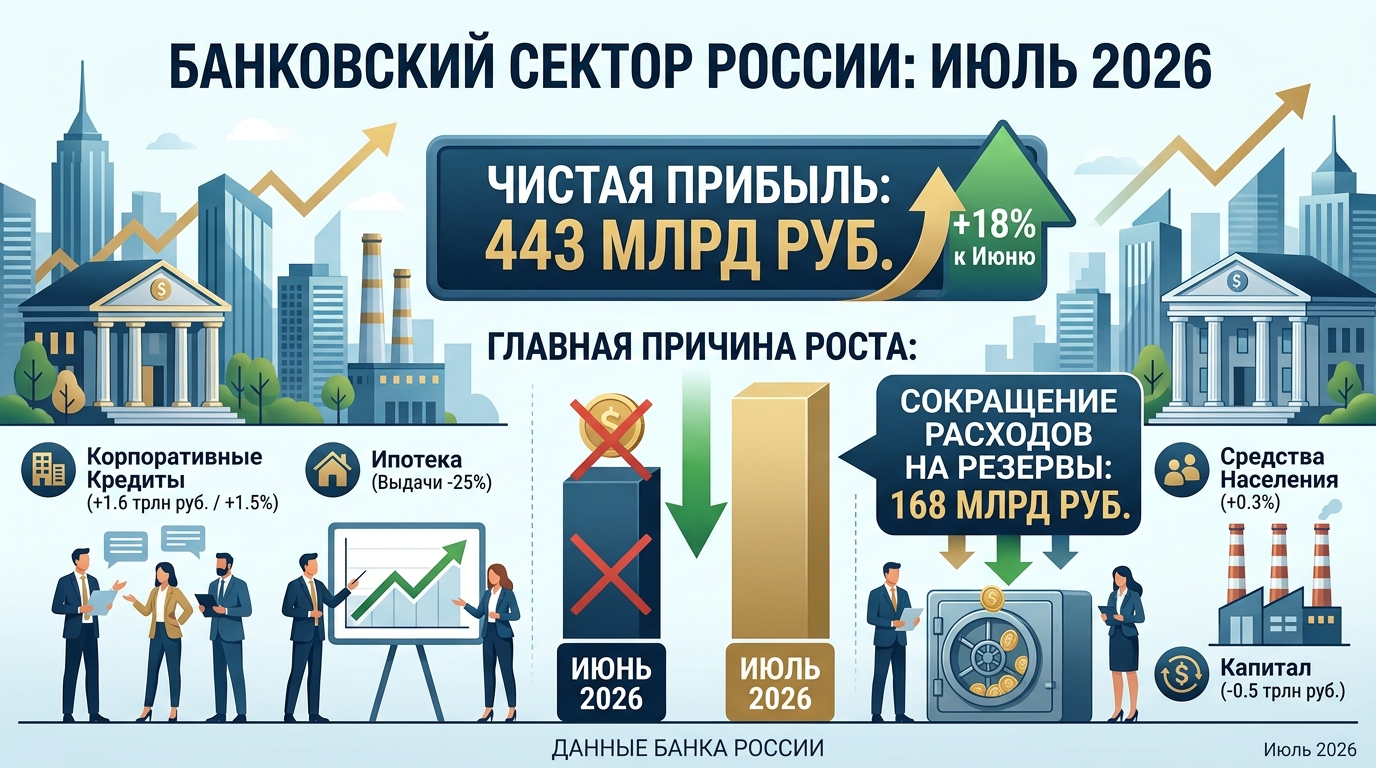
In July 2026, the Russian banking sector generated RUB 443 billion in net profit, 18% more than in June. The main reason for the increase was not a sharp acceleration in recurring income, but lower provisions for impaired assets: they fell by RUB 114 billion, or 40%. The strong monthly result should therefore be read primarily as the effect of lower credit costs, rather than as evidence that all risks in the banking system have disappeared.
At the same time, the Bank of Russia report presents a more complex picture. Corporate financing accelerated significantly, while mortgage lending and subsidized mortgage originations cooled, and household deposits grew only modestly. Banks also accrued around RUB 0.9 trillion in dividends, which reduced their balance-sheet capital by RUB 0.5 trillion during the month despite the profit earned. These factors explain why one high profit figure cannot be assessed separately from provisions, capital, loan quality, and funding sources.
Why Did Banking Sector Profit Rise to RUB 443 Billion in July 2026?
Profit increased mainly because banks allocated substantially less to cover expected credit losses. According to the Bank of Russia, sector net profit reached RUB 443 billion, rising by RUB 68 billion, or 18%, from June. Core profit totaled RUB 442 billion and increased by RUB 98 billion, or 28%. The difference between these growth rates matters: the net result did not rise because of one universal income source, but because a specific expense item declined.
Provisions for impaired assets fell from RUB 282 billion in June to RUB 168 billion in July. In absolute terms, that was a RUB 114 billion decrease; in relative terms, a 40% decline. The corporate segment made the largest contribution: its provisioning expenses decreased by RUB 103 billion, or 77%. The regulator noted that some banks were able to release previously established provisions after certain borrowers updated their business plans to reflect higher revenues.
This effect represents a reassessment of part of the risk recognized earlier, rather than an automatic improvement in every portfolio. To evaluate the sustainability of earnings, it is important to distinguish this effect from recurring income and financial-instrument revaluations.
|
July 2026 Indicator
|
Value
|
Change from June
|
What It Shows
|
|
Sector net profit
|
RUB 443 billion
|
+18%
|
A strong monthly financial result
|
|
Core profit
|
RUB 442 billion
|
+RUB 98 billion, +28%
|
Growth before the impact on capital
|
|
Provisioning expenses
|
RUB 168 billion
|
-RUB 114 billion, -40%
|
The main driver of profit growth
|
|
Total financial result
|
RUB 422 billion
|
Higher than in June
|
Includes the impact of capital revaluation
|
|
Negative revaluation of debt securities
|
RUB 21 billion
|
Lower than in June
|
Reduced the final result, but was substantially smaller than a month earlier
|
What Does a 40% Decline in Provisioning Expenses Mean?
A 40% decline in provisioning expenses means that banks recognized a significantly smaller volume of expected credit losses in July than in June. Provisions are a financial cushion that a bank builds in advance when it assesses the risk that issued loans may not be fully repaid. The higher the expected risk, the larger the share of current profit directed to a reserve. If the risk assessment declines or a borrower's condition improves, part of that burden may be reduced or released.
A loan-loss provision is not an actual loss at a given moment. It is an accounting and risk-management estimate of potential losses on a borrower's obligation.
The July review primarily concerns corporate loans. Banks reduced provisioning expenses in this segment by RUB 103 billion, while some borrowers updated their business plans to reflect higher revenue. This gave banks grounds to reassess part of the reserves that had been established earlier. According to the regulator, this adjustment was the main contributor to the monthly increase in profit.
Lower provisions do not mean that problem loans have disappeared. In the latest corporate asset-quality assessment for June, the share of problem loans rose to 11.8%. As of August 1, 13.1% of unsecured retail loans and 2.0% of mortgages were classified as problem loans. These portfolios have reserve and collateral coverage, but the risks remain relevant to future earnings.
The correct conclusion is therefore that the July result improved because less new provisioning was needed and some existing reserves were released, not because credit risk disappeared altogether. Results in subsequent months will depend on borrower payment discipline, the resilience of corporate sectors, funding costs, and the quality of restructured loans.
What Role Did Securities Revaluation and Non-Core Income Play?
Securities revaluation supported the total financial result relative to June, but it was not the main source of net profit. The banking sector's total financial result amounted to RUB 422 billion, RUB 21 billion below net profit. The gap was caused by a RUB 21 billion negative revaluation of debt securities, which is recognized directly in capital rather than in ordinary profit for the period.
The comparison with June is more important: negative revaluation then totaled about RUB 140 billion. The July revaluation loss was materially smaller, so pressure on capital eased. The regulator linked the June movement to the market revising expectations toward a more cautious easing of monetary conditions over the next one to two years. In July, this factor became less severe, although negative revaluation did not disappear entirely.
Non-core income, by contrast, did not support the profit increase. According to the Bank of Russia, it declined by RUB 46 billion, or 31%, primarily because dividend income from subsidiaries and affiliates was lower. This is an important correction to the common assumption that the July result was driven by one-off income: in this case, non-core income was falling, while the leading driver was lower provisioning expenses.
Consequently, net profit, the total financial result, and non-core income should not be conflated. They are indicators with different economic meanings and different degrees of sustainability.
Why Did Bank Capital Decline Despite High Profit?
Banks' balance-sheet capital declined because accrued dividends exceeded the positive effect of the July financial result. With a total financial result of approximately RUB 0.4 trillion, the sector lost RUB 0.5 trillion of balance-sheet capital during the month, or 2.3%, and ended July with RUB 21.8 trillion. Individual banks accrued dividends totaling around RUB 0.9 trillion.
To understand the mechanism, it is important to distinguish profit earned from the decision to distribute that profit to owners. Profit can increase capital if it remains in the bank. Once large dividends are accrued, however, part of accumulated capital leaves the bank. The regulator's chart shows that current-year profit added RUB 443 billion, accrued dividends reduced capital by RUB 912 billion, and securities revaluation contributed another negative RUB 21 billion.
According to the Bank of Russia's preliminary data, the N1.0 total capital adequacy ratio fell by 0.5 percentage points to 13.5%. Regulatory capital decreased by 2.8% as a result of dividend payments, while risk-weighted assets increased by 1.3% due to lending expansion. This does not negate the 16.5% year-on-year growth in balance-sheet capital, but it shows why, during periods of active investor payouts, retained earnings matter as much as profit itself.
The report does not show an automatic weakening of the sector; rather, it shows a redistribution of results. Positive profit was smaller than the large dividend distribution. Capital adequacy, risk-weighted assets, and profit-distribution policy are therefore key factors to monitor.
What Does July's Corporate and Retail Lending Trend Show?
July lending displayed a two-speed pattern: corporate financing accelerated, while the mortgage market cooled noticeably after a June spike. Bank claims on companies, including investments in corporate bonds, increased by RUB 1.6 trillion, or 1.5%, compared with 0.4% in June. Their volume reached RUB 109.9 trillion, and the annual growth rate accelerated to 13.8%.
Ruble-denominated corporate loans increased by RUB 1.4 trillion, or 1.5%, to RUB 102.9 trillion. Around 30% of the portfolio increase came from the largest state-owned companies, while the remainder was distributed among borrowers in different industries. Banks' investments in corporate bonds also increased by RUB 0.2 trillion, primarily because certain loan transactions were restructured.
This does not mean that all growth came from private investment demand. The material contribution of the largest state-owned companies and the technical effect of restructuring require caution in interpretation. Nevertheless, faster corporate portfolio growth expands banks' income base while also increasing the importance of credit-quality control, because rising risk-weighted assets already contributed to the decline in N1.0.
Why Did Mortgage Originations Fall 25% While Mortgage Debt Continued to Grow?
Mortgage originations fell 25% month on month in July, to RUB 363 billion from RUB 483 billion in June. Yet the outstanding mortgage balance still grew by 0.4% and reached RUB 24.7 trillion. This combination is possible because the portfolio reflects loans already issued and not yet repaid, whereas originations reflect only the new monthly flow.
The cooling resulted from the postponement of tighter family mortgage terms. In June, the market accelerated in anticipation of the changes; after the delay, demand returned to a more moderate path. The share of subsidized programs in July originations declined to 52% from approximately 65% a month earlier, the lowest level since mid-2023. Family mortgage originations totaled RUB 154 billion, compared with RUB 288 billion in June.
Market-rate mortgages, by contrast, rose to RUB 175 billion from RUB 162 billion. However, the average rate on market-rate loans issued in July remained around 18% per year. Therefore, the growth of the market segment does not change the overall conclusion: mortgage affordability in July was shaped both by the parameters of government programs and by the still-high cost of unsubsidized borrowing.
What Happened in Consumer Lending?
Consumer lending continued to grow, although its pace slowed slightly. According to the regulator's preliminary data, the unsecured consumer loan portfolio increased by 1.1%, following 1.3% growth in June, and reached RUB 13.0 trillion. Cash loans supported growth, while the credit-card segment also expanded, although more slowly than a month earlier. Auto lending grew 0.9% after increasing 0.1% in June.
For banks, this segment can be more profitable, but it requires stricter risk assessment than collateralized mortgages. The acceleration of unsecured lending should therefore be considered together with the level of problem retail loans and their reserve coverage, rather than as an unambiguously positive signal.
What Changed in Household and Corporate Deposits?
Client funds at banks grew moderately, with the main shift occurring among corporate rather than household clients. Excluding escrow accounts, client funds increased by RUB 0.6 trillion, or 0.5%, to RUB 133.3 trillion. Ruble balances rose by RUB 0.6 trillion, while foreign-currency balances increased by only RUB 40 billion in ruble equivalent.
Household funds rose by RUB 0.2 trillion, or 0.3%, to RUB 68.4 trillion, the same pace as in June. The Bank of Russia attributed the restrained trend to stronger consumer activity and sustained demand for cash. Cash in circulation increased by RUB 0.7 trillion in July after rising by RUB 0.5 trillion in June. Ruble balances held by households rose by RUB 0.3 trillion through current accounts, while foreign-currency balances declined by RUB 45 billion in ruble equivalent.
Corporate funds rose by RUB 0.4 trillion, or 0.6%, to RUB 64.9 trillion after nearly flat movement in June. The regulator attributed this growth mainly to exporting companies, and it occurred despite substantial dividend payments. This distinguishes corporate funding from retail funding: corporate dynamics depended more heavily on export cash flows, whereas household dynamics depended on consumption, savings preferences, and demand for cash.
Slower household deposit growth does not mean that banks lost funding. Client funds increased, while the coverage of those funds by ruble liquid assets stood at 20.4%. Including additional non-market collateral, the ratio reached 29.3%.
What Conclusions Should Bank Customers and Market Participants Draw From the Report?
The central conclusion is that high July profit reflects a combination of lower provisioning expenses and active corporate lending, rather than one uniformly sustainable rise across all bank income streams. Assessing the sector's resilience requires simultaneous attention to loan quality, future provisioning needs, capital after dividends, and the pace of funding growth.
The first common misconception is that lower provisions mean bad loans have disappeared. A more accurate interpretation is that banks reassessed some loss estimates and released certain reserves in July. Risks in problem corporate and retail portfolios still require monitoring. A second misconception is to regard RUB 443 billion as the total effect on capital. For capital, the relevant result was RUB 422 billion, and, more importantly, dividend accruals totaled around RUB 0.9 trillion.
A third misconception concerns deposits: 0.3% growth in household funds is not an outflow. Household funds did increase, but slowly, while the inflow of corporate funds accelerated. For banks, this means balancing credit expansion against available liquidity. For customers, it means assessing product terms based on rate, maturity, deposit-insurance coverage, and personal liquidity needs, rather than relying only on headlines about sector profit.
July's two-speed pattern confirms that regulatory decisions and the parameters of subsidized programs can quickly change demand. Conclusions about the sector should be tied to the period and to the source of growth, rather than to a single month.
KuCoin Offers A More Stable Option in A Volatile Market
If you worry about the frequent ups and downs in the market, and pursue a more stable option to earn money passively, KuCoin is the right place to come:
Simple Earn: Deposit and withdraw tokens anytime, earning stable returns.
Kucoin Earn: Earn stable profits with professional asset management.
Hold to Earn: Earn rewards by holding assets in Funding, Trading, Margin, Futures, Mining, and Unified Accounts.
Staking: Unlock the earning potential of on-chain assets.
Advanced Investments: Advanced Investments offer a variety of structured products to help your money grow in any market.
Shark Fin: Principal Protection and Guaranteed Gains
Dual Investment: Buy low and sell high with transparent return calculations.
Snowball: High yields, with price protection.
Discount Buy: Buy crypto at discount prices.
KCS Loyalty: Level up to enjoy exclusive perks by staking ≥ 1 KCS.
KuCoin Wealth: Discover future value and begin your smart investing journey.
KCS Benefits: Hold and stake KCS to access benefits across the platform.
KCS Staking 2.0: Participate in KCS on-chain governance to earn yield.

Conclusion
The Russian banking sector's RUB 443 billion profit in July was primarily the result of a RUB 114 billion, or 40%, reduction in provisioning expenses. Most of the effect came from the corporate segment, where some banks released part of the reserves created earlier. At the same time, non-core income fell by 31%, so it would be incorrect to explain the result through one-off income.
The monthly picture remains uneven. Negative revaluation of debt securities narrowed to RUB 21 billion and placed less pressure on capital, but large dividends of around RUB 0.9 trillion outweighed the positive financial result, reducing balance-sheet capital by RUB 0.5 trillion. Corporate financing grew by RUB 1.6 trillion, while mortgage originations fell 25% after the June spike. Household funds increased by only 0.3%, whereas corporate funds were supported by exporters.
The conclusion is straightforward: July confirms that banks can generate profit, but it does not remove the need to monitor provisions, credit quality, capital, and the funding structure. A strong result in one month should be assessed in the context of these interconnected indicators, not as a stand-alone signal of the entire system's condition.
Frequently Asked Questions
1. When Did the Bank of Russia Publish Data for July 2026?
The Bank of Russia published its news release and full analytical material on banking-sector developments in July 2026 on August 24, 2026. The report's data cutoff date was August 18, 2026.
2. How Does Net Profit Differ From the Banking Sector's Total Financial Result?
Net profit shows the result that totaled RUB 443 billion in July, whereas the total financial result includes the effect of certain items recognized in capital. In July, it amounted to RUB 422 billion because of a RUB 21 billion negative revaluation of debt securities.
3. Why Did Growth in Market-Rate Mortgages Not Offset the Fall in Total Mortgage Originations?
Market-rate mortgage originations rose from RUB 162 billion to RUB 175 billion, but family mortgage originations fell from RUB 288 billion to RUB 154 billion, while the share of subsidized programs declined to 52%. As a result, total originations decreased to RUB 363 billion.
4. Were Bank Deposits Insured in Russia in July 2026?
Yes. The deposit insurance system applies to insured household funds held at participating banks. However, specific terms and coverage limits should be checked on the Deposit Insurance Agency's website and in the bank agreement because they may change.
5. Can Banking Sector Profit Be Used to Forecast the Ruble Exchange Rate or Cryptocurrency Prices?
No. Bank profit is only one indicator of financial conditions and does not provide a reliable stand-alone forecast for the ruble or crypto assets. Assessing these markets requires separate data on monetary policy, liquidity, foreign trade, market sentiment, and the risks of a specific asset.
Disclaimer : This material is provided for informational purposes only and does not constitute financial, investment, legal, or tax advice. Transactions involving cryptocurrencies and tokenized assets carry substantial risks — including price volatility, limited liquidity, counterparty exposure, and the potential for total loss of invested capital. Readers should conduct their own research and, where appropriate, consult a qualified professional before making any financial decisions.