

Russia Regulates Crypto: Sberbank and VTB Open Bitcoin, Ethereum, and USDT Access to 140 Million Banking Clients
Introduction
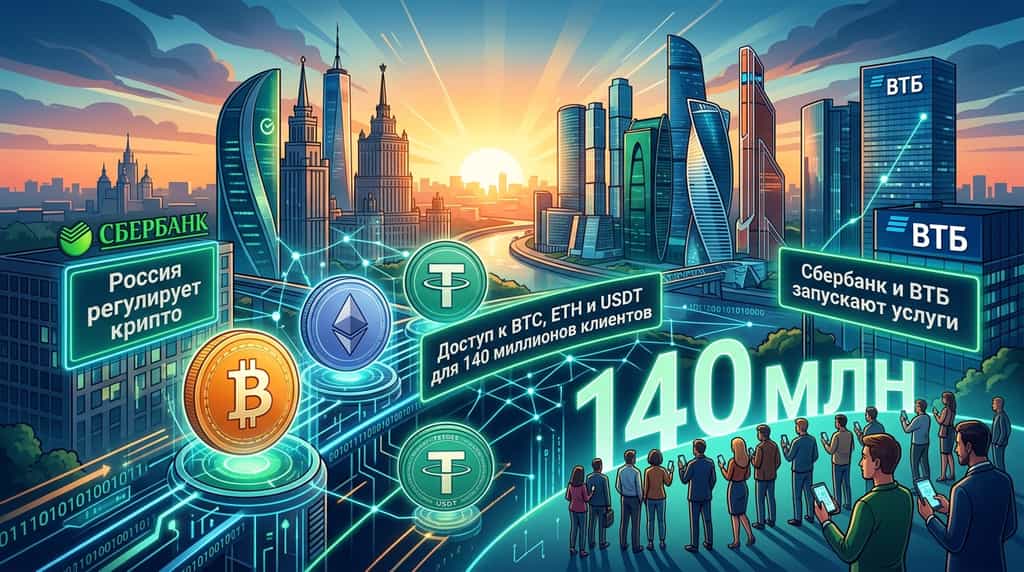
Russia’s retail financial system is undergoing its largest structural shift in decades as state banking giants integrate cryptocurrency trading into their mainstream apps. The Bank of Russia formally included Sberbank and VTB in its newly created official registers of digital asset custodians and exchange operators, enabling more than 140 million combined retail clients to buy, sell, and hold cryptocurrencies directly through their daily banking interfaces. Under the framework signed into law by President Vladimir Putin, Sberbank, with its 110 million retail customers—and VTB—with 31 million clients—will support Bitcoin (BTC), Ethereum (ETH), and Tether (USDT). Testing in Sberbank Online is already underway, targeting a full commercial launch on December 1, while VTB plans to offer crypto trading through its investment portal starting November.
What Is the Sberbank and VTB Cryptocurrency Integration Plan?
Sberbank and VTB are embedding cryptocurrency custody, trading, deposit, and withdrawal services directly into their retail banking applications for over 140 million Russian account holders. Following the Bank of Russia’s regulatory authorization, Sberbank was officially registered as a digital asset custodian, while VTB secured dual approvals as both a custodian and an exchange operator.
The integration roadmap unfolds across several key phases:
-
Regulatory Entry Barriers: According to Bank of Russia regulations, digital depositories must maintain minimum capital thresholds between 50 million and 250 million rubles depending on activity scope, while exchange operators require at least 15 million rubles in equity.
-
Deployment Timeline: VTB is scheduled to open Bitcoin trading features through its VTB Investments app in November. Sberbank began live app testing in October and targets a full rollout on December 1, pending finalized subordinate central bank acts.
-
Supported Digital Assets: Initial retail offerings focus exclusively on the top liquid market assets—Bitcoin (BTC), Ethereum (ETH), and Tether (USDT).
-
Direct Asset Transfers: Unlike closed-loop "paper crypto" models, the banking framework permits transfers to self-custodial external wallets, though withdrawals exceeding 100,000 rubles trigger a mandatory 48-hour cooling-off period.
-
Transition Period: Financial institutions and market operators have until July 1, 2027, to fully align all infrastructure with updated compliance guidelines.
Why Is the Central Bank of Russia Legalizing Bank-Led Crypto Trading Now?
The Central Bank of Russia is legalizing crypto operations through commercial banks to shift volume away from unmonitored peer-to-peer (P2P) platforms and establish controlled channels for domestic capital. Deprived of international financial messaging rails like SWIFT, Russian institutions and retail investors increasingly utilize global liquidity in crypto assets as a reserve tool and alternative wealth store.
By creating a national regulatory perimeter, authorities bring retail trading under strict anti-money laundering (AML) protocols and Know-Your-Customer (KYC) identity verification.
How Does Retail Investor Protection Work Under New Russian Crypto Regulations?
Retail investors operating through Sberbank Online or VTB receive structured legal protections, tiered investment caps, and standardized identity checks. Non-qualified retail investors face an annual purchasing ceiling of 300,000 rubles, preventing unaccredited accounts from over-leveraging into volatile digital assets.
To surpass the 300,000-ruble limit, clients must qualify under central bank wealth rules or complete specialized financial risk assessments administered by the bank. Key investor protections include:
-
State-Monitored Custody: Client funds are stored by regulated institutions holding state licenses, eliminating counterparty risks associated with unregulated offshore exchanges.
-
Standardized Identity Protocols: Accounts operate under verified banking KYC, ensuring all deposits, transfers, and tax obligations maintain transparent legal documentation.
-
Cooling-Off Delays: The mandated 48-hour pause on external transfers over 100,000 rubles acts as a fraud mitigation filter against unauthorized wallet drains and social engineering scams.
-
Transparent Order Matching: VTB and Sberbank interface directly with registered exchange operators, offering clear order execution and narrow bid-ask spreads for BTC, ETH, and USDT.
How Will Sberbank and VTB Crypto Integration Impact Global Market Liquidity?
Bringing 140 million banking customers onto regulated crypto infrastructure creates a major new onboarding funnel for digital asset adoption across Eurasia. While domestic retail trading limits restrict systemic risk, the cumulative volume from Russia's two largest financial institutions is expected to channel substantial fiat liquidity directly into BTC, ETH, and USDT trading pairs.
Market analytics highlight several key macro impacts:
-
Stablecoin Absorption: Integration of USDT within domestic bank apps provides millions of users with a direct dollar-denominated digital hedge, potentially expanding Tether’s circulation in regional cross-border commerce.
-
Shift from Shadow Exchanges: Industry estimates indicate a significant portion of Russia’s historical multi-billion-dollar OTC and P2P crypto volume will migrate directly into bank-custodied ecosystems.
-
Institutional Collateralization: The bank-led infrastructure builds on successful domestic pilots—such as Sberbank’s corporate loan backed by cryptocurrency collateral issued to mining firm Intelion Data—setting a precedent for institutional crypto-backed lending.
What Are the Main Risks and Limitations of Trading Crypto via Russian Banks?
Trading digital currencies through state-supervised financial institutions introduces specific operational trade-offs, privacy constraints, and price exposure factors. While convenience and legal clarity are significantly improved, users must navigate distinct regulatory restrictions.
-
Complete Financial Monitoring: Every buy, sell, and withdrawal order is logged and reported to national tax authorities, entirely removing the transaction privacy native to decentralized networks.
-
Regulatory Dependency: Sberbank's full retail rollout targeted for December 1 remains explicitly contingent on the Bank of Russia issuing final subordinate acts on schedule.
-
Asset Price Volatility: Bank custody does not shield investors from underlying market swings; Bitcoin and Ethereum remain highly volatile risk assets subject to global macro sentiment.
-
Operational Limits on Self-Custody: Transferring crypto to private hardware wallets requires passing compliance checks and navigating mandatory transaction delay timers.
Beyond the Headlines: What KuCoin 5.0 Means for You
Market news moves fast — but where you act on it matters just as much. This October, KuCoin launches KuCoin 5.0, transforming KuCoin into a rebuilt platform. Here's what actually changes for you:
-
One account for everything. Older platforms split your money across separate "spot," "margin," and "futures" accounts and expected you to understand why. KuCoin 5.0's unified account removes that entirely — deposit once, and everything is simply there (only available to VIPs for now).
-
Stocks, indices, and commodities. KuCoin 5.0 expands beyond crypto into global markets. When crypto chops sideways and equities rally (or the reverse), you rotate in minutes instead of opening a brokerage account and waiting days for fiat rails.
-
Real-world assets (RWA). Tokenized exposure to traditional assets like commodities, right inside your crypto account. One of the fastest-growing segments in global finance is no longer reserved for institutions — you access it from the same balance you trade with.
-
Earn while you learn. Not ready to trade? KCUSD lets your stablecoins earn daily, auto-compounding interest. The lowest-stress way to put your idle deposit to work for 4% yield.
-
An AI assistant in plain language. Ask questions, get market context, understand what you're looking at — built into the platform, no jargon required.
-
An app that doesn't overwhelm. Faster, cleaner, and consistent — intuitive from the first tap, not after a tutorial.
-
Safety you can check, not just trust. A MiCAR-licensed EU entity, Proof of Reserves you can verify yourself, and internationally certified security (SOC 2 Type II, ISO 27001:2022).
Conclusion
The Bank of Russia’s regulatory approval of Sberbank and VTB marks a historic milestone in mainstream banking adoption, opening digital asset access to 140 million retail clients. By authorizing Sberbank as a custodian and VTB as a dual custodian and exchange operator, Russian authorities have constructed a regulated perimeter for Bitcoin, Ethereum, and USDT trading. Scheduled for full commercial implementation starting November and December, this framework replaces informal shadow platforms with state-supervised banking apps operating under strict annual investment caps and mandatory KYC rules. While local bank gateways simplify fiat entry for regional users, global crypto traders continue to rely on international exchanges like KuCoin for superior asset choice, advanced trading features, and unencumbered market liquidity.
FAQs
Can Russian banking clients use Bitcoin to pay for goods and services inside the country?
No, the legal framework signed by President Vladimir Putin strictly prohibits using Bitcoin or any other cryptocurrency as a payment method for goods, services, or commercial invoices within Russia. Digital assets are classified strictly as investment products and financial reserves.
What is the maximum amount of cryptocurrency a non-qualified investor can buy per year?
Non-qualified retail investors are subject to an annual purchase cap of 300,000 rubles across bank crypto services. To trade without limits, investors must pass an accreditation test or meet specific wealth and experience criteria established by the central bank.
When will Sberbank and VTB launch their retail cryptocurrency services?
VTB plans to open Bitcoin trading in November through its investment application, while Sberbank is actively testing app functionality with a target launch date of December 1, subject to final central bank subordinate regulations.
Are clients allowed to transfer crypto bought at Sberbank or VTB to external personal wallets?
Yes, the regulations permit transfers from bank custodial accounts to external non-custodial wallets. However, external withdrawals exceeding 100,000 rubles are subject to a mandatory 48-hour cooling-off period before execution.
Which specific cryptocurrencies are included in the initial banking rollout?
The initial rollout across Sberbank and VTB focuses on three primary digital assets: Bitcoin (BTC), Ethereum (ETH), and the Tether (USDT) stablecoin.
Disclaimer
This article is for informational purposes only and does not constitute financial, legal, or investment advice. Always conduct your own research before interacting with digital assets.