

Russia Boosts Daily FX and Gold Purchases Fivefold to 12.7 Billion Rubles: What It Means for Markets
Introduction
Did you know that massive sovereign foreign exchange interventions can drastically reshape global liquidity and shift investor sentiment toward alternative digital assets? According to official data released by the Russian Ministry of Finance in October 2026, the Russian government has aggressively scaled up its daily currency and gold acquisition operations.
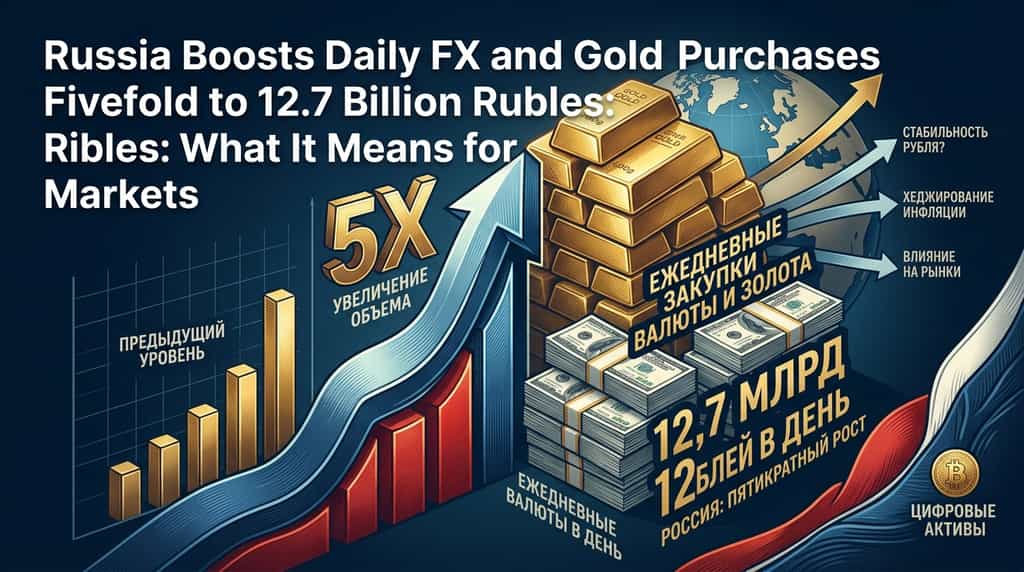
The Russian Ministry of Finance has increased its daily foreign exchange and gold purchase volume fivefold, reaching a staggering 12.7 billion rubles per day starting October 7, 2026. This monumental shift reflects heightened budgetary adjustments, volatile commodity revenues, and a sustained push toward hard asset accumulation under state fiscal rules. For global traders, understanding these massive macroeconomic maneuvers provides critical insights into currency stability, inflation hedging, and evolving capital flows across traditional and digital markets.
Why Did the Russian Ministry of Finance Increase Purchases Fivefold?
The Ministry of Finance ramped up its daily currency and gold purchases to absorb excess oil and gas revenues and offset domestic budget adjustments under the fiscal rule framework. Based on official statements from the Russian Ministry of Finance (October 2026), this fivefold surge from previous levels aims to rebuild national reserves and stabilize macroeconomic balances amidst ongoing geopolitical pressures.
Why is this massive liquidity shift critical for market participants? Central bank interventions directly influence domestic currency liquidity, import-export dynamics, and broader commodity valuations. When a sovereign entity diverts billions of rubles daily into gold and foreign assets, it signals a strategic reallocation toward tangible stores of value. Analysts monitoring global capital flows note that such aggressive state buying creates immediate ripple effects across emerging market currencies and precious metals pricing.
How Do Sovereign Gold and Foreign Exchange Purchases Impact Global Liquidity?
Sovereign accumulation of gold and foreign currencies directly reduces circulating fiat liquidity while strengthening physical reserve backing. According to reports from the Central Bank of the Russian Federation (October 2026), systematic central bank acquisitions help insulate the national economy from external shocks by locking up state assets in non-Western instruments.
How does this impact everyday traders and investors? As state entities pull massive amounts of gold and hard assets off the open market, supply constraints can drive up bullion prices and alter cross-border trade settlements. Furthermore, heavy reliance on non-dollar mechanisms forces a structural evolution in international trade corridors. Investors increasingly evaluate how sovereign treasury decisions correlate with alternative decentralized hedges, including digital assets and tokenized commodities.
What Are the Implications for Ruble Stability and Inflation?
The massive daily injection of 12.7 billion rubles into asset purchases serves as a neutralizing mechanism against fluctuating energy export windfalls. According to macroeconomic data published by the Russian Ministry of Finance (October 2026), these operations prevent excessive currency appreciation during periods of high commodity prices while ensuring fiscal cushion during downturns.
Does this heavy intervention guarantee long-term currency stability? While targeted fiscal rules help manage short-term budget volatility, sustained high-volume purchases can introduce domestic inflationary pressures if not properly sterilized. Market participants closely track these daily allocations to gauge the health of state finances and anticipate potential shifts in monetary policy tightening or interest rate adjustments by the central bank.
How Are Commodities and Precious Metals Reacting to State Accumulation?
State-backed gold purchases create a resilient price floor for precious metals as sovereign demand supplements retail and institutional buying. According to market analysis from specialized financial data providers (October 2026), central banks remain among the largest net buyers of physical gold globally, seeking refuge from sanction risks and fiat debasement.
What does this mean for commodity-backed tokens and crypto assets? The growing disconnect between traditional fiat systems and hard asset accumulation has accelerated interest in decentralized financial instruments. Investors looking for protection against sovereign currency devaluation often draw parallels between central bank gold accumulation strategies and the fixed-supply mechanics governing digital assets like Bitcoin.
Beyond the Headlines: What KuCoin 5.0 Means for You
Market news moves fast — but where you act on it matters just as much. This October, KuCoin launches KuCoin 5.0, transforming KuCoin into a rebuilt platform. Here's what actually changes for you:
-
One account for everything. Older platforms split your money across separate "spot," "margin," and "futures" accounts and expected you to understand why. KuCoin 5.0's unified account removes that entirely — deposit once, and everything is simply there (only available to VIPs for now).
-
Stocks, indices, and commodities. KuCoin 5.0 expands beyond crypto into global markets. When crypto chops sideways and equities rally (or the reverse), you rotate in minutes instead of opening a brokerage account and waiting days for fiat rails.
-
Real-world assets (RWA). Tokenized exposure to traditional assets like commodities, right inside your crypto account. One of the fastest-growing segments in global finance is no longer reserved for institutions — you access it from the same balance you trade with.
-
Earn while you learn. Not ready to trade? KCUSD lets your stablecoins earn daily, auto-compounding interest. The lowest-stress way to put your idle deposit to work for 4% yield.
-
An AI assistant in plain language. Ask questions, get market context, understand what you're looking at — built into the platform, no jargon required.
-
An app that doesn't overwhelm. Faster, cleaner, and consistent — intuitive from the first tap, not after a tutorial.
-
Safety you can check, not just trust. A MiCAR-licensed EU entity, Proof of Reserves you can verify yourself, and internationally certified security (SOC 2 Type II, ISO 27001:2022).
Create your account in minutes — and start on the platform built for where crypto is going, not where it's been.
Conclusion
The decision by the Russian Ministry of Finance to elevate daily foreign exchange and gold purchases fivefold to 12.7 billion rubles marks a pivotal development in macroeconomic policy. Driven by the need to manage commodity revenues and fortify state reserves under fiscal rules, these massive daily injections underscore a broader global trend toward hard asset accumulation. For traders and investors, monitoring sovereign interventions provides essential context for understanding currency dynamics, precious metals valuations, and shifting global liquidity. As traditional financial systems undergo rapid structural transformations, staying informed on macroeconomic shifts remains crucial for navigating both traditional markets and digital asset ecosystems effectively.
Frequently Asked Questions
What specific date did the 12.7 billion ruble daily purchase rule take effect?
The increased purchase volume officially commenced on October 7, 2026, following formal directives from the Russian Ministry of Finance.
Why does the Russian government use a fiscal rule for currency and gold purchases?
The fiscal rule is designed to decouple federal budget expenditures from volatile oil and gas export revenues by saving excess earnings during high-price periods.
Are these purchases conducted directly by the Ministry of Finance or the Central Bank?
The Ministry of Finance calculates and sets the purchase parameters, while the actual execution of currency and gold transactions on the market is carried out by the Central Bank of the Russian Federation.
How do these sovereign purchases affect international gold markets?
Sovereign accumulation absorbs significant physical supply, reinforcing long-term price floors and demonstrating sustained central bank demand for non-fiat reserves.
Can individual retail traders participate in these Ministry of Finance transactions?
No, these are sovereign-level fiscal operations executed directly through state financial institutions and authorized domestic banks to manage national reserves and budget execution.
Disclaimer: This article is for informational purposes only and does not constitute financial, legal, or investment advice. Always conduct your own research before interacting with digital assets.