

How Is Zcash Preparing for Quantum Computing? Post-Quantum Signatures Explained
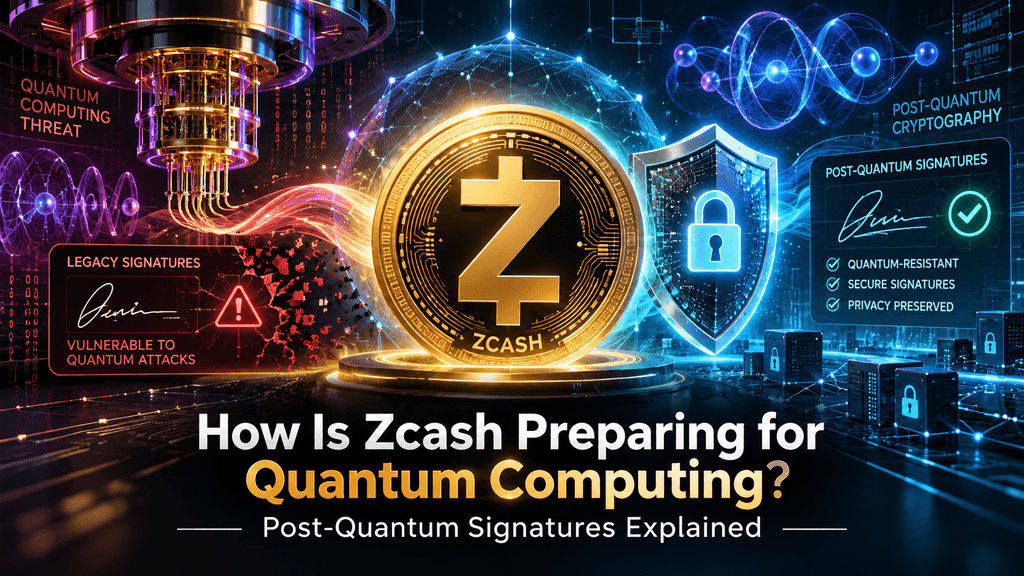
The concept of a "Q-Day"—the exact moment when a sufficiently powerful quantum computer breaks the cryptographic foundations of the modern internet—is no longer confined to the realms of science fiction. For the cryptocurrency industry, which relies entirely on complex mathematical proofs to secure billions of dollars in digital wealth, this looming milestone is akin to a catastrophic Y2K event. While many blockchain networks are paralyzed by indecision or bureaucratic governance, Zcash has proactively decided to fire the first major shot in the war against quantum decryption. Recognized globally as a pioneer in digital privacy, Zcash is fundamentally overhauling its network security to ensure its ecosystem remains impenetrable.
At the heart of this proactive defense is a critical network upgrade scheduled for January 2027, which will permanently alter how the blockchain validates user transactions. By deploying advanced cryptographic tools known as Post-Quantum Signatures, Zcash aims to neutralize the quantum threat years before it materializes. This article delves deep into the existential threat posed by quantum computers, the unique vulnerabilities currently haunting the Zcash network, and the comprehensive roadmap developers have established to future-proof one of the world's most prominent privacy coins.
The Quantum Threat: Is Crypto’s Doomsday Approaching?
Understanding Shor's Algorithm
To grasp the magnitude of the quantum threat, one must first understand the fundamental difference between classical brute-force attacks and quantum decryption capabilities. In classical computing, cracking a secure cryptographic key is like trying every single possible key combination in a universe of locks—a process that would take billions of years even for the world's most powerful supercomputers. However, in 1994, mathematician Peter Shor developed an algorithm that changes the rules of the game entirely. Shor's Algorithm allows a theoretical quantum computer to analyze the public lock and, instead of guessing randomly, deduce the exact mathematical structure of the private key almost instantaneously. It is the equivalent of looking at a lock's keyhole and using the laws of quantum mechanics to directly 3D-print the perfect key.
The Flaw in Elliptic Curve Cryptography
Currently, the vast majority of blockchain networks—including Bitcoin, Ethereum, and Zcash—rely heavily on Elliptic Curve Cryptography (ECC) to generate the public and private key pairs that govern asset ownership. ECC relies on the extreme difficulty of finding the discrete logarithm of a random elliptic curve element with respect to a publicly known base point. While this mathematical barrier is practically insurmountable for traditional processors, ECC is highly susceptible to Shor's Algorithm. When technology giants like Google and IBM eventually scale their quantum processors to contain enough stable, error-corrected qubits, the mathematical assumptions protecting ECC will collapse. This technological progression transitions the threat from a hypothetical academic debate to a concrete timeline, making it a visible reality within the next decade.
The Zcash Vulnerability: Why 70% of ZEC is at Immediate Risk
Transparent vs. Shielded Dynamics
To understand why Zcash developers are acting with such extreme urgency, it is essential to examine the dual-address architecture that defines the network. The Zcash ecosystem operates using two distinct types of addresses: transparent addresses, which function identically to Bitcoin by exposing transaction details on a public ledger, and shielded addresses, which utilize zero-knowledge proofs to encrypt transaction metadata. This bifurcated system was designed to offer users a choice between absolute privacy and regulatory compliance or exchange compatibility.
| Feature | Transparent Addresses | Shielded Addresses |
| Cryptography | Standard ECC Signatures | Zero-Knowledge Proofs (zk-SNARKs) |
| Public Visibility | High (Balances and history are public) | Zero (Amounts and senders are hidden) |
| Quantum Risk | Immediate (Public keys exposed upon spending) | Secondary (Underlying proofs need eventual upgrade) |
The Public Key Exposure Dilemma
The most pressing vulnerability lies within the mechanics of the transparent addresses. Whenever a user spends funds from a transparent address, the network protocol requires the broadcast of that address's public key to validate the transaction signature. Once this public key is exposed on the ledger, it becomes permanently visible to anyone—including future operators of quantum computers. If a user spends only a portion of the funds in that address, the remaining balance sits behind a compromised cryptographic wall. With approximately 70% of the total circulating supply of ZEC currently residing in these transparent addresses, the financial exposure is astronomical. If a quantum breakthrough occurs unexpectedly, these transparent funds would be the first to be compromised, functioning much like a glass vault in a world where criminals possess diamond cutters.
Post-Quantum Signatures Explained (No Ph.D. Required)
The Shift to Hash-Based Mathematics
To counteract the vulnerabilities inherent in Elliptic Curve Cryptography, the Zcash development team is transitioning the network toward a completely different mathematical paradigm: Post-Quantum Signatures (PQS). These are novel cryptographic algorithms specifically engineered to withstand the immense processing capabilities of both traditional supercomputers and future quantum machines. Rather than relying on the geometric complexities of elliptic curves, the upcoming 2027 upgrade will introduce signature schemes based on hash functions. This fundamental shift essentially replaces the compromised lock with a completely new security mechanism that Shor's Algorithm cannot decipher.
One-Way Functions and Collision Resistance
The security of hash-based signatures is anchored in two critical properties of hash functions: one-way directionality and collision resistance. A hash function takes any amount of input data and scrambles it into a fixed-length string of characters. This process is strictly one-way; you cannot reverse-engineer the resulting hash to discover the original input data. Furthermore, collision resistance ensures that it is mathematically improbable for two different inputs to ever produce the identical hash output. While quantum computers excel at finding hidden periodic structures in algebraic curves, they offer no significant advantage in reversing cryptographic hashes. Consequently, when the Zcash network updates its verification nodes to authenticate transactions matching these specific hash values, it completely circumvents the exploitable public-key derivation process.
Zcash’s Survival Guide: Inside the January 2027 Upgrade
Implementing New Protocol Opcodes
The ambitious transition to quantum resistance is being meticulously orchestrated by Zakura, a dedicated Zcash client development team. Their primary directive for the January 2027 hard fork is the introduction of brand new operation codes, or "Opcodes," directly into the protocol's consensus layer. These new opcodes will grant the blockchain the ability to recognize, process, and validate the new hash-based post-quantum signatures natively. By embedding these opcodes deep within the network architecture, the developers ensure that every node synchronizing with the blockchain will uniformly enforce the new, quantum-proof validation standards without fragmenting the community.
The Rotating Addresses Solution
Understanding that users will need a safe and intuitive way to migrate their wealth, developers have designed the "rotating addresses" mechanism. Once the new opcodes are live, users will not be forced into a complicated or risky technical maneuver. Instead, wallet software will automatically generate new, quantum-secure addresses derived from the upgraded signature schemes. Users will simply execute a standard transaction to sweep their existing funds from their vulnerable legacy addresses into these newly rotated secure vaults. This user-friendly migration path ensures that individuals can secure their assets long before a malicious quantum actor has the opportunity to target their previously exposed public keys.
Beyond Signatures: The Ultimate Privacy Masterplan
Quantum-Recoverable Wallets and PIR
The deployment of post-quantum signatures is merely the foundational layer of a much broader, long-term masterplan to fortify the entire Zcash ecosystem. Anticipating the need for comprehensive infrastructure, developers are targeting mid-2026 for the widespread testing and integration of "quantum-recoverable" wallets. Additionally, the Zakura team is heavily invested in Private Information Retrieval (PIR) technology, particularly within the Vizor wallet environment. Currently, when a wallet queries a server for balance updates, it risks leaking behavioral data that could link multiple addresses to a single IP. PIR mathematically ensures that the server returning the blockchain data remains completely blind to which specific addresses the user is actually querying, severing the last vestiges of metadata surveillance.
| Milestone Phase | Estimated Timeline | Core Objective |
| Phase 1: Wallet Testing | Mid-2026 | Deploy quantum-recoverable wallet infrastructure |
| Phase 2: Network Upgrade | January 2027 | Hard fork to activate Post-Quantum Signature Opcodes |
| Phase 3: Shielded Evolution | Post-2027 | Upgrade zero-knowledge proving systems for quantum security |
Securing the Shielded Pool
While the transparent addresses represent the most acute and immediate danger, the developers are acutely aware that true financial privacy demands long-term security for the shielded pool as well. The complex zero-knowledge proofs (zk-SNARKs) that give Zcash its unparalleled anonymity are also built upon cryptographic assumptions that will eventually degrade under sustained quantum analysis. Therefore, the long-term vision includes migrating the entire shielded ecosystem to post-quantum zero-knowledge proving systems. This ensures that the cryptographic curtain hiding transaction amounts and participant identities remains permanently drawn, safeguarding the core ethos of the project.
Will Other Cryptos Follow Zcash’s Lead?
Setting the Web3 Industry Standard
The aggressive timeline adopted by Zcash stands in stark contrast to the broader cryptocurrency market, which has largely remained passive regarding the quantum threat. Bitcoin, for example, is notoriously conservative regarding protocol upgrades, with no definitive timeline established for a quantum-resistant hard fork. By taking the initiative, Zcash is effectively serving as the live testing ground for the entire Web3 industry. As they align their cryptographic upgrades with the latest standards recommended by institutions like NIST (National Institute of Standards and Technology), Zcash is writing the blueprint for how decentralized networks can survive the post-quantum era.
| Network | Quantum Readiness Stance | Upgrade Strategy |
| Zcash (ZEC) | Highly Proactive | Scheduled hard fork for PQS (Jan 2027) |
| Bitcoin (BTC) | Highly Conservative | Theoretical discussions; no concrete timeline |
| Ethereum (ETH) | Moderately Proactive | Researching Account Abstraction and PQS integration |
Conclusion: Securing the Future of Digital Privacy
The scheduled January 2027 network upgrade represents a defining moment not just for Zcash, but for the entire cryptographic community. By proactively integrating post-quantum signatures and overhauling its validation mechanics, Zcash is demonstrating that true security requires anticipating the threats of tomorrow rather than merely reacting to the exploits of today. The shift to hash-based cryptography and the deployment of advanced privacy-preserving tools like Private Information Retrieval ensure that the network remains a fortress of financial sovereignty.
Ultimately, the advent of quantum computing will fundamentally alter the digital landscape, dismantling the cryptographic assumptions that have secured the internet for decades. For investors and privacy advocates, the message is remarkably clear: the ticking clock of the quantum threat cannot be ignored. Zcash's comprehensive survival guide proves that in the high-stakes world of decentralized finance, foresight and relentless technological evolution are the only true safeguards for digital wealth.
🔥 Beyond the Headlines: What KuCoin 5.0 Means for You
Market news moves fast — but where you act on it matters just as much. This October, KuCoin launches KuCoin 5.0, transforming KuCoin into a rebuilt platform. Here's what actually changes for you:
-
One account for everything. Older platforms split your money across separate "spot," "margin," and "futures" accounts and expected you to understand why. KuCoin 5.0's unified account removes that entirely — deposit once, and everything is simply there (only available to VIPs for now).
-
Stocks, indices, and commodities. KuCoin 5.0 expands beyond crypto into global markets. When crypto chops sideways and equities rally (or the reverse), you rotate in minutes instead of opening a brokerage account and waiting days for fiat rails.
-
Real-world assets (RWA). Tokenized exposure to traditional assets like commodities, right inside your crypto account. One of the fastest-growing segments in global finance is no longer reserved for institutions — you access it from the same balance you trade with.
-
Earn while you learn. Not ready to trade? KCUSD lets your stablecoins earn daily, auto-compounding interest. The lowest-stress way to put your idle deposit to work for 4% yield.
-
An AI assistant in plain language. Ask questions, get market context, understand what you're looking at — built into the platform, no jargon required.
-
An app that doesn't overwhelm. Faster, cleaner, and consistent — intuitive from the first tap, not after a tutorial.
-
Safety you can check, not just trust. A MiCAR-licensed EU entity, Proof of Reserves you can verify yourself, and internationally certified security (SOC 2 Type II, ISO 27001:2022).
Create your account in minutes — and start on the platform built for where crypto is going, not where it's been.
FAQs
Do quantum computers powerful enough to hack crypto exist today?
At present, quantum computers possessing the necessary power to break modern cryptocurrency encryption do not exist. Current quantum technology is heavily restricted by a limited number of stable qubits and high error rates, keeping them in an experimental phase. Experts generally believe we are still several years, or perhaps a full decade, away from a machine capable of executing Shor's Algorithm against a blockchain. Zcash is implementing these upgrades now purely as a preemptive defensive strategy to ensure the network is secure long before the technology matures.
Will I lose my ZEC if I don't do anything before the 2027 upgrade?
You will not experience an immediate loss of funds on the exact day of the 2027 upgrade if you take no action. The upgrade introduces the necessary infrastructure, but it relies on users eventually utilizing the new features. However, you will be required to update your wallet software to remain compatible with the network. To ensure your assets are protected against future quantum attacks, you will eventually need to initiate a transaction to move your ZEC from legacy addresses into the newly created, quantum-secure rotating addresses during the provided transition period.
Why doesn't Zcash just move everything to Shielded Addresses to be safe?
While shielded addresses offer superior privacy by concealing transaction details, they do not inherently solve the foundational quantum computing problem. The underlying zero-knowledge proofs (zk-SNARKs) utilized by the shielded pool still rely on cryptographic assumptions that a sufficiently advanced quantum computer could eventually unravel. Therefore, simply forcing all transparent funds into the current shielded pool is merely a temporary bandage; the fundamental "cryptographic lock" itself must be entirely replaced with post-quantum mathematics to achieve absolute, long-term security.
Will Post-Quantum Signatures make Zcash transactions slower or more expensive?
Integrating post-quantum cryptography does introduce specific technical challenges, primarily concerning data size. Post-quantum keys and their corresponding signatures are typically much larger in terms of data bytes compared to traditional ECC signatures. This increased size means transactions will consume more block space, which could theoretically impact transaction processing speeds and slightly increase network fees. However, the development teams are actively researching optimization techniques and data compression strategies to balance this robust new security layer with optimal network performance.
Disclaimer: This content is for informational purposes only and does not constitute investment advice. Investments carry risk. Please do your own research (DYOR).