

Why Leopold Aschenbrenner’s Situational Awareness LP Was Forced to Sell Its Entire Public Stock Portfolio to Citadel After AI Losses
2026/07/31 15:32:00
Introduction
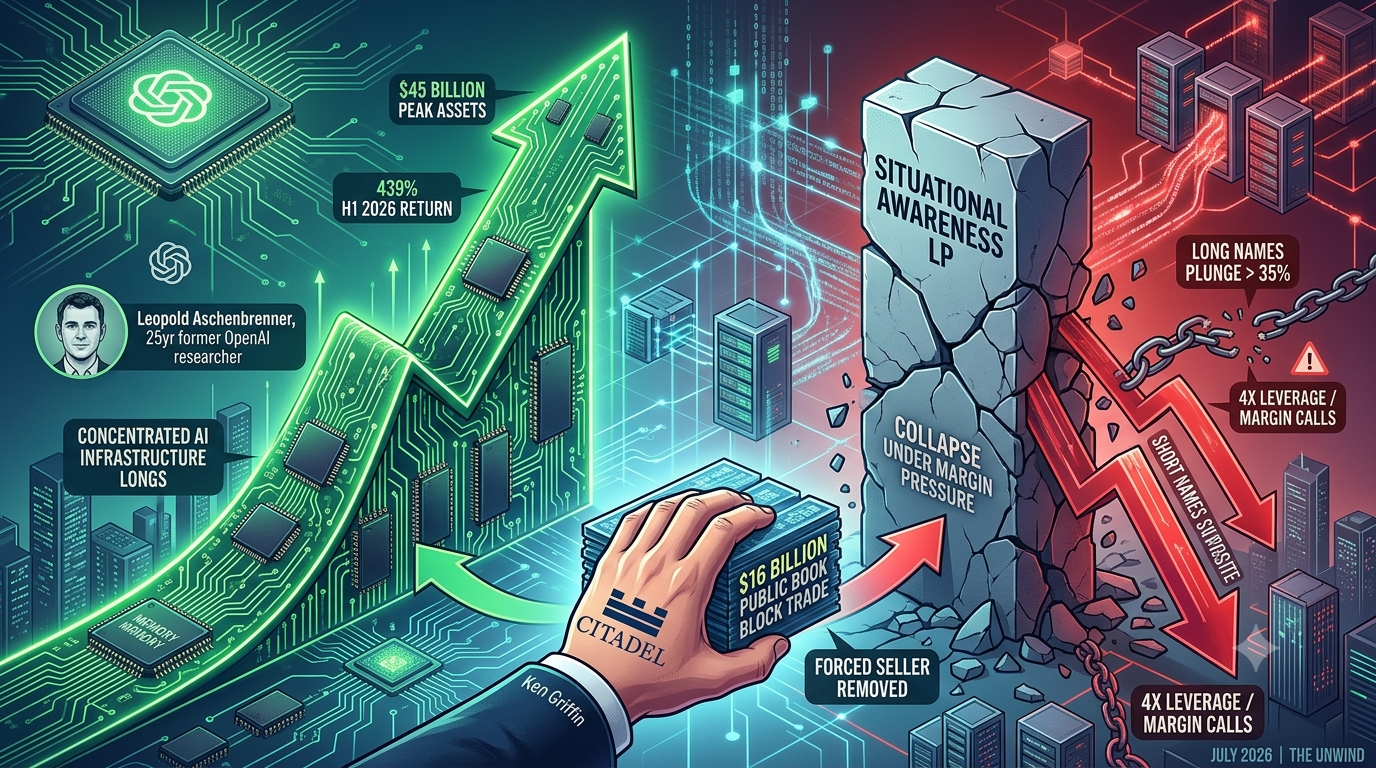
In July 2026, a high-flying AI-focused hedge fund that once reached $45 billion in assets collapsed under margin pressure and handed its entire public stock book to Ken Griffin’s Citadel. The forced sale of roughly $16 billion in holdings by Situational Awareness LP, founded by 25-year-old former OpenAI researcher Leopold Aschenbrenner, marks one of the sharpest reversals in the AI investment boom.
The unwind stemmed from heavy long exposure to AI infrastructure names that plunged more than 35 percent and short positions in software stocks that surged the opposite way. Combined with approximately 4x leverage, the losses triggered margin calls from prime brokers. The block trade to Citadel removed a major forced seller from the market and immediately sparked a sharp rebound in the affected semiconductor and data-center stocks.
Who Is Leopold Aschenbrenner and What Is Situational Awareness LP?
Leopold Aschenbrenner is a 25-year-old German-born AI researcher and investor who built one of the most closely watched hedge funds of the AI era in under two years. He graduated as valedictorian from Columbia University at 19, joined OpenAI’s Superalignment team, and was dismissed in 2024 after the company cited improper disclosure of internal information. Aschenbrenner has disputed that account, stating he shared a largely nonconfidential planning document and raised security concerns.
After leaving OpenAI, Aschenbrenner published a 165-page essay titled “Situational Awareness” that argued rapid AI progress would require massive expansion of chips, memory, data centers, and energy infrastructure. The essay attracted capital from Silicon Valley investors, including figures connected to Stripe. He launched Situational Awareness LP in late 2024 with a few hundred million dollars. By early July 2026 the fund had grown as large as $45 billion at its peak, according to people familiar with the matter cited by CNBC. It delivered a 439 percent net return in the first half of 2026, according to an investor letter reviewed by the Financial Times.
The fund concentrated on the physical layer of AI: memory chips, GPU cloud providers, data-center power, and related infrastructure. It retained a significant private stake in Anthropic, estimated at around $5 billion and representing a meaningful portion of remaining assets after the public equity sale.
What Triggered the July 2026 Losses at Situational Awareness LP?
Steep declines in AI infrastructure stocks and adverse moves in short positions produced large losses that leverage amplified into a margin crisis. According to CNBC and other reports citing people familiar with the fund, core long holdings including SK Hynix, Sandisk, Micron, CoreWeave, and Nebius Group each fell more than 35 percent during the month. Short positions in software names such as Adobe moved sharply higher against the fund.
The fund employed roughly 4x leverage, meaning price moves were magnified fourfold on both the long and short sides. Prime brokers Goldman Sachs, JPMorgan Chase, and Bank of America issued margin calls as portfolio value dropped. Aschenbrenner had sent investors a letter on July 24 describing the sell-off as creating “some of the most attractive opportunities since early 2025” and inviting fresh capital commitments by August 1. The capital did not arrive in time.
By the start of July the fund’s net asset value had stood near $45 billion. Rapid losses and the need to meet margin requirements left the firm with no choice but to liquidate its public equity book in an orderly block transaction rather than face a disorderly fire sale in the open market.
How Did the Forced Sale to Citadel Unfold?
Citadel acquired the bulk or entirety of Situational Awareness LP’s publicly traded long and short positions in a privately negotiated block deal completed around July 30, 2026. Reports from the Wall Street Journal, CNBC, Financial Times, and Axios confirm that Ken Griffin’s firm stepped in as the buyer after the fund’s prime brokers marketed the portfolio. Estimates place the public equity book involved at roughly $16 billion.
The transaction covered only public securities. Situational Awareness retained its private investments, most notably the Anthropic stake. After the sale, fund assets were reported to have fallen to around $10 billion. The structured sale avoided dumping shares into the open market and allowed the positions to transfer in a single package.
Market participants widely viewed the clearance of this large forced seller as removing near-term selling pressure. On July 30, several of the former holdings rebounded sharply: SK Hynix rose about 17 percent, Sandisk climbed around 24 percent, Micron advanced roughly 18 percent, CoreWeave gained more than 21 percent, and Nebius jumped over 27 percent, according to market data reported alongside the news.
What Positions Did Situational Awareness LP Hold Before the Unwind?
The fund’s public book was heavily concentrated in AI infrastructure names that reflected Aschenbrenner’s thesis on compute, memory, and power bottlenecks. Its largest disclosed holdings at the end of the first quarter of 2026 included Nebius Group, Sandisk, Micron, and CoreWeave, according to 13F filings and subsequent reporting. Additional exposure included SK Hynix, Bloom Energy, data-center related names such as Applied Digital, Core Scientific, and various Bitcoin miners that had pivoted toward high-performance computing.
On the short side, the fund held positions against software companies, with Adobe frequently cited as a notable example that moved against the portfolio. The combination of concentrated longs in hardware and infrastructure with opposing shorts in software created a double-sided vulnerability when the July correction hit AI-related equities and lifted certain software names.
This concentration, paired with high leverage, turned a sector-wide pullback into an existential margin event for the public equity portfolio.
Should You Trade AI Infrastructure Stocks on KuCoin?
Traders seeking exposure to the same AI hardware, memory, and infrastructure themes that drove Situational Awareness LP’s earlier gains can access a wide range of related tokens and perpetual contracts on KuCoin. The platform offers deep liquidity in major cryptocurrencies and a growing list of AI-related digital assets, along with leverage tools that users can control carefully rather than having them imposed by prime brokers.
KuCoin provides spot trading, futures, and copy-trading features that allow users to participate in AI sector volatility with position sizing and risk limits they set themselves. Registration is straightforward, and the exchange supports a broad suite of order types and risk-management tools. Anyone considering leveraged exposure to AI themes should start with a clear understanding of margin mechanics and maintain conservative leverage ratios to avoid the forced-sale outcome seen in this case.
Join KuCoin 9th Anniversary Trading Campaign
Now you can also trade underlying assets brought by Leopold previously on KuCoin, such as SK Hynix, MU, SNDK, and others.
KuCoin is celebrating its 9th anniversary with a special platform campaign filled with exclusive rewards, trading activities, and limited-time offers. Don’t miss the chance to participate and enjoy the benefits as the exchange marks nine years of growth and innovation. Visit the official campaign page now:
Conclusion
Situational Awareness LP’s forced sale of its roughly $16 billion public stock portfolio to Citadel in late July 2026 ended a remarkable run for Leopold Aschenbrenner’s AI-focused hedge fund. The 25-year-old founder had turned a widely read essay into a vehicle that scaled from a few hundred million dollars to as much as $45 billion and delivered a 439 percent first-half return. Concentrated bets on AI infrastructure names such as SK Hynix, Sandisk, Micron, CoreWeave, and Nebius, combined with short positions in software stocks and approximately 4x leverage, produced losses large enough to trigger margin calls from major prime brokers.
The block transfer to Citadel cleared a significant forced seller from the market and coincided with sharp rebounds in the affected stocks on July 30. The fund continues with its private holdings, including a substantial Anthropic stake, but its public equity chapter has closed. The episode underscores a timeless market lesson: leverage multiplies both gains and the speed at which positions can be taken away. For traders interested in AI infrastructure themes, understanding these dynamics remains essential.
FAQs
What was the size of Situational Awareness LP’s public stock portfolio sold to Citadel?
Reports place the public equity book involved in the transaction at roughly $16 billion. Citadel acquired the bulk or entirety of those long and short positions in a privately negotiated deal.
How much leverage did the fund use?
People familiar with the matter indicated the fund ran approximately 4x leverage, which amplified both earlier gains and the July losses that triggered margin calls.
Why did AI infrastructure stocks rebound on July 30, 2026?
Market participants attributed the sharp gains in names such as SK Hynix, Sandisk, Micron, CoreWeave, and Nebius to the removal of a large forced seller once the Citadel transaction was completed.