

What Is the Consensus Mechanism and What Are the Corresponding Representative Projects?
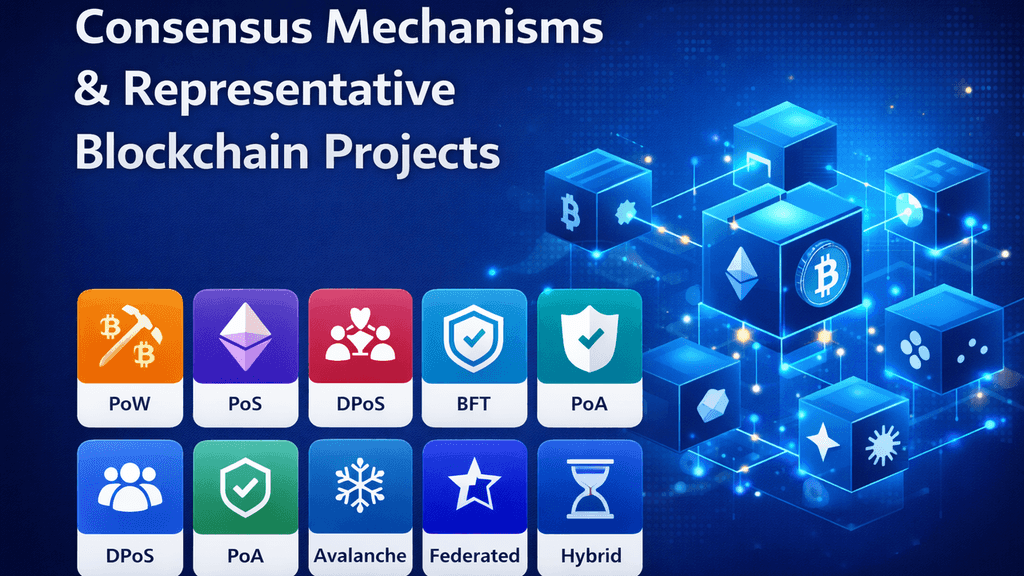
A consensus mechanism is the process a blockchain uses to make sure independent participants agree on one valid version of the ledger. It determines how transactions are verified, how new blocks are accepted, and how the network keeps moving without relying on a central authority. Ethereum’s developer documentation defines a consensus mechanism as the full stack of protocols, incentives, and ideas that allows nodes to agree on the state of a blockchain, which is broader than simply naming a chain “Proof of Work” or “Proof of Stake.”
That broader definition is important because consensus is the foundation of blockchain trust. In a normal database, one operator decides what the correct record is. In a blockchain, thousands of machines may be run by unrelated parties, and all of them need a way to converge on the same transaction history. Bitcoin’s white paper introduced this problem through a peer-to-peer payment system that uses proof of work to build a chronological chain of valid records without a trusted intermediary.
Overview
-
A consensus mechanism is the system that helps a blockchain network agree on valid transactions and one shared version of the ledger.
-
It is a core part of blockchain technology because it allows the network to operate without a central authority.
-
Different consensus mechanisms use different methods to secure the network, validate blocks, and maintain trust.
-
The consensus model of a blockchain affects important factors such as security, decentralization, speed, finality, and energy efficiency.
-
Understanding consensus mechanisms makes it easier to compare blockchain projects and see how they actually work in practice.
-
Looking at representative projects for each consensus type helps explain the real-world use of these blockchain models.
Consensus Mechanism Meaning in Blockchain
In blockchain, consensus means collective agreement on the current state of the ledger. It determines which transactions are valid, the order in which they are recorded, and which block is accepted as part of the chain. Without consensus, a blockchain would have no reliable way to maintain one shared version of truth across a distributed network.
A strong consensus mechanism helps a blockchain do several essential things:
-
prevent double spending
-
reject invalid or fraudulent transactions
-
keep the network running even if some participants fail
-
reduce the impact of malicious actors
-
ensure all honest nodes can agree on the same ledger state
Ethereum’s documentation also makes it clear that consensus is not only about technical agreement. It also includes the economic incentives and protocol rules that make honest participation the most rational path for validators and other network participants.
Consensus is one of the first things people examine when comparing blockchain networks because it shapes how the entire system operates. It affects the security model, the level of decentralization, transaction speed, finality, and overall energy use.
Different consensus models create different tradeoffs. For example:
-
a proof-of-work network relies on computational cost for security
-
a proof-of-stake network relies on staked capital and validator incentives
-
a federated or authority-based network can reach agreement faster, but with a narrower trust structure
For that reason, consensus is not just a technical feature in the background. It is the operating logic of the blockchain and one of the clearest ways to understand how a network secures itself and reaches agreement.
Main Types of Consensus Mechanisms
The Most Common Consensus Models
Blockchain consensus mechanisms are usually grouped into several widely recognized categories. The most common ones include:
-
Proof of Work (PoW)
-
Proof of Stake (PoS)
-
Delegated Proof of Stake (DPoS)
-
BFT-style validator consensus
-
Proof of Authority (PoA)
-
Avalanche-style repeated-sampling consensus
-
Federated or quorum-based consensus
-
Hybrid models, such as Solana’s PoH-assisted architecture
These categories help explain the different ways blockchain networks reach agreement, validate transactions, and maintain a shared ledger without central control.
These consensus types are useful for learning, but they are not always completely separate from one another. In some blockchain networks, one term explains how validators are selected, while another describes how those validators confirm and finalize blocks.
That is why some projects can fit into more than one discussion category. For example:
-
one layer may determine who participates in validation
-
another layer may define how final agreement is reached
-
some networks combine timing, staking, and voting systems in one architecture
Even with that overlap, these categories remain the clearest framework for understanding the main types of consensus mechanisms and linking each one to representative blockchain projects.
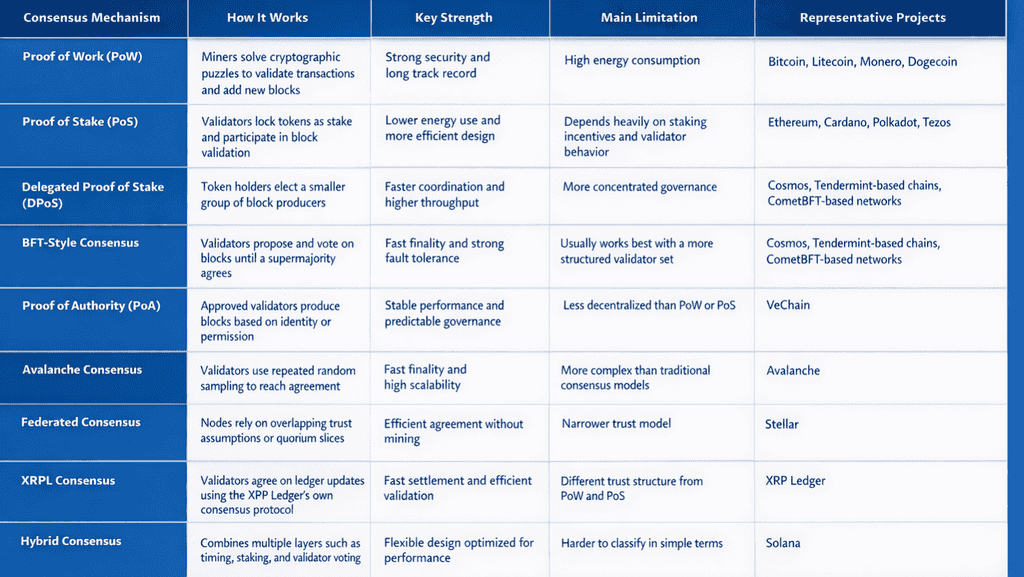
This table provides a quick comparison of the main consensus mechanisms used in blockchain networks. It outlines how each model works, its main strength, its key limitation, and the representative projects most commonly associated with it.
Proof of Work and Its Representative Projects
Proof of Work, or PoW, is the original public blockchain consensus model. In this system, miners compete to solve a cryptographic puzzle. Solving the puzzle requires real computational effort, but verifying the result is easy for the rest of the network. Bitcoin’s white paper explains that this proof of work acts as the basis for a distributed timestamp server, creating a chain in which each new block reinforces the validity of previous ones.
The defining strength of Proof of Work is that security is tied to real-world cost. To attack the network, an adversary must obtain and sustain a massive amount of computational power. That cost is what gives PoW chains their resistance to rewriting history. The most obvious tradeoff is energy use, because the network’s security depends on continuous computational competition. Bitcoin remains the flagship example of this model and the most important representative project for PoW.
The best-known representative projects for Proof of Work are Bitcoin, Litecoin, Monero, and Dogecoin. Bitcoin is the clearest representative because its architecture is inseparable from PoW. Litecoin is an early derivative that adapted the model with different parameters. Monero remains one of the best-known privacy-focused mining networks. Dogecoin also uses a mining-based model rather than staking. Among all of these, Bitcoin is still the standard reference point whenever Proof of Work is explained.
Proof of Stake and Its Representative Projects
Proof of Stake, or PoS, replaces miners with validators who lock up capital as stake. Instead of spending electricity to compete for block production, participants secure the network by committing tokens that can earn rewards or face penalties depending on behavior. Ethereum’s official documentation states that PoS underlies Ethereum’s current consensus mechanism and that Ethereum moved to PoS in 2022 because it is less energy-intensive and better suited to future scaling than its previous PoW design.
PoS changes the security model from computation to economics. In Ethereum’s case, validator behavior is shaped by rewards, penalties, and slashing conditions that make honest operation financially rational and malicious conduct expensive. This is why PoS is often described as more energy efficient but still strongly secured: it does not remove the cost of security, it changes the form that cost takes.
The most important representative project for Proof of Stake is Ethereum. After the Merge, Ethereum became the highest-profile large-scale public chain secured by PoS. Another major representative project is Cardano, which is widely associated with Ouroboros, its research-driven PoS protocol. Other commonly cited projects in this group include Polkadot and Tezos. For a simple project-to-mechanism mapping, Ethereum is the clearest modern example of PoS, while Cardano is often used to represent the academically oriented side of PoS design.
Delegated Proof of Stake and Its Representative Projects
Delegated Proof of Stake, or DPoS, is a variation of PoS in which token holders elect a smaller set of block producers or validators to operate the network on their behalf. Instead of allowing a very broad validator set to participate directly, the chain relies on an elected group. EOS documentation states that its network uses a delegated proof-of-stake consensus algorithm in which token holders elect block producers responsible for maintaining the network and reaching consensus on new blocks.
That structure gives DPoS a very different operational profile from open-validator PoS. Because the active validator set is smaller, coordination is easier and performance is often more predictable. The tradeoff is governance concentration. If too much influence ends up in a small producer group or among large token holders, decentralization can weaken. This is why DPoS is usually described as faster and more efficient, but potentially more centralized than broader staking systems.
The clearest representative project in this category is EOS. Other projects often grouped with DPoS include TRON, BitShares, and Steem. If the question is simply which project best represents Delegated Proof of Stake, EOS is the strongest answer because its official documentation describes the mechanism directly and clearly.
BFT-Style Consensus and the Cosmos Example
Byzantine fault tolerant consensus refers to systems that can keep working even when some validators are faulty, offline, or malicious. In blockchain, BFT-style protocols usually involve validators proposing blocks and voting in rounds until a supermajority agrees. CometBFT documentation describes the system as the Tendermint consensus algorithm adopted in CometBFT, with formal proofs of safety and termination. It also characterizes the algorithm as a BFT consensus model in which validators take turns proposing blocks and voting on them.
The most useful representative project here is Cosmos, or more precisely the Cosmos ecosystem built around the Tendermint and CometBFT lineage. Cosmos is often discussed in both the PoS and BFT categories, and that is not a contradiction. Staking determines who the validators are, while the BFT protocol governs how those validators agree on blocks and achieve finality. This layered structure is one of the best examples of why blockchain consensus should not always be reduced to one short label.
So if someone asks for the representative project for BFT-style blockchain consensus, Cosmos is usually the best answer. It is the clearest public example of a validator-voting model where agreement comes through a supermajority-based protocol rather than mining.
Proof of Authority and the VeChain Example
Proof of Authority, or PoA, uses a limited set of approved validators whose legitimacy comes from identity, governance approval, or institutional trust rather than open mining or broad staking participation. VeChain’s documentation states that VeChainThor implements a Proof of Authority consensus algorithm and explains that this design reflects its governance philosophy. VeChain’s broader blockchain overview also identifies its consensus mechanism as PoA, and its technical specifications describe the current system as PoA 2.0.
PoA is often chosen when the network values predictable validator behavior, controlled participation, and operational efficiency. It is commonly associated with enterprise or consortium settings, but VeChain is the most visible public example of a project openly built around the model. Because the validator set is narrower than in PoW or open PoS systems, PoA is usually seen as less decentralized. In return, it can deliver stronger governance control and more stable performance.
The clearest representative project for Proof of Authority is VeChain. If a short answer is required, “PoA is represented by VeChain” is accurate and well supported by the project’s own documentation.
Avalanche Consensus and Its Representative Project
Avalanche is frequently summarized as a staking network, but its consensus model is more specific than that. Avalanche’s official builder documentation describes the system as a family of Snow protocols, including Snowball, Snowman, and Avalanche consensus, which achieve agreement through repeated random sampling. The same documentation says these protocols provide probabilistic safety guarantees with sub-second finality, while Snowman is described as combining features of both classical and Nakamoto consensus to achieve high throughput, fast finality, and energy efficiency.
This makes Avalanche an important example because it does not fit neatly into the older “PoW versus PoS” framework. Stake still matters to validator participation, but the actual agreement process is best understood through the Snow family. Validators repeatedly query small random subsets of peers and update their preferences based on the responses. That repeated sub-sampled voting process is what gives Avalanche its distinct place in the consensus landscape.
The corresponding representative project is Avalanche itself. In other words, Avalanche is not just another project using a common mechanism; it is the flagship representative of its own consensus family.
Federated Consensus and the Stellar Example
Another major category is federated or quorum-based consensus. In these models, agreement is achieved through overlapping trust assumptions rather than mining or conventional open staking. Stellar’s official explanation of the Stellar Consensus Protocol says SCP provides a way to reach consensus without relying on a closed system to record financial transactions. Stellar’s developer documentation further describes SCP as a proof-of-agreement protocol that enables consensus and validates transactions on the network.
That makes Stellar the most important representative project for federated consensus. Stellar’s design is often described through Federated Byzantine Agreement, with SCP as the mechanism that allows distributed agreement while avoiding traditional mining. For readers trying to map project to mechanism, the clean link is straightforward: Stellar represents SCP and the federated consensus model.
XRPL Consensus and the XRP Ledger
The XRP Ledger is sometimes grouped loosely with Stellar because both are alternatives to mining-based systems, but the XRP Ledger has its own distinct consensus protocol. XRPL documentation states that the XRP Ledger Consensus Protocol is designed so participants can agree on the latest state and on which transactions occurred in which order, all without a central operator or single point of failure. The same documentation says the ledger can continue making progress even when some participants join, leave, or behave inappropriately.
Because of that, the representative project here is XRP Ledger itself. It is more accurate to describe XRPL as using the XRP Ledger Consensus Protocol than to force it into a generic PoS or federated label without explanation. It belongs in any complete article on major blockchain consensus models because it represents a separate, well-established approach to network agreement.
Proof of History, Tower BFT, and the Solana Model
Solana is one of the most misunderstood examples in blockchain consensus discussions. Many summaries say Solana uses Proof of History, but Solana’s own white paper describes PoH as a proof for verifying the order and passage of time between events. It explicitly says PoH can be used alongside a consensus algorithm such as PoW or PoS to reduce messaging overhead in a Byzantine fault tolerant replicated state machine. Solana’s newer developer materials also describe the network as a proof-of-stake network supercharged by Proof of History, and explain that Tower BFT uses PoH as a global clock before consensus.
That means the most accurate classification is that Solana is a hybrid architecture. PoH is not the whole consensus mechanism by itself. It is a timing and ordering layer that helps the broader staking and BFT-style validator system run more efficiently. This is a good example of why serious blockchain writing should separate the validator model, the agreement protocol, and any ordering or timing primitives built into the design.
The corresponding representative project is Solana, specifically as the flagship example of a Proof-of-History-assisted PoS/BFT hybrid model.
Representative Projects by Consensus Mechanism
Each blockchain consensus model has at least one project that clearly represents how that mechanism works in practice. Some networks are often used as reference points because their architecture is closely tied to a specific consensus design, while others are included as additional examples within the same category.
-
Proof of Work (PoW): Bitcoin is the clearest representative project, while Litecoin, Monero, and Dogecoin are also well-known PoW networks. Bitcoin remains the main reference point because its original design was built around mining-based consensus.
-
Proof of Stake (PoS): Ethereum is the strongest modern example of Proof of Stake, with Cardano, Polkadot, and Tezos also fitting this category. Ethereum is especially important because it is one of the largest public blockchains now secured by staking.
-
Delegated Proof of Stake (DPoS): EOS is the most widely cited representative project, using an elected block producer model maintained by token-holder voting.
-
BFT-style validator consensus: Cosmos is the clearest example here, especially through the Tendermint and CometBFT model, where validators propose and vote on blocks until a supermajority reaches agreement.
-
Proof of Authority (PoA): VeChain is the most visible representative project, with its network built around an authority-based validator model.
-
Avalanche consensus: Avalanche represents its own consensus family, using repeated random sampling through the Snow protocols.
-
Federated consensus: Stellar is the best-known example, using the Stellar Consensus Protocol to achieve agreement without mining.
-
XRPL consensus: XRP Ledger represents this category through its own distinct ledger consensus protocol.
-
Hybrid PoH-assisted consensus: Solana is the flagship example of a hybrid architecture where Proof of History works together with staking and Tower BFT-style coordination.
CTA
Want to learn more about blockchain technology and how major crypto networks work? Explore KuCoin Learn for more educational resources, or visit KuCoin to discover more about the broader crypto ecosystem.
Conclusion
Consensus mechanisms are the foundation of every blockchain network. They allow distributed participants to agree on valid transactions, maintain one shared version of the ledger, and keep the system running without a central authority. Whether a blockchain uses Proof of Work, Proof of Stake, Delegated Proof of Stake, BFT-style consensus, Proof of Authority, federated models, or a hybrid structure, the purpose remains the same: to create trust through rules, incentives, and verifiable agreement.
Understanding consensus mechanisms also makes it easier to understand why blockchain projects differ so much from one another. Bitcoin is built around the long-tested security model of Proof of Work, Ethereum represents the large-scale move toward Proof of Stake, EOS is often used as the best-known example of Delegated Proof of Stake, Cosmos reflects BFT-style validator consensus, VeChain represents Proof of Authority, Avalanche stands out for its repeated-sampling consensus model, Stellar and XRP Ledger use alternative agreement structures, and Solana shows how hybrid architectures can combine multiple ideas into one system.
FAQs
What is a consensus mechanism in blockchain?
A consensus mechanism in blockchain is the method used to help network participants agree on the current state of the ledger. It decides which transactions are valid, how blocks are added, and how the system stays secure without relying on a central authority.
Why is a consensus mechanism important?
A consensus mechanism is important because it prevents double spending, reduces the risk of fraud, and keeps all honest participants aligned on one shared version of transaction history. Without it, a blockchain would not be able to function as a decentralized system.
What are the main types of consensus mechanisms?
The main types of consensus mechanisms include Proof of Work, Proof of Stake, Delegated Proof of Stake, BFT-style consensus, Proof of Authority, federated consensus, Avalanche-style consensus, and hybrid models such as Solana’s Proof-of-History-assisted structure.
Which blockchain project is the best example of Proof of Work?
Bitcoin is the best-known and most representative example of Proof of Work. It uses mining to secure the network and remains the standard reference point for PoW-based blockchain design.
Which project is the best example of Proof of Stake?
Ethereum is the clearest large-scale example of Proof of Stake today. It uses validators and staked capital instead of miners and computational work to help secure the network.
Is Delegated Proof of Stake the same as Proof of Stake?
No, Delegated Proof of Stake is not exactly the same as Proof of Stake. In a standard PoS system, validators usually participate more directly, while in DPoS, token holders elect a smaller group of block producers or validators to operate the network on their behalf.
Can one blockchain use more than one consensus model?
Yes, some blockchains combine multiple consensus components. For example, one part of the system may decide how validators are selected, while another part handles block finality or event ordering. This is why some networks are described as hybrid consensus systems.
Disclaimer: The information provided on this page may originate from third-party sources and does not necessarily represent the views or opinions of KuCoin. This content is intended solely for general informational purposes and should not be considered as financial, investment, or professional advice. KuCoin does not guarantee the accuracy, completeness, or reliability of the information, and is not responsible for any errors, omissions, or outcomes resulting from its use. Investing in digital assets carries inherent risks. Please carefully evaluate your risk tolerance and financial situation before making any investment decisions. For further details, please consult our Terms of Use and Risk Disclosure