

Warsh Turns Hawkish at Jackson Hole: Will the Fed Hike in September After Stocks and Bitcoin Slip?
2026/08/31 11:26:00
Introduction
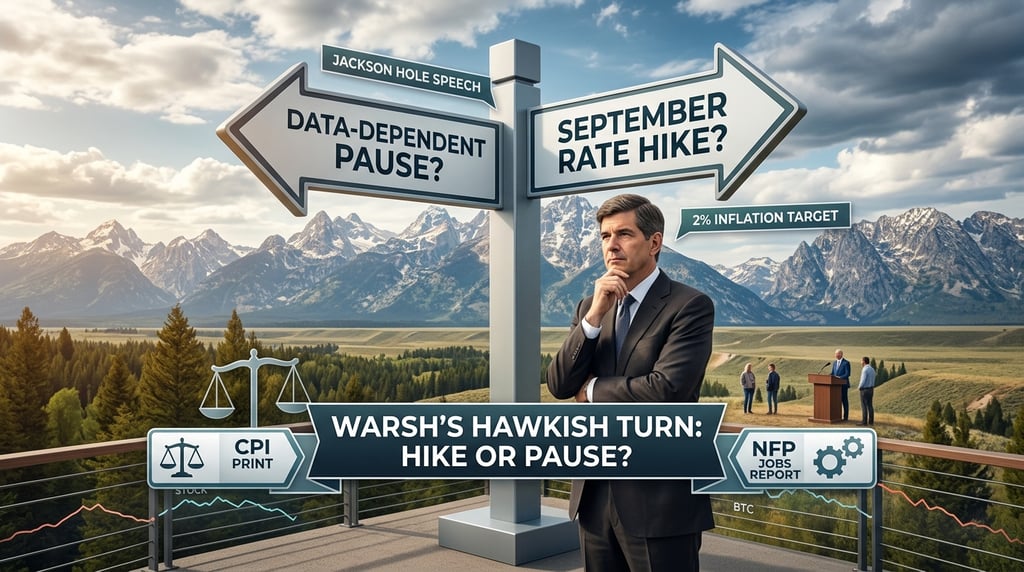
Did a single speech in Wyoming just rewrite September's rate-hike odds? Federal Reserve Chair Kevin Warsh told the Jackson Hole symposium on August 28, 2026, that if underlying inflation is not moving to 2% "clearly and at sufficient speed," the Fed still has "work to do." He did not lock in a September hike. He did lock in the framework: 2% is a firm target, the policy rate is the main tool, and recent price data have not shown enough progress.
Markets treated the message as hawkish. According to Reuters and CME FedWatch pricing cited after the speech, the implied chance of a September quarter-point hike jumped from roughly 35%-40% to about 55%-60%. The S&P 500 fell 0.25% to 7,711.76, the Nasdaq dropped 0.52%, and the Dow slipped 0.02%. Bitcoin price, which had pushed toward $81,000 earlier in the week, also pulled back toward the $78,000 area.
The next FOMC meeting is September 15-16. One more jobs report and one more CPI print will land first. That data — not the speech alone — will decide whether Warsh's hawkish words become a hike.
What Did Warsh Actually Say at Jackson Hole?
Warsh did not announce a September rate increase. He defined the standard the Fed will use.
"We must be confident that underlying inflation is moving to our objective, clearly and at sufficient speed. Otherwise, we have work to do," he said in the keynote, according to the Federal Reserve's published remarks. He called the 2% PCE target "firm" and "fixed." He also said summer PCE and CPI readings were better than expected but "do not tell me that underlying trends have meaningfully improved."
He rejected traditional forward guidance. He told the audience not to treat the speech as a reaction function or a rate path. That is consistent with his first 100 days as chair: less pre-commitment, more data dependence.
The hawkish bite came from the diagnosis, not a date. He described the labor market as consistent with full employment, financial conditions as not broadly restrictive, and inflation as still the Fed's predominant concern. Capital Economics called the message "far clearer — and hawkish — than his last press conference," according to Reuters.
Why Do the Latest Inflation Numbers Support a Hawkish Stance?
Headline PCE inflation remains too high for comfort. According to the Bureau of Economic Analysis, the PCE price index rose 3.7% over the 12 months through July 2026, unchanged from June and slightly above the 3.6% consensus. The six-month pace has been running hotter, near 4.1% annualized in recent Fed commentary. Core PCE held at 3.3% year over year. CPI comparable measures also remain well above 2%.
Warsh pointed to breadth as well as the headline. TD Economics noted that he cited 49% of goods and services in the PCE basket still running above 3% over six months — well above the pre-pandemic average. That is why "better than expected" monthly prints did not change his view of the trend.
None of these gauges is perfect. Energy shocks tied to U.S.-Iran tensions have lifted gasoline and diesel. Tariff effects have filtered into goods prices. Services inflation remains sticky. The policy implication is still blunt: the economy is not weak enough to require a rescue cut, and inflation is not clean enough to justify a relaxed pause.
Is a September Rate Hike Now Locked In?
No. A hike is possible, not promised.
Futures and prediction markets after Jackson Hole priced a coin-flip-to-lean-hike outcome. Reuters put CME odds near 60% after the speech, up from about 40%. Kalshi and related trackers around August 31 still showed a split near 50%-52% hike versus hold. That is a live debate, not a done deal.
The current target range remains 3.50%-3.75% after the July FOMC hold. That July decision was split 9-3, with three regional presidents dissenting for a hike. Warsh kept the door open without walking through it. Several private forecasts still expect a later hike — October or December — unless August CPI comes in firm. Morningstar and Navy Federal Credit Union commentary after the speech made that distinction explicit.
Incoming data can still cut the odds. July nonfarm payrolls fell 23,000, according to the Bureau of Labor Statistics, after several soft prints. Unemployment was 4.1%. Another weak jobs report or a cooler CPI reading before September 16 could "seriously weaken" hike expectations, as Warsh's own data-dependent stance implies.
Why Might Hawkish Talk Be More Useful to Warsh Than an Immediate Hike?
Hawkish language can defend Fed credibility without immediately tightening into a politically sensitive window.
Warsh was elevated to the chair by President Trump. If he sounds casual about 3.7% PCE inflation, critics will label the Fed a political extension of the White House. A clear inflation standard — 2% is fixed, short-term rates are the tool, and unfinished disinflation means "work to do" — is the cheapest way to reject that label.
An actual hike is a different calculation. Much of the latest inflation impulse traces to energy disruption from the Iran conflict and to tariff and supply shocks tied to current trade policy. Raising the policy rate is a blunt response to those shocks. It also tightens financial conditions in the months before the midterm elections. That mix makes a live hike less attractive than a verbal warning.
From that angle, Jackson Hole looks like expectation management. Talk hawkish. Keep optionality. Let the next payrolls and CPI reports carry the burden of proof. That reading is a hypothesis, not a forecast. If it is right, fears of a straight pre-midterm equity slide may be overstated, because a purely rhetorical tightening can coexist with a later bias toward easier financial conditions if the White House wants a stronger market tape into the vote. If it is wrong, sticky inflation plus a firm labor print can still produce a real 25-basis-point move in September.
What Data Still Matters Before the September FOMC?
The Fed under Warsh has become more data-dependent and less scripted.
Before September 15-16, markets will get another employment report, another CPI print, and several secondary releases. July already showed a 23,000 payroll decline and 3.7% PCE. A second weak labor print would undercut the "full employment plus high inflation" case for tightening. A hot August CPI would do the opposite.
Warsh also looks at distributional inflation measures, not just one headline. Breadth above 3%, core services, and whether financial conditions are actually restrictive all sit in that checklist. He has said he does not want markets to treat speeches as a mechanical rule. That means the September decision can still swing on two tables of government data.
Trade the Setup on KuCoin and Enter the Prize Pool
When a market narrative is in motion, the next step is not only to decide the view, but to place it where liquidity, tools, and extra incentives line up. KuCoin’s KuLeague (Fall Season 2026) futures trading competition runs from August 31 to September 21, 2026 (UTC+8) and offers a 400,000 USDT prize pool, split across a Team Battle (100,000 USDT), a Solo PnL Contest (60,000 USDT), and a Grand Lucky Draw (240,000 USDT). Trade $500 in a day to unlock a daily spin with a 100% prize rate. Use the same positions you would take for the story above — and compete for rewards at the same time:

Conclusion
Warsh's Jackson Hole speech raised the bar for inflation progress without dating a hike. The 2% PCE target is fixed. Recent 3.7% twelve-month PCE and hotter six-month readings are not compatible with a relaxed pause. Markets heard that and lifted September hike odds toward 55%-60%, while the S&P 500, Nasdaq, Dow, and Bitcoin all gave back gains.
The political and policy overlay matters. Hawkish words protect the Fed's independence narrative. An immediate hike would fight supply-and-tariff inflation with a blunt tool and would tighten conditions closer to the midterms. That is why the speech can be both genuinely hawkish and still short of a live September move.
The next payrolls report and CPI print will settle more than any Wyoming paragraph. Soft labor data can shrink hike odds quickly. Firm inflation can force the "work to do" line into a 25-basis-point decision on September 16. Until then, stocks and Bitcoin are pricing a coin-flip policy risk, not a completed tightening cycle.
FAQs
Did Warsh say the Fed will hike rates in September?
No. He said the Fed has "work to do" if underlying inflation is not clearly returning to 2% at sufficient speed, and he refused to offer forward guidance.
What inflation number is the Fed watching most closely?
The Fed's preferred gauge is PCE. According to the BEA, headline PCE was 3.7% year over year in July 2026, with core PCE at 3.3%.
Why did Bitcoin fall toward $78,000 after Jackson Hole?
Traders raised September hike odds after the speech, which tightened financial conditions and hit high-beta risk assets. Bitcoin dropped from the low $81,000s toward $78,000.
Can weak jobs data still stop a September hike?
Yes. July nonfarm payrolls fell 23,000 according to BLS. Another large miss before the September meeting would weaken the case for tightening.
Is Warsh's hawkish tone only about inflation math?
Not only. Clear anti-inflation language also defends Fed credibility after a politically appointed chairmanship, even if an immediate hike is harder to deliver before the midterms.
Disclaimer
This article is for informational purposes only and does not constitute financial, legal, or investment advice. Always conduct your own research before interacting with digital assets.