

Tokenized Stock Platforms Could Launch Next Quarter Under New SEC Exemption
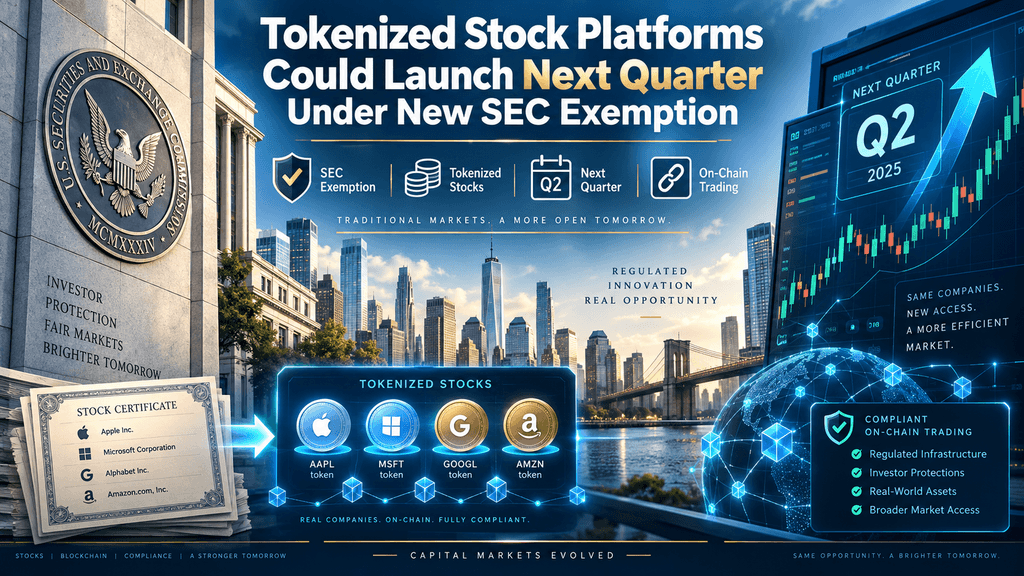
Tokenized U.S. stocks are moving closer to becoming part of regulated American capital markets. On September 17, 2026, the U.S. Securities and Exchange Commission introduced a five-year Innovation Exemption that creates a pathway for qualifying Tokenized Securities Venues, or TSVs, to facilitate onchain trading of tokenized National Market System stocks. These venues can use permissioned automated market makers and liquidity pools on public blockchains rather than relying entirely on the traditional exchange model.
Just days later, SEC Crypto Task Force chief counsel Taylor Lindman said the first firms could begin publishing the required notices outlining their plans as soon as the next quarter. That does not guarantee that a fully developed tokenized stock market will suddenly appear in Q4 2026, but it could reveal the first companies preparing to operate under the new framework.
The bigger question is no longer whether U.S. equities can technically move onchain. It is whether regulated tokenized ownership, 24/7 infrastructure and DeFi-inspired market design can become part of mainstream stock trading.
What Did the SEC Actually Approve?
The SEC's Innovation Exemption is a temporary and conditional regulatory framework rather than a permanent rewrite of U.S. securities law. It exempts qualifying Tokenized Securities Venues from the Exchange Act's definition of an “exchange” when they meet specific requirements for facilitating tokenized NMS stock trading. Certain firms that provide their own capital to liquidity pools can also receive limited relief from the definition of a dealer. The exemption is designed to last for up to five years while the SEC studies how tokenized markets operate and considers longer-term rules.
A TSV can bring buyers and sellers together through one or more permissioned AMM liquidity pools. That structure borrows technology familiar to decentralized finance, where smart contracts and liquidity pools can automatically quote prices and execute transactions rather than routing every trade through a conventional central limit order book.
This Is Onchain Finance, Not Unregulated DeFi
The distinction is important. Although the blockchain itself must be public and permissionless, access to the TSV is permissioned. Each venue has an identifiable operator responsible for defining participation standards and meeting the exemption's regulatory conditions. Lindman described the model as “more onchain finance than DeFi,” reflecting the fact that it uses blockchain-based trading mechanisms without eliminating accountable intermediaries.
The SEC is therefore experimenting with DeFi-style infrastructure without creating a completely unregulated stock market. Securities laws relating to fraud and investor protection continue to apply, while TSV operators remain responsible for complying with the specific limits imposed by the exemption.
What Does “Launch Next Quarter” Really Mean?
The phrase “next quarter” needs careful interpretation. Lindman said on September 22 that he expected some interested companies to begin publishing required notices “at some point in the next quarter.” Those notices will be the first clear public indication of which firms plan to operate under the Innovation Exemption. The relief itself is already effective, but firms need time to prepare their technology, compliance processes and liquidity arrangements.
The likely sequence is therefore more gradual than the headline may suggest. A company develops a TSV structure, prepares an operating notice, meets the exemption's requirements, handles any necessary issuer notifications, establishes permissioned access and liquidity arrangements, and then begins trading if all conditions are satisfied.
Q4 2026 may therefore be important because it could reveal who intends to build the first regulated U.S. tokenized stock venues, rather than because every major stock suddenly becomes available onchain. The difference matters for investors: a regulatory pathway has been created, but adoption still depends on companies actually building viable markets.
These Tokens Must Represent Real Stock Rights
One of the most significant parts of the SEC framework is its treatment of ownership. Tokenized NMS stocks eligible for the exemption must give holders the same rights and privileges as the corresponding conventional securities. SEC Chairman Paul Atkins specifically highlighted rights to receive dividends and exercise voting rights. Synthetic products that merely reproduce a stock's price without conveying those shareholder rights are outside the exemption.
This is a major distinction because “tokenized stock” currently describes several very different products. Some tokens are backed by securities but legally function as separate instruments, while others provide synthetic economic exposure. For example, Kraken says its xStocks are backed 1:1 by underlying equities but do not provide direct shareholder voting rights or cash dividends. Instead, the economic value of dividends is reflected through a rebasing mechanism, and xStock holders do not have a legal claim on the underlying company's shares. xStocks are also unavailable to U.S. customers.
| Feature | Existing Stock Token Models | SEC TSV Model |
| Stock price exposure | Usually | Yes |
| Underlying backing | Varies by product | Must represent qualifying tokenized NMS stock |
| Voting rights | Often absent | Same rights as traditional security |
| Dividend rights | May use alternative mechanisms | Same rights and privileges required |
| U.S. availability | Many products restricted | Designed for a U.S. regulatory framework |
| Synthetic stock exposure | Common in some markets | Excluded from exemption |
| Onchain trading | Yes | Yes, through qualifying TSVs |
The SEC's approach therefore attempts to move the industry beyond putting familiar stock tickers on blockchain tokens. The goal is closer to putting actual securities ownership onchain.
The Innovation Exemption also gives publicly traded companies an important role. A third party unaffiliated with an issuer can potentially tokenize that company's stock, but the issuer must be given an opportunity to object before the tokenized security trades on a TSV. SEC officials have described this protection as a way to preserve issuer control while still allowing third-party tokenization models to develop.
Crypto In America reports that an issuer generally receives a 30-day opportunity to object. If the company objects, the unaffiliated third party's tokenized version cannot trade on that TSV under the exemption. Commissioner Hester Peirce said she had heard substantial interest from issuers and did not expect objections to undermine the overall experiment, although the mechanism gives companies meaningful influence over how their shares appear in onchain markets.
This adds a new dimension to tokenization. Future headlines may not simply announce that a crypto platform has launched a tokenized version of Apple, Nvidia or another public company. Investors may also need to watch whether the issuer supports, participates in or objects to the tokenization. Corporate governance and issuer relationships could become as important as blockchain technology itself.
Could Tokenized Stocks Make U.S. Markets Trade 24/7?
Round-the-clock trading is one of the most widely discussed advantages of putting stocks onchain. Traditional U.S. equities remain centered around established exchange sessions, even though premarket, after-hours and overnight trading have expanded. Blockchain networks, by contrast, can operate continuously, allowing token transfers and potentially trading on weekends and holidays.
Existing overseas products already demonstrate some of this potential. Kraken says selected xStocks can trade 24/7 on Kraken Pro and can also move between compatible onchain wallets. The platform lists instant or near-instant blockchain settlement, fractional investment and self-custody among the differences between xStocks and conventional shares.
24/7 Trading Creates a New Price Discovery Problem
Continuous markets also create a difficult pricing question. Suppose significant Nvidia news breaks on Sunday. A tokenized NVDA product might continue trading while the main Nasdaq market is closed. That could allow investors to react immediately, but weekend liquidity may be thinner and spreads wider. The tokenized price could move sharply away from the last conventional market price before arbitrage becomes possible when traditional venues reopen.
Always-on trading is therefore both one of tokenization's biggest potential advantages and one of its hardest market-structure problems. Making a token tradable at all times is technically straightforward; ensuring that it remains liquid, fairly priced and closely connected to the underlying security is much harder.
AMMs Could Change How Stocks Trade
The use of automated market makers may be even more disruptive than extended trading hours. Traditional stock markets generally depend on exchanges, order books and professional market makers. Buyers submit bids, sellers submit offers, and trades occur when prices match. AMMs replace that interaction with pools of assets governed by smart-contract rules.
Under the new exemption, a permissioned participant could interact with an AMM liquidity pool containing tokenized stock and another settlement asset rather than waiting for a traditional order-book counterparty. The SEC specifically designed the exemption around this new market structure, arguing that tokenization may help modernize trading, transfer, settlement and ownership records.
That model creates new considerations for equity investors. Liquidity depth, slippage, pool composition and arbitrage become increasingly important. If a tokenized Apple stock trades through an AMM, the quality of the investor experience will depend heavily on how much capital liquidity providers commit to the pool and how efficiently outside market participants keep the tokenized price aligned with the conventional AAPL market.
Who Could Build the First U.S. Platforms?
The SEC has not announced a list of companies that will operate the first TSVs. That distinction matters because existing interest does not guarantee participation. Reuters reported that crypto companies including Coinbase and Robinhood have shown interest in the U.S. tokenized-stock market, while several crypto platforms already offer stock-token products outside the United States.
Robinhood provides one example of how far international experimentation has already progressed. CEO Vlad Tenev said on September 9 that Robinhood Chain had roughly 200 stock tokens, describing them as 1:1-backed representations of U.S. stocks that are DeFi-composable. He said the infrastructure could eventually provide market access across more than 120 countries outside the United States.
The competition may eventually involve three groups: crypto-native exchanges with blockchain infrastructure, brokerages with existing equity customers, and traditional market-infrastructure companies with deep experience in compliance, settlement and issuer relationships. The likely result is less a simple “crypto versus Wall Street” battle than a race to combine crypto's programmable technology with traditional finance's liquidity and regulatory infrastructure.
Tokenized Stocks Could Bring Equities Into DeFi
The longer-term opportunity extends beyond buying shares outside normal market hours. Once an equity exists as a blockchain-native token, it can potentially interact with smart contracts in ways a position locked inside a brokerage account generally cannot. Existing xStocks provide a glimpse of that model: Kraken says eligible tokens can be used as collateral in protocols such as Kamino and Morpho, supplied to liquidity pools or used in blockchain lending markets.
A future regulated tokenized security could theoretically allow an investor to hold stock exposure while also using the asset as collateral to access liquidity. For example, an investor might hold a tokenized equity, pledge it to a compatible onchain lending system, borrow stablecoins and deploy those funds elsewhere without immediately selling the stock position. That resembles securities-backed lending in traditional finance but could become more programmable and interoperable on blockchain networks.
However, the SEC exemption should not be interpreted as blanket approval for every imaginable DeFi use of tokenized securities. It specifically creates a pathway for onchain trading through qualifying TSVs. Broader lending, collateral and self-custody applications may raise additional securities-law, custody and investor-protection questions. The immediate breakthrough is regulated onchain ownership and trading; deeper DeFi integration would be a later stage.
Why This Matters for the RWA Market
Real-world asset tokenization has so far been driven heavily by stablecoins, tokenized U.S. Treasuries, money-market funds and private credit. These products bring existing financial value onto blockchain networks, but their primary use cases often center on payments, yield or cash management.
Equities could push RWA tokenization in a different direction. Public stocks are already among the most familiar and actively traded assets in the world. They combine potential capital appreciation with dividends, voting rights and corporate ownership. Moving those assets onchain could therefore expand RWA from a relatively specialized yield and settlement market into a broader onchain capital-market ecosystem.
That is why the SEC's exemption matters beyond a handful of Stock Tokens. If regulated equities can be issued, traded, transferred and eventually used across blockchain-based financial infrastructure, RWA tokenization may evolve from simply representing traditional assets to rebuilding some of the infrastructure through which those assets change hands.
What Could Slow the Tokenized Stock Boom?
Tokenization does not remove every friction in financial markets. In some cases, it creates new ones. The first challenge is liquidity fragmentation. If several tokenized versions of the same stock exist across multiple blockchains and venues, trading activity may be divided into smaller pools. Investors could encounter different prices, spreads and legal structures for tokens that all appear to represent the same underlying company.
Ownership and custody are equally important. Investors need to know where underlying shares are held, who maintains shareholder records, how corporate actions are processed and what happens if an intermediary or platform fails. Stock splits, mergers, dividends, voting events and trading halts all have to be reflected correctly in the tokenized system. A blockchain record can make transfers transparent, but it does not by itself resolve the legal questions surrounding securities ownership.
| Opportunity | Main Challenge |
| 24/7 trading | Thin off-hours liquidity |
| AMM-based markets | Slippage and price discovery |
| Faster onchain settlement | Integration with existing settlement systems |
| Self-custody potential | Investor protection and key management |
| DeFi composability | Securities-law and custody requirements |
| Global blockchain access | Jurisdiction and eligibility restrictions |
Regulatory uncertainty also remains. The Innovation Exemption lasts for five years and includes limits on the number of stocks a venue may offer and the volume it may handle. Peirce has described the exemption as a bridge toward longer-term rules rather than an endpoint. SEC officials believe the current caps are large enough for meaningful commercial experimentation, but permanent adoption will ultimately require a more durable framework.
What Should Investors Watch Next?
The first major signal will be the publication of TSV operating notices. Those documents should begin revealing which companies are serious about using the exemption and how they plan to structure their markets. Investors should look at the blockchain selected, the stocks proposed for tokenization, the operator's custody structure, eligibility rules, liquidity providers and how closely the model integrates with existing securities infrastructure.
Issuer participation will be another major indicator. If well-known public companies actively support tokenization rather than merely tolerating it, the market could develop very differently from today's third-party Stock Token model. Conversely, repeated issuer objections could limit the number of high-profile securities available through TSVs.
Finally, trading activity will matter more than launch announcements. A platform can offer dozens of tokenized equities and still fail to build a meaningful market. The key measures will be liquidity, spreads, trading volume, active investors and the ability of tokenized prices to remain closely aligned with conventional shares. The next important milestone is therefore not simply another regulatory announcement—it is evidence that investors actually want to use these venues.
Could Tokenized Stocks Change Wall Street?
Tokenized stocks do not need to replace Nasdaq, NYSE or traditional brokers to have a major impact. Even shifting a portion of equity trading, settlement or collateral management to blockchain infrastructure could change how financial firms think about market hours, custody and asset mobility.
Supporters point to 24/7 trading, programmable ownership, faster settlement and greater interoperability. The SEC's exemption adds something that earlier Stock Token experiments often lacked: a defined U.S. regulatory pathway tied to real shareholder rights. At the same time, the model still has to prove that AMM-based stock markets can provide sufficient liquidity and investor protection at scale.
The most likely near-term development is therefore convergence rather than replacement. Crypto platforms may adopt more securities-market controls, while traditional financial institutions increasingly use blockchain rails. The boundary between a “crypto exchange” and a “stock market” could become less clear if both eventually trade regulated tokenized securities.
🔥 Beyond the Headlines: What KuCoin 5.0 Means for You
Market news moves fast — but where you act on it matters just as much. This October, KuCoin launches KuCoin 5.0, transforming KuCoin into a rebuilt platform. Here's what actually changes for you:
-
One account for everything. Older platforms split your money across separate "spot," "margin," and "futures" accounts and expected you to understand why. KuCoin 5.0's unified account removes that entirely — deposit once, and everything is simply there (only available to VIPs for now).
-
Stocks, indices, and commodities. KuCoin 5.0 expands beyond crypto into global markets. When crypto chops sideways and equities rally (or the reverse), you rotate in minutes instead of opening a brokerage account and waiting days for fiat rails.
-
Real-world assets (RWA). Tokenized exposure to traditional assets like commodities, right inside your crypto account. One of the fastest-growing segments in global finance is no longer reserved for institutions — you access it from the same balance you trade with.
-
Earn while you learn. Not ready to trade? KCUSD lets your stablecoins earn daily, auto-compounding interest. The lowest-stress way to put your idle deposit to work for 4% yield.
-
An AI assistant in plain language. Ask questions, get market context, understand what you're looking at — built into the platform, no jargon required.
-
An app that doesn't overwhelm. Faster, cleaner, and consistent — intuitive from the first tap, not after a tutorial.
-
Safety you can check, not just trust. A MiCAR-licensed EU entity, Proof of Reserves you can verify yourself, and internationally certified security (SOC 2 Type II, ISO 27001:2022).
Create your account in minutes — and start on the platform built for where crypto is going, not where it's been.
Conclusion: From Stock Tokens to Onchain Stock Markets
The SEC's Innovation Exemption marks an important change in the U.S. tokenized-stock market. Rather than merely allowing blockchain products to track equity prices, the framework creates a five-year path for qualifying venues to trade tokenized NMS stocks with the same shareholder rights as conventional securities. Permissioned AMMs and public blockchains introduce a new market structure, while issuer-objection rights and regulatory limits attempt to preserve investor and corporate protections.
The next quarter could provide the first concrete evidence of how much industry demand exists. SEC officials expect firms to begin publishing TSV notices, but that should be viewed as the start of market formation rather than a guarantee of immediate large-scale trading.
The next phase of tokenization will ultimately be judged not by how many stock tickers appear on blockchains, but by whether issuers, liquidity providers and investors are willing to move meaningful capital-market activity onchain. If they are, Stock Tokens could evolve from a crypto product into a new layer of financial-market infrastructure.
FAQs
Do Investors Need a Crypto Wallet to Buy Tokenized Stocks?
Not necessarily. The answer will depend on each venue's design. Some platforms could provide tokenized-stock exposure through managed accounts, while others may allow users to withdraw assets to compatible self-custody wallets. The SEC's TSV framework itself does not mean every investor must manage private keys.
Can Tokenized Stocks Be Transferred Between Platforms?
Transferability depends on the security's technical and legal design. Even when a token uses a public blockchain, securities-law restrictions, investor whitelists, compliance requirements and platform compatibility can limit where it can move. Tokenized securities should therefore not automatically be assumed to be as freely transferable as ordinary cryptocurrencies.
What Happens to a Tokenized Stock During a Stock Split?
A properly structured tokenized security needs a mechanism to reflect corporate actions such as stock splits, mergers and distributions. The exact process will depend on the issuer, transfer infrastructure and tokenization model. Investors should review how each venue handles corporate actions before treating a tokenized share as operationally identical to a conventional share.
Can Tokenized Stocks Be Held in Retirement Accounts?
Potentially, but availability will depend on the brokerage, custodian, account type and final structure of the tokenized product. The existence of an SEC exemption for TSV trading does not automatically make every tokenized stock eligible for IRA or other retirement-account use.
Are Tokenized Stocks Insured Like Bank Deposits?
No. Securities and bank deposits operate under different protection regimes. FDIC insurance generally applies to qualifying bank deposits, not stock-market investments. Any protections available to a tokenized security investor would depend on the platform, custodian, legal ownership structure and applicable securities regulations.
Disclaimer: This content is for informational purposes only and does not constitute investment advice. Stock investments carry risk. Please do your own research (DYOR).