

Ripple CLO Steps Up CLARITY Act Push Ahead of Crucial September 15 Senate Vote
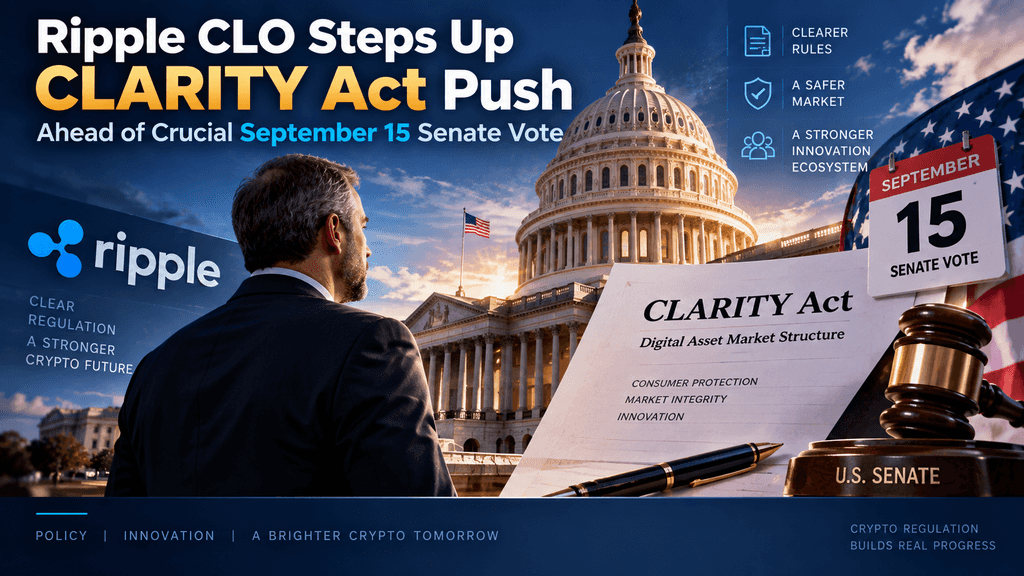
Ripple Chief Legal Officer Stuart Alderoty is intensifying his push for U.S. crypto legislation just days before the CLARITY Act faces a crucial Senate test. Alderoty has contacted senators who oppose the bill or remain undecided, asking them to hear directly from ordinary cryptocurrency holders before casting their votes. His appeal comes as the industry races to secure enough bipartisan support to clear a 60-vote procedural hurdle on September 15.
The timing is particularly important. Congress is approaching the 2026 midterm elections, disagreements over ethics rules, DeFi and stablecoin incentives remain unresolved, and banking groups are mounting their own campaign to change parts of the legislation. At the same time, XRP is trading near $1.40 as investors navigate rising oil prices, elevated Treasury yields and uncertainty over the Federal Reserve's next rate decision.
The September 15 vote will not make the CLARITY Act law. But it could determine whether comprehensive U.S. crypto market-structure legislation still has a realistic path forward this year.
What Is Happening With the CLARITY Act?
The Digital Asset Market Clarity Act, or CLARITY Act, has already moved through several important stages in Congress. The House of Representatives approved H.R.3633 in July 2025 with significant bipartisan support, and the Senate Banking Committee advanced its version in May 2026. The legislation is now approaching one of its most difficult political tests: securing enough support to move into formal Senate consideration.
The Senate schedule states that the cloture motion relating to the motion to proceed to H.R.3633 will ripen on September 15 at 2:15 p.m. Eastern Time. This is a procedural vote rather than a final vote on passage. If cloture is invoked, the Senate can move forward with debate and potential amendments to the legislation.
That distinction matters because headlines describing September 15 as the day Congress will "pass or reject" the CLARITY Act oversimplify the process. The immediate question is whether senators are willing to formally advance the legislation. Reaching that stage requires 60 votes, meaning Republican supporters need Democratic votes as well. The result will therefore provide one of the clearest tests yet of whether bipartisan support for comprehensive crypto legislation remains strong enough to survive the current political environment.
What Does the CLARITY Act Actually Do?
The CLARITY Act is best understood as a crypto market-structure bill. Rather than regulating only one token, exchange or part of the industry, it attempts to establish a broader framework governing how digital assets are classified and which federal regulator has authority over different parts of the market.
One of the central issues is the long-running jurisdictional divide between the Securities and Exchange Commission and the Commodity Futures Trading Commission. Crypto companies have repeatedly argued that uncertainty over when a digital asset should be treated as a security has made it difficult to know which rules apply before launching or listing products. CLARITY attempts to provide clearer definitions and a regulatory pathway for digital commodities, trading platforms, brokers, dealers and token issuers.
The bill is therefore broader than the GENIUS Act, which established a federal framework specifically for payment stablecoins in 2025. The simplest distinction is that the GENIUS Act addresses stablecoin issuance and reserves, while CLARITY seeks to define the rules for the wider digital asset market. That makes the Senate battle relevant far beyond Ripple or XRP.
Why Ripple Wants Regulatory Clarity
Ripple has stronger reasons than most crypto companies to support a clear market-structure framework. Its years-long confrontation with the SEC became one of the best-known examples of the industry's complaint about "regulation by enforcement"—the idea that companies were often forced to learn where regulators believed the legal boundary lay only after enforcement proceedings had already begun.
Alderoty has consistently argued that congressional legislation would provide greater durability than rules created only by regulatory agencies. In August, he described September 15 as a "bellwether" for the CLARITY Act and said that even if Congress fails to act, the SEC and CFTC will continue writing crypto rules. The difference is that legislation passed by Congress is generally harder for future administrations to reverse than agency policy.
His latest strategy also broadens the argument beyond Ripple. On September 8, Alderoty said he had asked the offices of senators who oppose CLARITY or remain undecided to meet an ordinary American crypto holder before voting. He pointed to National Cryptocurrency Association research estimating that around 67 million Americans now own cryptocurrency. The message is clear: supporters want senators to view crypto regulation not merely as an industry lobbying issue, but as a policy question affecting a substantial number of voters.
Why the Senate Vote Is in Doubt
Despite strong support from much of the crypto industry, CLARITY does not have an easy path through the Senate. Reuters reported on September 9 that crypto organizations and banking groups have both intensified lobbying in senators' home states ahead of the vote. Stand With Crypto, the Blockchain Association and other industry organizations are pushing for passage, while banking representatives are seeking changes to provisions they believe could threaten traditional deposits.
Several political disputes remain unresolved. Democratic lawmakers have pressed for stronger ethics provisions related to the crypto interests of senior government officials. Others have raised concerns about anti-money-laundering safeguards and the treatment of decentralized finance. Banks, meanwhile, are particularly focused on stablecoin incentives. They worry that products resembling yield-bearing digital dollars could encourage customers to move cash away from bank deposits, potentially increasing funding costs for smaller institutions. Republicans also do not appear completely united around the existing text.
That makes the fight more complicated than a simple pro-crypto versus anti-crypto divide. The Senate is balancing consumer protection, political ethics, financial stability, innovation and competition between banks and crypto companies. Reaching 60 votes requires enough senators to accept a compromise across several of those issues simultaneously.
Why September 15 Matters So Much
A successful cloture vote would not mean the CLARITY Act is finished. It would allow the Senate to proceed toward debate, where lawmakers could still modify important provisions covering DeFi, stablecoins, ethics rules and regulatory jurisdiction. The Senate would eventually need to approve a final version, and because its text may differ from the version already passed by the House, both chambers ultimately must approve identical legislation before it can be sent to the president.
The political calendar makes that process more difficult. The 2026 midterm elections are approaching, and Reuters reports that the crypto industry views the current legislative window as especially important. If control of Congress changes after the election, committee leadership and legislative priorities could also change, making it much harder to carry the existing momentum into a new Congress.
September 15 therefore matters less because it represents a final verdict and more because it tests whether a viable coalition still exists. A failure to reach the 60-vote threshold would not permanently kill the idea of crypto market-structure legislation, but it could sharply reduce the chances of completing a bill during the current congressional cycle.
What Could the Vote Mean for XRP?
For XRP investors, the most important point is what the vote does not do. A successful September 15 vote would not automatically declare XRP a commodity, approve a new XRP investment product or guarantee a price rally. It is a procedural step affecting the broader U.S. digital asset regulatory framework rather than a direct legal ruling on XRP itself.
The potential market impact instead comes through regulatory expectations. XRP has historically been especially sensitive to U.S. regulatory developments because Ripple's legal battles placed the asset at the center of the debate over token classification. If investors become more confident that Congress will ultimately create predictable rules separating digital commodities from securities and defining SEC and CFTC authority, some of the regulatory uncertainty surrounding the broader market could decline.
As of September 10, XRP was trading around $1.40, down slightly from the previous day and well below levels seen a year earlier. The relatively restrained price action suggests that the market is not treating a favorable CLARITY outcome as guaranteed. A positive Senate vote could improve sentiment, while a failure could reinforce regulatory uncertainty, but the final price response will depend on much more than Washington.
XRP Is Not Trading on Regulation Alone
The CLARITY Act is arriving at a difficult moment for global risk markets. Brent crude has moved above $100 per barrel as escalating Middle East tensions raise concerns about energy supply and renewed inflation. At the same time, the U.S. 10-year Treasury yield has been trading near 4.84%, around its highest level since 2023, as investors reassess the outlook for inflation and monetary policy.
Higher oil prices matter to crypto because they can keep inflation elevated, reducing the Federal Reserve's ability to ease monetary policy. Markets currently see roughly a 60% chance of another Fed rate increase, with upcoming U.S. inflation data likely to play a major role in expectations ahead of the September 16 policy decision. Higher Treasury yields also increase the return investors can earn from lower-risk assets, which can create a more difficult environment for Bitcoin, XRP and other speculative investments.
Bitcoin has recently struggled to decisively clear $80,000 after stronger U.S. employment data added to rate concerns. XRP therefore faces two overlapping catalysts: regulatory news from the CLARITY Act and macroeconomic signals from inflation, oil and the Fed. Even a favorable Senate development could be partly offset if bond yields continue climbing or markets become more risk-averse.
What Happens If the Vote Passes?
If the Senate reaches the necessary threshold to invoke cloture, the immediate market interpretation would likely be that CLARITY remains politically viable. That could improve sentiment across U.S.-focused crypto assets and companies because the probability of a comprehensive market-structure framework would increase.
Attention would then shift quickly from whether the bill can advance to what the final legislation will actually contain. Changes involving stablecoin rewards, DeFi protections, ethics provisions or the balance of power between the SEC and CFTC could materially change how attractive the bill looks to different parts of the industry. Ripple and other crypto companies would therefore still have reasons to lobby lawmakers even after a successful procedural vote.
For XRP, the result would be better described as a reduction in regulatory uncertainty than a direct fundamental change to the token. A successful cloture vote would be an important political signal, but investors would still need to follow subsequent amendments, the final Senate vote and any negotiations with the House.
What Happens If the Vote Fails?
Failure would be a more serious setback for supporters because it would show that the current coalition cannot reach the 60 votes needed to advance the legislation. With the congressional calendar tightening ahead of the midterms, finding another opportunity for a major bipartisan crypto bill could become increasingly difficult.
The difference is durability. Agency rules can change as administrations, regulators and courts change. For Ripple and many other industry participants, congressional legislation offers the possibility of a more stable framework that survives political transitions. A failed September vote would therefore represent a setback for legislative certainty rather than the end of U.S. crypto regulation.
Why This Matters Beyond Ripple
CLARITY is often discussed alongside Ripple because Alderoty has become one of its most visible advocates, but its potential impact extends across the digital asset industry. Exchanges need to know how to register and which regulator oversees their activities. Token issuers need clearer rules around fundraising and secondary-market trading. Institutional investors need confidence that assets and counterparties operate within predictable legal boundaries.
The lobbying battle also highlights how much crypto's relationship with traditional finance has changed. Banks are no longer simply opposing digital assets. Many are launching stablecoin, tokenization and blockchain initiatives of their own while simultaneously trying to protect traditional deposits and banking rules. The dispute surrounding CLARITY is therefore increasingly about who sets the rules for a financial system in which conventional institutions and crypto-native companies are beginning to compete in the same markets.
The bill's biggest long-term consequence would not be determining the fate of one cryptocurrency. It would be establishing a more predictable operating framework for a large part of the U.S. digital asset economy. That is why the September 15 vote is attracting attention from Ripple, exchanges, banks, investors and policymakers at the same time.
🔥 Beyond the Headlines: What KuCoin 5.0 Means for You
Market news moves fast — but where you act on it matters just as much. This October, KuCoin launches KuCoin 5.0, transforming KuCoin into a rebuilt platform. Here's what actually changes for you:
-
One account for everything. Older platforms split your money across separate "spot," "margin," and "futures" accounts and expected you to understand why. KuCoin 5.0's unified account removes that entirely — deposit once, and everything is simply there.
-
Stocks, indices, and commodities. KuCoin 5.0 expands beyond crypto into global markets. When crypto chops sideways and equities rally (or the reverse), you rotate in minutes instead of opening a brokerage account and waiting days for fiat rails.
-
Real-world assets (RWA). Tokenized exposure to traditional assets like commodities, right inside your crypto account. One of the fastest-growing segments in global finance is no longer reserved for institutions — you access it from the same balance you trade with.
-
Earn while you learn. Not ready to trade? KCUSD lets your stablecoins earn daily, auto-compounding interest. The lowest-stress way to put your idle deposit to work for 4% yield.
-
An AI assistant in plain language. Ask questions, get market context, understand what you're looking at — built into the platform, no jargon required.
-
An app that doesn't overwhelm. Faster, cleaner, and consistent — intuitive from the first tap, not after a tutorial.
-
Safety you can check, not just trust. A MiCAR-licensed EU entity, Proof of Reserves you can verify yourself, and internationally certified security (SOC 2 Type II, ISO 27001:2022).
Create your account in minutes — and start on the platform built for where crypto is going, not where it's been.
Conclusion
Ripple CLO Stuart Alderoty's latest push reflects how important the next stage of the CLARITY Act has become for the U.S. crypto industry. By asking undecided senators to hear directly from cryptocurrency holders, he is trying to broaden the debate beyond companies and lobbyists just as the legislation approaches a difficult 60-vote threshold.
September 15 will not decide whether CLARITY becomes law, nor will a successful vote automatically change XRP's legal status. It will instead show whether Congress still has enough bipartisan support to move comprehensive crypto market-structure legislation forward in 2026.
For XRP investors, that makes the vote an important regulatory catalyst, but not the only one. Oil above $100, Treasury yields near multi-year highs and uncertainty over the Federal Reserve remain equally important for market liquidity. The real significance of CLARITY is therefore larger than any single price move: it is a test of whether U.S. crypto regulation can move from fragmented enforcement toward a more durable legislative framework.
FAQs
What time is the CLARITY Act Senate vote?
The cloture motion relating to H.R.3633 is scheduled to ripen on September 15, 2026 at 2:15 p.m. Eastern Time. Senate floor procedures can still affect the exact timing of subsequent action.
Does the CLARITY Act regulate Bitcoin?
The legislation is not specific to Bitcoin. It creates a broader framework for digital assets, including the regulation of digital commodity markets, exchanges and intermediaries.
Is the CLARITY Act the same as the GENIUS Act?
No. The GENIUS Act primarily establishes rules for payment stablecoins, while the CLARITY Act focuses on the broader structure and regulation of U.S. digital asset markets.
Could the CLARITY Act affect crypto exchanges?
Yes. One of the legislation's major objectives is to clarify registration and oversight requirements for digital asset trading platforms and related intermediaries.
Can the CLARITY Act return if the September vote fails?
Yes. A failed procedural vote would not permanently prevent Congress from considering the legislation or similar bills later. However, the approaching 2026 midterm elections could make another near-term attempt more difficult.
Disclaimer: This content is for informational purposes only and does not constitute investment advice. Cryptocurrency investments carry risk. Please do your own research (DYOR).