

Navigating the Shift: Russian Central Bank Interest Rate Cuts and Crypto Market Implications
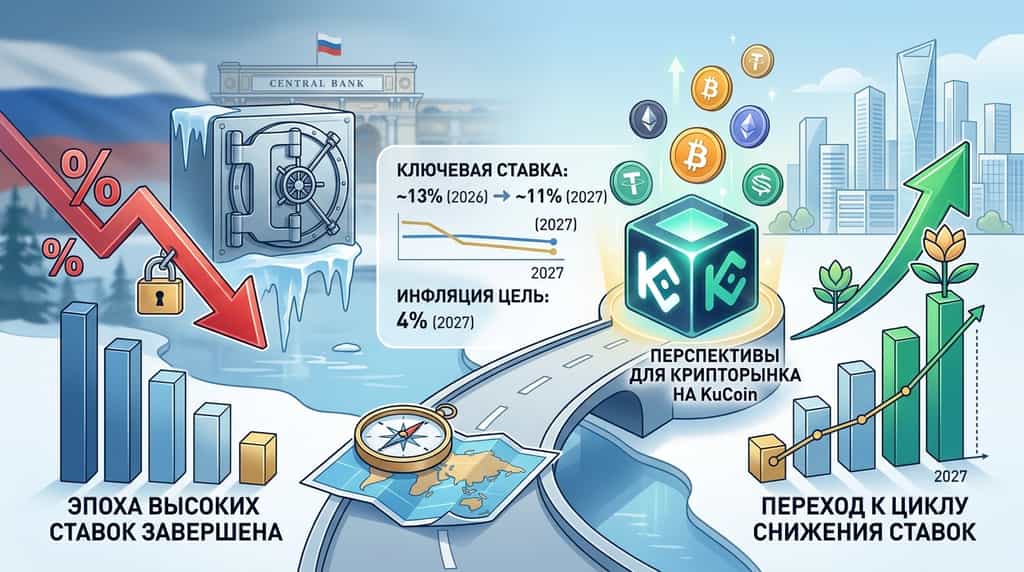
The Russian Central Bank has officially concluded its prolonged phase of ultra-high interest rates, marking the transition into a structural rate-cut cycle that is reshaping domestic financial markets, capital allocation, and cryptocurrency trading strategies. According to data and macroeconomic briefings reported by Vedomosti in October 2026, major financial sector leaders, including Sberbank CEO German Gref, confirmed that the Central Bank has initiated its benchmark interest rate reduction trajectory. With annual inflation projections targeting 6 to 7 percent for 2026 and stabilizing toward the 4 percent target by 2027, the macroeconomic backdrop is shifting away from restrictive monetary tightening. This policy pivot carries profound implications for digital assets, liquidity flows, and how investors hedge purchasing power amid evolving monetary regimes.
The decision to transition away from peak monetary tightening stems from stabilizing inflation metrics and the critical need to stimulate business investment and credit expansion. Based on macroeconomic reviews and statements from the Bank of Russia, the regulator held the key rate steady at 14 percent following a sustained phase of monetary policy adjustments, setting the stage for medium-term easing.
High nominal interest rates successfully suppressed short-term consumer credit and cooled domestic overheating, but they simultaneously drove up capital costs for industrial sectors and real asset developers. As core inflation indices align with central bank forecasts, maintaining punitive borrowing costs risks constraining long-term economic productivity. Consequently, financial authorities are pivoting toward a gradual normalization of monetary conditions to support business development and capital availability.
Transitioning from monetary tightening to a rate-reduction cycle directly alters domestic and cross-border liquidity distribution, driving capital away from risk-free fixed income instruments and into alternative asset classes. Based on financial market analytics from CoinMarketCap and industry performance metrics, falling sovereign yields historically reduce the attractiveness of local bank deposits, prompting institutional and retail participants to seek yield in growth assets, including digital currencies and tokenized commodities.
When risk-free yields decline, holding cash or short-term debt instruments yields lower real returns after accounting for inflation. Investors naturally reallocate portfolios toward assets with asymmetric return profiles, such as decentralized finance protocols, blue-chip cryptocurrencies, and stablecoins. This structural rotation increases trading volume and capital velocity across major digital asset exchanges, creating a more dynamic environment for crypto spot and derivatives trading.
Financial authorities and major commercial banking institutions project a steady downward trajectory for benchmark interest rates over the next twelve to twenty-four months. According to forecasts published by Sberbank and official Bank of Russia monetary policy guidelines in October 2026, the key interest rate is expected to decline to the 13 to 13.5 percent range by the end of 2026.
Looking further ahead into 2027, the baseline macroeconomic forecast anticipates the average key interest rate settling between 10.5 and 12.5 percent, a noticeable downward adjustment from the 14.5 to 14.6 percent averages recorded throughout 2026. This predictable, gradual easing path allows market participants to forecast corporate borrowing costs, plan capital expenditure cycles, and rebalance investment portfolios with greater confidence in medium-term monetary stability.
Cryptocurrency valuations are highly sensitive to global and regional liquidity expansions, reacting favorably as central banks reduce the cost of capital. Based on digital asset market correlations tracked by leading analytics platforms, lower interest rates expand the aggregate money supply and lower the opportunity cost of holding non-yielding assets like Bitcoin and Ethereum.
As traditional fixed-income yields contract, capital inflows into digital asset markets accelerate. Institutional investors utilize cryptocurrencies as both a hedge against currency depreciation and a high-beta growth allocation. Furthermore, lower borrowing costs enable leveraged trading desks and market makers to access liquidity more efficiently, driving tighter bid-ask spreads, enhanced market depth, and increased trading activity across global exchanges.
Market news moves fast — but where you act on it matters just as much. This October, KuCoin launches KuCoin 5.0, transforming KuCoin into a rebuilt platform. Here's what actually changes for you:
-
One account for everything. Older platforms split your money across separate "spot," "margin," and "futures" accounts and expected you to understand why. KuCoin 5.0's unified account removes that entirely — deposit once, and everything is simply there (only available to VIPs for now).
-
Stocks, indices, and commodities. KuCoin 5.0 expands beyond crypto into global markets. When crypto chops sideways and equities rally (or the reverse), you rotate in minutes instead of opening a brokerage account and waiting days for fiat rails.
-
Real-world assets (RWA). Tokenized exposure to traditional assets like commodities, right inside your crypto account. One of the fastest-growing segments in global finance is no longer reserved for institutions — you access it from the same balance you trade with.
-
Earn while you learn. Not ready to trade? KCUSD lets your stablecoins earn daily, auto-compounding interest. The lowest-stress way to put your idle deposit to work for 4% yield.
-
An AI assistant in plain language. Ask questions, get market context, understand what you're looking at — built into the platform, no jargon required.
-
An app that doesn't overwhelm. Faster, cleaner, and consistent — intuitive from the first tap, not after a tutorial.
-
Safety you can check, not just trust. A MiCAR-licensed EU entity, Proof of Reserves you can verify yourself, and internationally certified security (SOC 2 Type II, ISO 27001:2022).
Create your account in minutes — and start on the platform built for where crypto is going, not where it's been.
The official conclusion of the Russian Central Bank's high-interest-rate phase and the initiation of a rate-cutting cycle mark a pivotal turning point for macroeconomic stability and asset allocation strategies. With key interest rates projected to decline toward 13 percent by late 2026 and further moderate into 2027, the financial landscape is shifting from capital preservation toward growth-oriented investment. This monetary easing environment enhances liquidity availability, reduces the appeal of low-yielding fixed income, and historically drives increased participation in alternative asset classes, including digital currencies. Understanding these macroeconomic shifts allows investors to navigate changing monetary regimes effectively, optimizing portfolio positioning for the next phase of economic development.
What was the peak key interest rate level before the Central Bank initiated rate cuts?
The Bank of Russia maintained the key interest rate at 14 percent following an extended phase of monetary tightening before pausing and shifting toward the current rate-cut trajectory.
How do declining interest rates impact inflation expectations in Russia?
The Central Bank projects that annual inflation will settle between 6 and 7 percent in 2026 before returning to its target level of 4 percent by 2027 as monetary conditions normalize.
Why do lower interest rates historically benefit cryptocurrency markets?
Lower interest rates reduce the yields on traditional safe-haven assets and cash, lowering the opportunity cost of holding non-yielding digital assets and increasing aggregate market liquidity.
What are the projected average interest rates for 2027?
According to official baseline forecasts and major banking analytics, the average key interest rate in 2027 is expected to range between 10.5 and 12.5 percent.
How can traders position themselves ahead of a central bank easing cycle?
Traders typically reallocate portfolios away from fixed-income instruments toward growth assets, increase exposure to liquid cryptocurrencies, and utilize professional exchange platforms to manage market volatility.
Disclaimer: This article is for informational purposes only and does not constitute financial, legal, or investment advice. Always conduct your own research before interacting with digital assets.