

Memory Chip Stocks Surge Amid Low VIX: Why Storage Remains the Strongest Sector in US Markets
2026/08/18 11:07:00
Introduction
The VIX index has fallen steadily since early August 2026, dropping from near 20 to around 15, with a recent low of 14.2 according to Cboe data as of mid-August. This decline in the so-called fear gauge has coincided with the S&P 500 rising roughly 16% year-to-date, continuous equity fund inflows for 12 weeks, and multiple record highs for US stocks over three consecutive weeks.
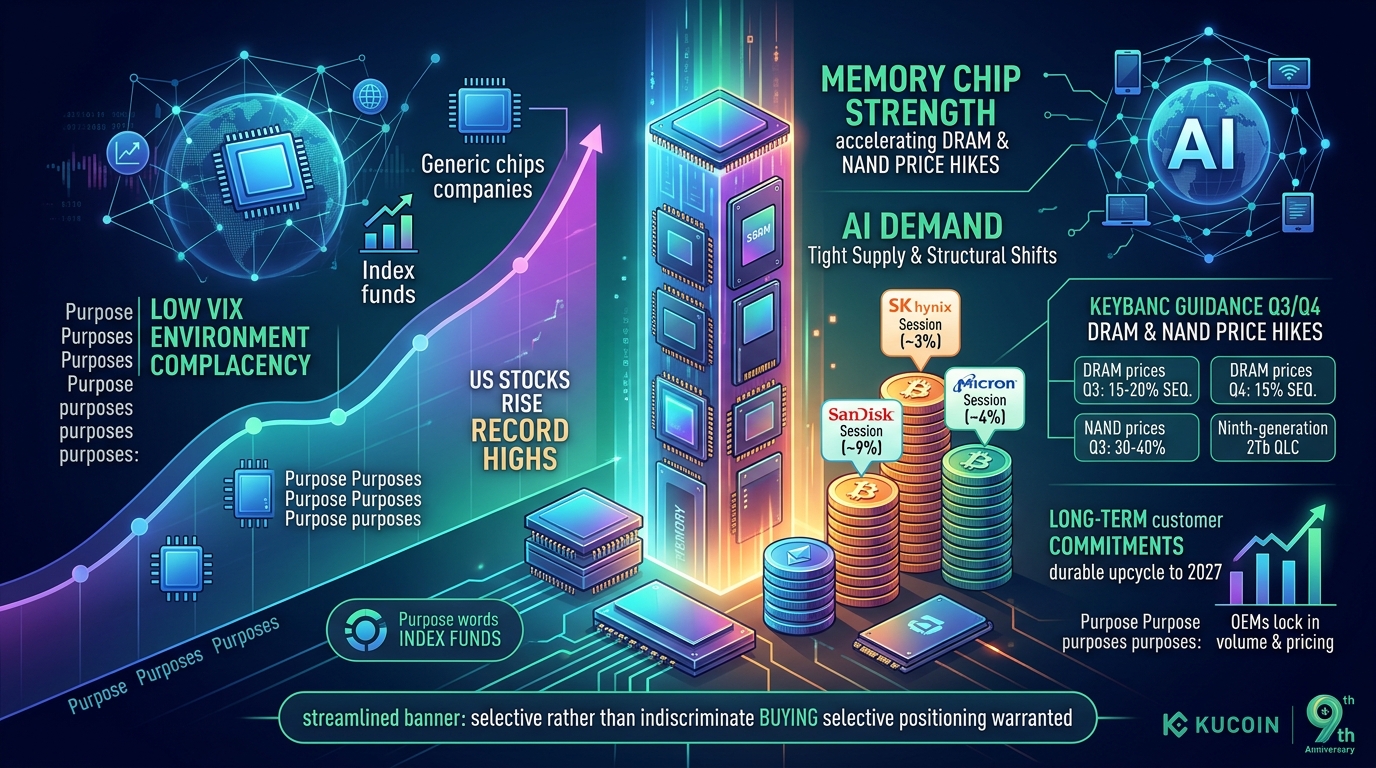
Yet in this low-volatility backdrop, memory chip stocks—SK Hynix up about 3%, SanDisk nearly 9%, and Micron more than 4% in a recent session—have stood out as one of the few sectors showing consistent strength. The reason is straightforward: accelerating DRAM and NAND price hikes driven by AI demand, tight supply from long-term agreements, and structural shifts that favor storage over other areas.
What Is Driving the Current Low VIX Environment in US Stocks?
Low VIX levels reflect reduced near-term expected volatility and broad investor complacency after strong equity gains. Based on Cboe figures through August 17, 2026, the index closed near 15.19 after dipping as low as 14.18 earlier in the period, well below its 52-week high of 35.30. Equity funds have posted net inflows for 12 straight weeks, supporting the S&P 500’s advance and repeated all-time highs.
Wall Street firms, however, caution against overconfidence. BTIG’s statistical models show that in every midterm election year since 1990, the equal-weighted S&P 500 has experienced at least a 7% drawdown from its average August 18 peak into mid-October. Historical patterns indicate that the stretch from mid-August to mid-October ranks among the weakest seasonal windows. With volatility already compressed, any fresh negative catalyst could expose how fragile the rebound remains. Investors may be underestimating downside risks precisely because the fear gauge sits near multi-month lows.
Why Are Memory Chip Stocks Rising Despite Broad Market Calm?
Memory chip names have reclaimed market attention because AI-related demand continues to tighten supply of high-bandwidth memory and conventional DRAM/NAND, producing sustained price power even while overall equity volatility stays muted. Recent sessions saw SK Hynix rise approximately 3%, SanDisk nearly 9%, and Micron more than 4%, according to market reports from mid-August 2026. These moves occurred against a backdrop of shallow broader-market declines, highlighting sector-specific strength.
The outperformance stems from fundamentals rather than pure momentum. High-bandwidth memory (HBM) and advanced DRAM have absorbed significant wafer capacity, leaving mainstream products in short supply. This dynamic has turned storage into one of the few areas still able to deliver sequential upside while the rest of the market digests gains under low VIX conditions.
How Are Accelerating Price Increases Supporting the Storage Rally?
Contract price hikes for DRAM and NAND are accelerating and appear more structural than a short inventory restocking pulse. KeyBanc Capitals guidance, reported in mid-August 2026, projects DRAM prices up 15–20% sequentially in the third quarter and another 15% in the fourth quarter. NAND is expected to rise 30–40% in Q3 alone. Compounded, these moves point to cumulative gains of roughly 32–38% for DRAM and 50–61% for NAND by year-end versus second-quarter levels.
These increases result from HBM and advanced DRAM consuming capacity that would otherwise serve conventional products, creating passive shortages. UBS and other firms have raised Micron price targets accordingly, reflecting expectations that the pricing trajectory remains intact into later periods. The speed and breadth of the hikes distinguish the current cycle from previous short-lived recoveries.
What Role Does Supply Discipline Play in Sustaining Strength?
Original equipment manufacturers have locked in volume and pricing through long-term agreements, limiting the risk of sudden capacity expansions or price wars. Micron holds among the highest LTA coverage, and industry participants overall remain reluctant to add aggressive new supply in the near term. Bank of America has argued that AI demand may have permanently altered Micron’s traditional cycle, projecting fiscal 2030 EPS as high as approximately $236 while gross margins hold near 80%.
This disciplined approach contrasts with past cycles in which oversupply quickly eroded pricing power. Long lead times for new fabs and the preferential allocation of wafers to higher-margin HBM further constrain mainstream output. As a result, the supply side remains supportive of elevated prices even as demand concentrates in AI infrastructure.
What Are the Longer-Term Growth Drivers for Memory and Storage?
Structural demand from AI data centers underpins multi-year revenue growth targets that extend well beyond the current pricing surge. SanDisk’s investor day in August 2026 outlined mid-to-high-teens annual revenue growth for fiscal years 2028–2030, alongside sustained non-GAAP gross margins near 80%. The company, together with Kioxia, has advanced ninth-generation 2Tb QLC technology aimed at capturing share from hard-disk drives in AI storage applications.
These targets rest on long-term customer commitments covering substantial portions of future bit shipments. Combined with HBM capacity intensity—requiring roughly three times the wafer space per bit—the outlook supports the view that pricing strength could persist at least through 2027. Industry forecasts from multiple houses now treat the upcycle as more durable than historical boom-bust patterns.
What Risks Could Cap or Reverse the Memory Chip Rally?
Chinese supply represents the largest near-term variable. ChangXin Memory Technologies (CXMT) has become one of China’s highest-valued listed companies, and major PC makers including HP, Acer, and ASUS have begun limited qualification and small-volume adoption of its DRAM in non-US notebooks, according to Nikkei Asia reporting from early August 2026. Yangtze Memory Technologies (YMTC) has climbed into the global top three for NAND bit shipments with roughly 14% share in the second quarter of 2026, per Counterpoint Research. Even if Chinese producers remain focused on lower-end products initially, progressive pressure on mainstream pricing remains possible.
Cyclical skepticism also persists. Micron has previously retraced more than 20% from peaks even without new earnings releases, and other names have experienced sharper swings. Market debate continues over whether current levels mark a late-cycle push or mid-cycle consolidation. Finally, demand concentration in AI capital expenditure creates vulnerability: nine major technology companies have made off-balance-sheet AI commitments approaching $3 trillion. Any digestion phase could open a temporary demand gap for storage. Bernstein has already raised two-year wafer fabrication equipment spending estimates by 75%, planting the seeds for eventual capacity responses.
In the near-to-medium term the sector can still sustain a constructive bias, with price strength potentially lasting into 2027. At current valuations, however, selective positioning rather than indiscriminate buying is warranted. Leading indicators to watch include sequential NAND contract price slopes, original-equipment LTA coverage rates, and the pace of Chinese high-end memory qualification.
KuCoin Offers A More Stable Option in A Volatile Market
If you worry about the frequent ups and downs in the market, and pursue a more stable option to earn money passively, KuCoin is the right place to come:
-
Simple Earn: Deposit and withdraw tokens anytime, earning stable returns.
-
Kucoin Earn: Earn stable profits with professional asset management.
-
Hold to Earn: Earn rewards by holding assets in Funding, Trading, Margin, Futures, Mining, and Unified Accounts.
-
Staking: Unlock the earning potential of on-chain assets.
-
Advanced Investments: Advanced Investments offer a variety of structured products to help your money grow in any market.
-
Shark Fin: Principal Protection and Guaranteed Gains
-
Dual Investment: Buy low and sell high with transparent return calculations.
-
Snowball: High yields, with price protection.
-
Discount Buy: Buy crypto at discount prices.
-
KCS Loyalty: Level up to enjoy exclusive perks by staking ≥ 1 KCS.
-
KuCoin Wealth: Discover future value and begin your smart investing journey.
-
KCS Benefits: Hold and stake KCS to access benefits across the platform.
-
KCS Staking 2.0: Participate in KCS on-chain governance to earn yield.
Conclusion
Low VIX readings near 15 have accompanied strong broad-market gains, yet memory chip stocks have emerged as a clear relative winner thanks to accelerating DRAM and NAND price increases, disciplined supply via long-term agreements, and multi-year AI-driven demand. KeyBanc’s sequential hike forecasts, Bank of America’s elevated 2030 EPS scenarios for Micron, and SanDisk’s mid-to-high-teens growth targets through fiscal 2030 all reinforce the constructive case into 2027.
At the same time, Chinese supply progress, residual cyclical volatility, and concentrated AI capital spending introduce meaningful risks that could reverse momentum if any of those signals turn first. Investors should treat the sector as selective rather than automatic, focusing on contract-price trends, LTA coverage, and high-end import progress from Chinese producers. Under the present low-volatility backdrop, storage remains one of the few areas still capable of delivering independent strength, provided the fundamental supports hold.
FAQs
What does a low VIX typically signal for equity markets?
A low VIX indicates reduced expected near-term volatility and greater investor calm, often accompanying rising stock indexes and fund inflows.
How long could DRAM and NAND price increases last?
Current forecasts from KeyBanc and others point to continued sequential gains at least through the fourth quarter of 2026, with structural tightness potentially supporting elevated levels into 2027.
Why are long-term agreements important for memory producers?
LTAs lock in volume and pricing, reducing the likelihood of abrupt capacity additions or price competition and providing greater earnings visibility.
Could Chinese memory makers disrupt the current upcycle?
Yes. Rising bit shipments from YMTC and limited adoption of CXMT chips by major PC OEMs introduce potential pricing pressure from the lower end of the market.
Is the memory sector still cyclical despite AI demand?
While AI has altered capacity allocation and raised the floor for demand, historical drawdowns and concentrated capital expenditure mean cyclical risks have not disappeared entirely.