

KuCoin Ventures Weekly Report: Onchain Financial Infrastructure Expands as Crypto Markets Remain Resilient Amid High Real Yields

1. Weekly Market Highlights
Stablecoin and Securities Tokenization Initiatives Advance in Parallel as TradFi Expands Further into On-Chain Infrastructure
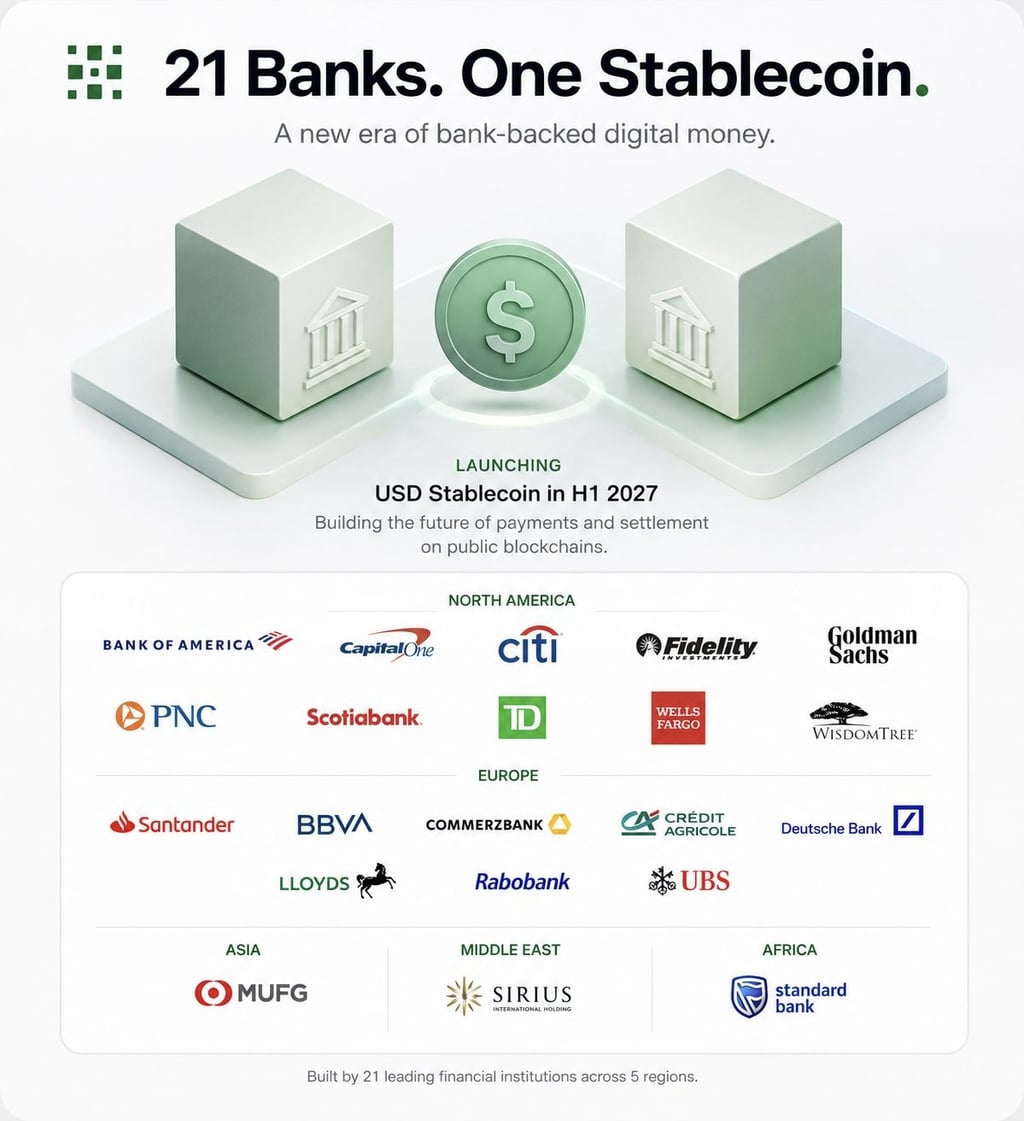
Last week saw new developments across both stablecoins and securities tokenization among traditional financial institutions. Twenty-one financial institutions, including Goldman Sachs, Bank of America, Citi, and Deutsche Bank, committed to establishing a new company, subject to relevant closing conditions, with the goal of launching a U.S. dollar stablecoin solution in the first half of 2027. At the same time, LSEG partnered with Kraken parent company Payward to explore tokenized UK equities, the SEC proposed a modernization of its Transfer Agent Rules, and South Korea’s Financial Services Commission (FSC) introduced a three-phase roadmap for securities tokenization. While these initiatives are at different stages, they all point to on-chain assets expanding beyond issuance into areas including payments, trading, recordkeeping, and settlement.
On the stablecoin side, the more notable development is that large financial institutions are beginning to explore a consortium-based model for building shared issuance and distribution infrastructure. The 21 participating institutions plan to establish a new company in the second half of 2026, initially focusing on a U.S. dollar stablecoin, with potential expansion into the euro and other G7 currencies over time. Proposed use cases include cross-border payments and digital-asset settlement. Compared with earlier efforts in which individual banks explored tokenized deposits or bank-issued stablecoins independently, the consortium model places greater emphasis on cross-institutional distribution and a shared usage network.
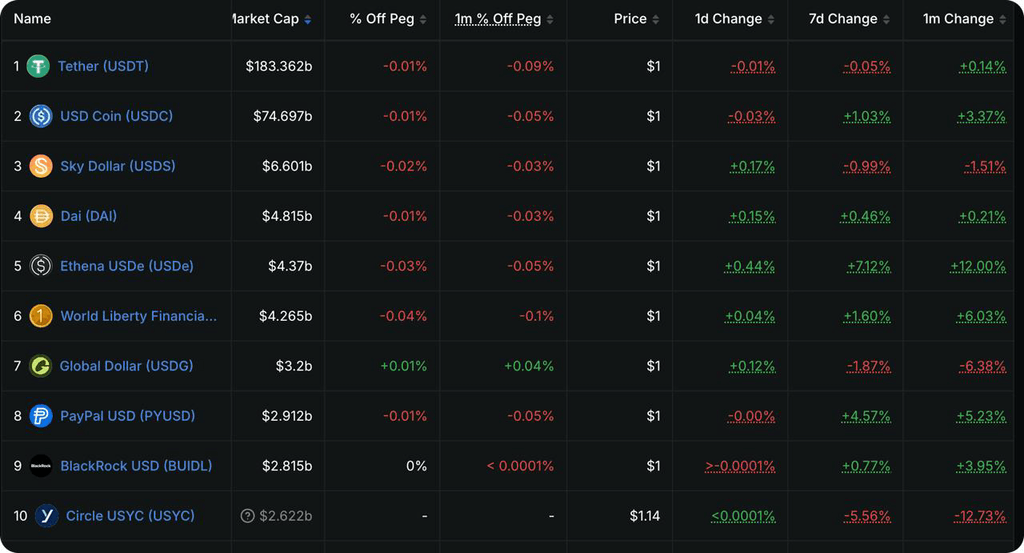
However, existing client relationships and distribution capabilities do not necessarily translate directly into on-chain demand. According to Reuters, Societe Generale’s previously launched U.S. dollar stablecoin has around $12.5 million in circulation, compared with more than $180 billion in USDT supply, leaving a substantial gap between bank-backed products and crypto-native stablecoins in terms of scale and network effects. The key question for the new consortium will therefore be whether its stablecoin can gain sustained usage across practical scenarios such as corporate payments, treasury management, and digital-asset settlement.
Source: BBVA / Participating institutions
Securities tokenization, meanwhile, is expanding from asset issuance into trading and post-trade infrastructure. On September 1, LSEG announced a partnership with Kraken parent company Payward to explore the tokenization of publicly traded UK equities. Subject to regulatory approval, the London Stock Exchange also intends to list xStocks and begin trading them on LSE 24 in 2027. LSEG is separately assessing how its Digital Securities Depository could support settlement and asset servicing for tokenized equities, meaning that the initiative already spans trading, settlement, and asset-servicing infrastructure.
Source: Payward / LSEG
On the same day, the SEC proposed an update to the rules governing registered transfer agents. Transfer agents are responsible for maintaining securities ownership records and processing transfers, making them an important component of the U.S. clearing and settlement system. The SEC proposal explicitly addresses electronic recordkeeping and the use of blockchain technology in securities offerings and share transfers, extending the regulatory discussion around tokenized securities into areas such as registration, transfer, and recordkeeping. The proposal remains subject to the public-comment process and has not yet taken effect as a final rule.
South Korea has outlined a more structured phased approach. On September 4, the FSC introduced a roadmap under which the first phase of securities tokenization is expected to begin in February 2027, initially covering privately pooled MMFs and bonds for institutional investors, unlisted shares issued through trust structures, and publicly offered fractional investment securities. A second phase may expand the scope to additional publicly offered securities, while the final stage would explore an on-chain payment infrastructure linked to stablecoins. The FSC also noted that implementation of the later phases will remain flexible depending on the results of the initial rollout, technological developments, and progress on stablecoin legislation.
Taken together, the developments across these two areas cover both the cash and asset sides of on-chain finance. Stablecoins can provide payment and settlement instruments, tokenized securities represent the issuance and trading of assets, while exchanges, transfer agents, and securities depositories address the additional layers of ownership records, transfers, and settlement. Where market attention previously focused more heavily on “which assets can be tokenized,” recent developments increasingly extend to “how those assets can be traded, recorded, and settled.”
As a result, the discussion around tokenization is also broadening beyond asset issuance toward distribution networks, trading liquidity, custody and recordkeeping, and payment and settlement infrastructure. Crypto-native platforms have their own advantages in areas such as 24/7 trading, global distribution, and on-chain composability, while traditional financial institutions bring established client relationships, securities infrastructure, and existing regulatory frameworks. How these two models may interact — and whether they can generate sufficient real-world usage — will depend on subsequent product development and adoption.Rather than focusing solely on the number of assets issued on-chain, the extent to which this infrastructure can support sustained capital flows and trading activity may provide a more useful indicator of how far tokenization is progressing in practice.
2. Weekly Selected Market Signals
Strong Payrolls Revive Rate-Hike Expectations, but Long-End Real Yields May Be the More Important Variable
Traditional markets remained broadly range-bound last week, with the three major U.S. equity indices showing mixed but relatively modest moves. The main market-moving event came on Friday, when the U.S. August nonfarm payrolls report significantly surprised to the upside: payrolls increased by 162,000, well above the market consensus of roughly 56,000, while the unemployment rate remained unchanged at 4.1%. Employment gains for June and July were also revised upward by a combined 55,000. Following the release, markets increased their pricing for a September rate hike, U.S. equities broadly declined on Friday, and the 10-year Treasury yield rose to 4.78%.
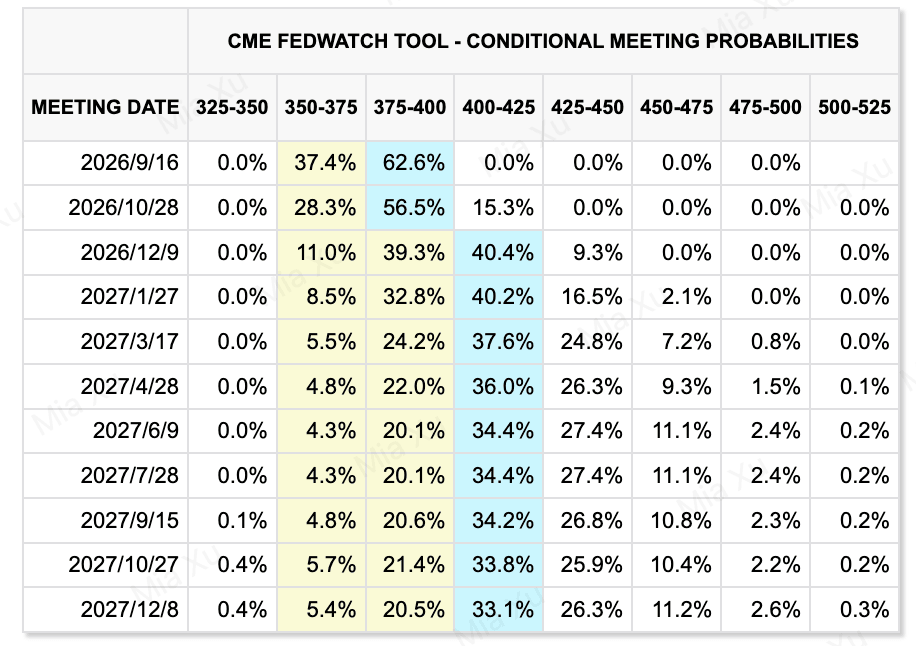
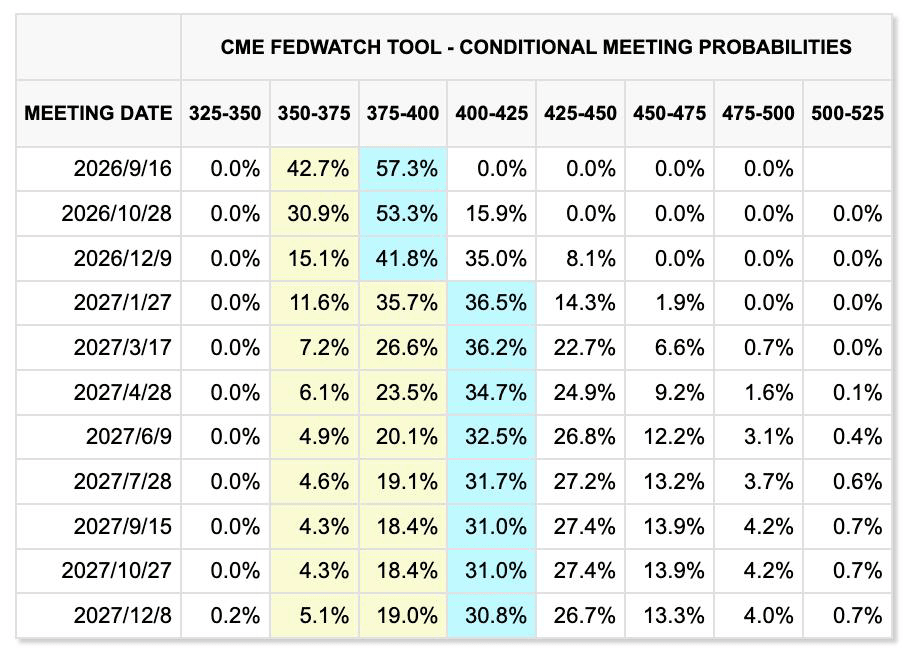
Changes in market pricing over the past two weeks (left: previous week; right: current week)
Source: CME FedWatch Tool
At present, interest-rate markets are pricing in roughly a 57% probability of a September rate hike, while expectations for further tightening in 2027 also remain relatively elevated. From the perspective of broader asset pricing, however, whether the Fed delivers its next rate hike may matter more for near-term trading sentiment, while persistently elevated long-end yields appear to reflect deeper changes in capital pricing. Since the beginning of the year, the U.S. 10-year real yield has risen from 1.94% to 2.43%, an increase of roughly 49 bps, equivalent to around 83% of the rise in nominal yields. This suggests that the increase in long-end yields this year has not been driven primarily by inflation expectations. More important factors may include a higher cost of capital, greater compensation demanded by investors for holding long-duration government bonds, and stronger private-sector financing demand—particularly from AI infrastructure—which is intensifying competition for capital.
Large technology companies continue to increase spending on data centers, computing capacity, and energy infrastructure, strengthening competition for capital between the private sector and government bond markets. If AI infrastructure can continue to generate relatively high returns on capital, its financing needs could keep long-term real yields structurally higher. At the same time, oil prices remain an important near-term inflation risk: Brent crude rose approximately 7.8% last week, while WTI gained nearly 10%.
The market is therefore facing a combination of elevated real yields and renewed upward pressure on energy prices. High interest rates have not yet triggered a broad contraction in equity markets, but they may continue to make valuation and sector selection increasingly challenging.
Rate-Hike Expectations Rise, Yet Crypto Assets Show Relative Resilience
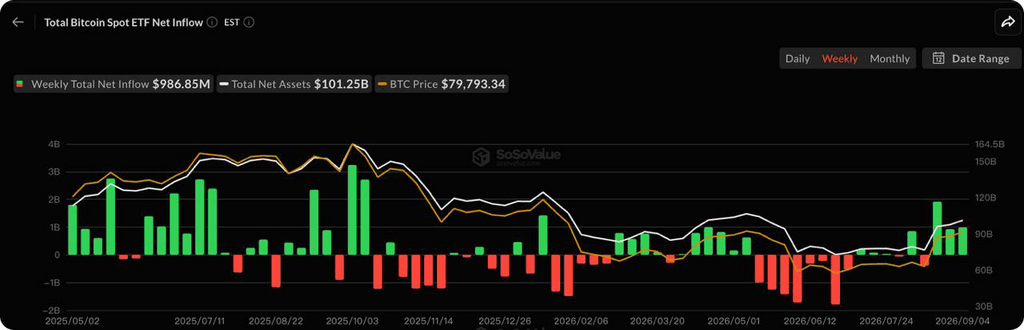
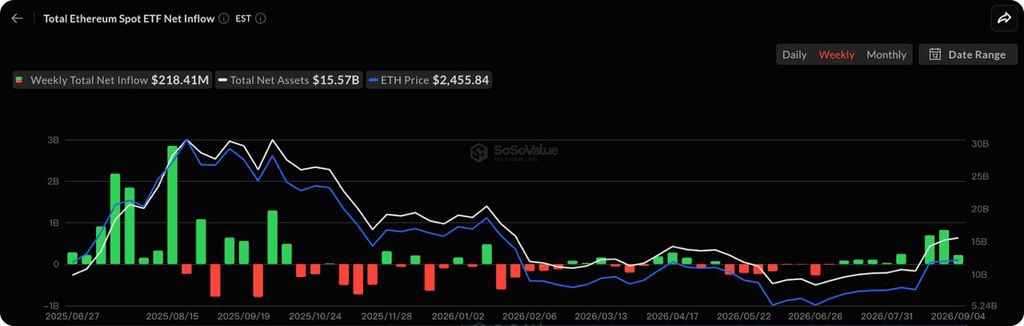
The crypto market initially weakened before recovering last week. BTC briefly pulled back on September 2 before rebounding and is currently hovering around the $80,000 level. ETH recovered from a midweek low of roughly $2,390 to around $2,500. Despite the continued rise in Treasury yields and renewed expectations for a September rate hike, crypto markets have not experienced a similarly pronounced risk-off move, while improving fund flows have continued to provide some support for BTC and ETH. Meanwhile, after pausing Bitcoin accumulation for approximately 10 weeks, MSTR purchased 4,603 BTC worth roughly $369 million, providing an additional positive sentiment catalyst for the market.
Performance across altcoins remained highly divergent. ZEC was one of the strongest performers, rising nearly 45% over the week amid ETF-related developments. For now, the market still appears characterized by rapid rotation into selected assets and specific narratives, rather than a broad-based altcoin rally.
Source: SoSoValue
According to SoSoValue, U.S. spot ETF flows improved significantly last week. From August 31 to September 4, BTC spot ETFs recorded approximately $987 million in cumulative net inflows, including $731 million of net inflows on September 3 alone. BlackRock’s IBIT attracted roughly $692 million over the week, accounting for around 70% of total BTC ETF net inflows. Notably, even after Friday’s stronger-than-expected payroll report revived rate-hike expectations, BTC ETFs still recorded approximately $175 million in net inflows that day. ETH spot ETFs attracted around $215 million over the same period, bringing combined BTC and ETH spot ETF net inflows to roughly $1.2 billion.
Stablecoins: Market Capitalization Resumes Expansion as the Onchain Dollar Liquidity Base Improves
Source: DeFiLlama
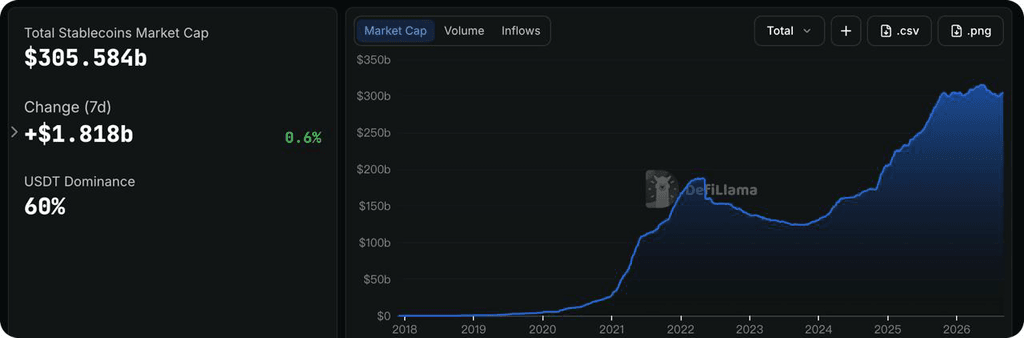
According to DeFiLlama, total stablecoin market capitalization stood at approximately $305.6 billion as of September 7, increasing by around $1.68 billion, or 0.55%, over the past seven days. Overall, the market continues to show a gradual upward recovery, with stablecoin supply still expanding on a net basis, although the pace of growth remains moderate. Together with sustained ETF inflows, this suggests that underlying U.S. dollar liquidity in the crypto market is improving gradually. The current environment is better characterized by a progressive return of incremental capital than by a rapid expansion in leverage or liquidity.
Key Events to Watch This Week
The coming week will bring another dense schedule of macroeconomic releases, with U.S. August PPI, CPI, and core CPI data all due. Fed Governor Waller, widely viewed as an important signal for the direction of monetary policy, has stated that the August inflation data will significantly influence his vote at the September meeting. CPI could therefore become the most important incremental data point ahead of the September 15–16 FOMC meeting.
-
September 10 (Thursday): U.S. August PPI, both year-over-year and month-over-month.
-
September 11 (Friday): U.S. August CPI and core CPI. Particular attention should be paid to whether month-over-month core CPI reaches the 0.3% policy threshold referenced by Fed officials.
Expectations for further monetary tightening also remain present in other major markets. If both U.S. and European rate expectations turn more hawkish, global long-end yields could remain highly volatile. Conversely, if U.S. inflation comes in below expectations, market pricing for a September Fed hike could retreat relatively quickly.
Primary Market Fundraising Watch
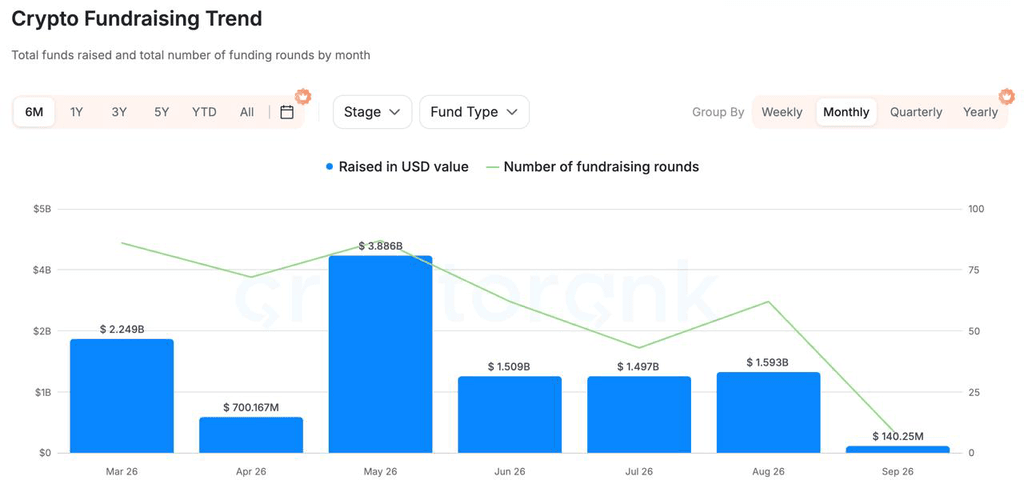
Source: CryptoRank
Primary-market capital continues to gravitate toward payments, stablecoins, onchain banking, and infrastructure connecting crypto with the traditional financial system. Compared with protocols that rely primarily on token trading demand, these projects are more directly tied to existing financial use cases such as cross-border payments, bank accounts, settlement, and treasury management. This is also pushing the investment thesis around stablecoins beyond simply “issuing another stablecoin” toward building a broader financial-services and distribution layer around stablecoins and Tokenized Money.
Cari Network is one of the more representative cases this week. Cari is building a tokenized deposit network jointly governed by participating banks. Its $32.5 million financing round was funded entirely by banks, including U.S. regional lenders such as First Horizon, KeyBank, and M&T Bank. Cari has already completed the full mint, transfer, and burn workflow for tokenized deposits. Through shared infrastructure, it aims to allow small and mid-sized banks to offer 24/7 programmable onchain deposits without having to build their own blockchain systems independently.
Against the backdrop of 21 major international financial institutions jointly announcing plans to establish a new stablecoin company, what makes Cari particularly interesting is that it is attempting to solve a problem that large banks can address internally but regional banks often cannot. Building an independent blockchain stack, wallet infrastructure, compliance framework, and interbank settlement system is expensive. Cari’s opportunity is essentially to turn this infrastructure into a shared utility for banks, enabling smaller institutions to offer tokenized deposits while retaining their own customer relationships and deposit base. Cari currently says that more than 30 banks have joined the network, with over 40 additional institutions in discussions.
Stablecoin competition is becoming increasingly tangible, with the focus gradually shifting toward who controls real users and payment flows, who can connect bank accounts with onchain capital, and who can build higher-value financial services—including deposits, credit, yield products, and asset management on top of stablecoin infrastructure.
About KuCoin Ventures
KuCoin Ventures, is the leading investment arm of KuCoin Exchange, which is a leading global crypto platform built on trust, serving over 40 million users across 200+ countries and regions. Aiming to invest in the most disruptive crypto and blockchain projects of the Web 3.0 era, KuCoin Ventures supports crypto and Web 3.0 builders both financially and strategically with deep insights and global resources.
As a community-friendly and research-driven investor, KuCoin Ventures works closely with portfolio projects throughout the entire life cycle, with a focus on Web3.0 infrastructures, AI, Consumer App, DeFi and PayFi.
Disclaimer This general market information, possibly from third-party, commercial, or sponsored sources, is not legal, compliance, financial, or investment advice, an offer, solicitation, or guarantee. We make no express or implied representations or warranties regarding its accuracy, completeness, or reliability, and disclaim liability for any resulting losses. Investments/trading are risky; past performance doesn't guarantee future results. Users should research, judge prudently, and take full responsibility. Please consult professional legal, tax, or financial advisors if necessary.